END–OF-CHAPTER EXERCISES
TOOLKIT EXERCISE 7.1
Critical Thinking Questions
Consider the following:
Travelink Solutions describes an organization that is experiencing change initiatives that
are producing negative outcomes for both the organization and the recipients of change.
William, a young staff member, sees multiple problems within this 24/7 travel business. As
a low level, sixteen month employee, William has documented and discussed the situation
with his friend, Robert, a marketing manager who has been with the organization for three
years. William and Robert both must decide if they will shift from being recipients of
change to becoming change agents. They must decide if and how they might bring the
organizational problems and possible solutions, to the attention of management.
• If you found yourself in William or Robert’s situation, what would you do?
• What is you assessment of the situation at Travelink and the underlying causes?
Cawsey, Deszca, and Ingols: Organizational Change, 4e
and leader became leaders of change within their country.
• Why did the women dress in white and sit in the marketplace for days on end?
What did they hope to accomplish? Why were they successful in reaching their
goal of petitioning the dictator, Charles Taylor?
• How did the Liberian women, who were not a formal part of the negotiating
teams in Ghana, impact the negotiation processes? Who were the important
allies of the Liberian women during the negotiations?
The ‘X’ model of employee engagement: Maximum Satisfaction meets Maximum
Contribution – Video of 7:43
• How can you engage employees in each area to increase their engagement to the
organization and an organizational change effort?
Cawsey, Deszca, and Ingols: Organizational Change, 4e
TOOLKIT EXERCISE 7.2
Working Through the Phases of Change
1. Consider a significant and disruptive change situation that you know about (or talk to a friend or
relative about such a change situation). Identify the different phases of change.
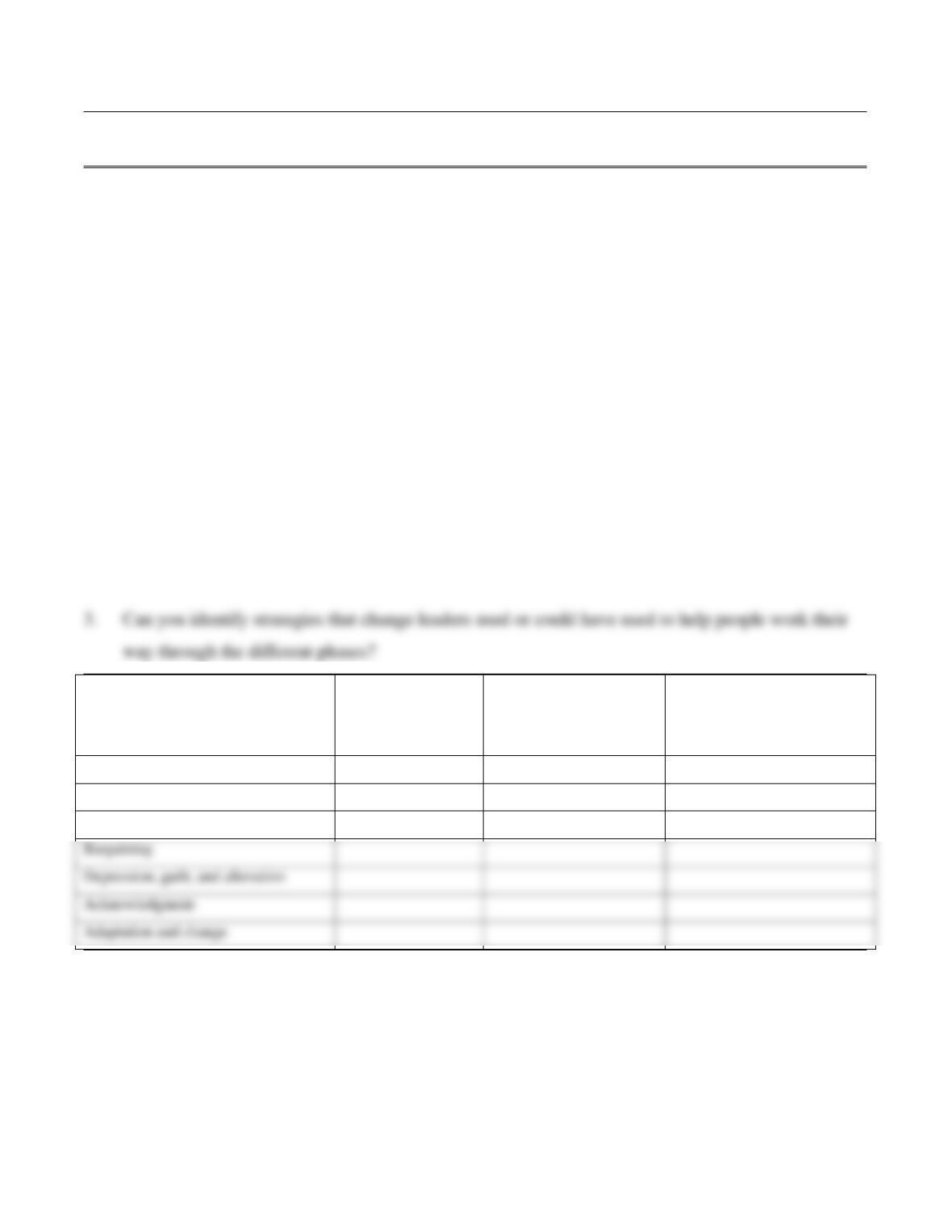
2. Can you identify strategies that people used or could have used to help them work their way
through the different phases?
Awareness Yes/No
recipients
Strategies people can use
to help them work
through stage
Strategies change leaders can
use to help recipients work
through stage
Prechange anxiety
Shock
Defensive retreat
Bargaining
Depression, guilt, and alienation
Adaptation and change
Does the model hold? Why or why not?
What other consequences of change can you identify?
TOOLKIT EXERCISE 7.3
Personal Reactions to Change
1. Think through your organizational experiences at school and at work when you have been a
recipient of change. How have you typically responded to these changes? What were the factors
that led to those responses?
To help you think about these questions, ask yourself the following concerning three to four such
changes:
a. What was the change and how was it introduced?
c. What was your initial reaction? Enthusiasm? “Wait and see” attitude? Ambivalence, due to
conflicting reactions? Cynicism?
2. Was there a pattern to your response?
a. Under what circumstances did you support the change? When did you resist? What can you
generalize from these experiences?
3. Overall, have your earlier experiences with change been largely positive, largely negative, or
mixed?
TOOLKIT EXERCISE 7.4
Your Normal Reaction to Innovation and Change
When you find yourself dealing with matters of innovation and change, how do you typically react?
1. Do you find that you fall into the category of innovator or early adopter, readily considering and
often adopting new approaches, well in advance of most people?
3. Or are you generally in the category of the late majority? You wait until the innovation or new
approach has been tried and tested by many people before you commit to adopt.
5. What is your tolerance for change? What level of turbulence and ambiguity in a work situation
do you find most stimulating and satisfying?
7. How do you react when the rate of change is at a moderate level? What constitutes a moderate
level for you? Are your tolerance levels lower or higher than those of others you know?
9. Have you had to cope with prolonged periods of serious upheaval or periods of extreme
turbulence? Have these experiences affected your acceptance of change?
TOOLKIT EXERCISE 7.5
Disruption of the Psychological Contract
Think about a change initiative that you are aware of. What happened or will likely happen to the
psychological contracts of recipients?
1. What is the existing psychological contract? (If in the past, what was the contract?)
What were the explicit and implicit pieces?
3. Given the individuals and the context, what reactions to these disruptions to the psychological
contract do you anticipate? (If in the past, what were the reactions?)
5. How should a new psychological contract be developed with affected individuals? (If this is in
the past, how could this have been done?)

6. If you are the recipient of change, what steps could you take to better manage your way through
the development of a new contract? (If this is in the past, what could you have done?)
TOOLKIT EXERCISE 7.6
Leadership and Change Recipients
Think more specifically about an example of change leadership that you know.
1. What was the nature of that leadership?
4. What kind of power did the leader use?
5. How were the messages about the change conveyed? Were they believable messages?
6. Did organizational systems and processes support, or at minimum, not impair the change leader’s
messages?
8. What can you learn about the impact of the leader on people and stakeholders as a result of your
responses to the above questions?

10. Talk to others about their experiences. Can you generalize? In what way? What cannot be
generalized?

TOOLKIT EXERCISE 7.7
Assessing Recipient Openness to Change
This exercise will provide you with a general sense of the openness of a person to a specific
undertaking.
1
Please use it to evaluate your own openness to the change.
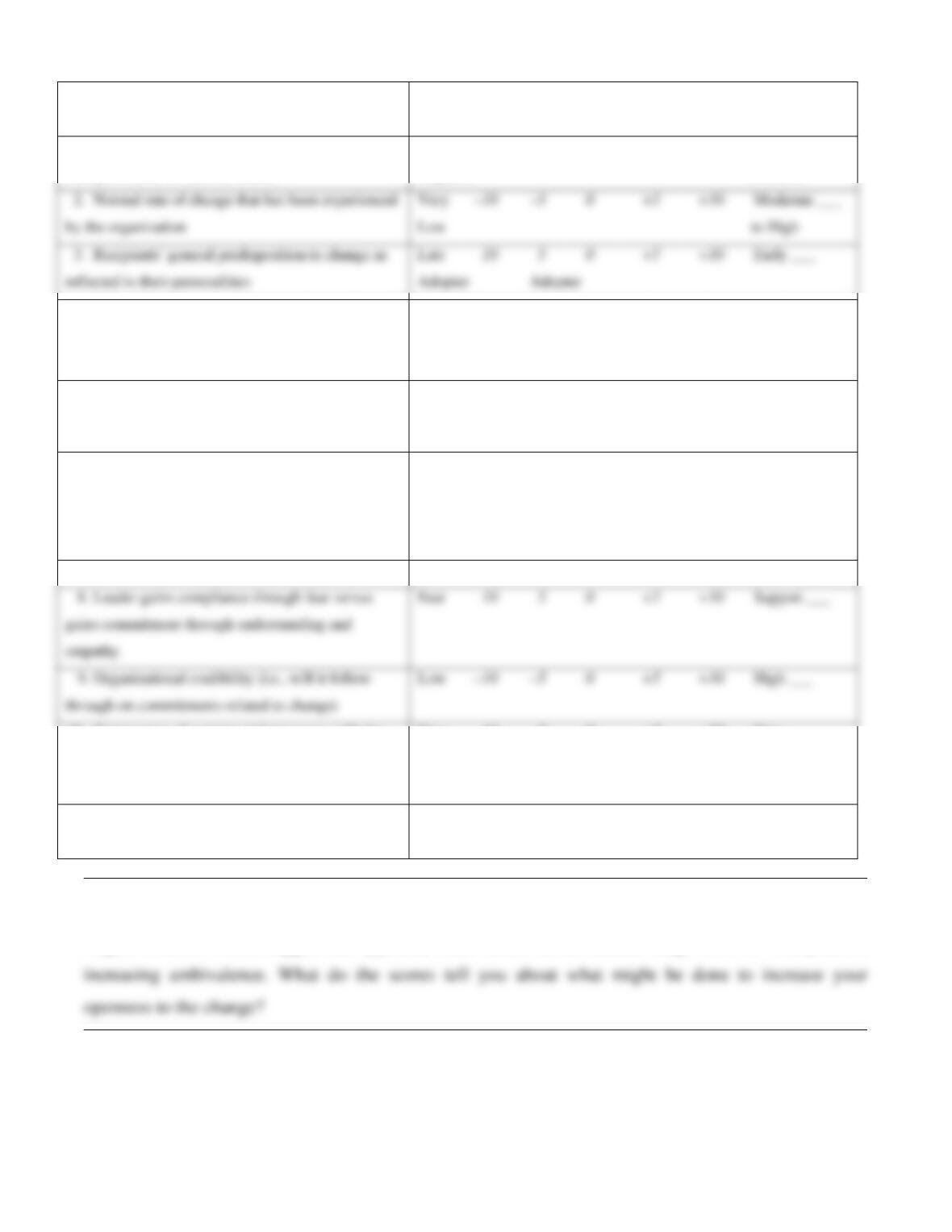
Cawsey, Deszca, and Ingols: Organizational Change, 4e
If your scores are in the +50 or greater range, you will likely be quite open to change and ready to cope.
Negative scores would suggest the opposite, while scores in the middle range (+50 to –50) point to
Think about a change situation you know of or are
involved with. Please rate the following factors.
Score
1. Past experience with change, particularly
changes similar to that advocated
Very –10 –5 0 +5 +10 Very ___
Negative Positive
by the organization
Very –10 –5 0 +5 +10 Moderate ___
Low to High
Late –10 –5 0 +5 +10 Early ___
4. People believe they understand the nature of the
proposed change and the reasons for it (i.e., the need
for change)
Low –10 –5 0 +5 +10 High ___
5. Recipients’ personal beliefs about the need for
this particular change
Very –10 –5 0 +5 +10 Very ___
Negative Positive
6a. Reactions of coworkers to the change
6b. Strength of coworker relations (norms)
Very –10 –5 0 +5 +10 Very
Negative Positive
Multiply #6a by #6b
Weak 0.1 0.3 0.5 0.7 1.0 Strong ___
7. Leader credibility
Low –10 –5 0 +5 +10 High ___
gains commitment through understanding and
empathy
through on commitments related to change)
Low –10 –5 0 +5 +10 High ___
10. Congruence of systems and processes with the
proposed change (or confidence that they will be
brought into congruence)
Very –10 –5 0 +5 +10 Very___
Incongruent Congruent
Predisposition to Change Index:
Scores can range from –100 to +100
Overall Score ___