Chapter 06 – Financial Strategy
6-13
ANSWERS TO DISCUSSION QUESTIONS AND PROBLEMS
1. What are the key productivity ratios for measuring the retailer as a whole, its
merchandise management activities, and its store operation activities? Why are these
ratios appropriate for one area of the retailer’s operation and inappropriate for others?
One key measure for assessing the productivity of the retailer as a whole is the return on
assets (ROA). ROA is the profit generated by the assets possessed by the firm and is a
comprehensive picture of firm performance. Other general measures are net profit margin.
2. What are examples of the types of objectives that entrepreneurs might have for a retail
business they are launching?
Retailers can have three types of objectives: 1) financial, 2) societal, and 3) personal.
Examples of financial objectives for an entrepreneur might include sales or profit. In the
Chapter 06 – Financial Strategy
6-14
3. Buyers’ performance is often measured by their gross margin percentage. Why is this
figure more appropriate than the operating or net profit percentage?
A buyer can impact the gross margin percentage because he/she can, to some extent,
4. A supermarket retailer is considering the installation of self-checkout POS terminals. How
would the replacement of cashiers with these self-checkouts affect the elements in the
retailer’s strategic profit model?
The machinery involved in self-checkout POS terminals would be counted as a long-term
5. Macy’s and Costco have targeted different customer segments. Which retailer would you
expect to have a higher gross margin? Higher operating expenses as a percentage of
sales? Higher operating profit margin percentage? Higher inventory turnover and asset
turnover? Higher ROA? Why?
Gross margin gives a retailer a measure of how much profit it is making on merchandise
sales without considering the expenses associated with operating the store and covering
corporate overhead. Macy’s should have a significantly higher gross margin than Costco.
Chapter 06 – Financial Strategy
6. Why do investors place more weight on comparable-store sales than growth in sales?
Comparable-store sales growth compares sales growth in stores that have been open for at
least one year. Growth in sales can result from increasing the sales generated per store or
7. Blue Nile is a jewelry retailer that only uses an Internet channel for interacting with its
customers. What differences would you expect in the strategic profit model and key
productivity ratios for Blue Nile and Zales, a multichannel jewelry retailer?
On the profit margin path, Blue Nile and Zales might have very different sales numbers, as
Zales is a much larger company than Blue Nile. Also, we would expect to see lower
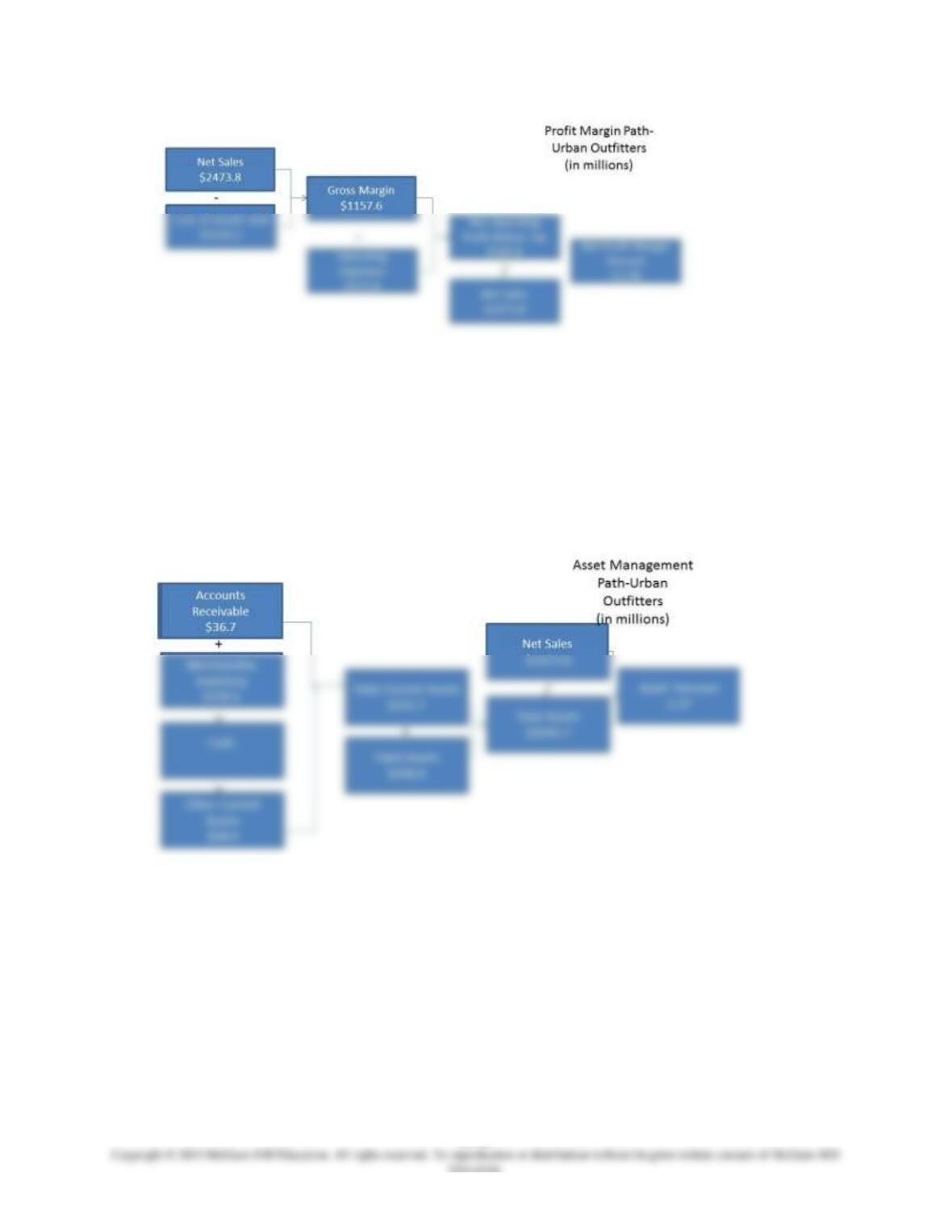
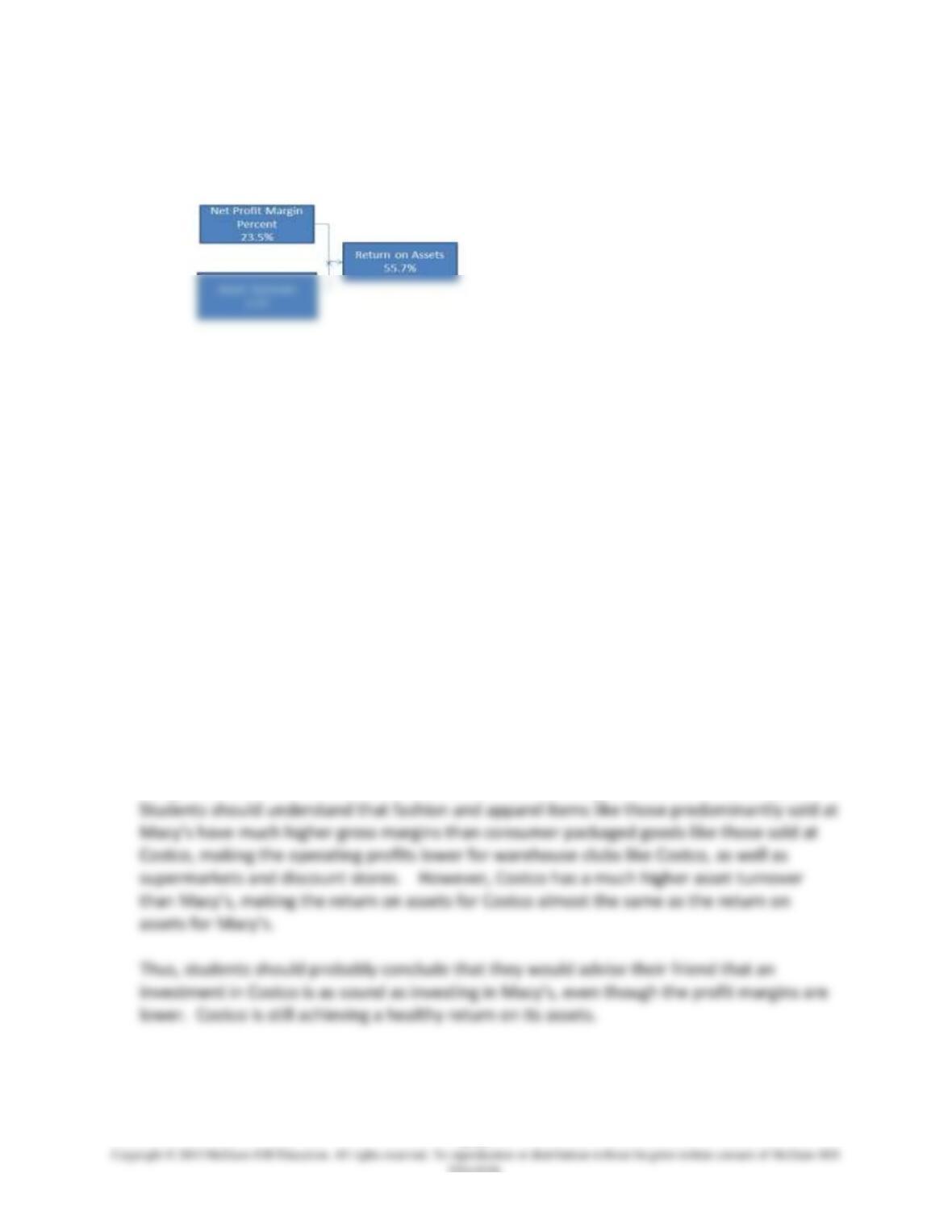
8. Using the following information taken from the 2016 balance sheet and income statement
for Urban Outfitters, develop a strategic profit model. (Figures are in millions of dollars.)
Net sales $2,734.8
Cost of goods sold $1,316.2
Chapter 06 – Financial Strategy
6-16
Chapter 06 – Financial Strategy
6-17
9. A friend of yours is considering buying some stock in retail companies. Your friend knows
that you are taking a course in retailing and asks for your opinion about Costco. Your
friend is concerned that Costco is not a good firm to invest in because it has such a low
net operating profit. What advice would you give your friend? Why?
When compared to Macy’s, Costco has a lower net operating profit but it is because the
margins on items sold at Costco is much lower than the margin on items sold at Macy’s.
Chapter 06 – Financial Strategy
ANCILLARY LECTURES AND EXERCISES
————–——–——–——————-
LECTURE # 6-1: THE STRATEGIC PROFIT MODEL (SPM)
Instructor’s Note: Instructors may wish to use this ancillary lecture in lieu of the annotated
————–——–——–——————-
Background
• Also known as the DuPont model, it was developed by the DuPont family around 1920.
• The DuPonts developed the model because they needed to find a basis for evaluating
the financial performance of complex organizations.
Purpose of the SPM
• The SPM serves two managerial purposes:
• Identifies three profit paths a firm can take to increase O.E. by increasing:
1. profit margin
• The preceding performance ratios are related to the following three areas of decision–
making:
4. margin management
Chapter 06 – Financial Strategy
Margin management
• This information is taken from the income statement:
• Net sales means after adjusting for returns and allowances
• Invoice costs
• Freight in (transportation cost of bringing in merchandise)
• Workroom costs (alterations, set up)
• Vendors—cash discounts. For example, 2/10 n 30 provides incentives to get retailers to
pay quickly for the vendors’ accounts receivable reasons.
• Why are these adjustments made to cost of goods sold?
• Gross margin, gross margin percent, and inventory turnover are extremely important in
the world of retailing. They represent aspects of the business with which buyer has
direct control.
• Total expenses (two types—variable and fixed):
1. Variable—(varies with sales) — the cost of doing business; e.g., sales commission
and is thus variable with sales).
Chapter 06 – Financial Strategy
6-20
• Net profit (after tax):
• Treat tax as a variable expense—a retailer always needs after tax profit for decision-
making. Net profit margin is net profit as a percentage of sales, just like gross margin is
• How to evaluate profit margin
3. Firm’s past history
Asset Management
• To obtain a better idea of what asset management is about, examine the Asset
Management Model.
• Current assets—“cycle”
1. cash to inventory
• Inventory—strive for best selection which
5. minimize inventory investment
Chapter 06 – Financial Strategy
6-21
• Accounts receivable = Merchandise sold on credit. Want to minimize accounts
receivable because may be an unproductive asset. Most retailers offer credit because:
1. tradition
2. part of services mix
• Bankcard—Visa, MasterCard, or American Express (T&E—travel and entertainment
card); can be converted to cash immediately, but card company charges retailer a
percentage of sales.
• Cash: keep to a minimum
Fixed assets:
1. fixture
2. store (if owned, not rented)
Chapter 06 – Financial Strategy
6-22
Asset turnover:
• Net sales/ total assets = Asset turnover.
Return on assets
• ROA uses both asset management and margin management.
• Used for evaluating and programming performance of profit centers (like stores), used
• Total assets
• The question here is, how much profit are you able to generate from retailer’s assets?
• Return on assets is an extremely important measure of how a retailer is performing.
Financial leverage management
• Leverage ratio = Total assets/O.E. or (Total liabilities +O.E.)/O.E.
• How to manage leverage:
1. Too leveraged (too much debt) means financial instability, i.e., too much risk.
Chapter 06 – Financial Strategy
6-23
Conclusion
• Depending where one is in the firm, different managers will use different performance
ratios.
Chapter 06 – Financial Strategy
6-24
CONNECT ACTIVITIES FOR CHAPTER 6
Activity Title
Activity Type(s)
Topic
Learning Objective(s)
Financial Growth for
Hooper’s Outdoor
Adventure
Case Analysis
Profit Planning and
Paths to Financial
Performance
6-1 Review the
strategic objectives of
a retail firm.
6-2 Contrast the two