Chapter 05 – Retail Market Strategy
5-14
• After completing the SWOT analysis, the next step is to
identify opportunities for increasing retail sales. The
strategic alternatives are defined in terms of the squares in
the retail market matrix.
D. Step 4: Evaluate Strategic Opportunities
• The evaluation of strategic opportunities identified in the
SWOT analysis determines the retailer’s potential to
establish a sustainable competitive advantage and reap
long-term profits from the opportunities under evaluation.
Have students evaluate the
market attractiveness and
competitive position of some
opportunities the local college
E. Step 5: Establish Specific Objectives and Allocate Resources
• The retailer’s overall objective is included in the mission
statement. The specific objectives are goals against which
progress toward the overall objective can be measured.
Ask students which opportunities
the bookstore should pursue.
Relate these opportunities to the
competitive advantages the
F. Step 6: Develop a Retail Mix to Implement the Strategy
• The next step is to develop a retail mix for each
Chapter 05 – Retail Market Strategy
5-15
G. Step 7: Evaluate Performance and Make Adjustments
• The final step in the planning process is evaluating the
results of the strategy and implementation program.
H. Strategic Planning in the Real World
• As described here, the strategic decisions in the planning
process seem to be made in a sequential manner. After
the business mission is defined, the SWOT analysis is
Ask students to relate the
strategic decision-making process
to the strategy they will use for
VI. Summary
• A retailer’s long-term performance is largely determined by
its strategy. A strategy coordinates employees’ activities
and communicates the direction the retailer plans to take.
• Retail market strategy describes both the strategic
Chapter 05 – Retail Market Strategy
5-16
• Four types of growth opportunities that retailers may
pursue are market penetration, market expansion, retail
format development, and diversification.
• By expanding internationally, retailers can increase their
sales, leverage their knowledge and systems across a
Chapter 05 – Retail Market Strategy
5-17
ANSWERS TO SELECT “GET OUT AND DO IT!” QUESTIONS
store experience of these retailers?
Ikea’s in-store experience is a little bit more utilitarian and less hedonic than other retailers.
Which chain has the most pervasive global strategy? Justify your answer.
International growth can be accomplished by means of new start-ups, expansion of existing
4. GO SHOPPING Visit two stores that sell similar merchandise categories and cater to the
same target segment(s). How are their retail formats (the elements in their retail mixes)
similar? Dissimilar? On what bases do they have a sustainable competitive advantage?
Explain which you believe has a stronger position?
Students’ answers will vary. Most retailers that target similar audiences and sell similar
Chapter 05 – Retail Market Strategy
5-18
ANSWERS TO DISCUSSION QUESTIONS AND PROBLEMS
1. For each of the four retailers discussed at the beginning of the chapter (Sephora,
Lululemon, and Save-A-Lot)), describe its strategy and the basis of its competitive
advantage.
Sephora has a broad selection of products from around the world and specializes in the
beauty market. The company is a globally recognized brand and has trained staff in the
2. Choose a retailer and describe how it has developed a competitive strategic advantage.
Students should examine how their chosen retailer has developed a strategic competitive
advantage. This should include at least one of the following components.
Customer Loyalty: In order to keep customers committed to shopping at their store(s)
Chapter 05 – Retail Market Strategy
5-19
Human Resource Management: Since retailing is a labor-intensive business and also has
high levels of contact between employees and customers, retailers need to develop
programs to motivate and coordinate employee efforts. These are usually done by providing
3. Give an example of a market penetration, a retail format development, a market
expansion, and a diversification growth strategy that a store called Performance Bicycle
might use.
Market Penetration: Performance Bicycle could offer a loyalty program to customers which
would increase sales among existing customers using its present format. They could also
open additional locations in the same format targeting the same market.
Chapter 05 – Retail Market Strategy
5-20
4. Choose your favorite retailer. Draw and explain a positioning map, like that shown in
Exhibit 5-3, that includes your retailer, retailers that sell the same types of merchandise,
and the target customer segments (ideal points).
Students’ answers will depend on the market in which they live and their preference of
5. Do a SWOT analysis for McDonald’s. What is its mission? What are its strengths and
weaknesses? What opportunities and environmental threats might it face over the next
10 years? How could it prepare for these threats?
Students should perform a SWOT analysis for McDonald’s.
The mission statement for McDonald’s is: “Our overall vision is for McDonald’s to become a
modern, progressive burger company delivering a contemporary customer experience.
Chapter 05 – Retail Market Strategy
5-21
6. What are Neiman Marcus’s and PetSmart’s bases for sustainable competitive advantage?
Are they really sustainable, or are they easily copied?
Neiman Marcus offers extensive service and stocks fashion merchandise that could be
called “fashion forward,” since these may be offered first and/or exclusively at these stores.
7. Assume you are interested in opening a restaurant in your town. Go through the steps in
the strategic planning process shown in Exhibit 5–7. Focus on conducting a SWOT analysis
of the local restaurant market, identifying and evaluating alternatives, and selecting a
target market and a retail mix for the restaurant.
(1) Define the Business Mission: Looking to be in the Italian restaurant business, my target
market would be those customers in my local town and surrounding towns interested in
paying money for an authentic Italian meal in a romantic setting. The mission of this
Chapter 05 – Retail Market Strategy
5-22
(4) Evaluate Strategic Opportunities: In evaluating the alternatives, we must look at both
the market attractiveness and the competitive position. Retailers can maximize their growth
opportunities by investing in areas that have high market attractiveness and a low
competitive position. In the restaurant business, this might include opening additional
restaurants, opening a to-go restaurant, and manufacturing their own food products, like
spaghetti sauce.
(6) Develop a Retail Mix to Implement Strategy (merchandise and services offered,
merchandise pricing, advertising and promotional programs, store design, and convenience
of the store’s location): The restaurant will offer a large variety of Italian dishes with a large
experienced wait staff, the pricing will be medium to high to attract the upscale customer
8. The Gap owns several chains, including Old Navy, Banana Republic, INTERMIX, and
Athleta. What type of growth opportunity was the Gap pursuing when it opened each of
these retail concepts? Which is most synergistic with the original Gap chain?
Developing retail concepts to target specific markets offers Gap a number of market
expansion strategies. Each of the concepts described here is very similar to the others.
Chapter 05 – Retail Market Strategy
5-23
9. Identify a store or service provider that you believe has an effective loyalty program.
Explain how the program works and why it is effective.
An example that would readily come to mind to most students would be frequent flyer
10. Choose a retailer that you believe could be, but is not yet, successful in other countries.
Explain why you think it could be successful.
A nonstore retailer such as Amazon.com is poised to be successful globally with the
increasing spread and prevalence of the Internet and World Wide Web. Since the costs
11. Amazon.com started as an Internet retailer selling books. Then it pursued a variety of
growth opportunities, including expanding to groceries, DVDs, apparel, software, and
travel services; introducing e-readers (Kindle); operating the Internet channel for other
retailers; and hosting virtual stores for small, independent retailers. Evaluate these
growth opportunities in terms of the probability that they will be profitable businesses for
Amazon.com. What competitive advantages does Amazon.com bring to each of these
businesses?
Groceries and Apparel: These categories represent somewhat risky growth propositions for
Chapter 05 – Retail Market Strategy
5-24
DVDs: These growth opportunities will most likely be profitable because, like books, they
do not need to be touched and felt prior to purchase. Most customers will feel very
comfortable ordering DVDs over the Internet without previous viewing or experience. The
primary threat to profitability here is competitive from movie downloads and increasingly
popular pay per view and DVD rental services. Yet for those consumers interested in
purchasing and owning DVDs, Amazon.com will bring a competitive advantage to selling
DVDs mainly through their name recognition over many other dot.com companies. Also,
Amazon has an amazing database system that will be able to better target their customers
and keep track of their purchases. Amazon’s distribution system will be able to deliver the
goods in minimal time at a minimal cost.
Internet Travel Site: This market expansion to a new service has its strengths and
weaknesses. Amazon may attract a larger customer base by offering this new service.
However, most travel, including airline travel is now viewed as a commodity, with
consumers often deciding more on price than on brand name. There is more intense
competition and the prices may not be much lower on Amazon’s site as compared to those
offered directly by the service providers.
Chapter 05 – Retail Market Strategy
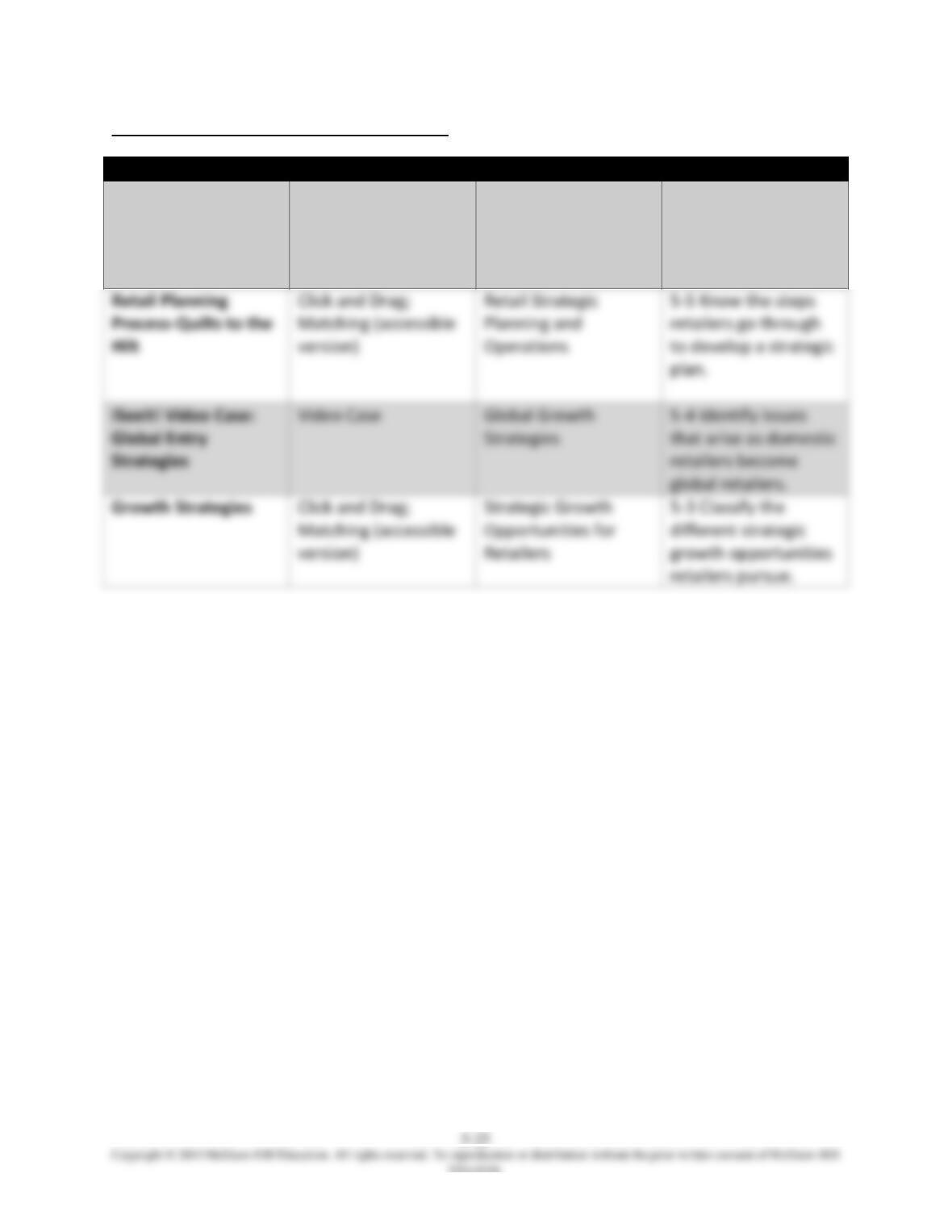
CONNECT ACTIVITIES FOR CHAPTER 5
Activity Title
Activity Type(s)
Topic
Learning Objective
Brad’s Bike Shop-
Market Growth
Opportunities
Decision Generator
Strategic Growth
Opportunities for
Retailers
5-3 Classify the
different strategic
growth opportunities
retailers pursue.