Chapter 04 – Customer Buying Behavior
4-18
ANSWERS TO SELECTED “GET OUT AND DO IT!” QUESTIONS
2. GO SHOPPING Go to a supermarket and watch people selecting products to put in their
shopping carts. How much time do they spend selecting products? Do some people spend
more time than others? Why is this the case? Does consumer behavior vary in the store
perimeter versus in the aisles? Explain your observations.
Students may find a variety of shopping styles from this observational research trip. Some
shoppers will have a list, some will go up and down each aisle, and others will go through
3. INTERNET EXERCISE To better understand the segmentation classification of consumers,
Strategic Business Insights has developed the VALS tool, which uses psychology to segment
people according to their distinct personality traits. Go to the firm’s home page at
http://www.strategicbusinessinsights.com/vals/presurvey.shtml and take the survey to
identify your VALS profile according to your values, attitudes, and lifestyle. According to the
results, what is your VALS profile type? Do you agree with your consumer profile? Why or
why not? How can retailers effectively use the results of this survey when planning and
implementing their business strategies?
“The purpose of the VALS™ survey is to identify the VALS type of the person taking the survey.
That’s it. To find out about a person’s product ownership, media preferences, hobbies,
4. INTERNET EXERCISE Retailers want to segment the market on the basis of the geographic
classification of customers to select the best sites for their businesses. Go to the ESRI
Chapter 04 – Customer Buying Behavior
4-19
campus, and read the results. How would a retailer, such as a local restaurant, use the
information in this report when making a decision about whether to open a location in this
zip code?
ESRI uses geography to help governments, industry leaders, academics, and other
organizations make critical and analytical decisions. The Tapestry tool classifies US
5. INTERNET EXERCISE Go to the following Internet sites offering information about the latest
shown by designers. Which of these fashion trends do you think will be popular with college
students? Why?
Students interested in fashion and apparel merchandising will really like this exercise.
Chapter 04 – Customer Buying Behavior
4-20
ANSWERS TO DISCUSSION QUESTIONS AND PROBLEMS
1. Does the customer buying process end when a customer buys some merchandise? Explain
your answer.
No, the customer buying process does not end when a customer buys some merchandise.
One of the most important stages of the buying process is the postpurchase evaluation.
2. Describe how service retailers, such as hotels, are using Twitter to provide information
and answer questions about rates, services offered, and other amenities. How is this form
of communication changing their expectations?
The Internet in general, social media, and the increasing applications for mobile devices
.
3. Considering the steps in the consumer buying process (Exhibit 4-1), describe how you (and
your family) used this process to select your college or university. How many schools did
you consider? How much time did you invest in this purchase decision? When you were
deciding on which college to attend, what objective and subjective criteria did you use in
the alternative evaluation portion of the consumer buying process?
To answer this question, students need to consider the following steps in the decision–
making process:
Need recognition—What stimulates the student to first think about going to college? What
Chapter 04 – Customer Buying Behavior
4-21
4 In Exhibit 4-6, The Inner City Tenant is described. How should banks, restaurants,
drugstores, and car dealers alter their retail mixes to meet the needs of this segment
compared to the Top Rung segment?
The Inner City Tenant is a younger customer from a diverse background who lives in a city
and is interested in playing sports, music, and fashion. The Top Rung customer, on the
5. Any retailer’s goal is to get customers in its store so that they can find the merchandise
that they are looking for and make a purchase at this location. How could a sporting
goods retailer ensure that the customer buys athletic equipment at its outlet?
A sporting goods retailer can ensure that a customer buys athletic equipment in their store
by helping customers decrease their information search. In general, retailers want to
6. A family-owned used-book store across the street from a major university campus wants
to identify the various segments in its market. What approaches might the store owner
use to segment its market? List two potential target market segments based on this
segmentation approach. Then contrast the retail mix that would be most appropriate for
the two potential target segments.
• Target segment defined on demographics might be:
Chapter 04 – Customer Buying Behavior
4-22
Note that the target segment determines the nature of the merchandise offered. For
example, a target segment of students for used books means that the store has to get
information about tastes of the current batch of students at the university, what types of
books they would be looking for used versus new, and their price preferences. Also the
customers can relax to browse the selection.
7. How does the buying decision process differ when consumers are shopping on the
Internet or mobile device compared with shopping in a store in terms of locations or sites
visited, time spent, and brands examined?
When shopping online, customers might spend more time searching for information and
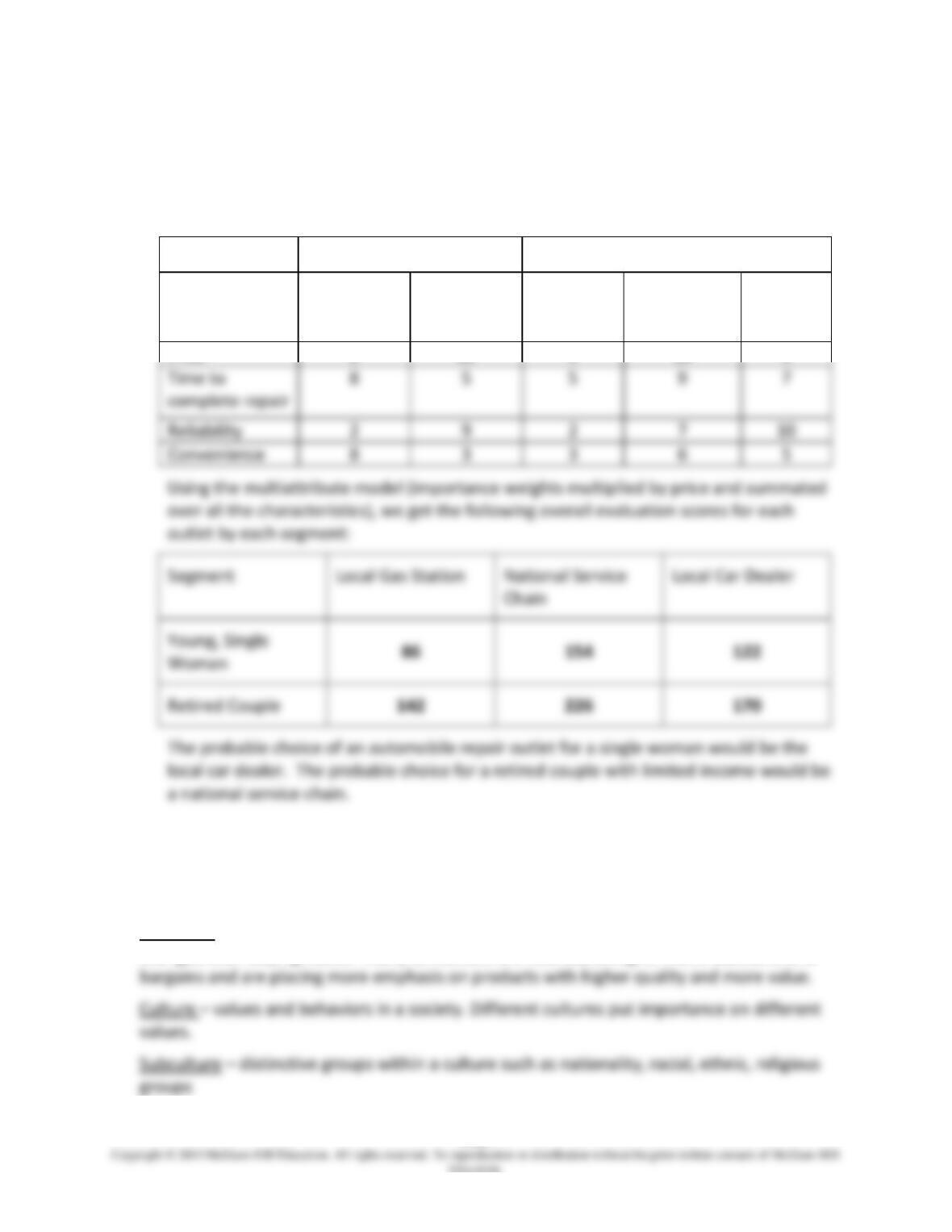
8. Using the multiattribute attitude model, identify the probable choice of a local care dealer
for a young, single woman and for a retired couple with limited income (see the
Chapter 04 – Customer Buying Behavior
4-23
accompanying table). What can the national retail chain do to increase the chances of the
retired couple patronizing its dealership?
Importance Weights
Performance Beliefs
Performance
Attributes
Young,
Single
Woman
Retired
couple
Local Gas
Station
National
Service
Chain
Local Car
Dealer
Price
2
10
9
10
3
Reliability
2
9
2
Convenience
8
3
3
5
9. Think of a recent purchase that you made and describe how economic and social
environmental factors (e.g., reference group, family, and culture) influenced your buying
decision. How are retailers using social media to impact your buying decisions?
Economy- based on the changes in the national and global economy, consumers have
changed their buying habits. Many consumers are now searching for more discounts and
Chapter 04 – Customer Buying Behavior
4-24
10. Think about the merchandise sold at Office Depot/OfficeMax and Staples, and list three
to four types of merchandise that fall into extended problem solving, limited problem
solving, and habitual decision making for college students. Explain how the categories of
merchandise would change for each type of buying decision if the customer was the
owner of a medium-sized business.
As marketers we examine the level of involvement and amount of time a consumer spends
in the buying process. Depending on the significance of the purchase, consumers will be
more or less involved in the purchase process with varying amounts of time and research.
Extended Problem Solving – considerable time, complex, unfamiliar, and significant, less
frequently purchased, considerable risk, and uncertainty. Customers will spend more time
Chapter 04 – Customer Buying Behavior
4-25
Appendix 4A
I. Customer Buying Behavior and Fashion
• To sell fashion merchandise profitably, retailers need to (1)
understand how fashions develop and diffuse throughout
Ask students to discuss the latest
trends they see other students
II. Customer Needs Satisfied by Fashion
• People use fashions to both develop their own identity and
gain acceptance from others; however, these can be
opposing forces. To satisfy these conflicting needs,
Fast Fashion has been a
tremendous success in supplying
consumers with “fresh trend-right
III. How Do Fashions Develop and Spread?
• Fashions are not universal. A fashion might be accepted in
one geographic region, country, or age group and not in
another.
Ask students from different
backgrounds to discuss the
current “fashions” in their own
cultures. What are some
A. Creation
• New fashions arise from several sources including fashion
designers, creative consumers, celebrities, and even
retailers.
Chapter 04 – Customer Buying Behavior
4-26
B. Adoption by Fashion Leaders
• Initial adopters of a new fashion are called fashion leaders,
innovators, or trendsetters, and they are the first people
to display the new fashion in their social group or write
about them in social media.
Discuss with students the impact
of fashion that comes from
celebrities in film, sports, and
social media. What impact do
influencers and bloggers have on
C. Spread to Large Consumer Groups
• The fashion becomes increasingly visible, receives greater
publicity and media attention, and is readily available in
retail stores.
• Compatibility is the degree to which the fashion is
consistent with existing norms, values, and behaviors.
Ask students what fashions they
would most likely find in a luxury
store, discount store, and off-price
retailer. Compare fashions in
Neiman Marcus and Macy’s.
Compare fashions in Urban
D. Saturation
• All consumers in the target market are aware of the fashion
and have decided to either accept or reject it, which makes
the fashion become old and boring to many people.
E. Decline in Acceptance and Obsolescence
• When fashions reach saturation, they have become less
Chapter 04 – Customer Buying Behavior
4-27
ANCILLARY LECTURES AND EXERCISES
Lecture # 4-1 THE MULTIATTRIBUTE MODEL
Instructors’ Note: This lecture can be used to demonstrate a model designed to predict a
Introduction
• The multiattribute model is based on the notion that customers see a retailer or a product
as a collection of attributes or characteristics.
Beliefs about performances
• A customer considering shopping at three retailers mentally processes the “objective”
information about each of the retailers and forms an impression of the benefits the retailer
provides.
• His or her beliefs about these benefits may be a combination of several objective
Chapter 04 – Customer Buying Behavior
4-28
Importance weights
• A customer may develop an overall evaluation of each retailer based on the importance
he/she places on each of the benefits provided by the retailers. For example, the
Choice of Alternatives
• For the young woman, the Internet grocer has the highest score, and thus the most
favorable evaluation. However, the Supercenter has the highest score for the parent, who
would probably buy the family’s weekly groceries there.
Implications for retailers
• First, the model indicates what information customers use to make their decision about
which retailer to patronize. Thus, to develop a program for attracting customers, the
retailer needs to do market research to collect the information listed below.
1. Getting into the consideration set
The retailer must make sure that it is included in the customer’s consideration set. The
consideration set is the set of alternatives the customer evaluates when making a
Chapter 04 – Customer Buying Behavior
4-29
2. Changing performance beliefs
The first approach involves altering customer’s beliefs about the performance of the
retailer—increasing the retailer’s performance rating on a characteristic. For example,
the supermarket would want to increase its overall rating evaluation by improving its
3. Changing importance weights
Altering customers’ importance weights is another approach to influencing retailer choice. A
4. Adding a new benefit
The retailer might try to add a new benefit to the set of benefits that customers
Chapter 04 – Customer Buying Behavior
4-30
Chapter 04 – Customer Buying Behavior
4-31
ANCILLARY EXERCISE # 4-1: USING THE MULTIATTRIBUTE MODEL FOR CHOOSING A STORE
————–——–——–——————-
Instructor’s Note: This exercise is intended to give students the opportunity to use the
multiattribute model found in the text. Instructors might want to use this lecture as a stimulus
to a class discussion on the topic.
————–——–——–——————-
Instructions
• Pick a student who has recently made a store choice decision — such as choosing a retailer
to buy jeans, get a haircut, buy groceries, or eat a meal.
• Typical factors are convenience (location), price of merchandise, availability of specific
items, offering credit, service, etc.
• List these benefits offered on the row in the left-hand column.
• Ask the student which characteristics or benefit is the most important to him/her and give
that benefit a 10 in the importance weight column.
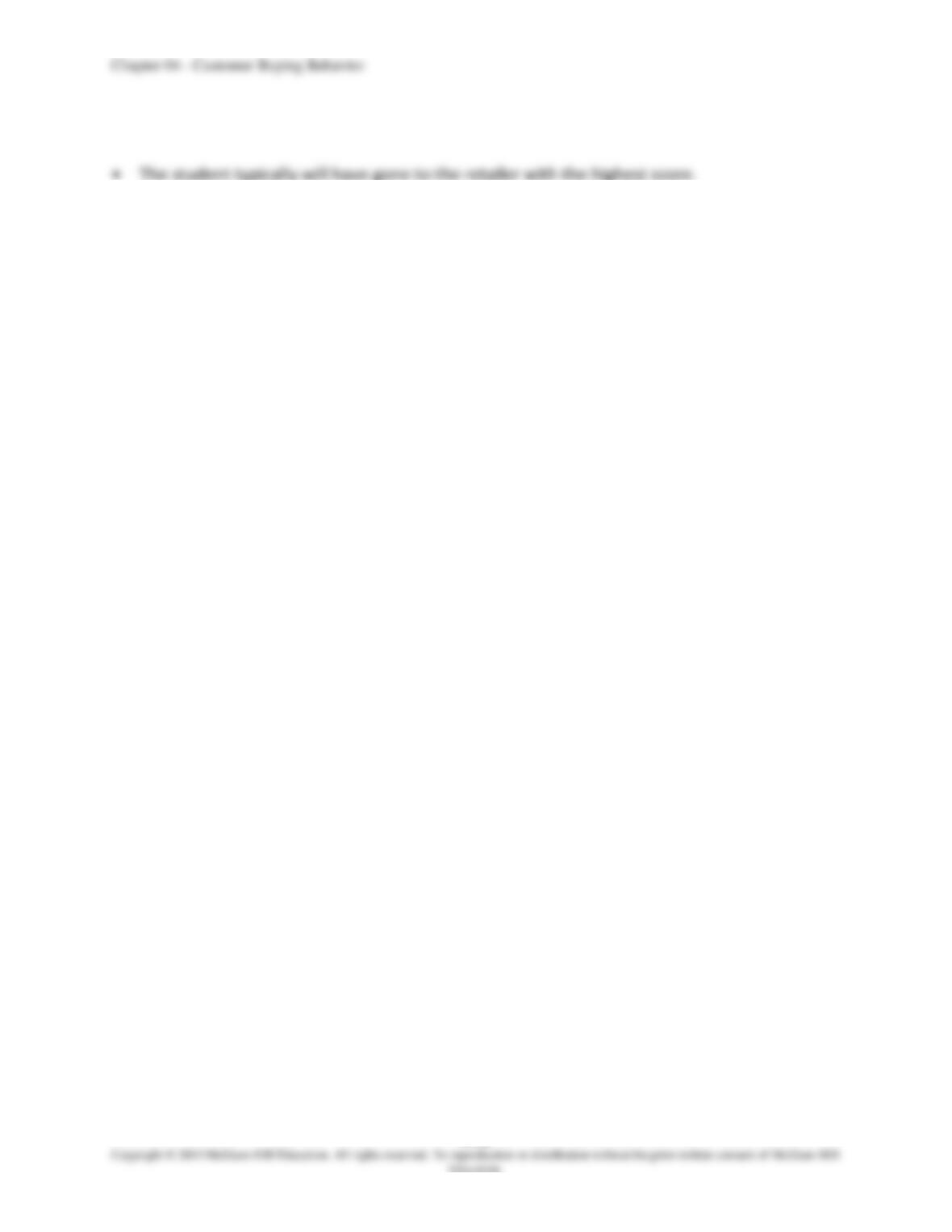
4-32
Chapter 04 – Customer Buying Behavior
4-33
ANCILLARY EXERCISE # 4-2
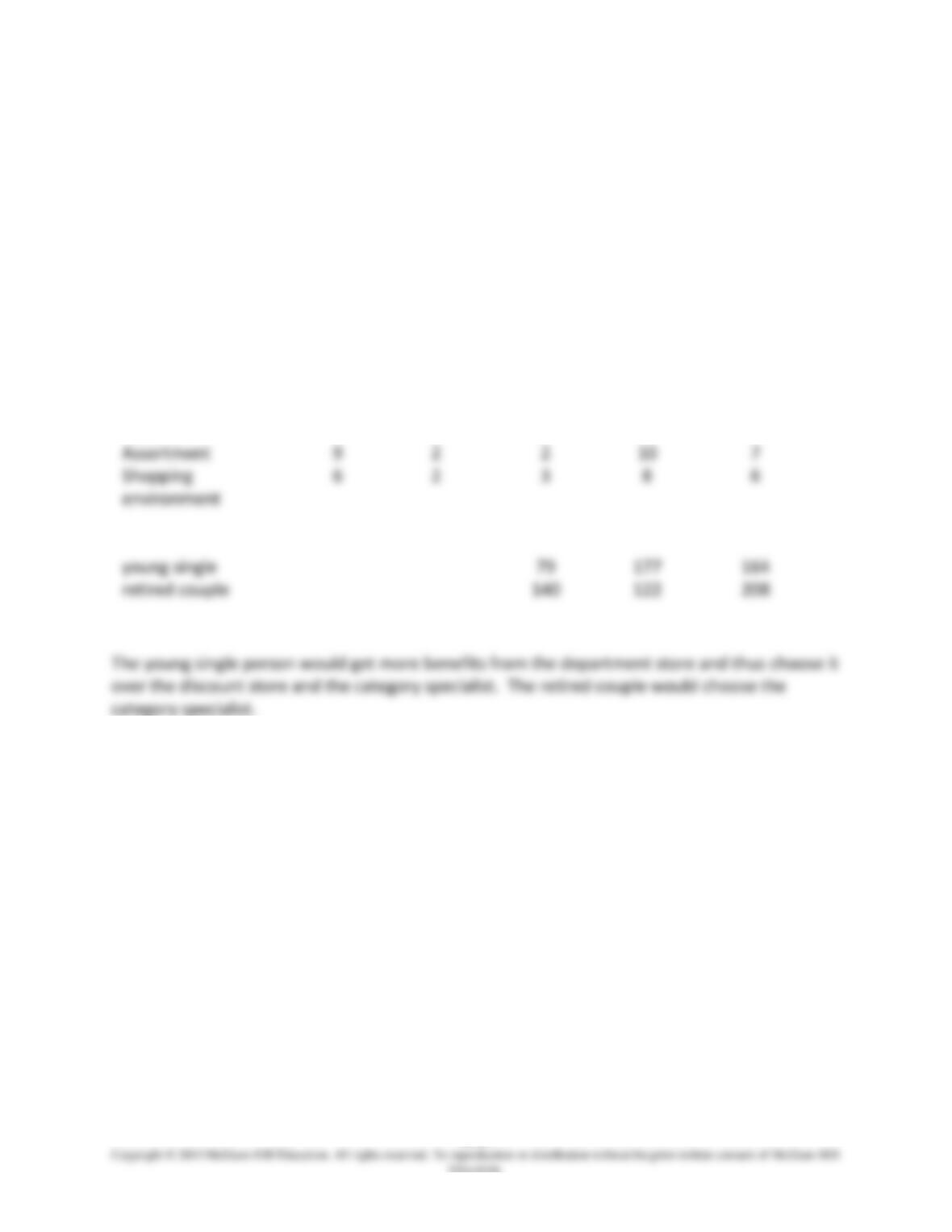
Using the multiattribute attitude model and the following information, identify the probable
choice of a retail store for a young single businesswoman and for a retired couple with limited
income buying a TV set.
IMPORTANCE WEIGHTS
PERFORMANCE BELIEFS
CHARACTERISTIC
YOUNG
SINGLE
RETIRED
COUPLE
DISCOUNT
STORE
DEPART-
MENT
STORE
CATEGORY
SPECIALIST
Price
2
10
9
3
10
Services
5
8
5
17
9
Assortment
9
2
2
10
7
young single
retired couple
Chapter 04 – Customer Buying Behavior
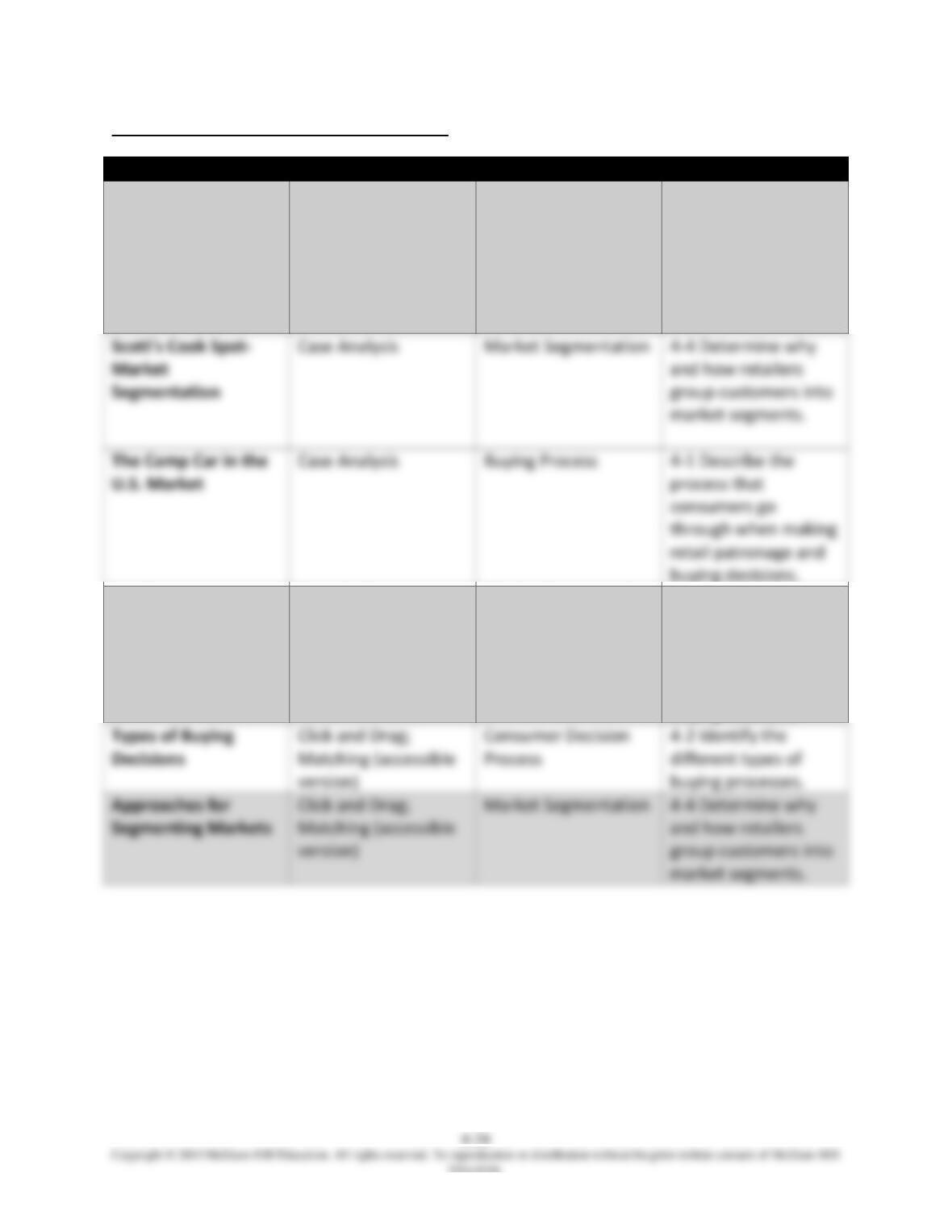
CONNECT ACTIVITIES FOR CHAPTER 4
Activity Title
Activity Type(s)
Topic
Learning Objective
Consumer Buying
Process
Timeline; Matching
(accessible version)
Buying Process
4-1 Describe the
process that
consumers go
through when making
retail patronage and
buying decisions.
Market
Segmentation Tool
Case Analysis
Market Segmentation
4-1 Describe the
process that
consumers go
through when making
retail patronage and
buying decisions.
version)
buying processes.
Matching (accessible
version)
and how retailers
group customers into
market segments.