
Teaching Note: Omada Health: Making the case for digital health
Erin E. Sullivan, PhD, Center for Primary Care, Harvard Medical School
Boston MA
Case Synopsis
This case chronicles Adrian James and Sean Duffy’s experience in developing Omada Health (Omada), a
company dedicated to digital therapeutics and behavioral health interventions for prediabetes. In 2002,
the Diabetes Prevention Program (DPP) randomized control study concluded that the most effective
treatment for prediabetes is prevention and behavioral intervention. However, James and Duffy observed
a problematic gap between a surplus of data that confirmed the efficacy of intensive behavioral health
counseling in diabetes, and the 86 million individuals with prediabetes who have not yet completed a
DPP type program. James and Duffy believed that Omada’s digital approach to scaling a validated DPP
program could resolve the critical need. The case briefly captures how James and Duffy designed their
Learning Objectives
After studying the case, students should be able to:
1) Analyze the potential benefits of a digital health platform as well as some of the challenges the
company faces;
Links to Concepts and Theories
This case is fundamentally about a behavior change intervention, one that asks participants to move
through a program that aims to change their eating, exercise, and sleep habits in order to prevent
diabetes. Related to Chapter 10, “Measuring Change,” Omada invested in a team of data scientists to
measure the outcomes of the intervention and to do so in a way that was easy for participants: all
program participants receive a cell chip enabled scale that automatically transmits daily weigh-in data to
Omada’s health coaches and data scientists. The idea is that the daily weigh-in will become a habit for
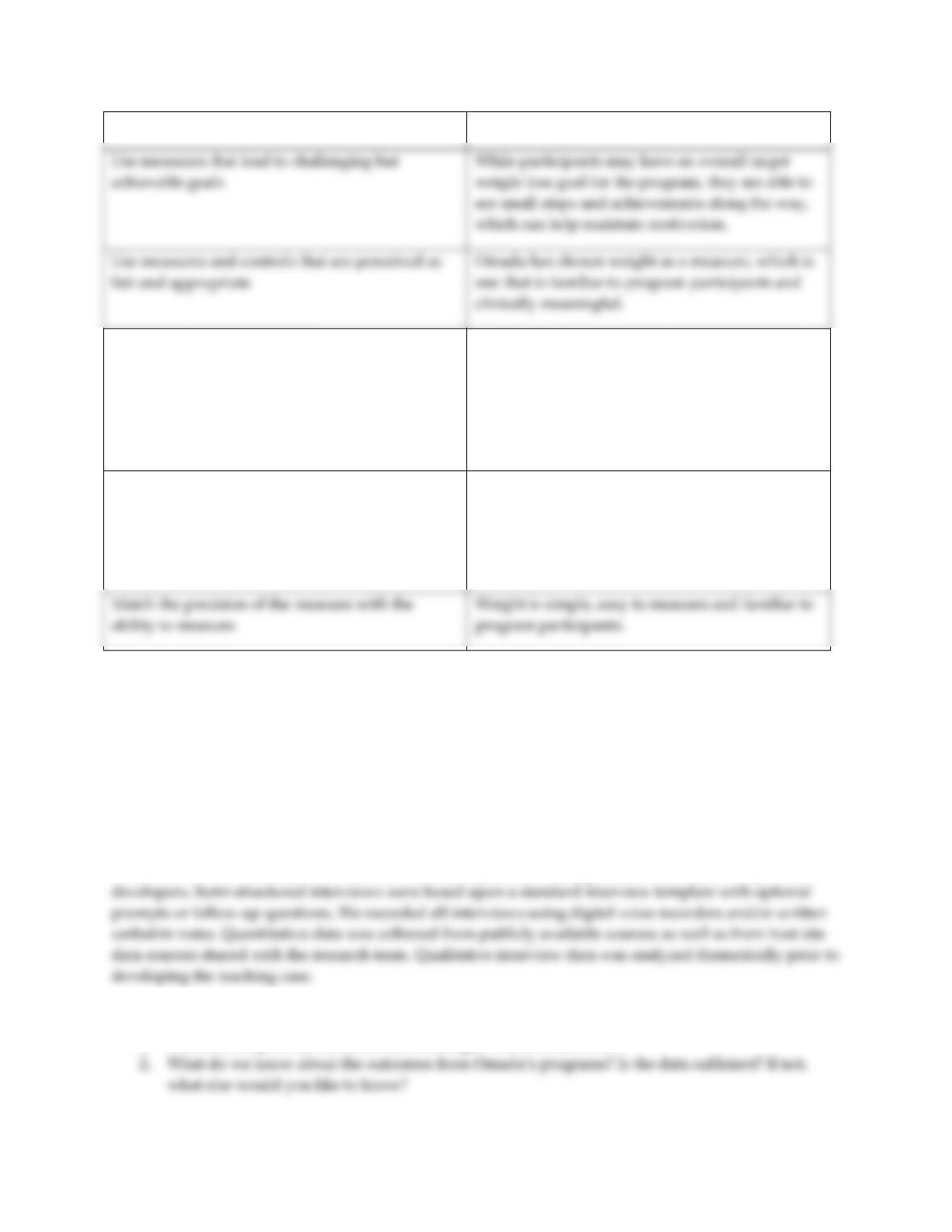
The “Selecting and Deploying Measures” section in Chapter 10 forms a way for students to evaluate
Omada’s choice in terms of metrics for change. If you wish, you could add this to your case discussion
and board plan for class:
Focus on key factors
Omada chose to focus on one key metric: weight.
This is also a clinically meaningful outcome as
losing weight will make a difference in reducing
the risk of type-2 diabetes.
Use measures that lead to challenging but
While participants may have an overall target
see small steps and achievements along the way,
which can help maintain motivation.
Use measures and controls that are perceived as
Omada has chosen weight as a measure, which is
one that is familiar to program participants and
clinically meaningful.
Avoid sending mixed signals
Omada is collecting a plethora of data via their
digital platform (data about participants, data
about number of times participants engage with
the platform, data about what participants are
eating, etc.) but keeps the participant focus on the
daily weigh-in data.
Ensure accurate data
Each program participant receives a cell chip
enabled scale that transmits data to Omada.
Participants step on the scale and the data is sent,
they do not have to log-in to an app and report
data.
Match the precision of the measure with the
ability to measure
Weight is simple, easy to measure and familiar to
program participants.
The bigger challenge for Omada is the long-term measures and outcomes of their program: does it work
over time? Do participants maintain their weight loss and prevent the progression from prediabetes to
diabetes in the long term? This will be discussed in “Suggested Teaching Plan”.
Research Methodology
Data for this case was collected during a three-day field visit to Omada Health in San Francisco, CA. The
visit included key informant interviews and several demonstrations of Omada’s product.
A multidisciplinary research team collected both qualitative and quantitative data. Key informant
interviews were conducted with Omada’s leaders, department managers, data scientists, and product
Discussion Questions
1. What are the potential benefits and challenges with Omada’s DPP?
3. If you are Omada’s CEO, how would you respond to the CMS decision to not reimburse for
telehealth and digital delivery of DPP programs? What is your next move?
Suggested Teaching Plan
Roadmap for Class Discussion
Teaching Suggestions
In this brief case discussion, you might begin the discussion by asking students if they have any personal
experience with digital behavior change programs or even simple health apps that may aim to help them
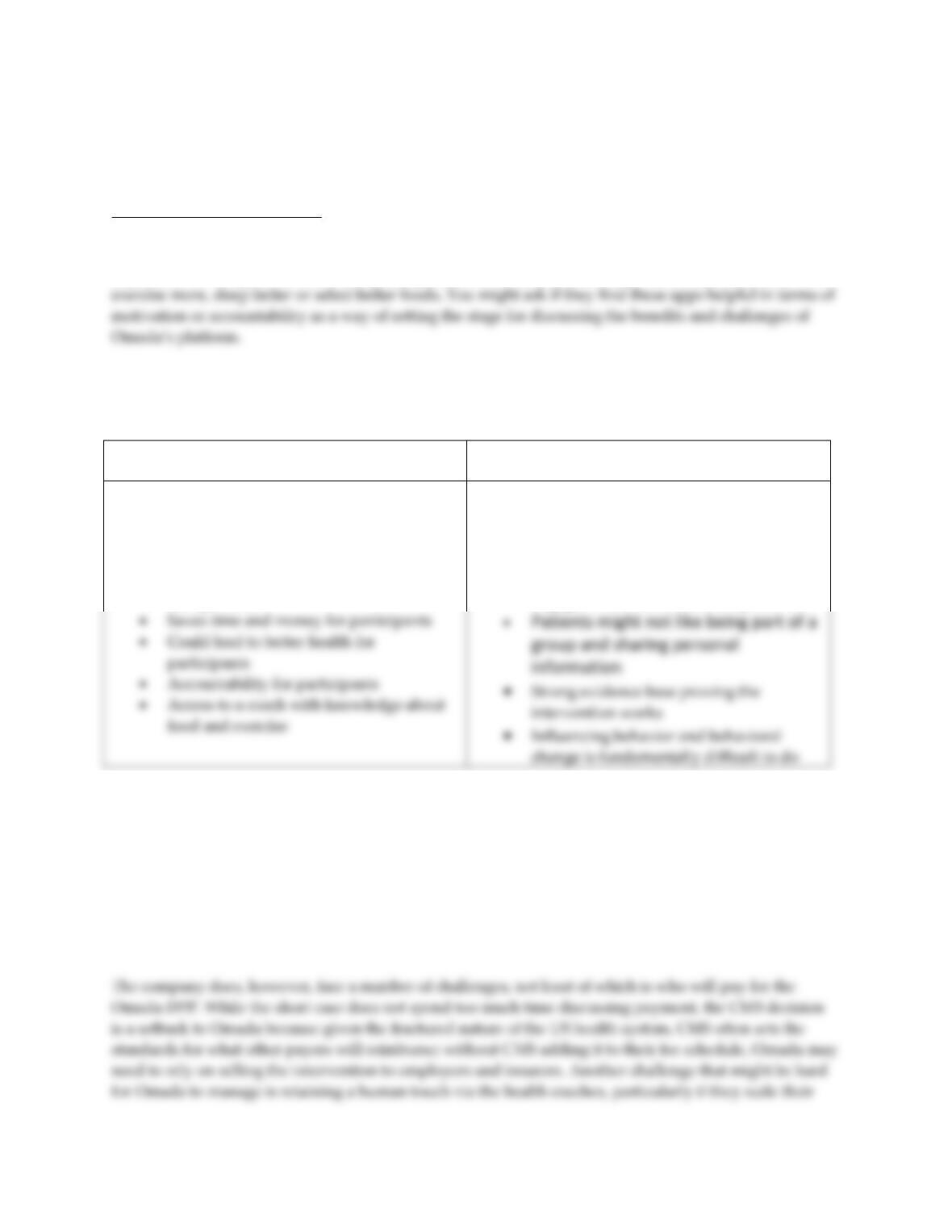
1. What are the perceived benefits and challenges of Omada’s DPP program? You might choose to
focus on benefits and then challenges, making the following list on the board:
Benefits
Challenges
• Potential to scale
• Meet a need and gap for 86 million pre–
diabetics
• Increase access in remote locations or for
people with difficulty accessing
transportation
• Payment: who pays for this?
• Scaling a resource intensive intervention
(health coaches likely have a limit to how
many participants they can support)
• Patients must be motivated to stay
engaged and interact with the platform
On the benefits side, student should consider what may appeal to patients. While medicine tends to resist
online programs, the Omada DPP is accessible via a smartphone app, which means there might be less
activation energy for patients than having to go to the medical office and see a health coach in person. In
todays’ society, people are glued to their cell phones and because of that, we might see changes in the
way that people manage their health. For patients, the Omada program also introduces a new type of
accountability—there is someone else you are accountable to (here it is the health coach) so people might
be more motivated to follow through on a diet and exercise program.

program; there is a related question of whether you can truly cultivate effective in-person relationships
via a digital platform.
Worth noting on both the benefit and challenge side is the issue of patient engagement; there is an
2. What do we know about the outcomes from Omada’s programs? Is the data sufficient? If not,
what else would you like to know?
Here is what students know about outcome data from the case:
• Omada’s program tracks daily weigh–ins from participants.
• Weight loss is a clinically meaningful outcome.
Students can also safely assume that given Omada’s data science team and their digital platform, there
are many other data points they are collecting about their program.
In general, students should not be convinced that this outcome data is sufficient. This should be
reinforced by the CMS decision to not reimburse for digital DPP programs because of a lack of evidence
regarding clinical efficacy. Essentially, there needs to be more outcomes data that proves Omada (or other
digital DPP programs) is effective and is effective over time since preventing prediabetes is not necessarily
limited to 16-weeks or one year. Students will often raise questions about how Omada is paid and what
their program costs, which is a valid data request (the company declined to share their pricing structure
at the time of the case).
3. If you are Omada’s CEO, how would you respond to the CMS decision to not reimburse for
telehealth and digital delivery of DPP programs? What is your next move?
At this point in the discussion instructors may need to frame for students why the CMS decision is not
good news for Omada’s platform: CMS often sets the standard via the Medicare Physician Fee Schedule

• Collect more data and build the evidence base.
• Close up shop or sell the company.
• Reconsider their client focus and evaluation shifting towards private payers or direct to
customers.
Epilogue
In January 2018, Omada announced that it was partnering with the University of Nebraska Medical
Center (UNMC) and Wake Forrest to conduct the largest randomized control trial (RCT) on digital DPP.
The primary outcome measure for the study was reduction in HbA1C levels and secondary outcomes