
“Not an option to even consider” (A) and (B):
Teaching Note
1
Case synopsis
Ajith is a pharmaceutical executive working in the Southeast Asian nation of Kamaria.
He currently markets products in the over-the-counter and personal care product
categories in Kamaria, and is working to enter the potentially lucrative pharmaceutical
market as well. While attempting to obtain registrations to market his company’s
products in Kamaria, he discovers that his competitors are paying bribes to officials at
the ministry of health and that he is expected to do the same in order to move his
applications forward. To complicate the situation, he learns that his most successful
product, an over-the-counter pain reliever, is threatened by inferior imitation products
that are stealing significant market share. Without the ability to either address the
problem of the fake medications or achieve registration for new products, Ajith’s
business in Kamaria appears to be doomed to fail. In case A, his challenge is to
determine an action plan that allows him to address these issues in the short term
without compromising his values. In case B, students read a synopsis of Ajith’s action
plan, the results of his plan, and the values that allowed him to make the decisions that
he made.
Intended course for the case
This case is intended for use at the MBA level in courses on Marketing, International
Business, Organizational Behavior, Leadership and Ethics, and Business Law. While
this case was written for an MBA curriculum, it could be taught to advanced
undergraduates who have developed a foundation in Giving Voice to Values, ethical
decision making, and/or international business.
2
1) Maintain one’s integrity in the face of multiple pressures.
2) Think creatively and resourcefully about how to solve problems.
3) Negotiate with savvy, using both incentives and deterrents (“carrots and sticks”).
Research methodology
To develop this case, the authors interviewed the case protagonist and used factual
information about the real company, country, and product to inform our understanding
of the surrounding business climate and issues in “Kamaria.” Due to the sensitive
nature of the issues presented here, many of the case details, including the protagonist,
company, country, and brand name, have been disguised. We did, however, quote the
protagonist extensively and readers will find his voice throughout the case.
Teaching plans
Pre-class preparation: students can prepare for the classroom discussion in two ways:
1. Read or review an overview of the philosophy and assumptions of Giving Voice to
Values. Ideally, students should be grounded in the GVV process of analyzing
situations and articulating how they would voice solutions before leading students in a
2. Read “’Not an option to even consider:’ contending with the pressures to compromise
(A).” Since this seven-page case will take students varying amounts of time to read and
analyze (from approximately 15 to 25 minutes), it is wise to assign them to read it ahead
of the class.
Teaching Plans
3
Plan I: An alternative teaching plan to the one described below is to invite students to
work in teams, prior to class, to prepare their best script and action plan for Ajith to
enact his objectives. Then during the actual class session, they would present these
scripts and action plans and engage in a peer coaching exercise as described below.
The following plan is for a 90-minute class:
A.
Re-introduce GVV
5 minutes
B.
Discuss Case A
20 minutes
C.
Ask students to work individually and to script to
whom they will speak and what they will say
5 minutes
D.
Put students into trios and ask them to deliver their
scripts and give one another feedback. Debrief this
part of class, asking students what they learned
from listening to one another’s plans and scripts.
20 minutes
together to make the scripts and action plans as
Coaching” at www.GivingVoiceToValues.org.
F.
Read and discuss Case B
15 minutes
G.
Summarize the significant learning from the case
5 minutes
A. Re-introduce Giving Voice to Values (5 minutes):
4
To start the class discussion, remind students that the Giving Voice to Values curriculum
makes several assumptions:
• Students will encounter conflicts in values between themselves, others,
and the norms of their environments, whether it is in their home countries
or overseas;
B. Discuss Case A (20 minutes):
Students need to understand how gently and thoughtfully Ajith developed
relationships among numerous stakeholders in Kamaria. In fact, in listening to Ajith tell
this story about how he maneuvered and managed in Kamarie, he did not appear to let
external pressures from numerous stakeholders interfere with his respectful approach
to developing and managing across a variety of institutions and people at different
levels within these organizations. When you set up the following grid, leave enough
room on the right to add the second set of questions about Ajith’s relationship with the
various stakeholders.
1. Who are the stakeholders in this situation and what is at stake for each of them? (It
would be wise to create a grid on the black/white board, allowing the students to watch
and keep track of the flow of the stakeholders).
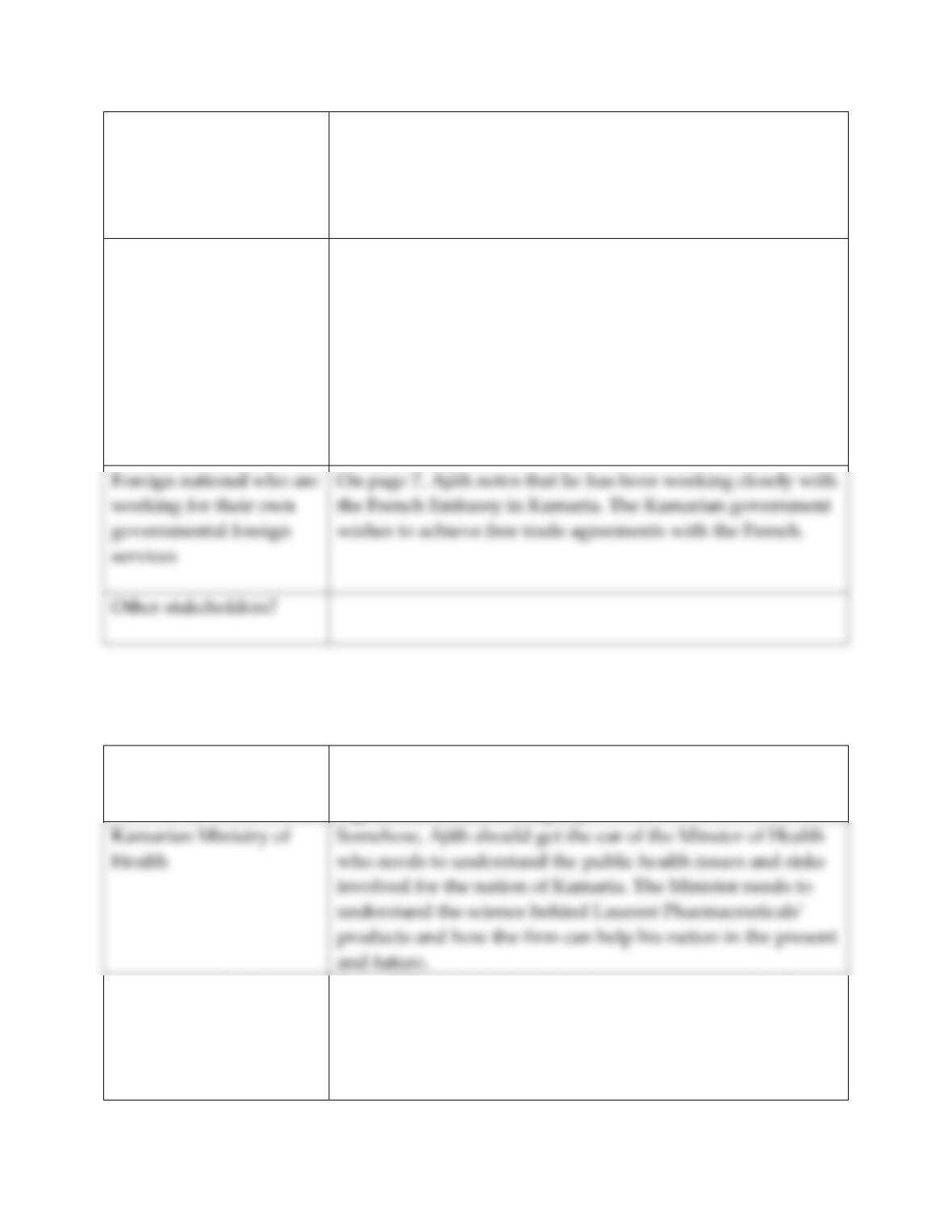
Stakeholders
What’s at stake for specific individuals and/or groups?
Ajith
Ajith has staked his career and reputation on being
successful in Kamaria, particularly in this ability to grow the
ability to grow Laurent when it appears that their
competitors are by-passing them in the race to win
5
have been motivated by pay, since they tripled,
approximately, their pay by moving their allegiance from
the state-run hospitals to the new pharmaceutical firm. One
can easily imagine that Ajith’s team is quite excited about
their job opportunities since people most likely started their
careers in a state-run enterprise with low pay and little
opportunity for advancement. At Laurent Pharma, it is
much more likely that they will be able to have expanded
opportunities and greater pay.
Kamarian Ministry of
Health
There are multiple layers of stakeholders in this broad
category. Ajith talks about the first gatekeeper. This sounds
like a low-level bureaucrat who has his hand out; to date,
Ajith has not greased the palms of this gatekeeper. At the
highest level, there is the Minister of Health, a person, one
may kindly assume, is broadly concerned about the health of
people in his nation-state; his own career and trajectory of
opportunities; and the role that his government plays in the
health of people in his country. The Minister may also want
to protect the private enterprises which are beginning to
develop in Kamaria. The case suggests that mid-level
bureaucrats, like their counter-parts down the
organizational level, are also asking/expecting kick-backs
from the people with whom they are working.
India
Kamaria
from these operations will be their reward for services to
their country.
US, the UK, and other
may be intensified and codified.
6
EU countries who are
stationed in Kamaria
and those who will
follow in Ajith’s
footsteps
The population of
Kamaria, particularly
those who are most
vulnerable to the spread
of diseases, such as
Hepatitis B and other
serious diseases that
might be cured with
antibiotics
A population that is wasted by disease cannot be
productive. The alarming carrier rate of Hepatitis B, for
example, means that all levels of society would benefit from
a strong, effective health-care system.
Foreign national who are
working for their own
governmental foreign
services
On page 7, Ajith notes that he has been working closely with
the French Embassy in Kamaria. The Kamarian government
wishes to achieve free trade agreements with the French.
Other stakeholders?
2. Which of these stakeholders does Ajith need to involve to move forward Laurent’s
submissions and issue registrations for the company?
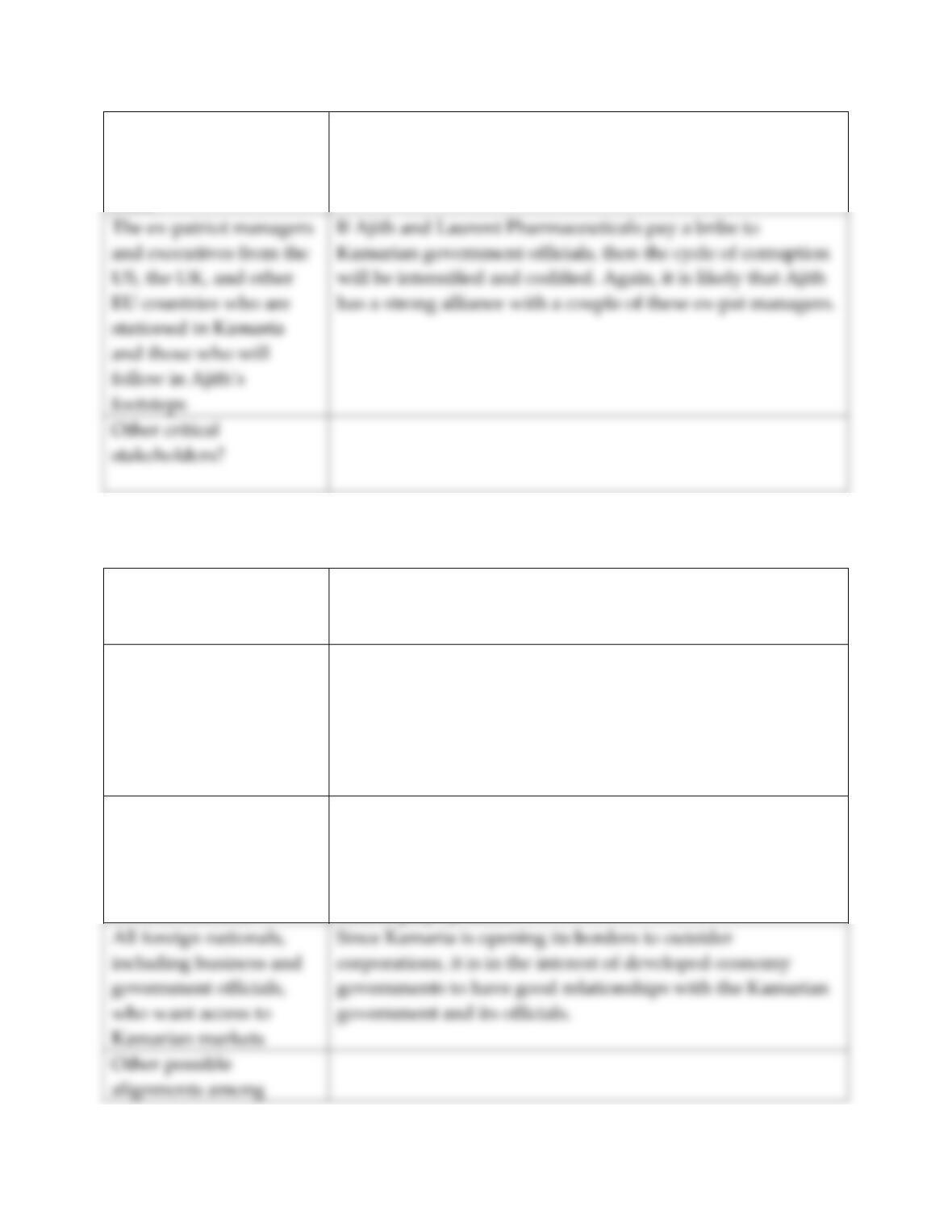
Stakeholders
Which of these stakeholders does Ajith need to involve to
move forward Laurent’s submissions and issue
registrations for the company?
Kamarian Ministry of
Somehow, Ajith should get the ear of the Minster of Health
involved for the nation of Kamaria. The Minister needs to
understand the science behind Laurent Pharmaceuticals’
products and how the firm can help his nation in the present
and future.
Approximately 30
competitor companies
from outside Kamaria,
such as other large
pharmaceutical
It would be helpful if Ajith had one or two powerful allies
among this large group. It does not work for any of them to
pay bribes to a number of government officials.
7
companies from the US,
the UK, other European
countries, Korea, and
India
EU countries who are
stationed in Kamaria
follow in Ajith’s
footsteps
has a strong alliance with a couple of these ex-pat managers.
Other critical
stakeholders?
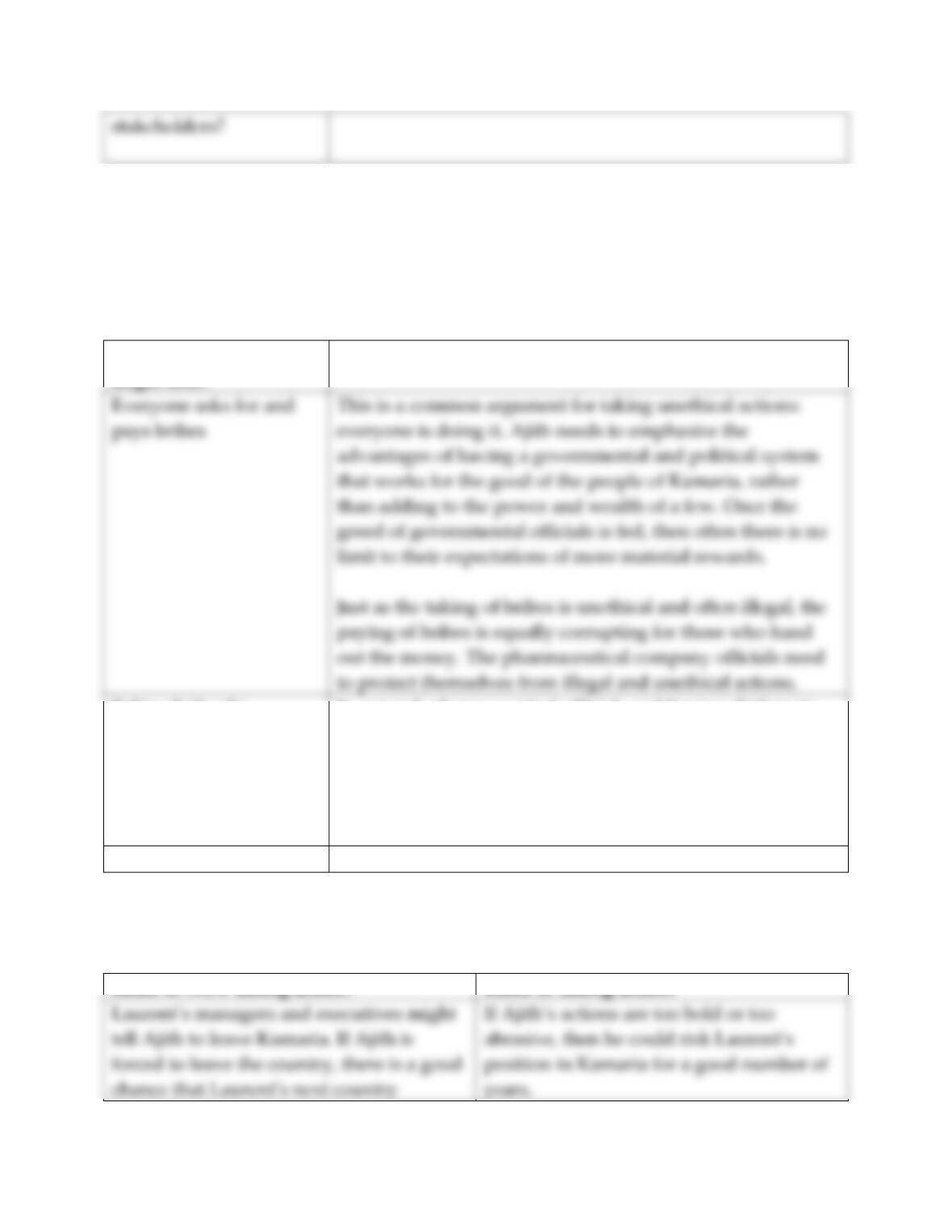
3. Where is there possible alignment among the interests of these various stakeholders?
Possible alignments
among the above
stakeholders:
What would bring them together?
The international
pharmaceutical
companies, the
Kamarian Ministry of
Health, and the people
of Kamaria
The health of the nation is at risk, and at the same time, the
pharmaceutical companies want to sell their products. Their
interests could align.
Current and future
business people from
international
corporations who will
work in Kamaria
No one wants to pay bribes and for a system of government
to be corrupt. It is in the interest of all international players
to help facilitate a political and economic system that has a
transparent set of rules about how the game is played and
then to play by them.
All foreign nationals,
including business and
government officials,
who want access to
Kamarian markets
Since Kamaria is opening its borders to outsider
corporations, it is in the interest of developed economy
governments to have good relationships with the Kamarian
government and its officials.
alignments among
8
stakeholders?
4. Ajith has been in Kamaria for a year and his bosses are becoming anxious for
something to happen. As Ajith considers to whom he should talk and what he should
say, what are the arguments that he might expect to hear. What are the reasons and
rationalizations that various stakeholders could use to maintain the status quo? How
should Ajith counter these arguments?
Arguments that Ajith
out the money. The pharmaceutical company officials need
to protect themselves from illegal and unethical actions.
Response to these reasons and rationalizations:
Taking bribes by
government officials are
the norm in Kamaria and
who are we, as outsiders,
to change these norms?
In general, pharmaceutical officials and foreign diplomats
are people whom one would expect to espouse high ethical
standards. Ajith needs to help them get in touch with these
standards and to see how their behavior helps to establish
the norms of interactions with Kamarian government
officials.
Other arguments?
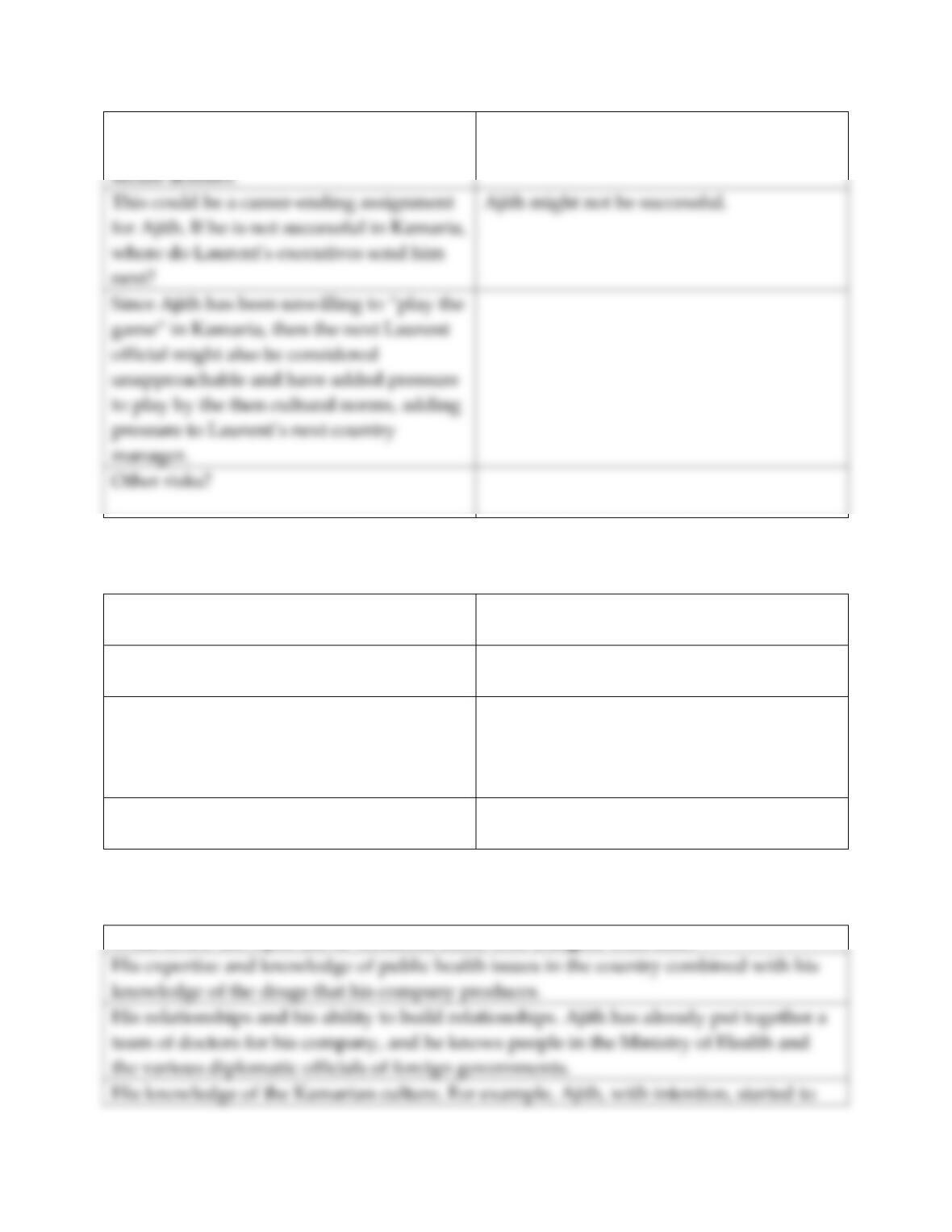
5. As we learn at the beginning of Case A, it is clear to Ajith that he needs to take action.
What does he risk by not taking action? What does he risk by taking action?
years.
9
manager would engage in giving bribes,
since Ajith had not found any other way to
secure licenses.
This could be a career-ending assignment
for Ajith. If he is not successful in Kamaria,
next?
Ajith might not be successful.
to play by the then cultural norms, adding
pressure to Laurent’s next country
manager.
Other risks?
6. What factors enable Ajith to act? What factors make it difficult for him to act, or
disable him from taking action?
Factors that enable Ajith to act:
Factors that disenable Ajith from taking
action:
His own moral values and code of ethics;
he has withstood pressures for one year.
Ajith might be seen as a person who is
slow to take action.
He has built a strong web of supportive
relationships in the country. The team that
he has put together within Laurent is the
best example of this web of support.
The norms of the entire community are
working against Ajith’s code of conduct.
Other enabling factors?
Other disenabling factors?
7. What levers are available to Ajith to influence those who disagree with him?
What levers can Ajith use to influence those who disagree with him?
His expertise and knowledge of public health issues in the country combined with his
knowledge of the drugs that his company produces.
His knowledge of the Kamarian culture. For example, Ajith, with intention, started to
10
learn and communicate with his staff in the Kamarian language; he only stopped this
practice when his staff explained that they preferred English since they wanted to
practice their language skills. And he made a point of visiting the various relevant
players on a regular basis, often with no particular request but rather to build his
relationships and insight.
C. Students write their scripts and action plans individually (5 minutes):
Ask students to work alone for about 10 minutes and to figure out with whom they
want to talk and what they want to say. Push them to write what they will actually say
D. Students work in trios to give feedback to one another and then to write one
strong script and action plan (20 minutes):
Most likely, individual students will feel challenged and now look forward to
E. Students articulate their scripts and action plans and receive feedback from one
another (20 minutes):
Talk about the purpose of feedback and how it will be given. Mention that feedback can
help us figure out what we do well, and how we might want to improve from the
perspective of our audience. In addition, if we do find ourselves in a situation where we
F. Read and discuss Case B (15 minutes):
The following is the fundamental question for discussing Case B:
• Ajith pursued a three-part strategy. What was this three part strategy and why
do you think that this integrated approach was successful?
11
and raised the thorny problems of trademark infringement and the fake and
imitation products being produced in Kamaria. Apparently, the diplomats raised
these thorny problems in their talks with the Kamarian officials as they discussed
the trade agreements. At the same time Ajith built his network and relationships
inside the Ministry of Health, finally reaching the Minister. When Ajith talked
directly with the Minister, Ajith noted the public health dangers of pharmacists
G. Summarize lessons from the case discussion (5 minutes):
• Develop relationships before you need them: it is always important to
have relationships with relevant parties.
• Note what various people want and understand what levers to use to
• Stay true to your “north:” Ajith did not waver in his commitment to his
values.
• Think outside the box: Ajith figured out a sophisticated strategy where
many have stumbled. He was able to do this because of his keen
observation skills, his nuanced attention to the Kamarian culture and its
population’s needs, and his extensive knowledge and understanding of
the pharmaceutical industry and what it offers populations in terms of
health care issues.
References

12
Economist Intelligence Unit. (2005, June). Asia and Australasia: Healthcare and
pharmaceuticals at-a-glance. Healthcare & Pharmaceuticals Forecast Asia & Australasia, 3-4.
Focus Reports. (2009). Indonesia: Demographic dividend or delusion? Pharmaceutical
Executive, 29 (6), S2–S9.
Focus Reports. (2007). Thailand: Critical need for new investment. Pharmaceutical
Executive, 27 (2), S2–S5.
Goldberg, P. K. (2010). Intellectual property rights protection in developing countries:
The case of pharmaceuticals. Journal of the European Economic Association, 8 (2/3), 326–
353.
Koppal, T. (2004). Global teams battle neglected diseases. Drug Discovery & Development,
7 (4), 28–32.
Kremer, M. (2002). Pharmaceuticals and the developing world. Journal of Economic
Perspectives, 16 (4), 67–90.

13
Quagmire or Goldmine? The rapid growth in developing countries prompts a rethink by drugs
companies. (2008, May 15). Retrieved August 14, 2011, from The Economist:
http://www.economist.com/node/11376895?story_id=11376895