1
Turning Around Cote Construction Company
Teaching Note
By Cynthia Ingols
Simmons University
Boston, MA, USA
Case synopsis
When Liam Cote, cousin to Felix Cote, arrived at Cote Construction Company, he knew that the company
had financial problems. However, Liam was not aware of the depth and breadth of managerial and
organizational problems at the company. After three weeks of diagnosing and making lists of the
problems at Cote Construction on flip-chart paper, Liam was ready to take action. “Where should I
begin?” Liam Cote asked himself.
Learning objectives for the case discussion
The learning objectives for a discussion of the Cote Construction Company case are threefold:
1) to make explicit the process of collecting data at Cote, including the who, how, and when
of data collection; and then to rank order the importance of tackling the problems that the
data highlights and the associated reasons for tackling the problems in specific order;
Students’ preparation for classroom discussion of the case
In preparation for a discussion of the Cote Construction Company case, ask students to answer
the following two questions: Either assign the questions as homework and have students make
their lists and evaluate Liam’s process prior to class Or during a class divide the students into
small working groups of three or four students and have them answer the questions in class. Or,
combine these two approaches to prepare for a strong discussion of the case.
2
2. How did Liam Cote collect the data about the problems at the construction company? What do
you think about his data collection process? How might Cote Construction employees feel about
Liam’s methods of data collection? From the case we do not know if he hung the flip-chart
papers on the walls of his office, allowing everyone who entered his office to see his data
collection process, or if he added his data to the flip-chart paper at the end of each day, and in the
privacy of his office. Which process do you hope that he followed and why?
Teaching Plan: Discussion Questions and Answers
Step 1: The following are questions to ask the class and then their possible answers.
1. In the Introduction to the case, we learn that Liam Cote, when he first arrived at the
construction company, began a list of problems that he encountered. At the end of the case, he
says that he has more than two dozen items. What problems did you identify as you read through
the case? What underlying issues did a problem, or group of problems, suggest to you?
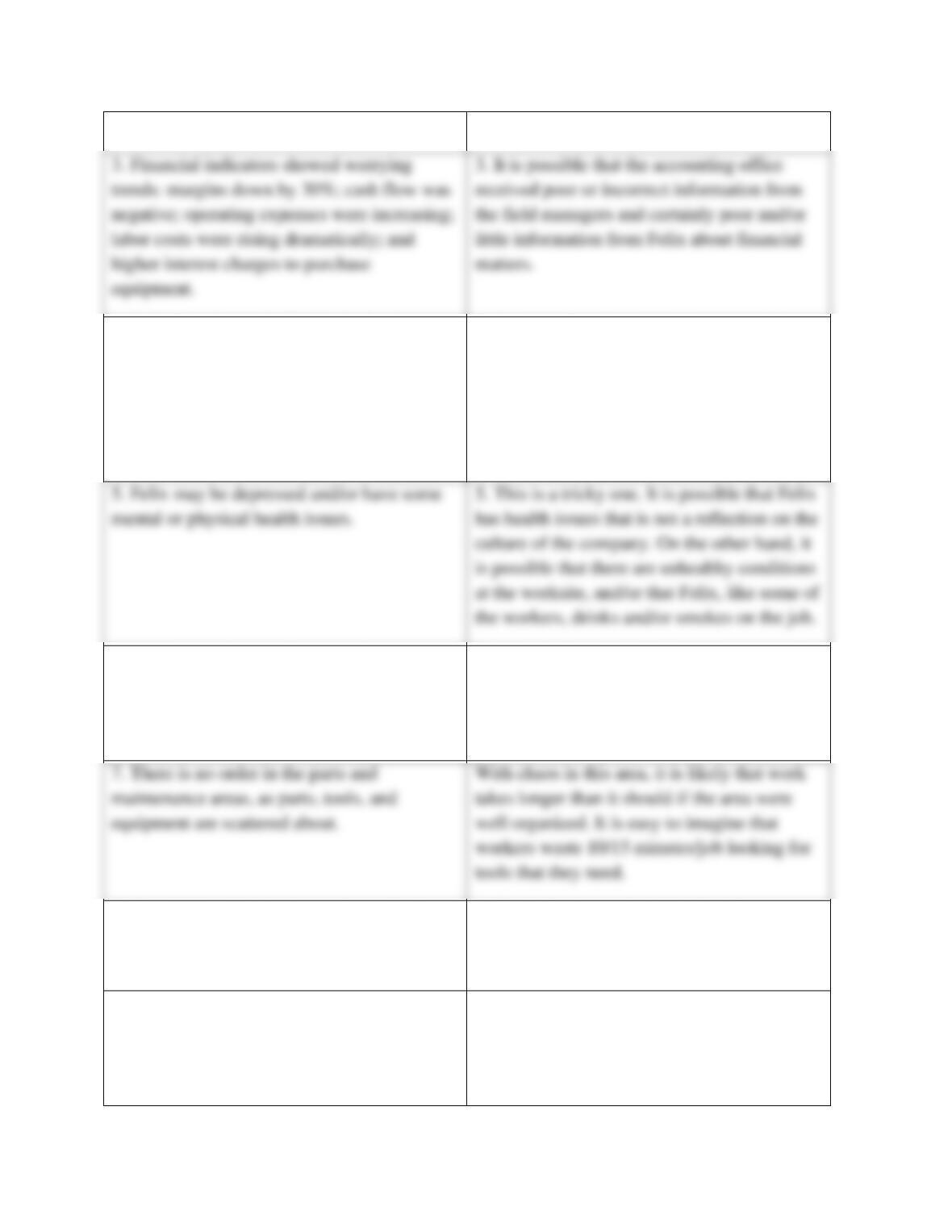
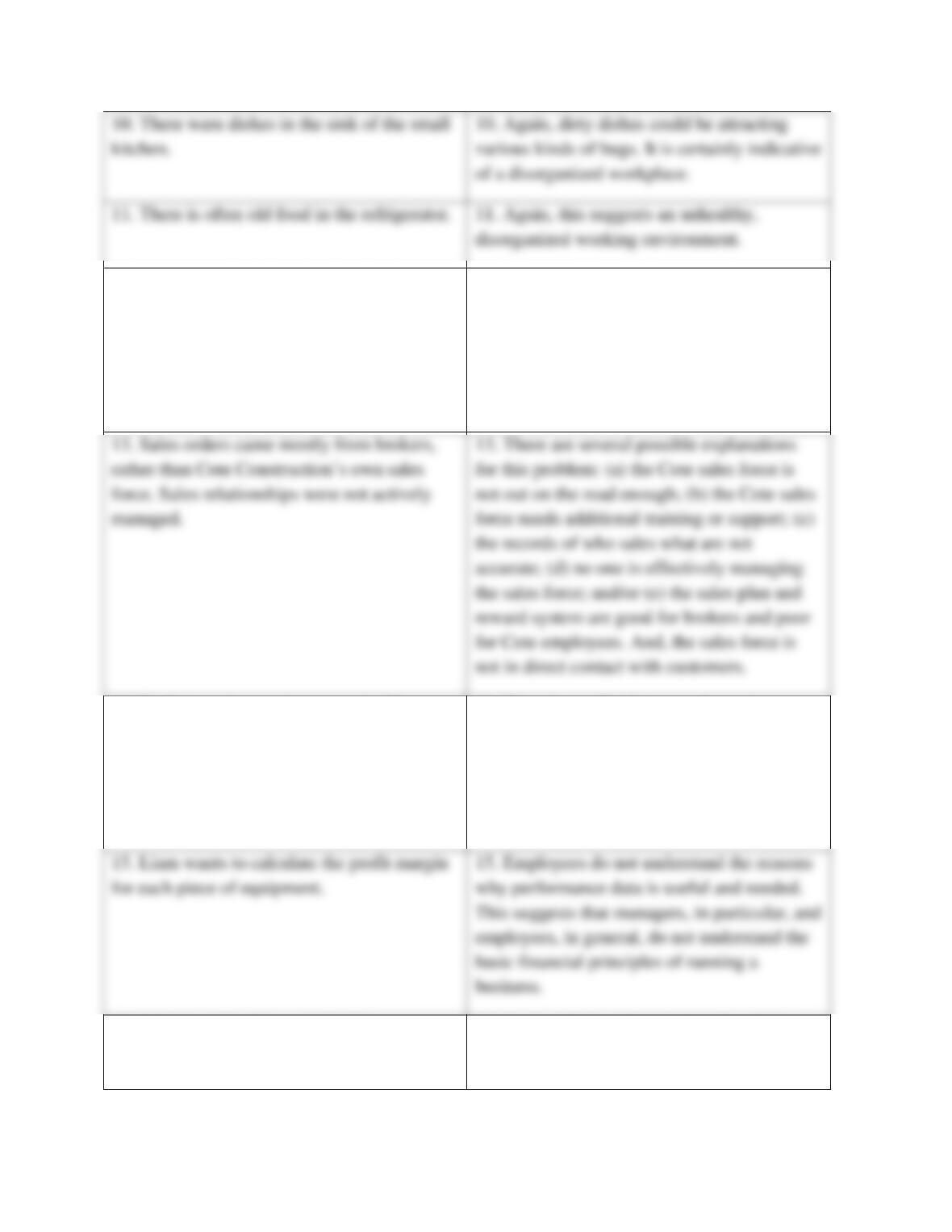
Put an empty chart up on the board. Fill in the chart with the students’ answers.
Problems explicitly stated in the case (your
list should look something like the list that
Liam Cote has created…although we do not
have a copy of his list)
Possible additional problems. These are not
explicit, but possible underlying problems.
Ask students for their reason (s) for the
possibility
2. Felix Cote does not communicate with
Liam or others when he leaves the office.
2. It is likely that others do not communicate
their whereabouts, since the owner/boss is
behaving so poorly. Felix is a role model, too,
even though he is modeling poor behavior.
Official communications within the company
is likely to be poor, while the rumor mill is
3
likely to be strong.
labor costs were rising dramatically; and
higher interest charges to purchase
equipment.
little information from Felix about financial
matters.
4. Felix is nicknamed “Waldo,” after the
character in the children’s book, Where’s
Waldo?
4. It is a good sign that employees see the
“black” humor in the situation. It would be
fun to go to lunch with various groups within
the company and see what other “gallows”
humor there is, as the humor is likely to tell
us about the company’s culture.
at the worksite, and/or that Felix, like some of
the workers, drinks and/or smokes on the job.
6. Employees smoking in areas with no-
smoking rules.
This is clearly a sign of permissiveness as the
case notes. And, it is possible that it is a sign
of poor health habits among employees. It is
clearly a sign that employees disregard rules.
equipment are scattered about.
well organized. It is easy to imagine that
workers waste 10/15 minutes/job looking for
tools that they need.
8. There is trash in the parts and maintenance
areas.
8. This is both unhealthy (is the garbage
attracting rats?) and unproductive, as noted
above.
9. There is grease on the floor in the
maintenance area.
9. As the case writer states, this is an
impediment to walking and another sign that
the work areas could expose employees to
physical dangers.
4
of a disorganized workplace.
disorganized working environment.
12. There was alcohol on the breath of an
employee.
12. Liam fired him on the spot. We expect
that this story spread quickly through the
ranks of employees. Again, drinking alcohol
at a workplace or coming to work with
alcohol on one’s breath is another sign of an
unhealthy workplace.
not in direct contact with customers.
14. Broken equipment is not repaired in a
timely manner. When Liam asks why he is
told about the conflict among managers. He
labels this: “unclear lines of authority.”
14. There is conflict between the maintenance
supervisor and the field service foreman and
the sales staff over the allocation of repair and
maintenance charges. So…nothing gets done.
15. Liam wants to calculate the profit margin
15. Employees do not understand the reasons
business.
16. Equipment has been repaired at
customers’ work sites, rather than on a regular
schedule of repairs. No formal preventive
16. Again, this is another indication of the
poor organization of the business.
5
maintenance system for equipment.
17. Questionable inventory management
system with missing parts and excess
inventory in other area.
17. It is impossible to know if these tools and
equipment are misplaced (since they don’t
have a place), stolen, or never received.
18. Employee morale is “in the toilet.”
18. One can only say: “of course!”
and, some of whom smoke where they should
not.
20. Felix, Head of Equipment and Operations,
is not working.
20. As noted earlier there are unclear lines of
authority and responsibility for getting tasks
done.
Integration of the Change Path Model & Cote Construction Company case
To use this short case for a summary discussion, we suggest that you draw the Change Path
Model on the board. Below we have tied the Change Path and case directly together.
The Change Path Model
Awareness
1. Identify a need for change: confirm the problems through collection of data.
Liam has collected data by listing the problems at the company. (Students have their lists of
problems, too.) Liam could call together his managers and present his List of Problems. Ask:
If Liam’s list of problems is new to the company’s managers, how do you think that they will
6
If they have known about Liam’s “List,” because the List has been up on his office walls for
three weeks, how do you think that they will respond? They will probably laugh nervously and
talk about their “favorite” problems. They might add to the List, too.
Ask: How else could have Liam collected data about the problems in the company? Liam
2. Articulate the gap in performance between the present and the envisioned future state and
spread awareness of the data and the gap throughout the organization.
Liam should set up a time and place for a Town Hall Meeting, a gathering of everyone in the
company. He needs to be careful to make sure that everyone is paid for the time that they
Liam also needs to put data and/or examples of things that are going well at Cote
Construction. Ask students why Liam should put up positive examples of things and/or people
at Cote?
Why should Liam include positive aspects of Cote Construction Company?
If Liam overwhelms employees and managers with negative examples, they are likely to
7
3. Develop a powerful vision for change.
It is likely to be Liam and his managers who develop a new vision for Cote Construction
4. Disseminate the vision for the change and why it’s needed through multiple communication
channels.
Liam should talk about his vision for the company at the Town Hall Meeting. He might also
Mobilization
1. Analyze the formal systems and structures and decide what needs to change.
In analyzing the conflict over the scheduling of the repair of equipment, Liam noted that the
lines of authority and responsibility were not clear. Now, he should draw an organization
chart, making who reports to whom explicit. He might also use BART:
B = boundaries
A = authority
R = roles
8
T = tasks
2. Make sense of the desired change through formal systems and structures and leverage those
systems to reach the change vision.
Using BART in a conversation with the executive and management teams, as noted above,
3. Communicate the need for change organization-wide and manage employees of Cote
Construction and other stakeholders (such as Cote’s customers) as they react to and move the
change forward.
Liam should meet weekly with his management team. In addition, he should continue to walk
around the company, being very present and visible. He should learn the name of each
employee. During the first year, Liam should hold short (one-hour) quarterly Town Hall
9
4. Leverage the change agent’s personality, knowledge, skills, and abilities, and related assets
(e.g., reputation and relationships) for the benefit of the change visions and its
implementation.
This is a critical aspect of successfully changing Cote Construction Company. Liam Cote
needs to be—and apparently is—the successful heir to the CEO position at the company.
Acceleration
1. Reach out to engage and empower others in support, planning, and implementation of the
change. Develop new knowledge, skills, abilities, and ways of thinking that will support the
change.
The case identifies three groups of employees who need development of their skills:
(a) the sales team needs training in sales and team building;
2. Use appropriate tools and techniques to build momentum, accelerate and consolidate
10
progress.
Training will be an important tool to build momentum of the change process. Cote
3. Manage the transition, celebrate small wins and the achievement of milestones along the
larger, more difficult path of change.
Institutionalization
1. Track the change periodically and through multiple balanced measures to help assess what
is needed, gauge progress toward the goal and to make modifications as needed and mitigate
risks.
At some point early in the change process, Liam made a plan (hopefully) about when and how
he and others would lead change in each specific area. He most likely has also carefully
2. Develop and deploy new structures, systems, processes and knowledge, skills and abilities,
as needed, to bring life to the change and new stability to the transformed organization.
Cote Construction is a very small organization of 55 to 60 employees. The new structures and
systems should have been in place for some time and the Institutionalization should be well
along in the process.
If we had been talking about a global corporation, then it is at this point that the lead change
agent might re-structure the corporation to interact with the environment in new and important
ways.
As a final question to the students, ask: what did you learn about “leading change” from this case
and from other cases?