
Case: Travelink Solutions
Teaching Note
By Noah Deszca, Secondary School Teacher, Durham Board of Education,
Whitby, Ontario, Canada
&
Gene Deszca, Wilfrid Laurier University, Waterloo, Ontario,
Canada
1
1
TRAVELINK SOLUTIONS
Case Objectives and Use
This case is designed to be used to demonstrate what happens when a firm that has done a
number of things right in the past and finds itself seriously out of alignment with its
environment. It provides students with insight into life in an inbound call center and the
challenges involved in successfully managing such a business. Challenges include those that
revolve around capacity management (ramping capacity up and down), the alignment of the
staffing levels and competencies of customer service representatives (CSRs) with customer
needs and marketing initiatives, mismanaged organizational change initiatives, and the impact
2
TRAVELINK SOLUTIONS
INSTRUCTOR’S MANUAL
Case Synopsis
The case explores the experience of William, a recent university graduate, during his 16 month
period of employment in the Canadian call center of a mature service business. The Travelink
call center handles only inbound calls and deals with customers making claims and seeking help
in accessing services and support. Travelink is a very successful US firm that offers protection to
global travelers against a variety of risks, including theft, automobile accidents and breakdowns,
and emergency legal, accommodation, and travel arrangements. In addition to its own branded
services, Travelink provides product design, back office, and call center support for firms
wishing to offer their customers access to similar services under their own brand. It has a history
of double digit growth in a mature industry, anchored by quality service and strong supplier
relationships with its key customers.
William’s concerns for his future prospects are eased when he is assigned to the Datasmart
project in June. This initiative is designed to revamp Travelink’s information technology and was
undertaken to improve information flow, enhance efficiency, and reduce the need for staff.
William’s role involves the drafting, editing, and entry of standardized correspondence, forms,
and documentation to be used by the Canadian operation. The task appears to be congruent with
his skill set, but technical aspects of the project dominate the attention of others and he receives
little guidance. Unfortunately, this project also stumbles during implementation and once again,
the organizational coping mechanism defaults to silence and avoidance.
3
Research Approach
While the case adopts the voices of William and, to a lesser extent, Robert, case data is anchored
in interviews and feedback from participants employed in the Canadian operation and company
documents. As a condition of the release of the case, it was disguised.
Teaching Objectives
This case is designed to demonstrate what happens when a well-intentioned firm finds itself out
The case exposes students to an inbound call center and the fact that such facilities are, in
essence, service factories. Case use extends to the development of student assessment and action
planning skills in such areas as staff development, communication, performance management,
leadership, motivation, employee commitment, alienation, conflict management, and
organizational change. As such, it has the capacity to be used in a number of targeted ways,
depending on the instructor’s agenda.
The teaching objectives to which the case can be put include:
o
Assessing strategic and operational issues related to the management of an inbound call
center that serves its own customers as well as provides call center service to other
firms.
o
Exploring the management of issues related to capacity management and the ramping up and
down of trained call center staff.
o
Developing assessment skills in the area of organizational alignment, organizational
change, and the impact of misalignment.
4
escalating negative impact on the culture of the firm and the capacity of a firm to recover and
effectively cope with market needs.
o
Explore the personal career development implications of being involved in a context such as
this.
Courses and Levels for Which the Case Is Intended
Discussion Questions
1.
What are the strategic and service delivery issues that managers at Travelink face?
Travelink is a successful firm that does not seem to have well-developed skills in dealing with
business setbacks that impact on employment levels. Its strategy has been to build high-quality
services that are designed to be very responsive to the needs of global and domestic travelers
who wish to protect themselves from a variety of travel perils (e.g., theft, emergency travel
arrangements, automobile breakdowns, accidents, and so on). These services are delivered
through products under its own brand name (25% of the cases) and through products carrying
the brand name of other firms (75% of the cases). As a result, its capacity to be a trusted and
2.
What do you think of their initial approach to employee training and development? To the
placement and development of operators within the call center? To their initial approach to
leadership, communication, and motivation?
5
Travelink does many things right at the start. Careful recruitment and selection is followed by a
3.
What changes when the firm finds itself out of alignment with demand? How does it handle
it and what is the impact?
The Canadian branch seems to lack skill in handling the misalignments that stress the
organization. There are comments concerning the need for more sales and greater efficiency, but
both of these areas are largely outside of the control of the CSRs. As perceived pressure from the
US parent mounts for action on the Canadian division’s financial results, management turns to
downsizing, but it manages the process very ineffectively.
Avoidance of a meaningful discussion of the issues faced by the firm and its responses only
4.
What should Robert, the marketing manager, do? What are the change challenges he faces
and how should he manage these?
This is an organization that invested in the creation of a more committed labor force and then
acted in ways that sabotaged that outcome. Robert understands the risks to major contracts
associated with current service levels and appears to want to make senior management aware of
the need for change and the risks associated with the current strategies and tactics being
deployed in the call center. There are a variety of ways he might do this, but a quick undertaking
to compile feedback from customers and data on where they are out of compliance with their
contractual obligations would represent good places to start.
6
and it is interesting to see which ones students chose to explore. Triage options include (a)
attempting to entice back former employees who had performed well; (b) simplifying the job
commitments for how the problem will be quickly resolved; and (e) have senior management
address employee concerns, own up to their role in creating the problem, and make firm
commitments for what will be done to address the situation. Given management’s past behavior
and defensiveness, this will not be easy to accomplish and will require the careful and yet rapid
building of support around approaches that can stabilize things and begin to alleviate and
improve the worsening situation and begin the journey to restore the positive performance
culture that management have previously taken pride in.
When the immediate situation has been stabilized and short-term processes put into place to
reduce lost calls and wait times to much more manageable levels, then attention can turn to how
to more effectively manage growth and demand fluctuations over the longer term. With regard to
this, a variety of alternatives can be explored, including call screening and call management
5.
What should William do?
William’s decision is largely already made. He has decided that exit is in his best interest, and
this has been reinforced by the fact that the work place has deteriorated and earlier commitments
(e.g., the six-month performance review and promised salary increase) only seem to get acted
upon when management is faced with his resignation. If he decides to stay, William needs to
consider what sort of role he wishes to play in the firm, what he would like to learn and earn, and
7
Teaching Plan
50-Minute Class
75-Minute Class
5 minutes
5 minutes
10 minutes
What are the strategic and
service delivery issues that
Travelink faces?
15 minutes
What are the strategic and service
delivery issues that Travelink
faces?
within the call center? To their
initial approach to leadership,
communication, and motivation?
within the call center? To their
initial approach to leadership,
communication, and motivation?
10 minutes
What changes when the firm
finds itself out of alignment with
demand? How does it handle it
and what is the impact?
15 minutes
What changes when the firm finds
itself out of alignment with
demand? How does it handle it
and what is the impact?
10 minutes
What should Robert, the
marketing manager do? What
are the change challenges he
faces and how should he manage
20 minutes
What should Robert, the
marketing manager do? What are
the change challenges he faces
and how should he manage these?
The above plan can be amended in a variety of ways, in order to shift the focus of the case
discussion to the specific teaching objectives you have in mind. For example, one can ignore the
question of what William should do? This time could then be reallocated to Robert’s alternatives
and action plan.
8
Bibliography
Beckhard, R., & Harris, R. (1987). Organizational transitions. Massachusetts: Addison-
Wesley, 1987.
Bedeian, G., & Armenakis, A. A. (1998). The cesspool syndrome. Academy of Management Executive,
12(1), 58-67.
Balogun, J., & Johnson, G. (2005). From intended strategies to unintended outcomes: The impact of
change recipient sensemaking. Organizational Studies, 26 (11), 1573–1601.
Cawsey, T., & Deszca, G. (2007). Toolkit for organizational change. Los Angeles: Sage, 2007.
Dailey, R.C., & Kirk, D. J. (March 1992). Distributive and procedural justice as antecedents of job
dissatisfaction and intent to turnover. Human Relations, 305–316.
Gopinath, C., & Becker, T. E. (2000). Communication, procedural justice, and employee attitudes:
Relationships under conditions of divestiture. Journal of Management, 26, 63–83.
Hirshman, A. O. (1970). Exit, voice, and loyalty: Responses to decline in firms,
organizations, and states. Cambridge, MA: Harvard University Press.
Klein, S. (1996). A management communication strategy for change. Journal of Organizational
Change Management, 9(2), 32–46.
9
I
IN
NP
PU
UT
T
O
OU
UT
TP
PU
UT
T
E
EN
NV
VI
IR
RO
ON
NM
ME
EN
NT
T
(
(P
P.
.E
E.
.S
S.
.T
T.
.)
)
S
S
T
T
S
SY
YS
ST
TE
EM
MS
S
L
LE
EV
VE
EL
L
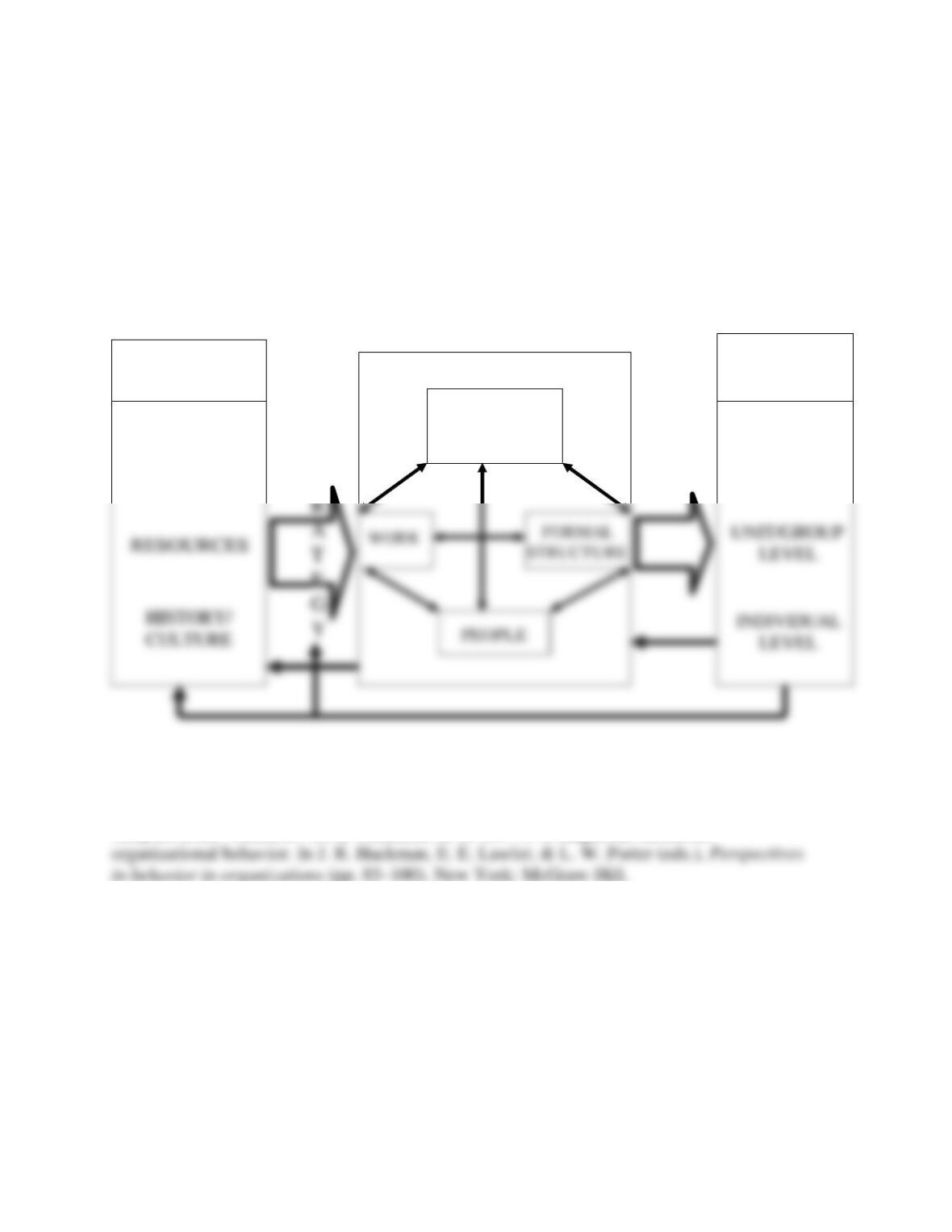
INFORMAL
STRUCTURE
& PROCESS
Possible Overheads for Use With the Case:
a)
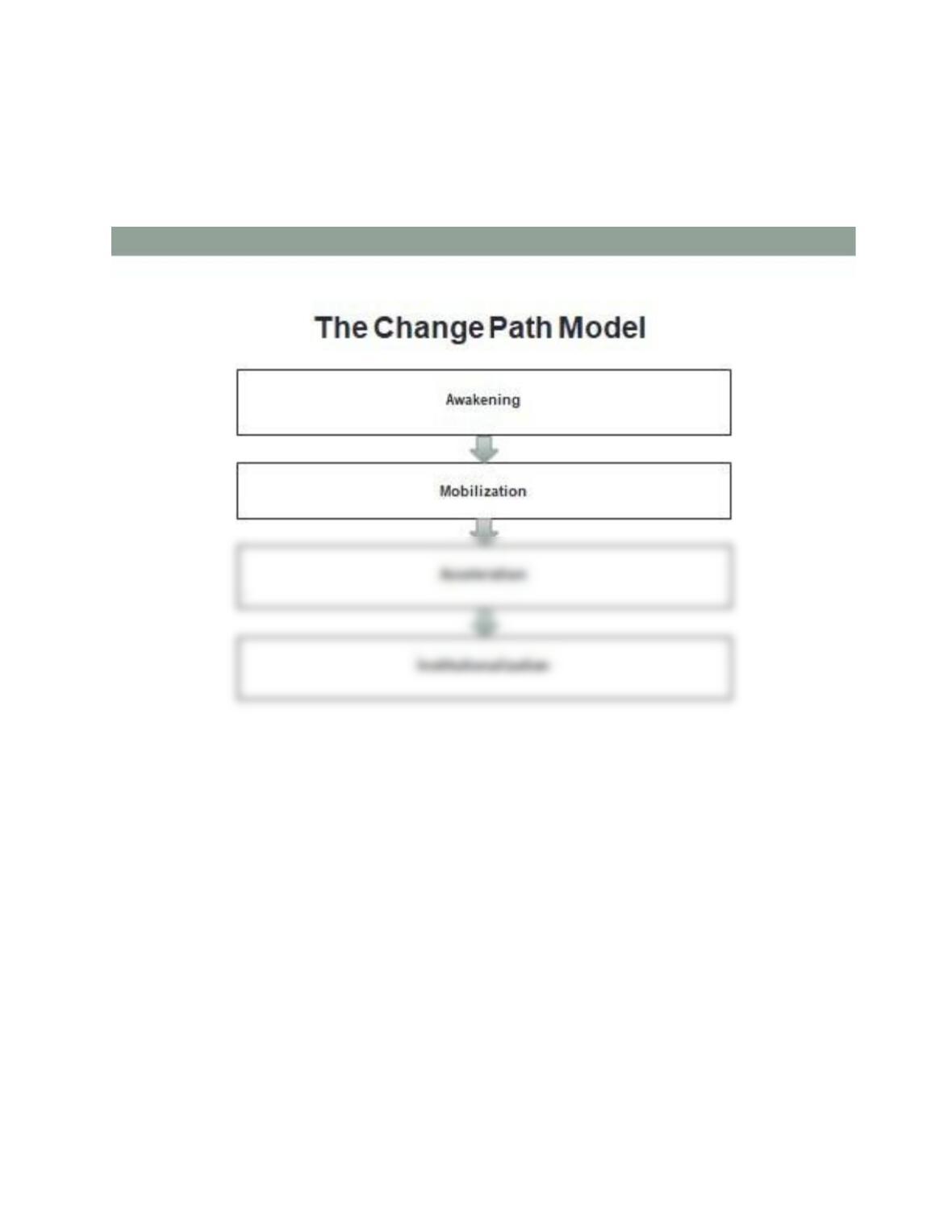
Open Systems Models
The Nadler–Tushman Congruence Model for Organizational Analysis
T
TR
RA
AN
NF
FO
OR
RM
MA
AT
TI
IO
ON
N
P
PR
RO
OC
CE
ES
SS
S
Adapted from: Nadler, D. A., & Tushman, M. L. (1977). A diagnostic model for
10
b)
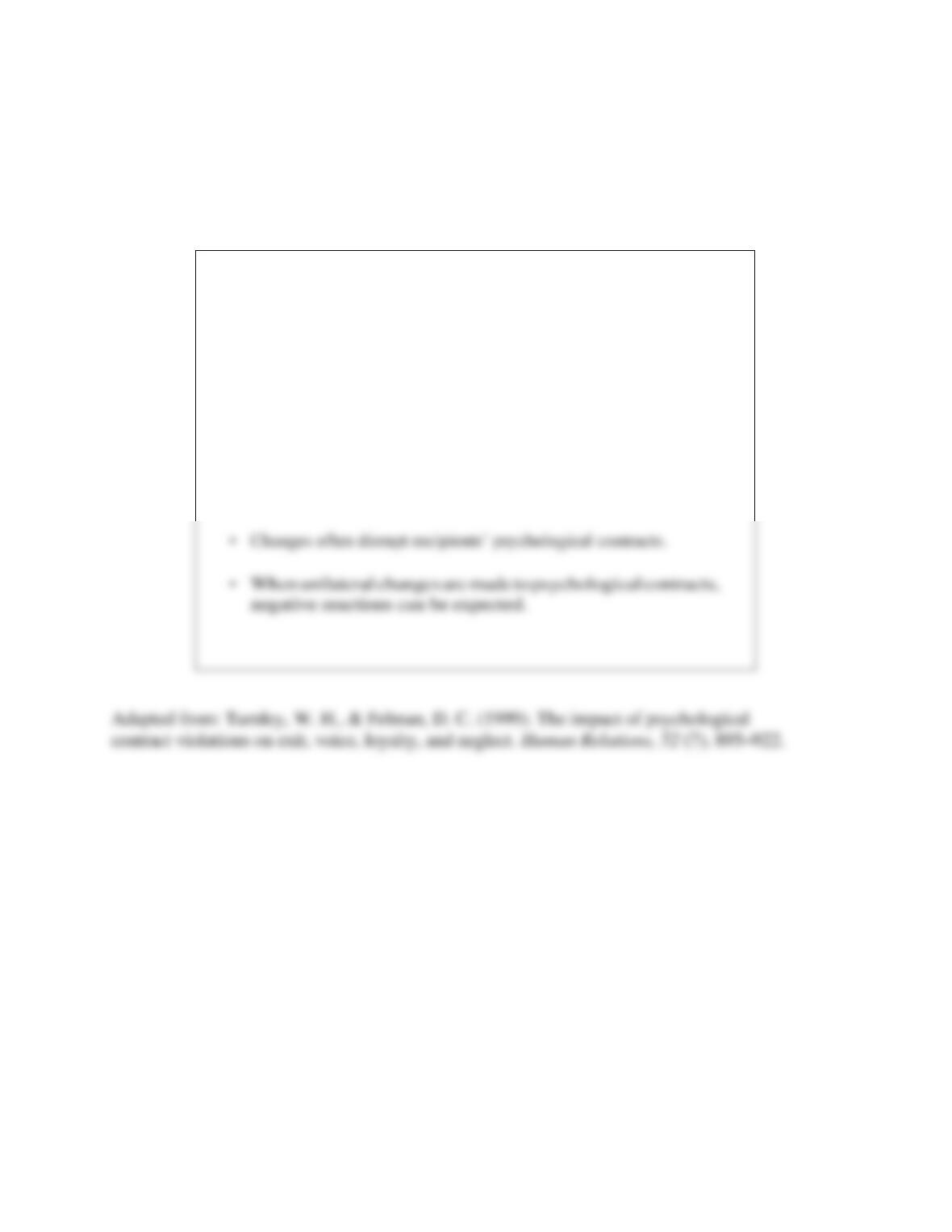
The Change Path Model
11
c)
Psychological Contract
Slide to frame discussion of what was the contract and was the contract violated
Psychological Contract
•
The psychological contract represents the sum of the implicit
and explicit agreements we believe we have with our
organization.
•
It defines our perceptions of the terms of our employment
relationship and includes our expectations for ourselves and
for the organization, including organizational norms, rights,
rewards, and obligations.
12
d)
Perception of fairness and justice slide.
Perceptions of Fairness and
Justice
•
Perceptions of fairness and justice will influence
how recipients view and react to the change.
13
e)
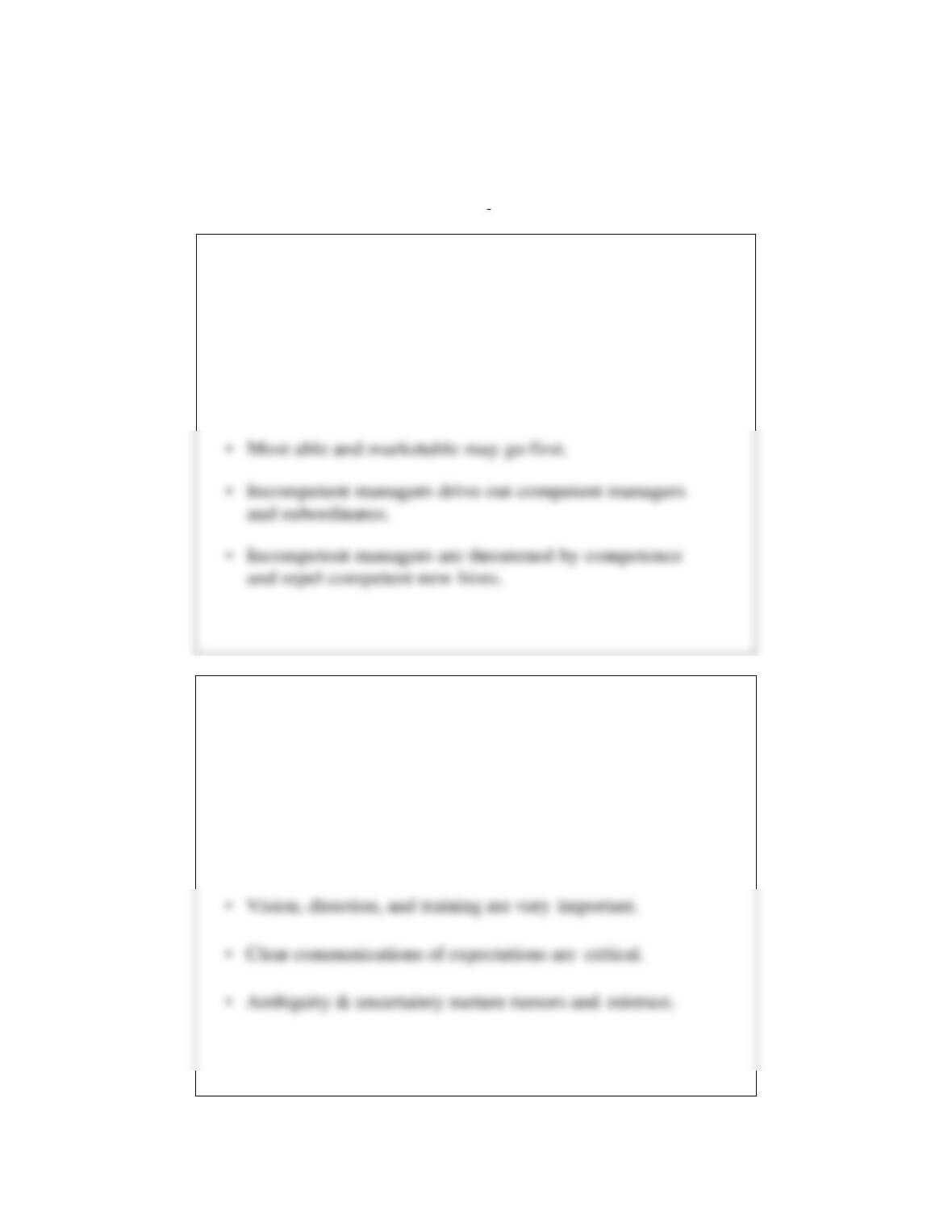
Exit, voice, loyalty and declining job satisfaction.
Adapted from: Hirshman, A. O. (1970). Exit, voice, and loyalty: responses to decline in
firms, organizations, and states. Cambridge, MA: Harvard University Press.
Loyalty
Neglect
Constructive
Destructive
Voice
Exit
Active
Responses to Job Dissatisfaction
14
f)
Downsizing Slides
Adapted from: Bedeian, G., & Armenakis, A. A. (1998). The cesspool syndrome. Academy of
Management Executive, 12(1), 58–67; Mishra, K. E., Spreitzer, G. M., & Mishra, A. K. (1998).
Preserving employee morale during downsizing. Sloan Management Review, 39 (2), 83–95.
The Cesspool Syndrome
When downsizing is not thought through strategically:
•
Organizational anorexia + lose the wrong people = A
developing death spiral.
Cesspool (Continued)
•
Surviving and prospering depends upon identifying and
retaining star performers and core skills.
•
Decisions should be grounded in well-thought-out
strategy and criteria that are effectively communicated.
15
What Downsizing Promises
•
A leaner, more nimble, and adaptive organization.
•
Reduced head count = lower cost & more competitive.
What Downsizing Often Delivers
•
Shattered morale, trust, & confidence in the organization.
•
Guilt over having survived + anxiety about the future.
•
Concern re-capacity to take on added roles & duties.
•
No strategic plan for the downsizing.
16
Why Downsizing Doesn’t Deliver
•
Senior management may lack ability to manage a
downsizing (e.g., no vision &/or strategic thought).
•
No access to support systems and advisors to help
guide them through the process.
•
Cultural &/or systemic barriers impede the process.
What Organizations Need After Downsizing
•
High morale, trust, & confidence in the organization.
•
Understand downsizing reasons & future strategy.
•
Confident in their capacity to take on added roles & work.
17
Effective Downsizing Process
•
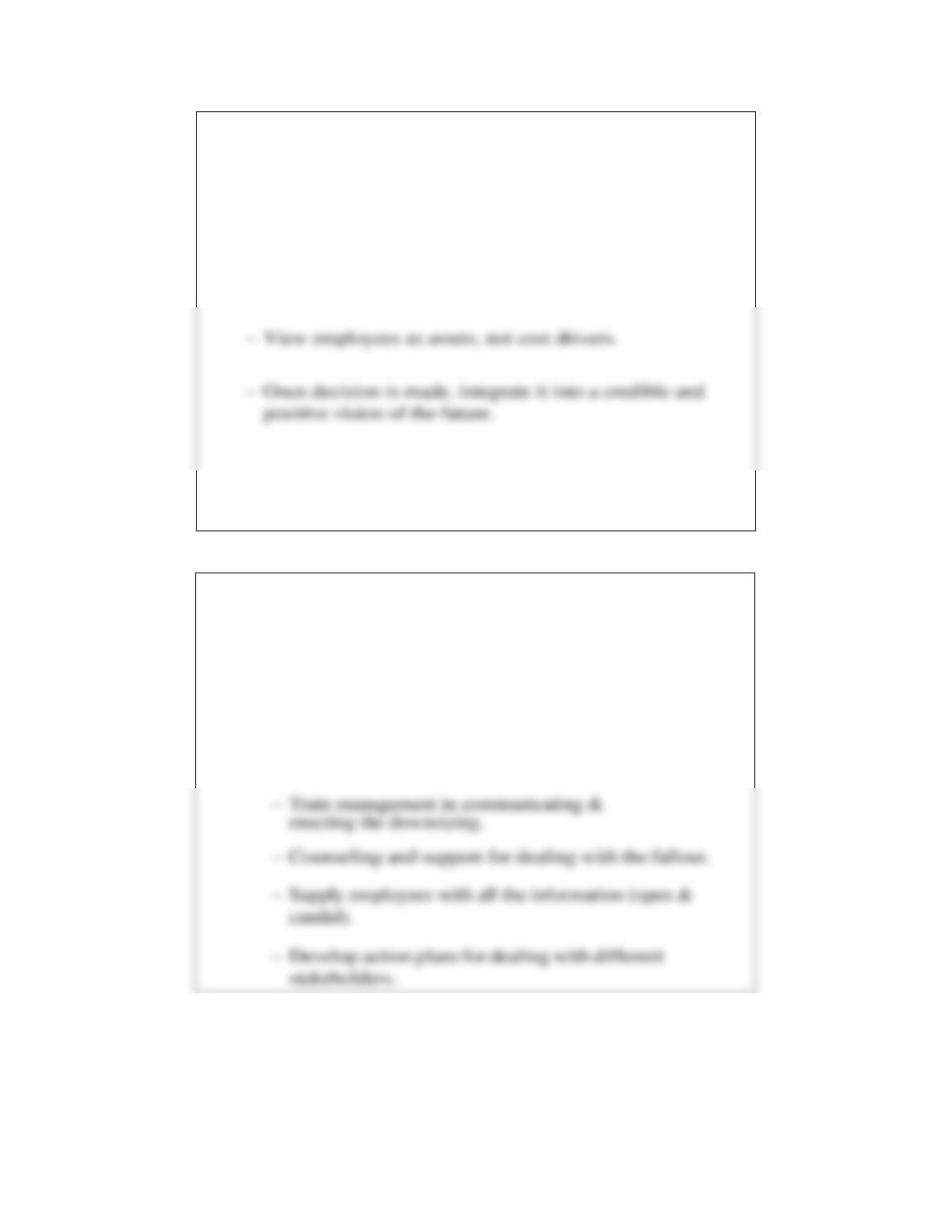
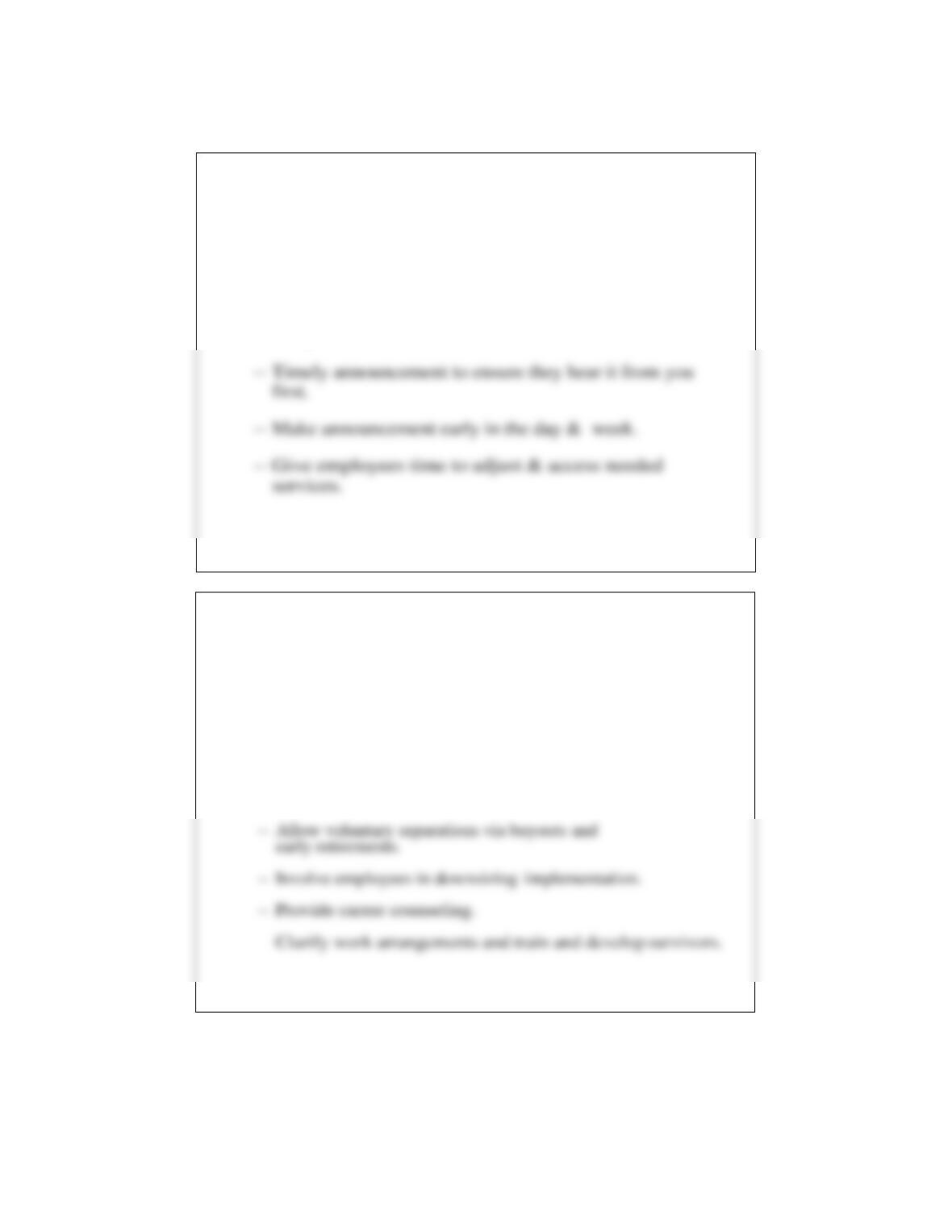
MAKE THE DECISION TO DOWNSIZE
–
Do it as a last resort, after all serious options considered.
Effective Downsizing Process
•
PLAN THE DOWNSIZING
–
Use a cross-functional team of credible, respected
people.
–
Identify and address the concerns of all
constituents.
18
Effective Downsizing Process (cont.)
•
MAKE THE ANNOUNCEMENT
–
Ensure rationale, direction, & vision are clear.
–
Be specific about what action will be taken.
Effective Downsizing Process
•
IMPLEMENT THE CHANGE
–
Tell the truth and err on the side of over communication.
–
Deal fairly, equitably & generously with departing
employees.
–
Announce subsequent separations as planned.