CLASSROOM EXERCISES AND ACTIVITIES
Retailing Management 10th Edition
Chapter 2 Types of Retailers
What retailers or types of retailers are characterized as follows:
1. Offer a broad variety and deep assortment, with customer service.
______________________________________________________________
2. Target low-income customers, but higher-income customers are increasingly
patronizing these stores.
______________________________________________________________
6. Large stores that combine a supermarket with a full-line discount store.
__________________________________________________________________
7. Not popular in U.S., but popular in Europe
______________________________________
8. Can be further categorized into 3 tiers
__________________________________________
CLASSROOM EXERCISES AND ACTIVITIES
Retailing Management 10th Edition
3
14. 30% of sales are made through a party plan system.
________________________________
18. Prices are 40% lower than conventional supermarkets
______________________________
19.
_________________________________________________
________________________________
23. Placing more emphasis on private label brands
_____________________________________
24. Target low-income customers with smaller packages.
_______________________________
25. Most significant trend is conversion into supercenters.
_______________________________
CLASSROOM EXERCISES AND ACTIVITIES
Retailing Management 10th Edition
28. Concentrate on health and personal grooming.
_____________________________________
32. Discount store that offers a deep, but narrow assortment of merchandise.
__________________
33. Emphasize perishables
__________________________________________________________
34. Retail format in which salespeople contact customers directly in a convenient
location, demonstrate merchandise or explain a service, take an order, and then
deliver or perform.
38. To survive, attempting to form exclusive arrangements with nationally recognized
brands.
__________________________________________________________________
39. Offering is communicated to a customer through a catalog.
_____________________________
CLASSROOM EXERCISES AND ACTIVITIES
Retailing Management 10th Edition
41. Over ½ items bought are consumer within 30 minutes.
________________________________
45. By opportunistically from other retailers and manufacturers.
____________________________
46. Organize stores into separate departments for displaying merchandise
_____________________
47. Off-price retailer owned by a manufacturer.
_________________________________________
50. Fastest growing retail category
____________________________________________________
51. Also called extreme value food retailers and only stock about 1,250 SKUs
_________________
CLASSROOM EXERCISES AND ACTIVITIES
Retailing Management 10th Edition
6
55. Tailor retail mix to a very specific target market.
_____________________________________
56. Small, full-line discount stores that offer a limited merchandise assortment at very
low prices
__________________________________________________________________
57. Small stores that offer limited variety and assortment of merchandise at a convenient
location for higher prices
________________________________________________________
Answers:
1. Offer a broad variety and deep assortment, with customer service. DEPT. STORE
2. Target low-income customers, but higher-income customers are increasingly
patronizing these stores. EXTREME VALUE RET.
9. Offers a broad variety of merchandise, limited service, and low prices. FULL-LINE
DISCT
10. A self-service food store offering groceries, meat, and produce with limited sales of
nonfood items. CONVENTIAL SUPERMARKET
11. One of the fastest growing segments in retailing. EXTREME VALUE RET.
12. Carry a larger proportion of food items than supercenters. HYPERMARKET
13. Large stores located in low-rent areas WAREHOUSE CLUBS
CLASSROOM EXERCISES AND ACTIVITIES
Retailing Management 10th Edition
24. Target low-income customers with smaller packages. EXTREME VALUE RET.
25. Most significant trend is conversion into supercenters. FULL-LINE DISC.
26. Offer a limited number of complementary merchandise categories, high level of
service, and small stores. SPECIALTY STORE
33. Emphasize perishables HYPERMARKET
34. Retail format in which salespeople contact customers directly in a convenient
location, demonstrate merchandise or explain a service, take an order, and then
deliver or perform. DIRECT SELLING
35. Type of off-price retailer that sells broad but inconsistent merchandise, apparel, and
soft home goods. CLOSEOUT RETAILER
36.
44. Traditional services, such as free bags and credit, are not provided. LIMITED ASST.
SM (WAREHOUSE)
45. By opportunistically from other retailers and manufacturers. OFF-PRICE RET
(WAREH FROM MANUF)
46. Organize stores into separate departments for displaying merchandise
DEPARTMENT
CLASSROOM EXERCISES AND ACTIVITIES
Retailing Management 10th Edition
8
51. Also called extreme value food retailers and only stock about 1,250 SKUs LIMITED
ASST
52. Gas accounts for 66% of sales CONV. STORES
CLASSROOM EXERCISES AND ACTIVITIES
Retailing Management 10th Edition
9
Chapter 2 Retail Formats
Chapter 2 discusses several types of retail formats. After reviewing this section of your
text, complete the table below by listing the key issues impacting each retail format. Be
prepared to discuss your responses with the entire class.
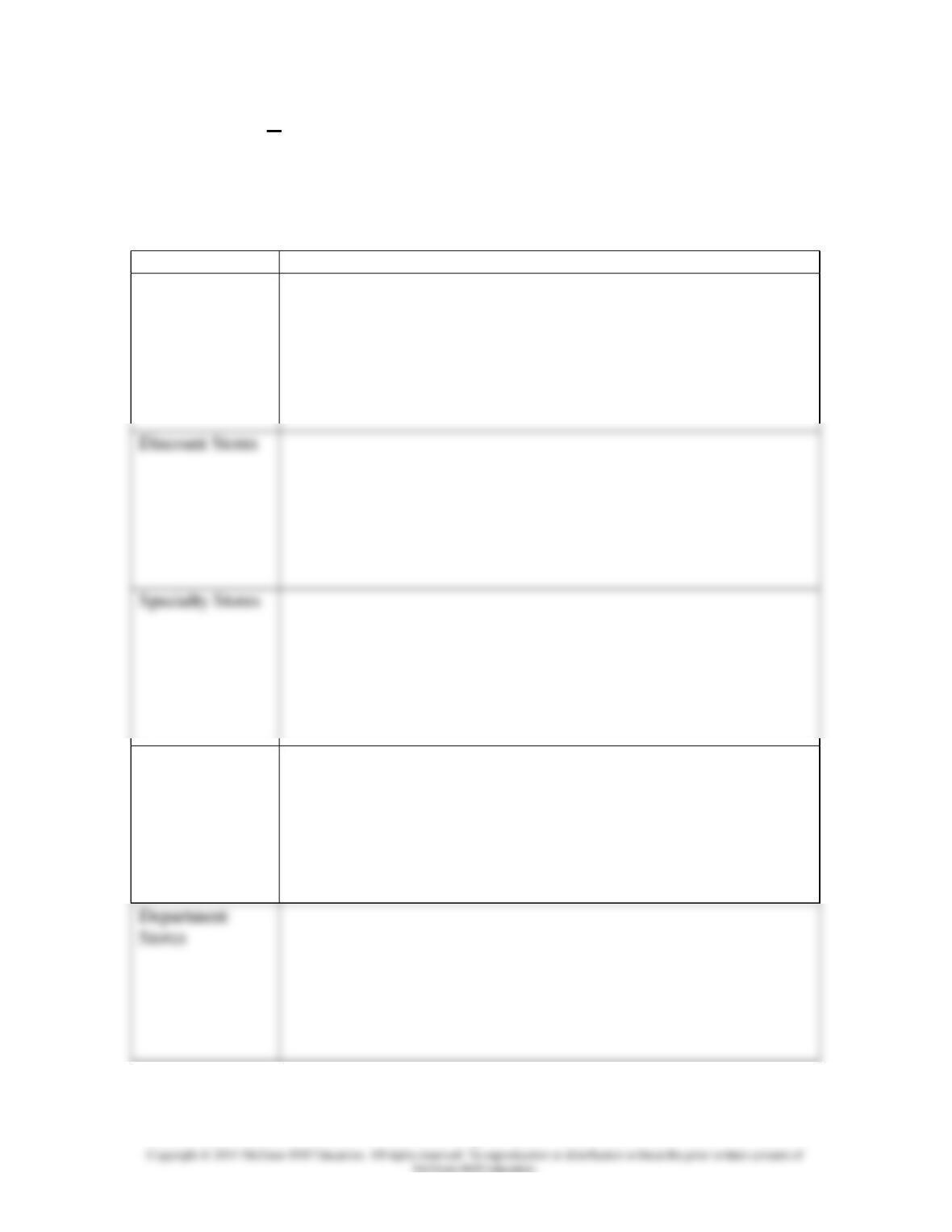
Retail Format Key Issues
Food Retailers
Category
Specialists
CLASSROOM EXERCISES AND ACTIVITIES
Retailing Management 10th Edition
10
Retail Formats with Answers
Chapter 2 discusses several types of retail formats. After reviewing this section of your
text, complete the table below by listing the key issues impacting each retail format. Be
prepared to discuss your responses with the entire class.
Retail Format Key Issues
Food Retailers
– Increasing competition from other types of retailers
– Walmart and other discounters selling more food items
– Drug chains carry much of the same merchandise as food stores
– Walmart dominates the category
Specialty Stores
– Weak, slow growing area in retailing
– Aging population is less interested in fashion spending
– Competition from discount stores
–
Fashion rapidly changes as do customers tastes and preferences
Category
Specialists
– Regional roots, now expanding
– Competition is intense and focused on price, therefore the result
is thin margins and little differentiation
– Stress decreasing costs through efficient operations and
economies of scale
–
Service level may be used for brand differentiation
–
Work closely with vendors to better stock merchandise