
Chapter 02 – Types of Retailers
2-19
The Top 10 Franchises for 2017 include many familiar names. Students will likely report having
visited a 7-Eleven, McDonald’s, or Dunkin’ Donuts. The web site notes that the list of the Top
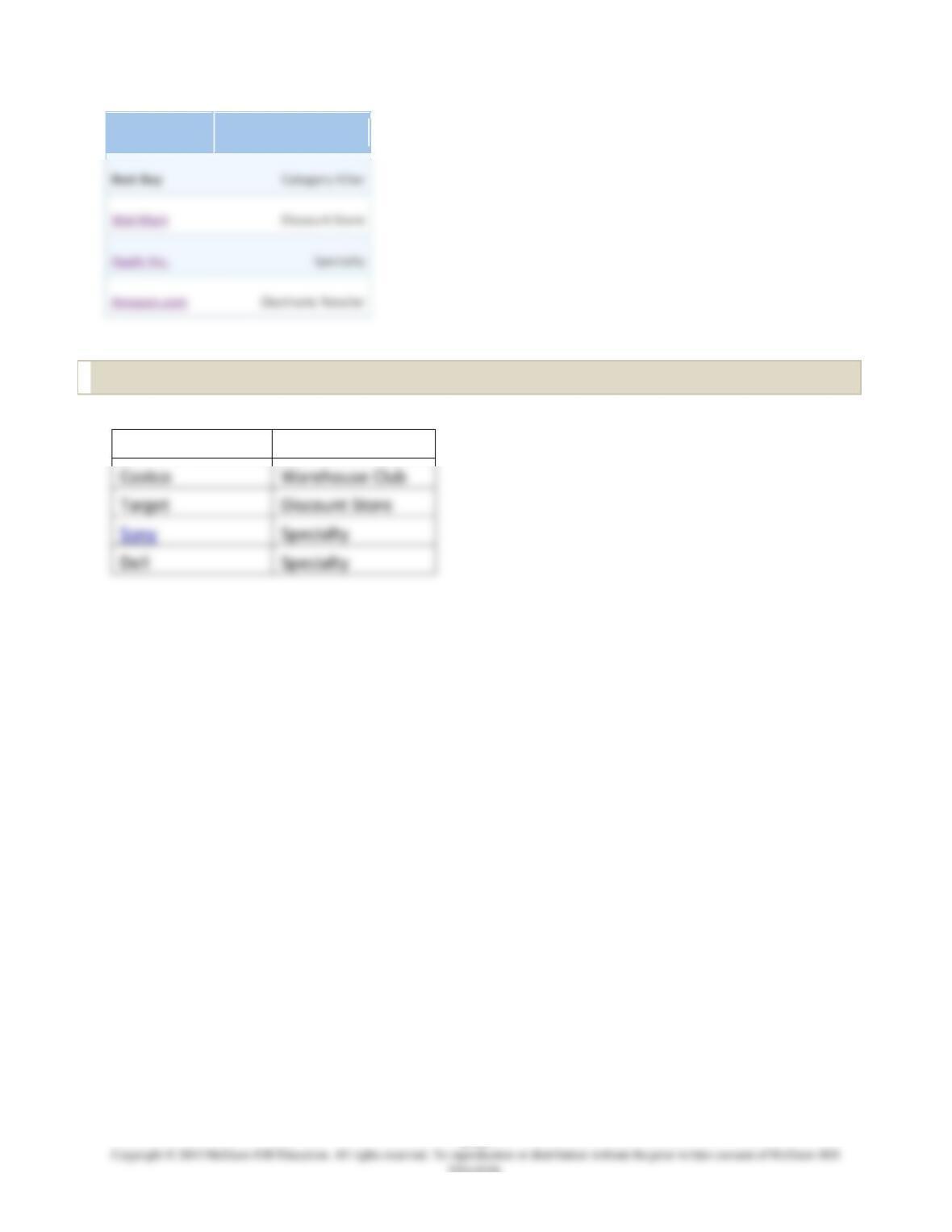
8. Best Buy is a category specialist with more than 1,400 store locations. It sells appliances
(refrigerators, washers and dryers, small household appliances) and electronics (televisions,
computers, cell phones, car electronics, wearable technology). What are the SIC and NAICS
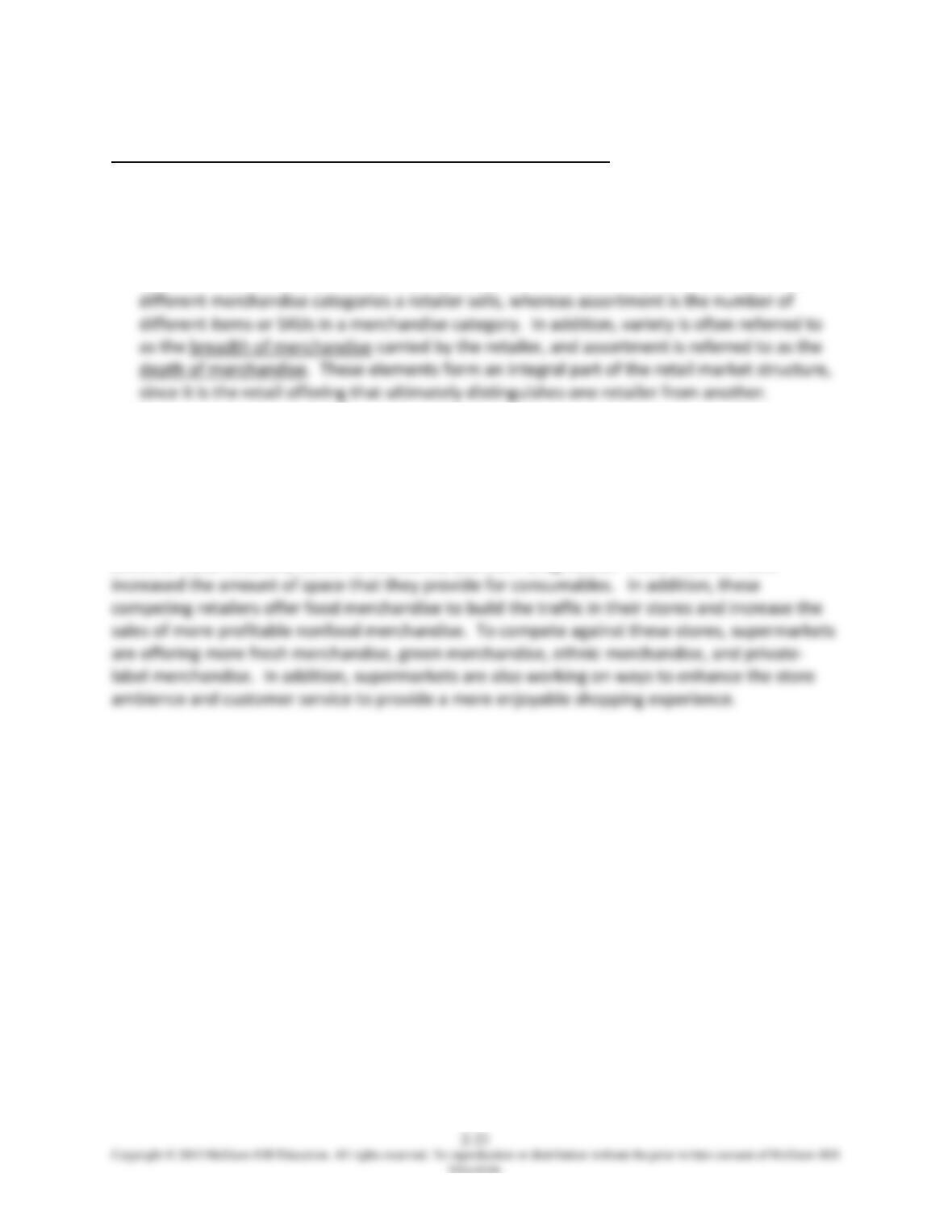
codes used by this retailer? What other retailers compete against Best Buy, and which store
format is implemented by each competitor?
PRIMARY SIC AND NAICS CODES
ASSOCIATED NAICS CODES
443141
Household Appliance Stores
443142
Electronics Stores
ASSOCIATED SIC CODES
5722
Household appliance stores
5731
Radio, TV, & electronic stores
5734
Computer and software stores
5946
Camera & photographic supply stores
Top Best Buy Competitors
Company
Format
Chapter 02 – Types of Retailers
2-20
Company
Format
Other Best Buy Competitors
Company
Format
Costco
Warehouse Club
Target
Discount Store
Specialty
Dell
Specialty
Chapter 02 – Types of Retailers
ANSWERS TO DISCUSSION QUESTIONS AND PROBLEMS
1. Distinguish between variety and assortment. Why are these important elements of retail
market structure?
The main difference between variety and assortment is that variety refers to the number of
2. What sorts of competitive pressures are confronting traditional grocery stores? What
options do these stores have to ease these pressures?
Supermarkets are under competitive pressures from supercenters, warehouse clubs,
extreme-value retailers, convenience stores, and even drug stores. These retailers have
2-22
3. What do off-price retailers need to do to compete against other formats in the future?
The main competitive weapon for the off-price retailers is their low price. While they may
not directly compete with higher service formats, such as department and specialty stores,
4. Compare and contrast the retail mixes of convenience stores, traditional supermarkets,
superstores, and warehouse stores. Can all of these food retail institutions be successful
over the long run? How? Why?

Chapter 02 – Types of Retailers
2-23
Element of
Retail Mix
Convenience Store
Traditional
Supermarket
Superstore
Warehouse Store
Location
Typically
freestanding, easily
accessible sites
Typically in strip
shopping centers
Typically in strip
shopping centers
Typically in strip
shopping centers
Advertising and
Promotion
Personal selling
Limited advertising,
frequent shopper
programs tied to
gasoline sales.
Minimal
High-low pricing
chains advertise
weekly specials.
Minimal
Limited advertising
since most have
everyday pricing.
Minimal
Minimal promotion
since all merchandise is
basically on sale.
Minimal
All four types will persist because they appeal to different customer needs. The warehouse
stores typically have larger pack sizes that are very attractive to customers with large
families and to small business owners like local restaurants. In addition, due to the varying
assortments, customers who are brand loyal might not want to shop in these stores.
Chapter 02 – Types of Retailers
2-24
The superstores are low in price but more inconvenient to shop in because of the large size.
Thus they appeal to customers who are very price conscious and are willing to drive a longer
distance and spend more time shopping in a larger store.
5. Why is Walmart, the largest retailer in the world, facing slower growth than in the past?
What can it do to accelerate its growth?
Full-line discount stores, like Walmart, face challenges from category specialists that
6. Why are retailers in the limited-assortment supermarket and extreme-value discount
store sectors growing so rapidly? From which retailers are they getting these additional
sales?
Both limited-assortment supermarkets and extreme-value discount stores focus on
relatively limited merchandise offerings at highly appealing (low!) prices. The retail formats
7. The same brand and model of tablet is sold by specialty computer stores, discount stores,
category specialists, online retailers, and warehouse stores. Why would a customer
choose one retail format over the others?
Each type of retail store provides a unique combination of price and services tailored to the
Chapter 02 – Types of Retailers
2-25
8. Choose a product category that both you and your parents purchase (e.g., business
clothing, casual clothing, music, electronic equipment, shampoo). In which type of store
do you typically purchase this merchandise? What about your parents? Explain why
there is, or is not, a difference in your store choices.
Students may emphasize specialty stores such as H&M, Old Navy, Forever 21, , and Best
Buy, etc. for their purchases for clothing, or electronic equipment, while mentioning that
their parents favor traditional department stores such as Macy’s or Sears for the purchase
9. At many optical stores you can get your eyes checked and purchase glasses or contact
lenses. How is the shopping experience different for the service as compared to the
product? Design a strategy designed to get customers to purchase both the service and
the product. In so doing, delineate specific actions that should be taken to acquire and
retain optical customers.
Optical stores present an interesting mix of service and related merchandise. On one hand,
the eye examination is usually done by a trained and licensed eye doctor and here the
Chapter 02 – Types of Retailers
2-26
10. There are services and products involved when buying or renting a car, and in both cases,
the customer drives away in a car. But buying a car focuses more on the product,
whereas renting involves the service. Explain four ways in which marketing for a rental
car company differs from marketing for an automobile dealership.
The differences in offerings provided by service retailers include (1) intangibility, (2)
simultaneous production and consumption, (3) perishability, and (4) inconsistency of the
offering to customers. Although the automobile at the rental car company is tangible, the
Chapter 02 – Types of Retailers
2-27
ANCILLARY LECTURE
LECTURE # 2-1: FRANCHISING
————–——–——–——————-–
Instructor’s Note: Franchising is one of the most popular and successful ways for individuals to start
their own business. The growth in franchising as a retail format will probably continue in the near
————–——–——–——————-–
Introduction
Franchising is the licensing of an ENTIRE business format by a parent company
(FRANCHISOR) to a number of outlets (FRANCHISEES) to market a product or service and
The growth of franchising
Franchising has had a steady stream of growth. Some of the reasons include
1. Technological advances,
2. Profitable utilization of capital resources,
Technological advances
Equipment and systems—reduce product variability and more efficient marketing and
distribution systems.
For example: Electronic Data Interchange
Profitable utilization of capital resources
Chapter 02 – Types of Retailers
2-28
Demographic expansion
Urban “sprawl” creates need for more small retail establishments.
Types of franchise systems
There are various types of franchise systems including
1. Territorial,
2. Operating,
3. Mobile,
Territorial franchise
The franchise granted encompasses several counties or states.
Operating franchise
The individual independent franchisee that runs his own franchise.
Mobile franchise
A franchise that dispenses its product from a moving vehicle, which is either owned by the
Distributorship
Chapter 02 – Types of Retailers
Co-ownership
The franchisor and franchisee share the investment and profits.
For Example: Denny’s Restaurant.
Co-management
The franchisor controls the major part of the investment.
Leasing/Licensing
The franchisor leases/licenses the franchisee to use his trademarks and business
techniques.
Manufacturing
The franchisor grants a franchise to manufacture its product through the use of specified
materials and techniques.
Service
The franchisor describes patterns by which a franchisee supplies a professional service, as
exemplified by employment agencies.
Why franchises fail
Individuals who are interested in franchising need to recognize that there is risk despite the
high potential for success.
Franchises can fail for several reasons including
1. Inept management,
Chapter 02 – Types of Retailers
2-30
Inept management
Poor finances, product/service mix rejected, grew too quickly.
Fraudulent activities
The selling of unsound or unproven franchises to ignorant buyers, unfair contracts, etc.
Market saturation
Manufacturer-wholesaler franchise
Coca-Cola, Pepsi, Seven-Up, etc. sell syrup they manufacture to franchised wholesalers who
bottle and distribute to retailers.
Wholesalers-retailer franchise
Rexall Drugs and Sentry Drugs.
Service Sponsor—Retailer franchise
Market information
Information such as sales, local advertising, employee turnover, profits, etc. is usually
provided.
Money
Royalty fees
Chapter 02 – Types of Retailers
2-31
Royalties provide continuous income although often the rate may decrease as sales volume
increase.
Sometimes a flat rate is established regardless of level of sales.
Sales of products
Management fees
Franchisor can charge for consultant fees, management reports, training, etc.
Franchisee benefits
Franchisors provide benefits for the franchisee through initial and continuous services. .
Initial services
There are a number of initial services that franchisors provide for franchisees including
1. Market survey and site selection,
2. Facility design and layout,
Continuous Services
There are also a number of continuous services that franchisors offer to franchisees
including
1. Field supervision,
Chapter 02 – Types of Retailers
2-32
6. Centralized purchasing,
Franchisor advantages/disadvantages
Depending upon which viewpoint one takes (the franchisor or franchisee) there are many
advantages and disadvantages of franchising.
From the perspective of the franchisor, the advantages include
1. Rapid expansion,
The disadvantages include
1. Company-owned units may be more profitable,
Franchisee advantages/disadvantages
From the viewpoint of the franchisee the advantages include
1. Established/proven product/service,
The disadvantages include
1. Loss of control — are really only semi-independent business people,
Franchising trends
Most of the growth of franchising has occurred in the retailing of goods and services.
However, there are two basic types of franchising that merit consideration.
Chapter 02 – Types of Retailers
2-33
The second, business format franchising, sells the right to operate the same business in
different geographic locations.
The emphasis here is on how the business is run.
Examples include KFC, McDonald’s and Burger King.
The major franchising trends are
1. Sustained growth,
Sustained Growth
It is perceived that franchising will continue to grow steadily.
Enduring plus unimagined applications
Today, such things like travel planning, pet-sitting services, and house calls by doctors may
be owned by franchises.
International expansion
Franchisors are currently exploring foreign markets.
Increasing tensions
Despite the overwhelming of franchisors on the whole, there is still a major source of
contention.
Chapter 02 – Types of Retailers
2-34
First, perceived inequity among this group regarding mandated or proposed changes may
be a major source of conflict.
Also unsatisfactory financial performance may be another cause of discord.
Greater emphasis on financial returns
The main sources of financial returns include: dual operations in which a franchisee may be
permitted to run two or more franchises from a common or adjacent area; reduced costs
Chapter 02 – Types of Retailers
2-35
CONNECT ACTIVITIES FOR CHAPTER 2
Activity Title
Activity Type(s)
Topic
Learning Objective(s)
Types of Retailers
Drag and Drop;
Matching (accessible
version)
Categories of food
and general
merchandise retailers
2-1 List the different
characteristics that
define retailers.
2-3 Identify the
various types of
general merchandise