Chapter 13 – Retail Pricing
13–15
ANSWERS TO SELECTED “GET OUT AND DO ITS”
key items and compare the price of each product at other online retail sites such as
outlet compare to those at a discount store, online retailer, and department stores? Are the
results what you expected or were you surprised? Explain your reaction.
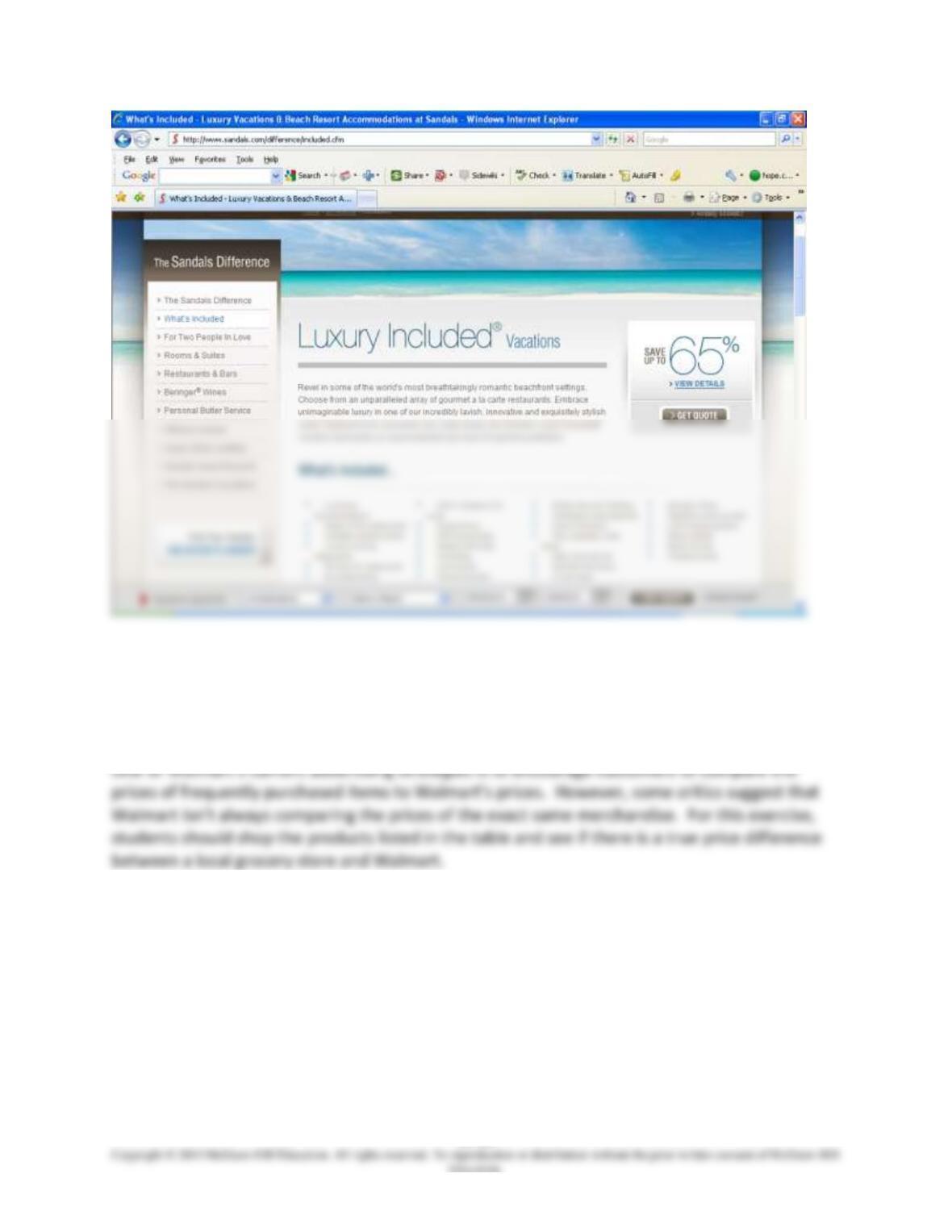
inclusive price. Describe how bundling services and products provides vacationers with value.
Find an example of price bundling outside the travel industry. Which method, bundling or
nonbundling, do you believe provides the customer with the best value? Which makes the
retailer or service provider more profits?
The Sandals website highlights what is included in the all-inclusive packaging. Bundling
Chapter 13 – Retail Pricing
13–16
4. Go to your favorite food store and your local Walmart to find their prices for the market
basket of goods listed in the accompanying table [see text]. What was the total cost of the
market basket at each store? How did the prices compare? Did Walmart live up to its slogan
of “Always lower prices”?
Chapter 13 – Retail Pricing
ANSWERS TO DISCUSSION QUESTIONS AND PROBLEMS
1. What types of retailers often use a high/low pricing strategy? What types of retailers
generally use an everyday low-pricing strategy? How would customers likely react if a
retailer switched its pricing strategy from one to the other? Explain your response.
High/Low Pricing – Retailers using a high/low pricing strategy frequently—often weekly—
discount the initial prices for merchandise through sales promotions. Examples: Department
2. Why would sewing pattern manufacturers such as Simplicity
(or more) on each pattern and then two times a year offer patterns for sale at $1.99 each?
How could this markdown influence demand, sales, and profits?
Sewing patters are marked down twice a year to move inventory and make space for new
Chapter 13 – Retail Pricing
13–18
3. What is the difference between bundled pricing and multiple-unit pricing?
Price bundling is the practice of offering two or more different products or services for sale
4. 4. A department store’s maintained markup is 38 percent, reductions are $560, and net
sales are $28,000. What’s the initial markup percentage?
MMU$ = 10,640.00
5. Maintained markup is 39 percent, net sales are $52,000, and reductions are $2,500. What
are the gross margin in dollars and the initial markup as a percentage? Explain why initial
markup is greater than maintained markup.
Gross margin (GM) = Maintained markup – Reductions
6. The cost of a product is $150, markup is 50 percent, and markdown is 30 percent. What’s
the final selling price?
Retail Price = Cost + Markup
Chapter 13 – Retail Pricing
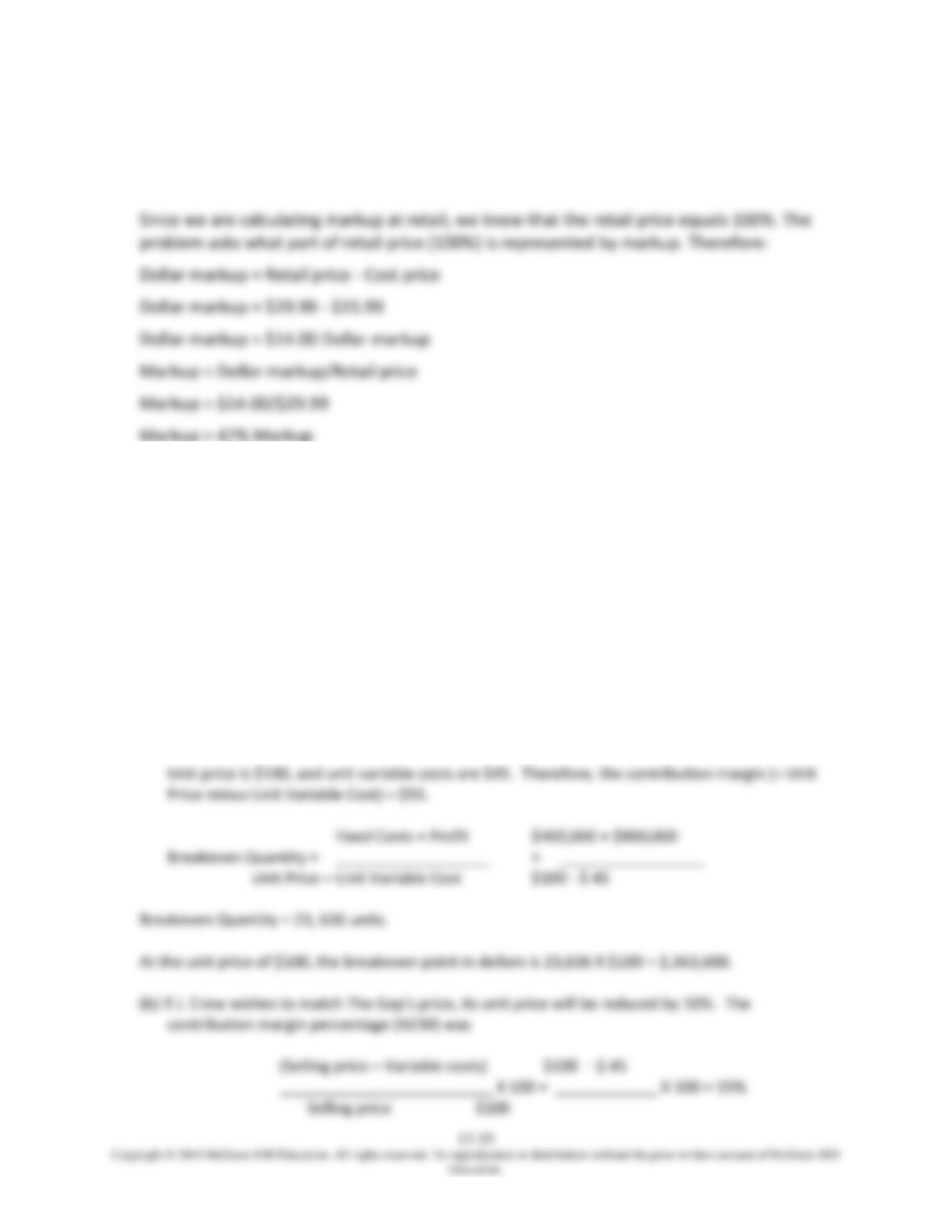
7. Men’s Wearhouse purchased black leather belts for $15.99 each and priced them to sell
for $29.99 each. What was the markup on the belts?
The basic formula applies: Markup = Retail – Cost
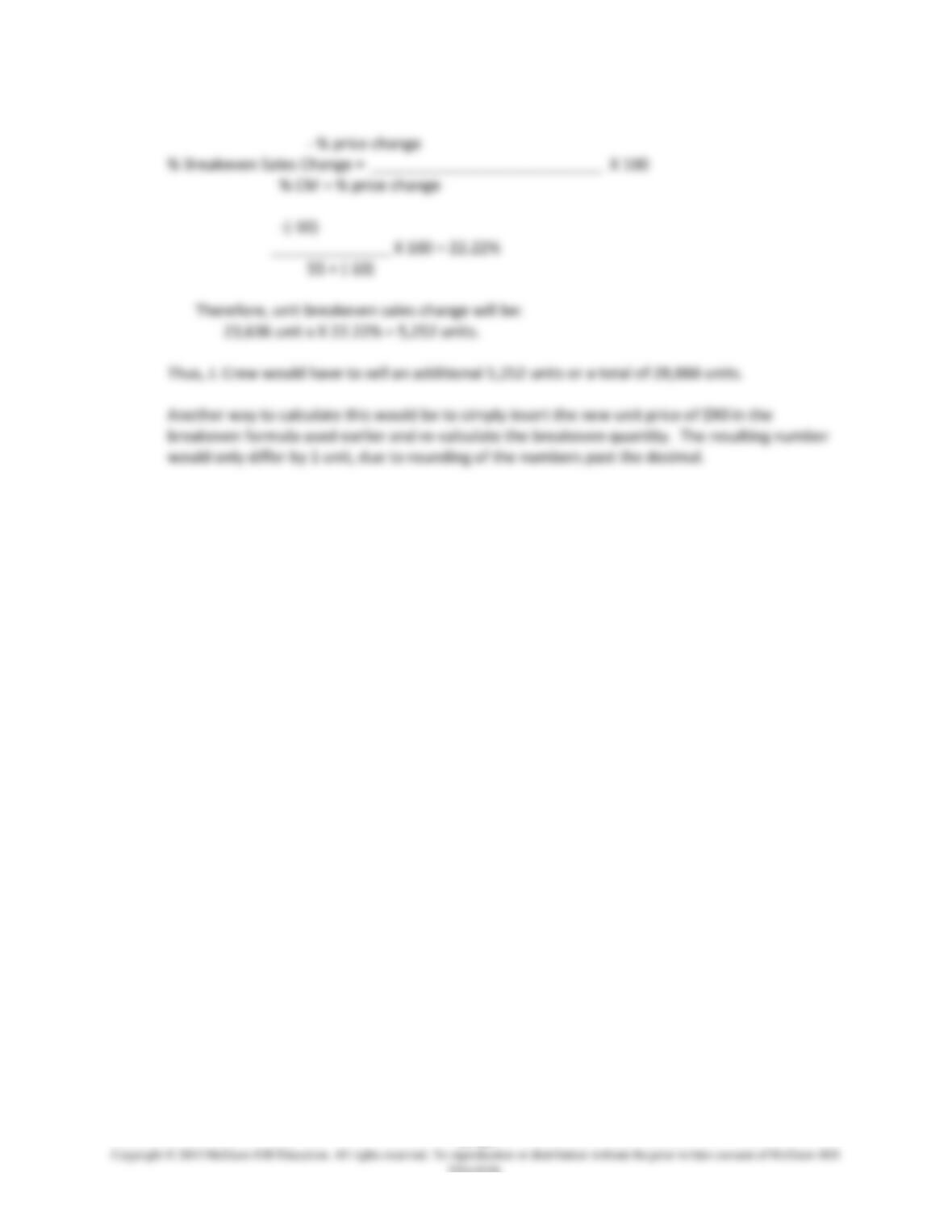
8. Answer the following questions: (a) J.Crew is planning a new line of jackets for fall. It
plans to sell the jackets for $100. It is having the jackets produced in the Dominican
Republic. Although J. Crew does not own the factory, its product development and design
costs are $400,000. The total cost of the jacket, including transportation to the stores, is
$45. For this line to be successful, The Limited needs to make $900,000 profit. What is its
break-even point in units and dollars? (b) The buyer has just found out that The Gap, one
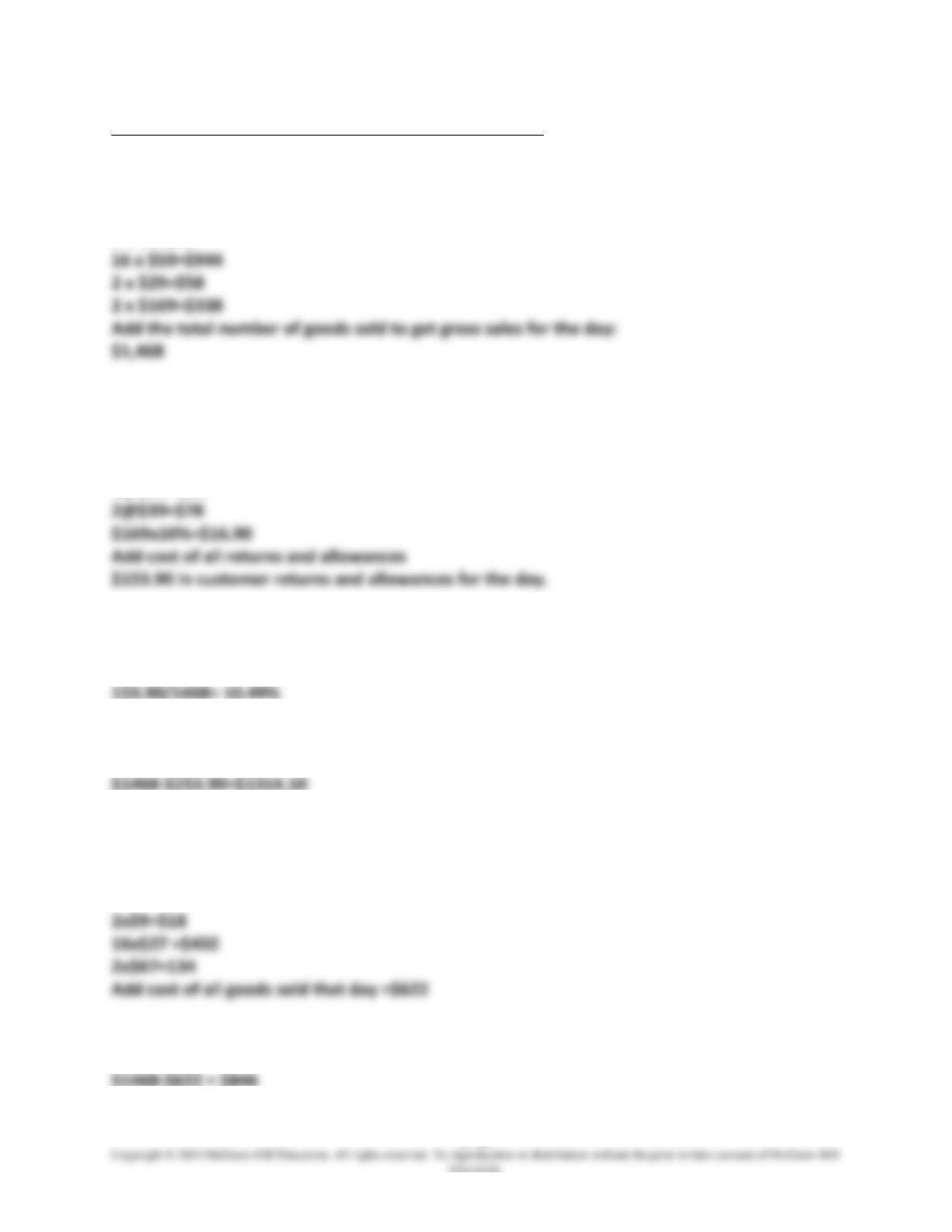
of J. Crew’s major competitors, is bringing out a similar jacket that will retail for $90. If J.
Crew wishes to match The Gap‘s price, how many units will it have to sell?
(a) In the example of J. Crew,
Product development and design costs could be taken as fixed costs.
Chapter 13 – Retail Pricing
13–20
Chapter 13 – Retail Pricing
13–21
ADDITIONAL RETAIL MATH/PRICING PROBLEMS
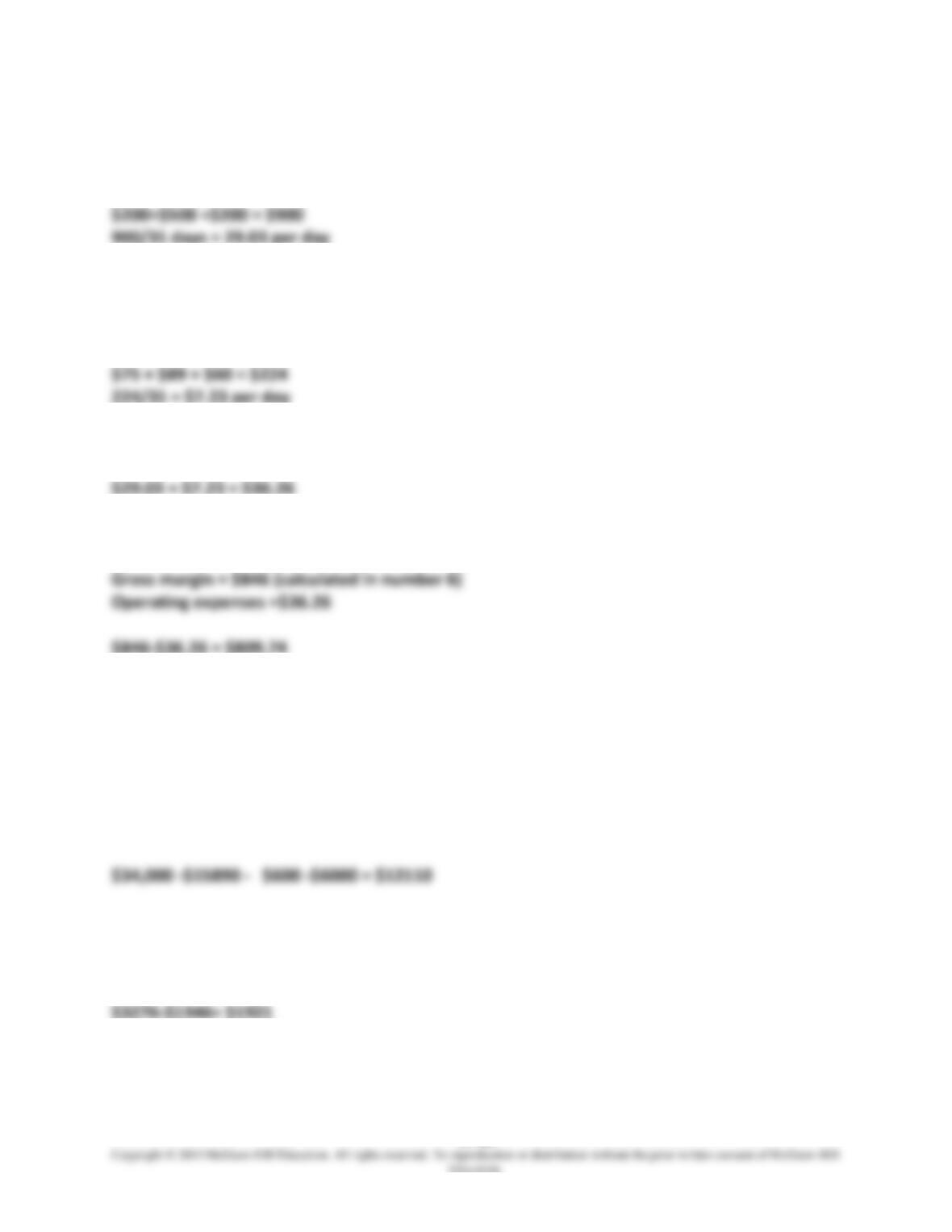
1. A store sold the following items for the day: 2 sweaters at $39, 16 pairs of jeans at $59, 2
purses at $29 and 2 suits at $169. What are the gross sales for the day?
2 x 39=$78
2. Using the problem above, besides the gross sales, the store had customer returns and
allowances: 1 jean returned at $59, 2 skirts at $39. They also had to give a discount of 10% on a
$169 suit because it was soiled. What were the customer returns and allowances for the day?
1@$59 =$59
3. The store wants to calculate the customer returns and allowances as a percentage of sales.
What is this percent?
4. Using the store above, what were the gross sales for the day?
5. The buyer wants to know her cost of inventory sold. She purchased the jeans at $19,
sweaters at $9, jeans at $27 and suits at $67. What was her cost of inventory sold on this day?
2x$19= 38
6. What is the gross margin, using the number calculated above?
Chapter 13 – Retail Pricing
13–22
7. The direct expenses for the month included the following: $200 for advertising, $500 for
salaries, and $200 in rent expenses for the month. What were the direct expenses for the
month? What were the direct expenses for the day, assuming a 31-day month?
8. Indirect expenses during the month included: $75 for water, $89 for electricity, $60 for
insurance. What were the indirect expenses for the month? For the day, assuming a 31-day
month?
9. What would be the total operating costs in this problem for the day?
10. What is the profit for this store on this particular day?
11. A buyer wants to calculate her profit for the month. She knows the following information:
The store sold $34,600 worth of merchandise
Cost of merchandise sold (cost of inventory) was $15,890
The store had $600 in customer returns and allowances
Her operating expenses were $6,000
Calculate her profit (or loss) for the month
12. What is the gross margin if the store had net sales of $3,267 and cost of inventory sold of
$1346?
13. A store had indirect expenses for the month of $500 for advertising, $30 for security
monitoring, and $75 for insurance. What would the direct expenses be for a day (when there
are 30 days in the month?)
Chapter 13 – Retail Pricing
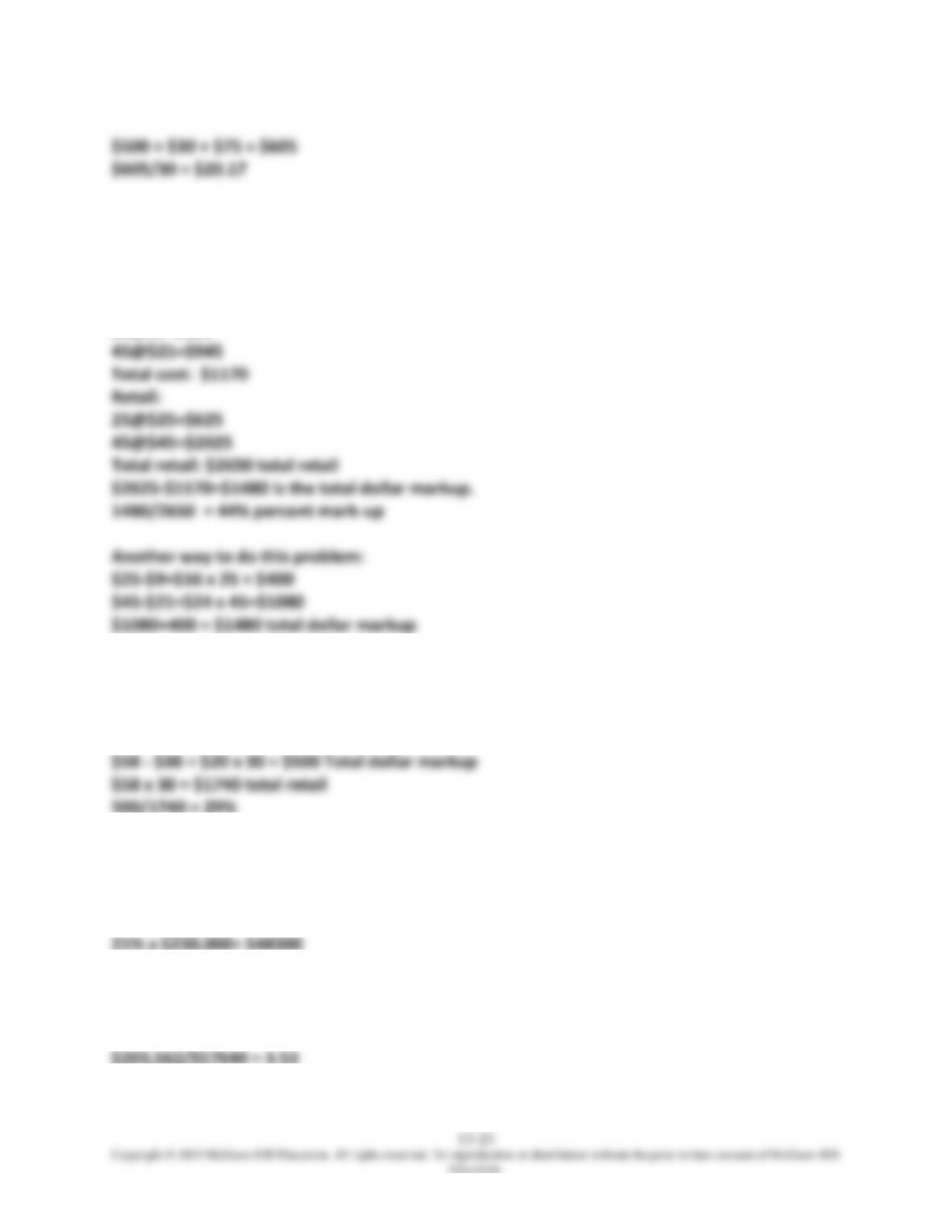
14. A buyer wants to know her mark-up on a purchase. She purchased 25 sweaters at $9 and
will sell them for $25. She also purchased 45 pairs of jeans at $21 and will sell them for $45.
What is her total dollar markup in dollar and percent for this purchase?
Cost:
25@$9=$225
15. A buyer realized several sweaters were not selling well. As a result, she marked them down
from $58 to $38. There were 30 sweaters she marked down. What is the total dollar
markdown? What is the total dollar markdown in percent?
16. A store had average markdowns last year of 21%. The projected sales are $230,000.
Assuming she is calculating based on a seven-month season, what is her planned markdowns?
17. A store had sales of $203,562 for the year. Their average stock was $57,640. What was
their turnover for the year?
Chapter 13 – Retail Pricing
13–24
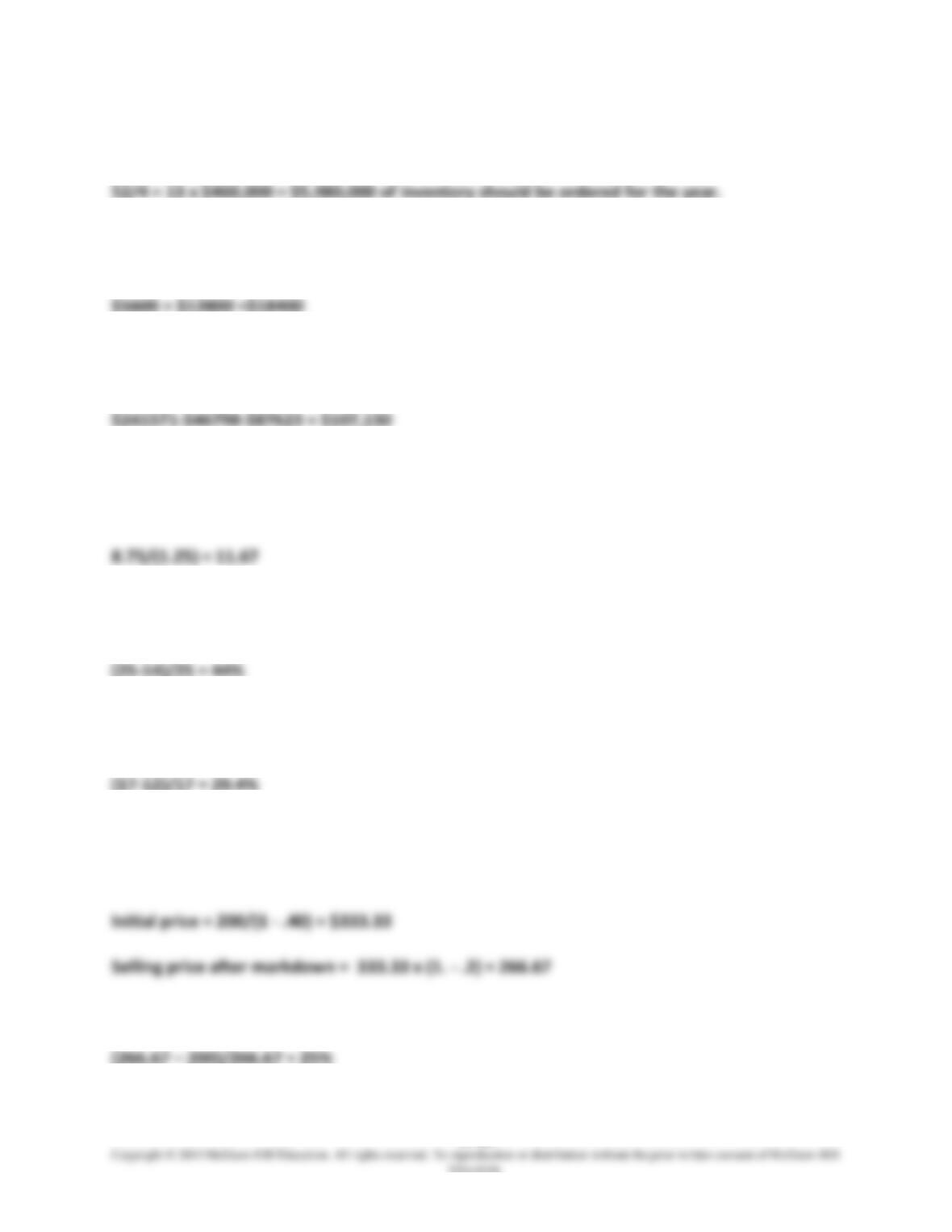
18. A buyer decides to use the weeks of supply method to develop her buying plan. Her
planned sales are $460,000 and her desired turnover is 4. What should her weeks of supply be
for the coming year?
19. A buyer has determined he desired level of stock per month is $12,800. she plans to have
sales of $5,600 for that month. What would her basic stock requirements be for the month?
20. A buyer has planned purchases (or desired inventory) of $241,571. She has already ordered
$46,798. She has received $87,623 worth of merchandise. What is her current open to buy?
21. The cost of a new CD album is $8.75. The buyer plans to make an initial markup up of 25%
on the retail price. What should the retail price be?
22. The initial selling price for a blouse is $25. The cost was $14. What was the initial markup
on retail?
23. A belt was originally priced a $17 and put on sale for $12. What was the markdown
percentage on retail?
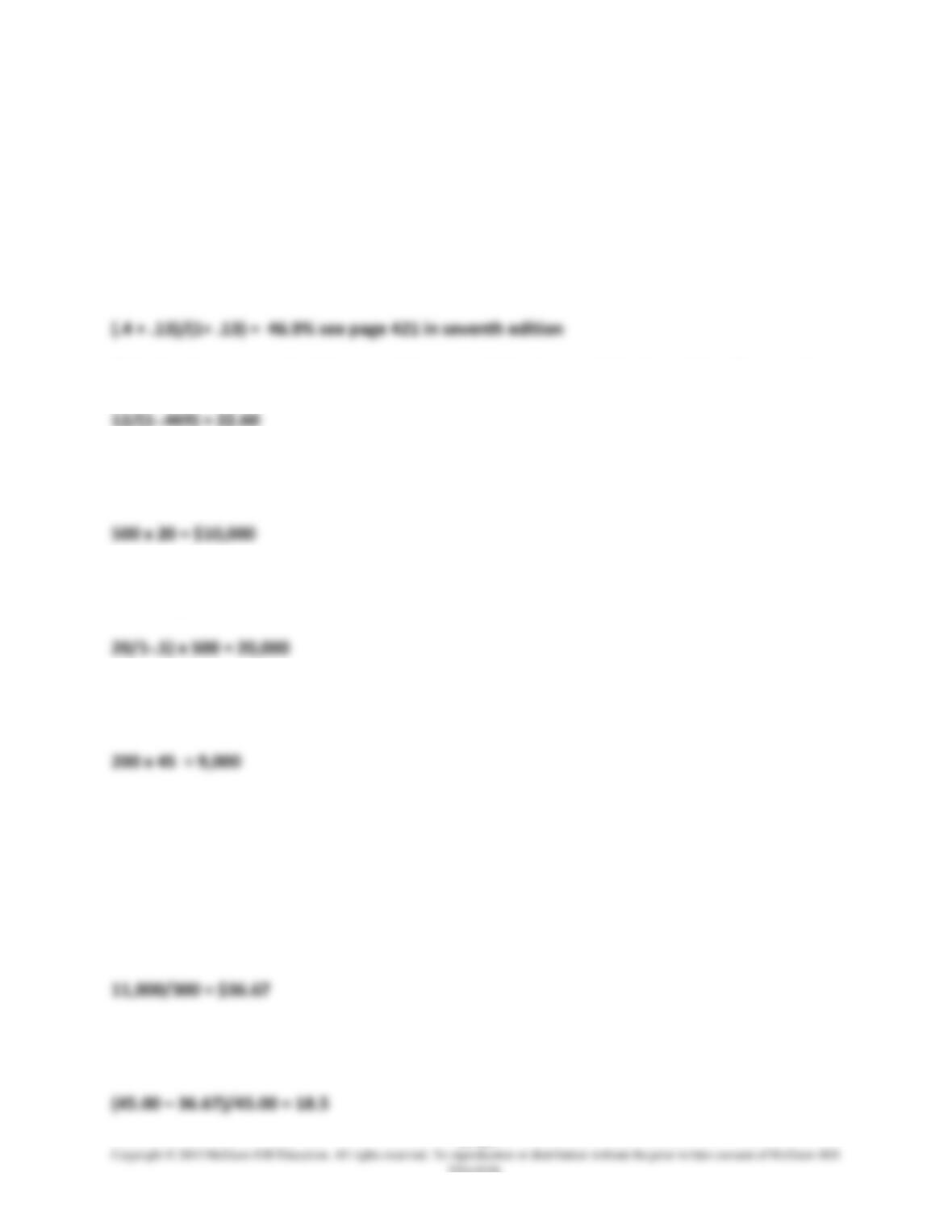
24. The cost of bicycle is $200. The initial markup on retail is 40%. After offering the bicycle at
the initial selling price, the bicycle was markdown by 20% and it sold at that price?
(a) What was the eventual selling price for the bicycle?
(b) (1) What was the maintained markup?
Chapter 13 – Retail Pricing
13–25
25. A woman’s dress suit was originally priced at $250. The first markdown was 20% on retail
and the second markdown was an addition 30%. What is the selling price of the suit after the
second markdown?
250 x .8 x .7 = $140
26. (a) A buyer for men’s ties wants to have a maintained markup of 40%. The buyer forecasts
that the reduction as a percent of sales will be 13%. What should the initial markup be?
(b) In the above example, if the cost of the ties is $12, what would be the initial selling price?
27. A buyer orders 500 cotton sweaters at a cost of $20 per sweater.
(a) What is the cost for all of sweater when they are sold?
(b) If the buyer wants to have a maintain markup of 50%, what is the total sales dollars that
must be generated by the sale of all 500 sweaters?
(c) The buyer sets the initial selling price for the sweaters at $45. 200 sweaters are sold at that
price. How many sales dollars were generated by the sales of the initial 200 sweaters?
(d) How many sales dollars must be generated by the remaining 300 sales to achieve a
maintained markup of 50%?
20,000 – 9, 000 = 11,000
(e) Sales of the sweaters are slowing and thus the buyer is going to mark them down. What
does he need to sell each of the remaining 300 sweaters at realize a 50% maintained markup?
(f) How much of a markdown on retail can the buyer take to realize a 50% maintained markup
on the sales of all 500 sweaters?
Chapter 13 – Retail Pricing
13–26
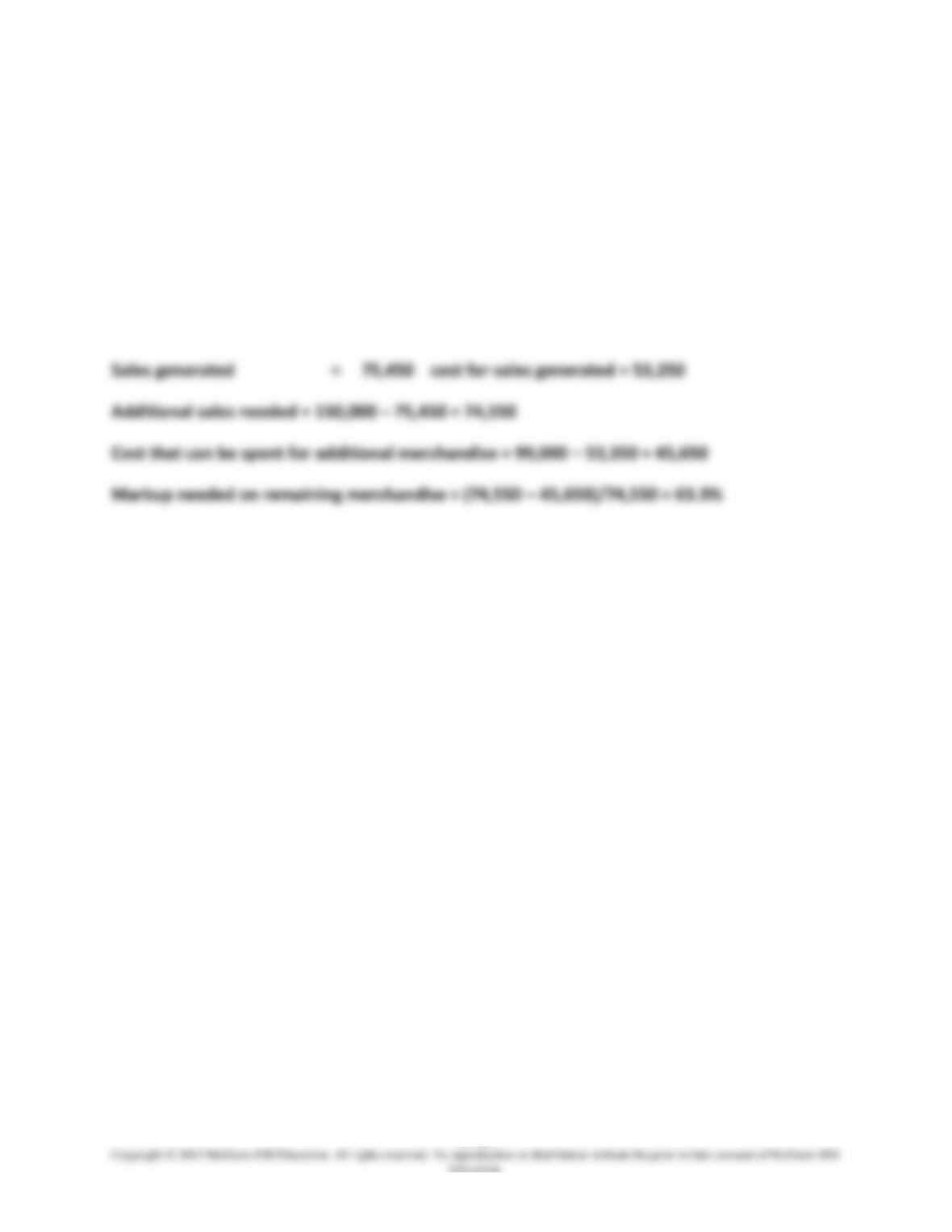
28. A buyer for women’s hosiery is planning to buy for merchandise to be sold during the
summer season that will generate retail sales of $150,000. The buyer wants to have a
maintained markup of 34% on retail for summer hosiery sales. Reductions will be very small
and can be ignored. The buyer has already spent $53,250 for merchandise that will generate
$75,450 at retail. What markup does the buyer need to have on the remainder of the
planned purchases to realize the overall markup of 34%?
Sales needed at end of season = $150,000 COGS at season end = (1-.34) x 150,000 =
99,000
Chapter 13 – Retail Pricing
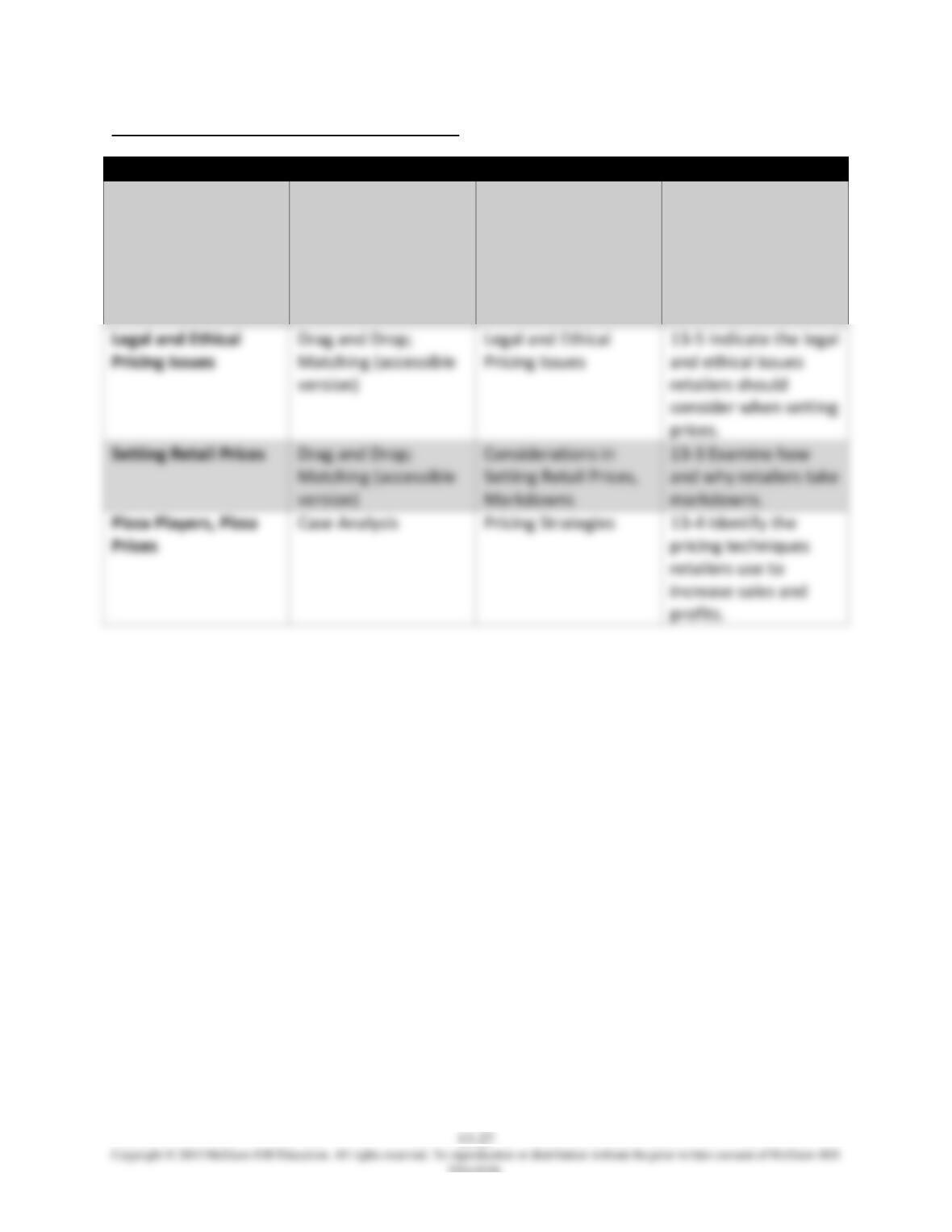
CONNECT ACTIVITIES FOR CHAPTER 13
Activity Title
Activity Type(s)
Topic(s)
Learning Objective
Performance-Setting
Retail Prices
Case Analysis
Considerations in
Setting Retail Prices,
Pricing Techniques for
Increasing Sales and
Profits
13-2 Identify the
factors retailers
consider when pricing
their merchandise.