Cawsey, Deszca, and Ingols: Organizational Change, 4e
End–of-Chapter Exercise
TOOLKIT EXERCISE 11.1
Critical Thinking Questions
Consider the questions that follow.
Please see the Zane case at the end of the book. Consider the following questions:
• Who are the stakeholders that you identified in each sub-story? What do they have at
stake?
• This is a long list of stakeholders who have various needs and interests. What’s
significant about this list of stakeholders and their interests? What can we learn from
this exercise?
• Is Zane’s power base different when she is negotiating with Blue Cross Blue Shield than
when she is negotiating with nurses at TMC?
Cawsey, Deszca, and Ingols: Organizational Change, 4e
• How did she effectively approach the hardest job?
• What inspired them to take on the change?
• Imagine in 10 years you become a CNN Hero. What story will they tell about you?
• How were founders Craig and Marc able to create such sweeping change at such a young
age?
• What challenges do you think they may have faced and how did they overcome them?
• How are the youth involved in ‘We Day’ working to create change?
TOOLKIT EXERCISE 11.2
Developing Your Change Plan
This Toolkit Exercise applies the tools from all chapters and asks you to develop a complete change plan
for a change you want to make happen.
As a first step, develop your statement of the need for change and your vision for the change.
Once the need for change and vision have been articulated, your assignment is to begin the development
of an action plan for the change. This will be broken into four parts:
a. The development of a sequence of action steps and the arrangement of them into a critical
path with a clearly defined end goal, intermediate targets, and specific first step.
b. The consideration of contingencies—what might go wrong? How will these things be
handled?
Cawsey, Deszca, and Ingols: Organizational Change, 4e
The Action Plan
Begin the development of an action plan. What are the critical steps that must be accomplished? Arrange
your action steps in sequence. Can some be done simultaneously? What activities cannot begin or
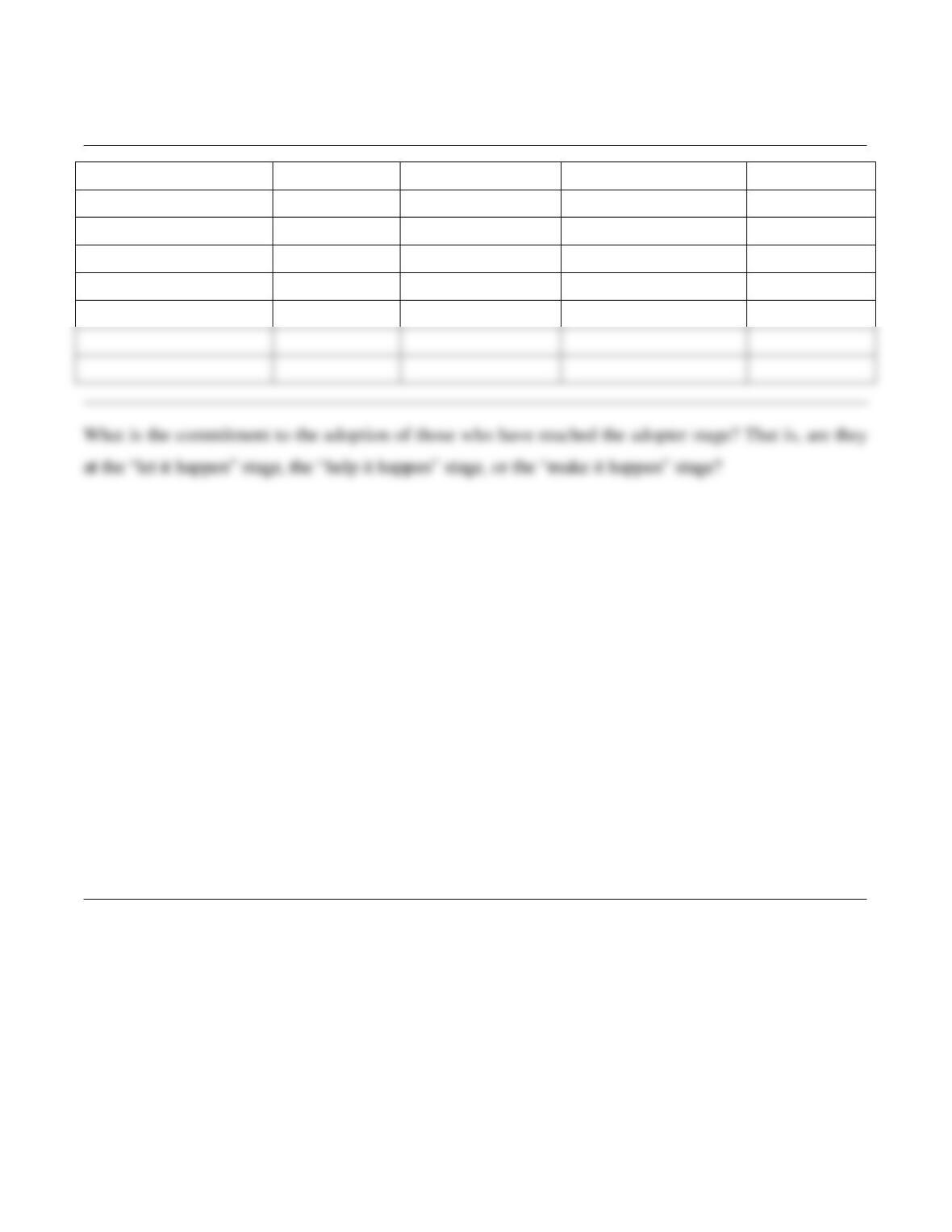
Who needs to become committed to the project?
What will it take to move them along the continuum in the direction of adoption?
Cawsey, Deszca, and Ingols: Organizational Change, 4e
The AIDA Continuum
Key Player Name
Aware?
Interested?
Desires Action?
Adopter?
How can the commitment levels of key stakeholders be increased?
Cawsey, Deszca, and Ingols: Organizational Change, 4e
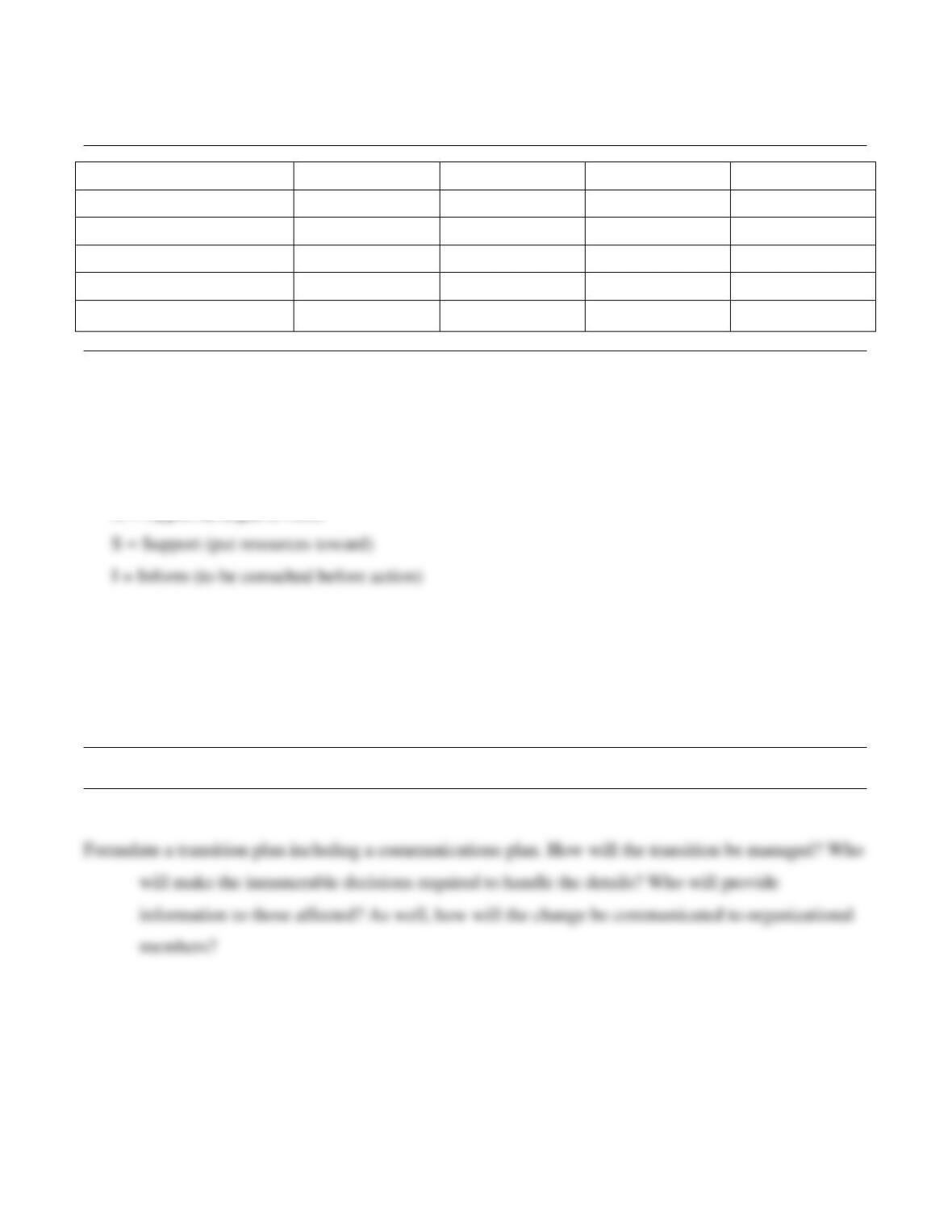
Responsibility Charting
i
Actions or Decisions
Person #1
Person #2
Person #3
Person #?
Action #1
Action #2
Decision #1
Action #3
.
.
.
.
.
Who will do what, where, when, and how? Often a responsibility chart can be useful to track these
things.
Coding:
R = Responsibility (not necessarily authority)
Note that if there are a great number of As on your chart, implementation will be difficult. Care must be
taken to assign As only when appropriate. Likewise, if there are not enough Rs and Ss, you will need to
think about changes needed here and how to bring them about.

Cawsey, Deszca, and Ingols: Organizational Change, 4e
The Measurement of Change
How will you know that your goal or change project is successfully implemented? (At times, success
will be obvious—e.g., a new system in place. At other times, success will be more difficult to measure—
e.g., attitudes toward the adoption and acceptance of a new system.)
What intermediate signals will indicate that you are making progress? What is the first step or sequence
of steps?
Your end goal is:
You can measure it by:

Contingency Planning
Remember O’Brien’s Law
1
? Well, it holds, and things will not go as planned. But you can plan for the
unexpected.
What are the critical decision points? Who makes those decisions?
What plans can you make to account for these contingencies? If you can, draw a decision tree of the
action plan and lay out the decision–event sequence.