
Cawsey, Deszca, and Ingols: Organizational Change, 4e
End–of-Chapter Exercises
TOOLKIT EXERCISE 10.1
Critical Thinking Questions
Self Managed Work Teams at South Australian Ambulance Service is a case available on the
book’s website that will help you think about the use of measurement to advance change
initiatives. Ray Main is part way through a transformational change in this agency and is
thinking about what he needs to do to bring the changes to a successful conclusion.
• What do you think Ray should do and what role should measurement play in his
plans?
• Develop an action plan for Ray.
TED talk by David McCandless, on the value of visualizing data in order to draw new meaning
and insights from complex data in order to better design, innovate, make better decisions, etc.
Can be a useful video prior to discussing the development of information and metrics to help
frame change, change views, and guide change initiatives.
• Give an example of how the reframing of data might bolster the change process in
each of the four stages.

Cawsey, Deszca, and Ingols: Organizational Change, 4e
• How might the data presented in the video prompt change? Explain.
• How do the skills Colantuono talks about matter to measuring and implementing change?
TOOLKIT EXERCISE 10.2
Reflecting on the Impact of Measures and Control Processes on Change
Think of a change initiative that you are familiar with.
1. What measures and control processes were employed in tracking and guiding the change initiative?
Were they consistent with the vision and strategy of the change? Were they viewed as legitimate by
those who would be using them?
3. Did the change managers consider how the measures might need to evolve over the life of the
change initiative? How was this evolution managed? By whom?
5. Were goals and milestones established to plot progress along the way and used to make midcourse
corrections if needed? Were the smaller victories celebrated to reinforce the efforts of others when
milestones were achieved?
7. How was the end-state measurement information captured and fed back to those who would need
to use it? Was it a user-friendly process?
TOOLKIT EXERCISE 10.3
Application of Simon’s Control Systems Model
Consider a change you are familiar with.
1. Describe the control processes and measures that were used with the change (i.e., the belief,
interactive, boundary, and diagnostic controls). When and how were they used and what was their
impact?
a. During the earlier stages of the change initiative
2. Were there forbidden topics in the organization, such as questions related to strategy or core
values? Were those limits appropriate and did anyone test those limits by raising controversial
questions or concerns? Were small successes celebrated along the way?
assisted in advancing the interests of the change?
TOOLKIT EXERCISE 10.4
Aligning the Change With Systems and Building the Balanced Scorecard for the Change
Think about a change you are familiar with.
1. State the mission, vision, and strategy for the change.
2. Consider the mission, vision, and strategy of the organization:
● Is the proposed change consistent with these?
3. Financial component of scorecard: If you succeed with the change vision, how will it appear to the
shareholders or those responsible for funding the change?
4. Customer component of scorecard: If you succeed with the change, how will it appear to your
customers?
How will you know (objectives and metrics)? Are there leading and lagging indicators here?
5. Internal business processes component of scorecard: If you succeed with the change, how will it
appear in your business processes?
How will you know (objectives and metrics)? Are there leading and lagging indicators here?
What about the information and organizational capital? How will you and they know (objectives
and metrics)? Are there leading and lagging indicators here?
7. Lay out the scorecard you’ve designed for your change and seek feedback.
Cawsey, Deszca, and Ingols: Organizational Change, 4e
TOOLKIT EXERCISE 10.5
Using the Risk Exposure Calculator
Consider a change initiative that you know is currently being considered for adoption and apply the risk
exposure calculator to it.
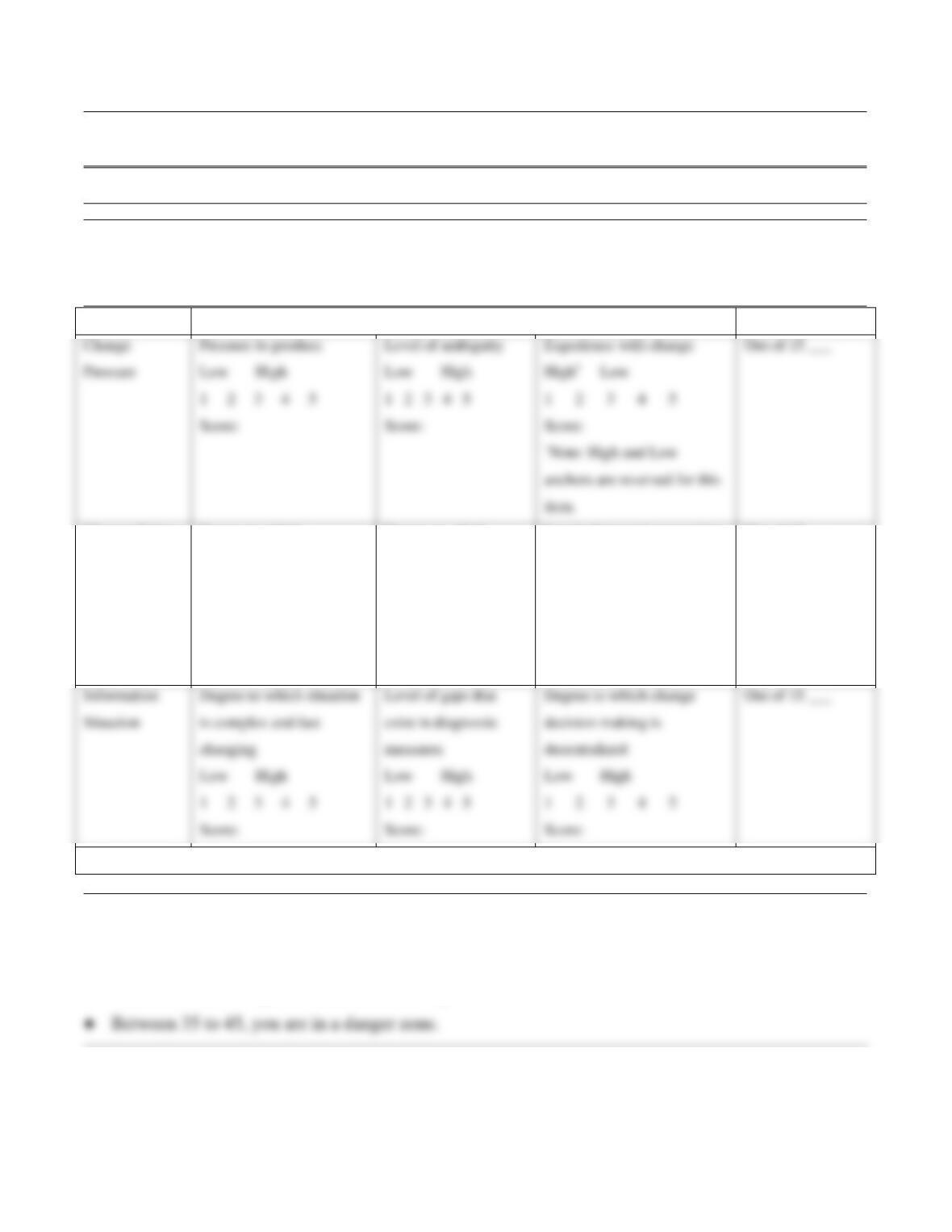
Score
item.
Change Culture
Degree to which
individuals are rewarded
for risk taking
Low High
1 2 3 4 5
Score:
Degree to which
executives resist
hearing bad news
Low High
1 2 3 4 5
Score:
Level of internal competition
Low High
1 2 3 4 5
Score:
Out of 15 ___
Score:
Score:
Score:
Total Score =
Using scoring criteria consistent with that developed by Simon:
● If your score is between 9 and 20, you are in the safety zone.
● Between 21 and 34, you are in the cautionary zone.

1. Does the organization have an appropriate level of risk taking given the nature of the business it is
in? Does it play it too safe, about right, or does it take excessive risks?
2. Does the approach help you in thinking about risk and what factors may be contributing to the
overall risk levels?
Cawsey, Deszca, and Ingols: Organizational Change, 4e
TOOLKIT EXERCISE 10.6
Applying the DICE Model
Consider a change initiative that you know is currently being considered for adoption and apply the
DICE model to it.
● Duration: How frequently is the project formally reviewed?
a) Time between project reviews is less than 2 months—1 point
b) Time between project reviews is 2–4 months—2 points
● Duration Score = ____
● Integrity: How capable is the project team leader? How capable and motivated are team members?
Do they have the sufficient time to devote to the change?
a. Leader is respected, team is capable and motivated, and members have sufficient time to commit
to the project—1 point
● Integrity of Performance Score: (Your Initial Score × 2) = ____
● Commitment of Senior Management: How committed is senior management to the project? Do they
regularly communicate the reasons for the initiative and its importance? Do they convincingly
communicate the message and their commitment? Is the commitment to the project shared by senior
management? Have they committed sufficient resources to the project?
a. If senior management clearly and consistently communicated the need for change and their
support—1 point
Cawsey, Deszca, and Ingols: Organizational Change, 4e
● Senior Management Commitment Score: (Your Initial Score × 2) = ____
● Local Level Commitment: Do those employees most affected by the change understand the need and
believe the change is needed? Are they enthusiastic and eager to get involved or concerned and
resistant?
a. If employees are eager to be engaged in the change initiative—1 point
● Local level Commitment Score = ____
● Effort: What incremental effort is required of employees to implement the change? Will it be added
on to an already heavy workload? Have employees expressed strong resistance to additional
demands on them in the past?
a. If incremental effort is less than 10%—1 point
b. If incremental effort is 10% to 20%—2 points
● Effort Score = ____
To calculate your overall DICE score: Add the scores from the above:___
1. What score did the change project receive? Was it in the low-risk category (7 to 14), the worry
zone (between 14 and 17), or the high-risk area (over 17)?
2. Do the findings help you to think about important sources of risk to the success of the project?