Chapter 10 – Customer Relationship Management
Student responses will vary depending on the website visited. Most should consider:
– Cookies
3. INTERNET EXERCISE Go to the website for the Electronic Privacy Information Center
organization feel are the most important retailers’ consumer privacy issues? How will these
issues evolve in the future?
Top Ten Consumer Privacy Resolutions – Protect Your Privacy in The New Year!
1. Engage in “privacy self-defense.” Don’t share any personal information with businesses unless
it is absolutely necessary (for delivery of an item, etc.). Don’t give your phone number, address,
or name to retail stores. If you do, they can sell that information or use it for telemarketing and
4. Use a temporary rather than a permanent change of address. If you move in 2005, be sure to
forward your mail by using a temporary change of address order rather than a permanent one.
The junk mailers have access to the permanent change of address database; they use it to
Chapter 10 – Customer Relationship Management
10–15
7. Opt out of financial, insurance, and brokerage information sharing. Be sure to call all of your
banks, insurance companies, and brokerage companies and ask to opt out of having your
financial information shared. This will cut down on the telemarketing and junk mail that you
receive.
before you lose out on a loan or home purchase. Currently, these reports are available to
residents of most western states. By September 2005, all Americans will have free access to
their credit report.
9. Enroll all of your phone numbers in the Federal Trade Commission’s Do-Not-Call Registry. The
shield against unwanted telemarketing. Be sure to enroll the numbers for your wireless phones,
too.
10. File a complaint. If you believe a company has violated your privacy, contact the Federal
Chapter 10 – Customer Relationship Management
4. INTERNET EXERCISE Go to the 1-800-Flowers Fresh Rewards Landing page at
this company’s CRM program help it to track its best customers, grow its business and
increase customer loyalty?
Fresh Rewards is a three-tier CRM program that rewards loyal customers with savings, a
ANSWERS TO DISCUSSION QUESTIONS AND PROBLEMS
1. What is a customer relationship management (CRM) program? Describe one CRM
program that you have participated in as a customer.
Customer relationship management (CRM) is a business philosophy and a set of strategies,
programs, and systems that focuses on identifying and building loyalty with a retailer’s most
value customers. CRM is based on the philosophy that retailers can increase profitability by
Chapter 10 – Customer Relationship Management
10–17
2. Why do retailers want to determine the lifetime value of their customers? How does past
customer behavior help retailers anticipate future customer retention?
Retailers have realized that it costs significantly more to sell products and services to new
customers than existing customers and that small increases in customer retention can lead
to dramatic increases in profits. Thus, it costs the retailer less to focus on customer
3. Why do some customers have a low or negative CLV value? What approach can retailers
take with these customers to minimize their impact on the bottom line?
Customers with the lowest CLV can cost the company money. They often demand a lot of
4. Why do customers have privacy concerns about the frequent-shopper programs that
supermarkets offer, and what can supermarkets do to minimize these concerns?
Frequent-shopper programs often collect a customer’s descriptive information when they
Chapter 10 – Customer Relationship Management
10–18
Some customers may be particularly disconcerted by the fact that the retailer not only
knows who they are but what they buy during each visit. Specifically, their privacy concerns
may come from the perception that they have little control over their personal information.
Besides, they may not know or be able to control how retailers use such information or
5. Why are most frequent-shopper programs ineffective in terms of building loyalty? What
can be done to make them more effective?
Most frequent-shopper programs are ineffective because consumers don’t perceive much
difference between programs from competing retailers. Most frequent-shopper programs
6. Which of the following types of retailers do you think would benefit most from instituting
a CRM program: (a) supermarkets, (b) banks, (c) automobile dealers, or (d) consumer
electronic retailers? Why?

Chapter 10 – Customer Relationship Management
10–19
Chapter 10 – Customer Relationship Management
10–20
Supermarkets may benefit from some aspects of CRM, such as frequent-shopper cards and
targeted promotions, especially if there is a strong competitor in the same trading area.
Automobile dealers benefit from CRM, especially since automobile servicing at the
dealership is a highly profitable business. The dealer’s goals should not simply be to sell a
car to a customer, but also ensure that the customer brings the car back to the dealership
every time some service is needed. For this, they would need to devise programs that
would enhance dealer repair services as well as special targeted promotions that would
encourage customers to use the dealer’s repair service not only more often, but also
beyond the warranty period.
In general, while all retailers benefit from CRM, banks are better positioned than others to
take advantage of the benefits from CRM programs. For one, these firms are much larger
than the others being compared and are better placed to make the necessary investments
in data warehousing and analysis. In addition, there are very few tangible factors for these
Chapter 10 – Customer Relationship Management
7. Develop a CRM program for a local store that sells apparel and gifts with your college’s or
university’s logo. What type of information would you collect about your customers, and
how would you use this information to increase the sales and profits of the store?
The various activities in the CRM program include: (1) collecting customer data, (2)
analyzing data and identifying target customers, (3) developing CRM programs, and (4)
implementing CRM programs. The focus here on collecting and using information addresses
the various activities involved in the CRM program.
Collecting Information. The local store could obtain data through various sources to build a
comprehensive database. First, it could make some mutually satisfactory arrangement with
the college/university and obtain the names and addresses of current students, faculty and
staff as well as the college/university’s alumni. Second, it could use transaction data from
Uses of Information. The store could then use the information to segment customers
according to their contribution to store sales and profitability. CLV analysis could be
performed to segment customers according to their contributions to store revenues and
profitability. These segments could then be matched to the basic descriptive information as
Chapter 10 – Customer Relationship Management
8. What are the different approaches retailers can use to identify customers by their
transactions? What are the advantages and disadvantages of each approach?
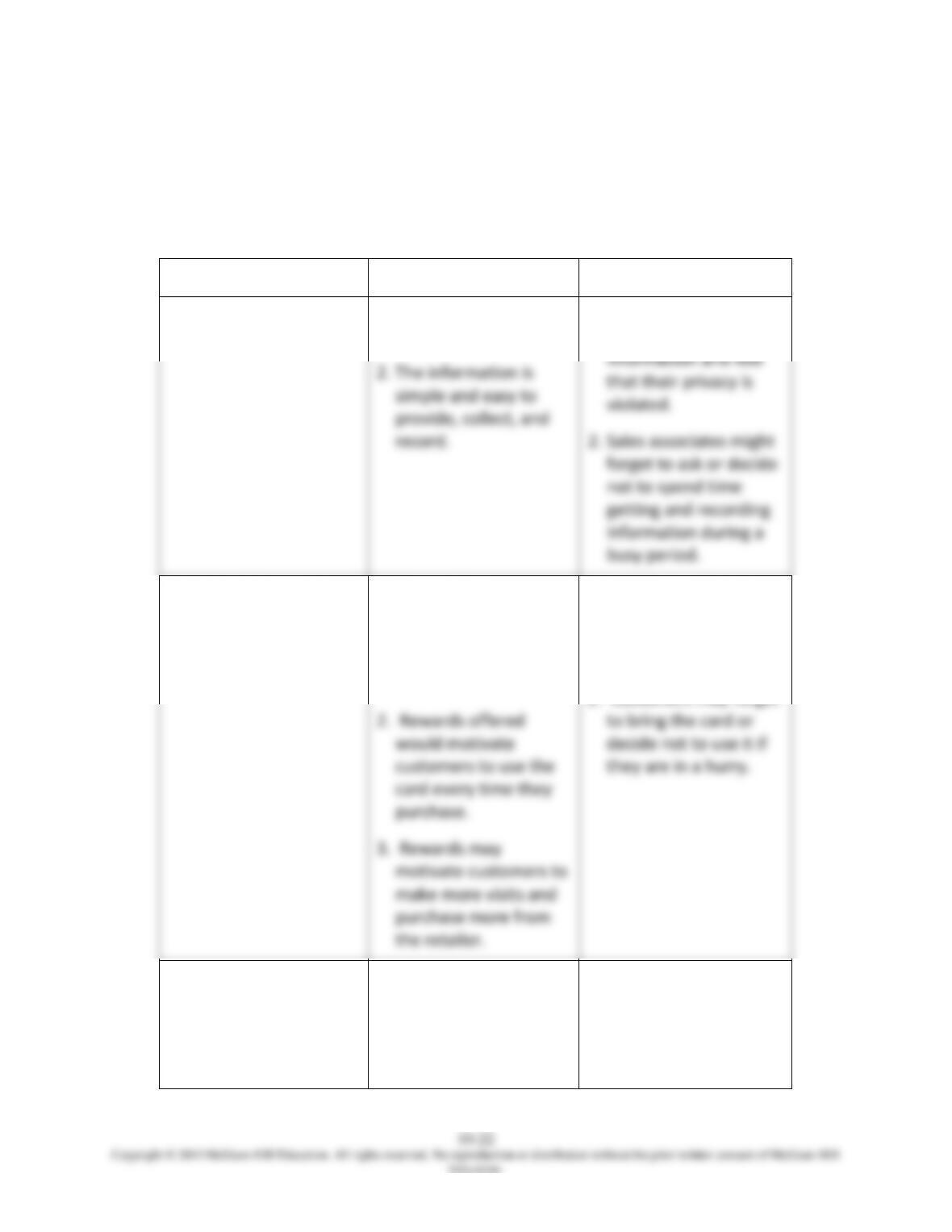
There are three approaches that retailers can use to identify customers by their
transactions. They can: (1) ask customers for the identifying information, (2) offer frequent-
shopper programs, and (3) connect Internet purchasing data with stores.
Advantages
Disadvantages
Asking Customers
1. Customers do not have
to carry a card.
1. Customers may be
reluctant to provide
Offering a Frequent-
Shopper Program
1. Transaction
information could be
better linked to
descriptive customer
information.
1. Customers already
carry too many cards
and may not want to
carry another one.
2. Customers may forget
Connecting Internet
Purchasing Data with
Stores
1. Information about
customers can be
obtained
unobtrusively.
1. Customers may not
feel they have
knowledge of use or
control over their
private information.
Chapter 10 – Customer Relationship Management
10–23
9. A CRM program focuses on building relationships with a retailer’s better customers.
Some customers who do not receive the same benefits as the retailer’s best customers
may be upset because they are treated differently. What can retailers do to minimize this
negative reaction?
On one hand, retailers may feel that the minimum negative reaction from customers would
be to not patronize the retailer again. If this segment of customers is the one most costly to
serve and the least profitable to the retailer, the unprofitable customers are weeded out
anyway. However, the problem is compounded during two likely cases: (1) the customers
Another way is the exact opposite: publicize the differences in benefits more clearly.
Customers then make their own decision as to the level and quality of interactions they
want with the retailer. For example, some banks clearly promote various types of checking
and savings accounts customers could enroll in as well as the interest rates for various levels
of balances. Customers can then decide, for example, if they want an account with higher
minimum balances and free checking or lower minimum balances and a charge for checks
above a low minimum limit per month.
10. Think of one of your favorite places to shop. How does this retailer create customer
loyalty and satisfaction, encourage repeat visits, establish an emotional bond between
the customer and the retailer, know the customer’s preferences, and provide personal
attention and memorable experiences to its best customers?
Chapter 10 – Customer Relationship Management
10–24
Retailers have any number of practices in place to create these positive relationships with
customers. One effort toward building these relationships is establishing a truly valued
frequent-shopper program. A truly valued program is one the retailer’s consumers
Personalization is another technique retailers use to foster emotional connections and
loyalty with customers. One-to-one relationships, like a personal shopper service, allow the
retailer to connect with each customer’s needs and wants directly. Internet retailers often
use this technique providing purchase suggestions and tailored merchandise information
each time a “best shopper” logs onto the retailer’s website.
Chapter 10 – Customer Relationship Management
10–25
CONNECT ACTIVITIES FOR CHAPTER 10
Activity Title
Activity Type(s)
Topic
Learning Objective
Customer
Relationship
Management
Terminology
Click and Drag;
Matching (accessible
version)
Customer
Relationship
Management Process
10-1 Describe the
customer relationship
management process.
Matching (accessible
version)
Relationship
Management Process
ways to implement
effective CRM