Collaborative Writing Guide 22
COLLABORATIVE WRITING GUIDE
by Deborah Bosley
The University of North Carolina at Charlotte
Charlotte, North Carolina
If we teach students that writing is a solitary activity, we may not be preparing them adequately for entry
into the business world. In business, a single report or other document is frequently planned, researched,
written, and edited by a team of colleagues. Thus, graduates who are not skilled in collaborative writing
may be unprepared for professional life.
When two or more students receive group credit for working together to produce a single document
or presentation, they are engaging in collaborative writing. Merely exchanging papers and evaluating one
another’s work, which is then turned in for individual credit, is peer evaluation—not collaborative
writing.
You might want to consider using collaborative writing in your business communication classes
(particularly in conjunction with the report-writing and presentation chapters) for several reasons:
PREPARING STUDENTS FOR COLLABORATIVE WRITING
Throughout their school years, students learn the value of individual accomplishment rather than
commitment to shared goals. With the weight of such experience behind them, students cannot learn to
work collaboratively just by listening to lectures. They must experience cooperative work for themselves.
The first step is to establish a sense of community and shared history among members of the entire
class as well as among members of each work group. One method of building that sense of community is
Collaborative Writing Guide 23
Copyright © 2018 Bovée and Thill LLC
Many instructors ask students to record their reactions to and feelings about the group process. This
activity encourages students to be more introspective about collaborative writing and, if the journals are
turned in periodically, gives instructors the opportunity to help students who are having trouble. The
journals also help the instructor evaluate the work of each group.
Forming Groups
Many researchers have offered criteria for dividing groups: along demographic lines, by ability, according
to interest in a particular topic, on the basis of common schedules and availability for meetings. You
might also randomly assign students to groups or, if you have watched students interact on smaller group
projects, form groups according to who seems to work well together.
Teaching Group Brainstorming and Decision Making
Students usually need to be taught how to cooperate in generating ideas and how to avoid letting one
member dominate the group’s decisions. They often think brainstorming means writing down a bunch of
ideas. In addition, they frequently let the group member perceived to be the brightest or the hardest
working or the one who assumes the leadership position to make many of the group’s decisions. Without
enough commitment to the task to “fight” for their perspective, the others may just give in. Weaker
Assigning Tasks
With three members in a group, each person can fill an important group-maintenance role: leader,
recorder, or evaluator. The leader is responsible for setting the agenda, making sure all members know
Collaborative Writing Guide 24
discussions about how the group is functioning.
The most effective way to assign tasks for a project is on the basis of students’ interests or abilities.
Groups should therefore encourage members who are proficient at doing library research, conducting one-
on-one interviews, or word processing to do so. You might want to supplement group assignment of tasks
ASSIGNING SHORT-TERM PROJECTS
If time for collaborative writing is limited, you might assign a project that will take only two or three class
Here are some additional short-term assignments:
1. Divide the class into groups of people in similar majors, then ask each group to compose a letter
soliciting career information from someone in their chosen field. For example, accounting students
2. To gather information for the report-writing project, each group might write a letter asking for
information from someone who has knowledge of their topic. This letter might serve as an interview
in written form.

Collaborative Writing Guide 25
EXHIBIT 1
INDIVIDUAL AND GROUP TASK SHEET
Name of Group/Team
Topic for Group Research Report
Individual’s Name
Function in Group (leader, secretary, editor, etc.)
What you did (be specific) Time spent (date; hours and minutes)
Group meetings (where and when) Who attended Time spent
Collaborative Writing Guide 27
discussion of evaluation procedures
Week 2
Week 3
• Group conferences on work plans; group work on survey questionnaires
Week 4
• Discussion of Chapter 13 (finding, evaluating, and processing information)
Week 5
Week 6
• Discussion of Chapter 9 (visuals) and Chapter 16 (electronic presentations)
Week 7
• FINAL REPORT DUE, EVALUATION AND TASK SHEET DUE, PRESENTATION DUE
The following week, return the final reports with grades, give students their individual evaluations, and
Step-by-Step Guide
These are the seven main steps in the process:
1. Selecting a topic
4. Composing a rough draft
2. Formulating a work plan
5. Writing a progress report
3. Collecting data through surveys and
interviews
6. Preparing a final report
7. Giving a presentation
Collaborative Writing Guide 28
Selecting a Topic. Groups should be allowed to select their own topics because students work better on
report assignments when they choose their area of research. Yet you can simplify their decision-making
process and your own evaluation of their work by providing some framework for their choices. You
might give them free range within any of the following three general areas:
• They could analyze some aspect of university life, such as housing or parking problems. Part of the
task is to recommend solutions to the problem they select. On-campus research has the advantage of
• They could work on one of the cases or collaborative activities at the end of Chapters 11 through 15.
The activities may be used as they are or supplemented with additional procedures suggested in the
Formulating a Work Plan. The first document the groups produce is a work plan (Chapter 14). In the
form of memos written to you, work plans include (1) a statement of the problem, (2) an analysis of the
audience, (3) a statement of the purpose of the report, (4) a description of research methodology, (5)
Collecting Data through Surveys and Interviews. The next phase is to collect data for the report
(see Chapter 14). Primary research should be emphasized because it demonstrates a major difference
between business reports and academic reports, in which library (secondary) research is the norm. Also,
primary research (surveys and interviews) is a relatively quick method of obtaining data.
Begin by discussing the design of questionnaires and the conduct of surveys. To demonstrate the ins
and outs of wording questions, you might present some models. Students must then determine the purpose
In addition to interviewing people who have information related to their report topic, students might
want to interview the audience for whom the report is intended, to determine their needs and concerns.
Collaborative Writing Guide 29
will gain useful experience in collaborating on the questions they ask, coordinating schedules, and
working together to transcribe their notes. (Strongly urge students to tape-record interviews so that they
can concentrate during the interviews on listening and asking questions.)
Composing a Rough Draft. So that students focus on essentials, ask them to provide rough drafts
consisting only of the introduction, body, and conclusions or recommendations. The introduction
Writing a Progress Report. The third document in the report package is a progress report, which is
written individually, not collaboratively. This progress report should be a one-page memo written to you
explaining what the group has accomplished and what the individual group member has accomplished.
Exhibit 2 (below) is a handout for the assignment.
Preparing a Final Report. The students’ final reports should have at least nine parts:
2. Title page
4. Synopsis
6. Body of the report
8. Appendixes (copy of the survey, handouts used in the presentation, visual aids not appropriate for
inclusion in the body of the report, and so on)
9. Bibliography
You might also require visual aids and a letter of transmittal.
Collaborative Writing Guide 30
EXHIBIT 2
PROGRESS REPORT
The purpose of a progress report in the business world is to let your supervisor (or project director) know
what steps are being taken to complete a project so that he or she can make decisions. The purpose of
ASSIGNMENT
FORMAT
Use memo format and the following headings:
BACKGROUND: A statement of the purpose of your project and the problem you are investigating
EVALUATION CRITERIA
Collaborative Writing Guide 31
The final report and the rough draft are usually written in the same manner. That is, if group members
write the draft together sentence by sentence, they write the final report that way. If they write parts of the
Giving a Presentation. In addition to the group-writing project, students may also collaborate on an
oral presentation (see Chapter 16), which they present to the class and possibly to the real audience for
EVALUATING COLLABORATIVE PROJECTS
Both short- and long-term projects may be evaluated on the merits of the end product and on the basis of
group members’ participation. But if the short-term project is considered a warm-up exercise, you should
focus on evaluating the long-term project, which takes place in seven phases:
2. Evaluation of survey questionnaire (group grade; optional)
4. Evaluation of progress reports (individual grade)
6. Evaluation of presentation (group and individual grade; optional)
7. Evaluation of participation in group (individual grade)
The purpose of the work plan is to allow students to develop goals for the project and for themselves, and
to allow you to foresee any problems they might have in focusing their research. The criteria for the grade
are the feasibility of the project, the care with which the plan was developed, and the ordinary concerns of
style, grammar, and the like.
In the second phase of evaluation, look over the survey questionnaire to be sure it is worded properly
and clearly. Instructors may or may not assign a group grade on the survey.
Collaborative Writing Guide 32
members. You may collect students’ task sheets (Exhibit 1). Also, the evaluation form in Exhibit 3
(below) lets students score and rank fellow group members’ work. You may find that students rank two or
REFERENCES
Notes
2. Shlomo Sharan, “Cooperative Learning in Small Groups: Recent Methods and Effects on
3. John F. Cragan and David W. Wright, Communication in Small Group Discussions: A Case Study
Approach (New York: West, 1980).
4. Slavin, “Cooperative Learning.”
Bibliography
Allen, Nancy, et al. “What Experienced Collaborators Say About Collaborative Writing.” Journal of
Duin, Ann Hill. “Implementing Cooperative Learning Groups in the Writing Curriculum: What Research
Shows and What You Can Do.” ERIC, ED 251849 (1984): 2–12.
Ede, Lisa S., and Andrea A. Lunsford. “Why Write . . . Together: A Research Update.” Rhetoric Review 5
(1986): 71–81.
Faigley, Lester, and Thomas P. Miller. “What We Learn from Writing on the Job.” College English 44
(1982): 557–569.
Collaborative Writing Guide 33
EXHIBIT 3
INDIVIDUAL EVALUATIONS
On the other side is an evaluation form to fill out for the members of your group. This information will
allow me to assign individual grades for group participation.
Write comments telling me specifically why each individual received the score he or she did. If these
forms are not filled out with comments, you will lose points.
2. No two people should get exactly the same assessment. Group members are individuals, with
3. Be ready to explain your assessments throughout the project if I ask you to do so.
5. Assign points for each group member’s participation in each category:
5 = Excellent
4 = Good
6. Be sure to total each person’s score.
8. You MUST write comments to justify your scores. Feel free to write any additional comments that
will help me fairly evaluate each individual’s participation.
Collaborative Writing Guide 34
EXHIBIT 3 (Continued)
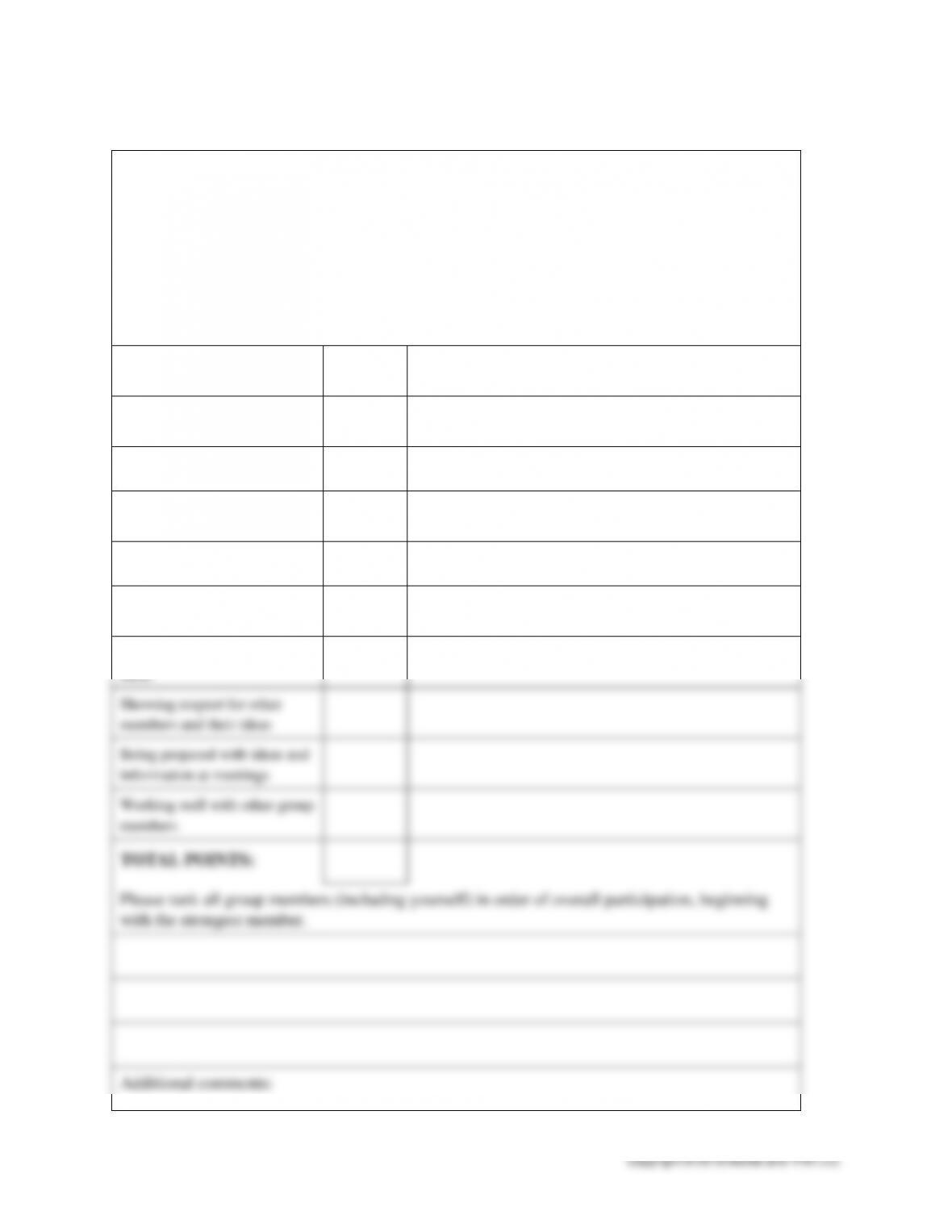
YOUR NAME _______________________________________________________________
GROUP MEMBER’S NAME ___________________________________________________
CRITERIA
POINTS
COMMENTS
Being at and on time for
meetings
Accepting responsibility and
volunteering
Contributing ideas
Talking and participating in
meetings/discussions
Doing a fair share of the work
Interacting smoothly with
other group members
Seeking/listening to others’
ideas
Showing respect for other
members and their ideas
Being prepared with ideas and
information at meetings
Working well with other group
members
TOTAL POINTS:
Please rank all group members (including yourself) in order of overall participation, beginning
with the strongest member.
Additional comments: