a. Consider these pointers on how to deliver bad news in person tactfully,
professionally, and safely:
i. Gather all the information. Cool down and collect the facts before
confronting someone. Remember that every story has two sides.
ii. Prepare and rehearse. Outline what you plan to say so that you are
confident, coherent, and dispassionate.
b. When refusing workplace requests (Model Document 9.8):
i. Start with a buffer that delivers honest praise.
ii. Provide reasons for the refusal that focus on positive elements.
c. When announcing bad news to employees and the public
(Model Document 9.9):
i. Smart organizations communicate bad news openly to employees
and stockholders.
d. When saying “no” to job applicants, follow these guidelines
(Model Document 9.10):
i. Show appreciation for the receiver.
ii. Reduce the receiver’s disappointment by using the indirect
approach.
e. Small Group Activity: 45 minutes total. Announcing Bad News
Break class into groups of three to five students. Have students complete the
activity outlined on the PPT slide. Students should collectively decide on their
small groups’ answers to the question and then share their findings with the
larger group.
[return to top]
Discussion Questions
You can assign these questions several ways: in a discussion forum in your LMS; as whole-
class discussions in person; or as a partner or group activity in class.
1. Discussion: Selective Truth (Critical Thinking #1, 9-3, PPT Slide 19)
Duration 15 minutes.
a. Mike Michalowicz, author of Profit First and CEO of Provendus Group, quotes
a famous American poet to illustrate how he refuses unpleasant potential
don’t have resources to support your specific needs,” he says.
b. Discuss this strategy, its advantages, and disadvantages.
i. Answer: Emily Dickinson seems to be suggesting that we tell the truth
2. Discussion: The Fallout of Careless Public Remarks (Critical Thinking #2, 9-1, PPT Slide
9) Duration 20 minutes.
a. At a sustainability conference, Levi Strauss CEO Chip Bergh caused a viral
sensation by revealing he had never laundered his two-year-old Levi’s in a
laundry stance will be mentioned in my obituary.”
b. Can you think of other, more negative examples of executives’ offhand public
comments?
i. Answer: Although Levi Strauss President and CEO Chip Bergh didn’t
seriously damage the reputation of his company, he lost control over
his carefully managed message of sustainability. Bergh’s well–
3. Discussion: The Ethics of an Indirect Strategy (Critical Thinking #3, 9-2, PPT Slide 15)
Duration 15 minutes.
a. Consider times when you have been aware that others were using the
indirect strategy in writing or speaking to you.
b. How did you react?
i. Answer: Students may indicate that they appreciated the indirect
4. Discussion: Firing by Text or E-mail (Critical Thinking #4, 9-5, PPT Slide 41)
Duration 15 minutes.
a. Experts agree that, if possible, workers should be fired in person—not by
phone, e-mail, or text message. The consensus is that the kindest way to fire
someone is when the direct supervisor delivers the bad news. However,
increasingly employees are getting fired by text or e-mail.
b. Make a case for and against firing workers by text or e-mail.
i. Answer: A case for letting someone go via a text message or an e-mail
is that a remote worker may not be able to come into the office to be
5. Discussion: The Ethics of Using Company Stationary (Critical Thinking #5)
Duration 10 minutes.
a. You work for a large corporation with headquarters in a small town. Recently,
you received shoddy repair work and a huge bill from a local garage. Your
b. Should you use corporation stationery?
i. Answer: Although the letter might seem more impressive on
[return to top]
Additional Activities and Assignments
1. Case Study: Zooming In—The Bad News Keeps Coming: Volkswagen and
Dieselgate: In this case study, students will read a description of the scandal known
as Dieselgate that plagued Volkswagen Group. They are then asked to answer a
series of critical-thinking questions.
a. What should an individual or organization such as VW do when caught in an
ethical impropriety or scandal?
i. Experts maintain that organizations that have seriously faltered
b. How do you feel about large payouts to departing managers like CEO Martin
Winterkorn who are forced to step down in the aftermath of a scandal?
i. Students almost invariably fall into two groups—one that defends
high compensation of managers to reflect their enormous
c. Can we conclude from this scandal that the public’s memory is short, or can
we assume that reputational damage may linger?
i. A high stock price and devoted diesel fans buying refurbished cars at
2. Case Study: Zooming In—Your Turn: Applying Your Skills at Volkswagen Group:
In this case study, students will read a summary of how Volkswagen Group
executives have historically approached bad news and how executives handled
a. After reading this chapter, evaluate Volkswagen’s handling of Dieselgate.
Focus on communication, crisis management, and apologies. Consider
questions such as these: What are the biggest problems at VW as evidenced
by the scenario? How might corporate culture have played into the scandal?
What may have led to cheating? What other options did the company have to
tackle and overcome Dieselgate? Discuss these and other questions in class,
in small groups, or on a discussion board. If your instructor directs,
summarize your analysis in writing, either in an e-mail or a memo.
iii. Students should examine the wording of the executives’ apologies.
They may notice euphemisms as the managers carefully avoid naming
the fraud (problem, irregularities, situation) and deflect responsibility:
Martin Winterkorn said he accepted responsibility only to say he was
not aware of any wrongdoing on his part. While apologizing almost
too profusely in two head-scratching NPR interviews in 2016, Matthias
Müller blamed “a misunderstanding” of U.S. law for Volkswagen’s
moral lapse and his own language interference for first asserting that
VW had not lied to regulators. Oliver Schmidt, who seemed sincere in
apologizing, in the end put the blame on his loyalty to the company
and said VW had taken advantage of him. Incidentally, even as he was
going to prison, Schmidt did not give away any names of executives
who ostensibly had given him talking points and had pressured him to
greenlight the fraud.
September 18). You thought Dieselgate was over? It’s not. The Verge.]
v. As a purportedly clean(er) fuel, diesel has been completely
discredited. Germany, a country that subsidized diesel car production
and kept the price of diesel fuel low, is now gradually banning diesel
vehicles from city centers and some roadways because they emit too
much nitrogen oxide. NOx contributes to smog, acid rain, water
quality deterioration, childhood asthma, respiratory ailments, and
premature death, according to the EPA. Without technical fraud,
tailpipe emissions of VW diesel cars were 40 times higher than the
pollution limits in the United States. The scandal has pushed VW into
developing electric cars, a technology the company had neglected.
viii. The culture at Volkswagen is characterized by arrogance, insiders say.
One of Germany’s premier newspapers (FAZ) blamed the massive
moral failure on a siege mentality at VW. Ferdinand Piëch, a majority
shareholder of both VW and Porsche AG, and his hand-picked
successors exerted such pressure to perform that several VW
executives apparently saw no other option than fraud. Also, the
internal pressure at Volkswagen was laser-focused on becoming the
world’s largest automaker by volume, apparently at all cost. In
addition, Volkswagen is an iconic German company, which has a
reputation for technological and engineering prowess to uphold.
Admitting failure in creating “clean diesel” was not an option. Former
x. A scholar in the Darden School of Business at University of Virginia,
Luann Lynch, identified the three factors that may have led to an
ethical breakdown at Volkswagen Group: Pressure, opportunity, and
rationalization. The “dangerous triad” or “fraud triangle” helps explain
the scandal, she says. The pressure from the top was immense.
xi. Dale Bell, cofounder of The Media and Policy Center in Burbank,
California, produced a documentary about the Volkswagen emission
scandal, BACKFIRED: When VW Lied to America. Bell confessed his
fascination with this colossal ethical failure and decided to explore the
questions at the core of Dieselgate: “How could a corporate entity
turn so abruptly on its customers, eviscerate its own corporate values,
3. Chat About It: At the end of each chapter, you will find additional open-ended
questions related to the chapter material. You may assign these topics for
discussion in class, in an online chat room, or on an online discussion board. You
may also ask students to read and respond to postings made by their classmates.
(Chat About It Topics #2 and 5 can be found in the chapter outline above as PPT
activities.)
© 2022 Cengage. All Rights Reserved. May not be scanned, copied or duplicated, or posted to
a publicly accessible website, in whole or in part.
23
Topic 3: Which strategies have you used to soften the blow of significant bad
news with your family and friends? If you haven’t, imagine situations in which
such strategic thinking might be wise.
Topic 4: Analyze the corporate jargon for getting laid off: realigning the workforce,
reallocating resources, focusing on involuntary attrition, rightsizing the company,
eliminating redundancy, rewiring for growth, smartsizing the company, redeploying
workers, rebalancing human capital, and decruiting. How do these terms compare
to fired, booted out, given the boot, or get the ax?
[return to top]
Additional Resources
Cengage Video Resources
• MindTap Videos:
o Learn It: Chapter 09 Negative Messages
▪ Learn It: Video Lesson 9-1
▪ Learn It: Video Lesson 9-2
o Model Document Video: Refusing an Internal Request (Chapter 09 Negative
Messages)
[return to top]

Appendix
Generic Rubrics
Providing students with rubrics helps them understand expectations and components of
assignments. Rubrics help students become more aware of their learning process and
progress, and they improve students’ work through timely and detailed feedback.
Standard Writing Rubric
Criteria
Meets Requirements
Needs Improvement
Incomplete
Content
The assignment clearly
and comprehensively
addresses all questions
in the assignment.
conclusions are logically
related and consistent.
arguments, and
conclusions are mostly
logically related and
consistent.
7 points
logically related and
consistent.
0 points
The assignment partially
addresses some or all
questions in the
assignment.
The assignment does not
address the questions in
the assignment.
0 points
Research
The assignment is based
upon appropriate and
adequate academic
literature, including peer
reviewed journals and
other scholarly work.
5 points
The assignment is based
upon adequate
academic literature but
does not include peer
reviewed journals and
other scholarly work.
3 points
The assignment is not
based upon appropriate
and adequate academic
literature and does not
include peer reviewed
journals and other
scholarly work.
0 points
The assignment follows
the required citation
guidelines.
5 points
The assignment follows
some of the required
citation guidelines.
3 points
The assignment does not
follow the required
citation guidelines.
0 points
Negative Messages
5 points
3 points
0 points
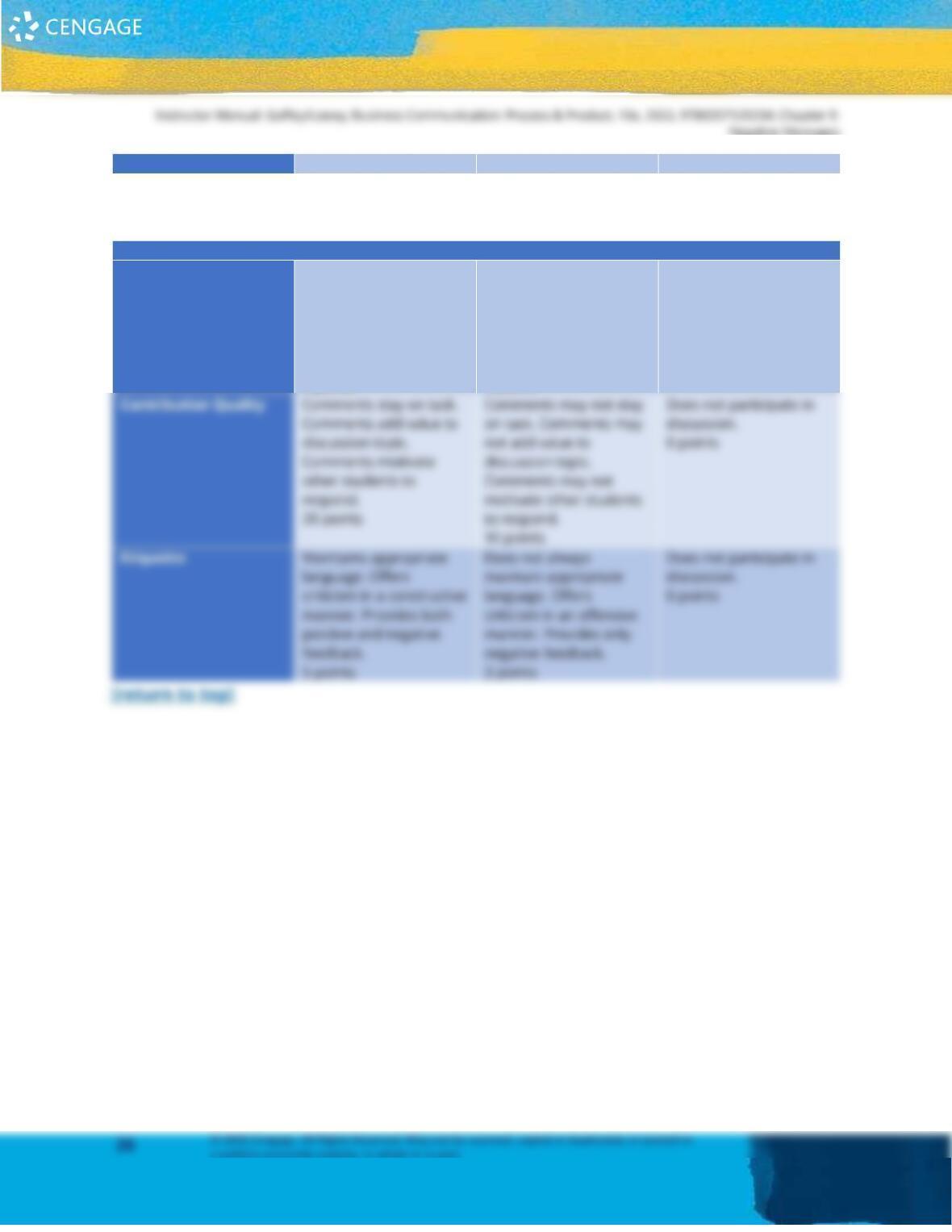
Standard Discussion Rubric
Criteria
Meets Requirements
Needs Improvement
Incomplete
Participation
Participates in or
submits discussion by
the posted deadlines.
Follows instructions for
initial post and
responses.
5 points
3 points
Does not participate in
or submit discussion by
the posted deadlines.
Does not follow
instructions for initial
post and responses.
Does not participate in
discussion.
0 points