b. When saying thank you or writing notes of appreciation, use special
notepaper or heavy card stock, understanding they are significant to their
receivers.
i. To express thanks for a gift, tell the receiver what the gift means to
you using sincere, simple statements.
c. Always respond to notes of congratulations and other goodwill messages.
i. Avoid minimizing your achievements or suggesting the sender is
exaggerating your good qualities.
d. Follow these guidelines for expressing sympathy and sending condolences:
i. Personal notes are more meaningful than commercial sympathy
cards.
ii. Refer to the death or misfortune sensitively.
e. Guidelines for using e-mail for goodwill messages include the following:
i. E-mail is acceptable if you frequently communicate with the receiver
f. Writing Activity: 60 minutes total. Thanking a Supporter
Have students think of a situation where someone has recently offered
support to them. Students should write a letter thanking their supporter. You
may wish to have students share their letters with the larger group.
• Do you regularly send letters of thanks to your supporters?
[return to top]
Discussion Questions
You can assign these questions several ways: in a discussion forum in your LMS; as whole-
class discussions in person; or as a partner or group activity in class.
1. Discussion: Why the GDPR Matters (Critical Thinking #1) Duration 15 minutes.
a. Whenever you navigate to any website today, you will see pop-ups forcing
you to accept cookies and agree to or reject certain uses of your data. Most
b. Why does the GDPR matter in the United States, and why is it serious
business?
i. Answer: The GDPR matters in the United States because the Internet
is global, and many U.S. companies collect or use EU residents’ data
ii. In the United States, the California Consumer Privacy Act is one of the
toughest in the nation. Critics worry that such strict regulations will
stifle small businesses that cannot afford the high cost of compliance
or penalties should they violate the legal provisions. Opponents also
2. Discussion: The Unique Expression of a Letter (Critical Thinking #2, 8-1, PPT Slide 6)
Duration 10 minutes.
a. A writer compared letters and social media posts: “What is special about a
letter is the time that is taken in creating a letter—that someone went to the
b. How might these observations apply to business letters?
i. Answer: In her book Signed, Sealed, Delivered: Celebrating the Joys of
Letter Writing, Connecticut-based author Nina Sankovitch movingly
c. What other special traits can you identify?
i. Answer: Business letters are confidential. They are less likely than
electronic media to be intercepted, misdirected, forwarded, retrieved,
or otherwise inspected by unintended recipients. Also, business
3. Discussion: Smartphones in Social Settings (Critical Thinking #3) Duration 15 minutes.
a. A Pew Research Center study found that 89 percent of smartphone owners
b. Do you split your attention between your screen and face-to-face
conversations? Do you believe it’s possible to be sufficiently present while
texting?
i. Answer: Student answers will vary, of course. As MIT professor Sherry
Turkle writes, students swear they can look someone in the eye and
type on their phones at the same time. They love the option of being
4. Discussion: Keeping Your Cool (Critical Thinking #4, 8-3, PPT Slide 24)
Duration 10 minutes.
a. When supporting a claim, it’s important to state facts logically, objectively,
and unemotionally.
b. Why is it smart to keep your cool when making a claim, and how should you
go about it?
i. Answer: Avoid becoming angry or trying to fix blame. Bear in mind
that the person reading your message is seldom responsible for the
Instructor Manual: Guffey/Loewy, Business Communication: Process & Product, 10e, 2022, 9780357129234; Chapter 8:
Positive and Neutral Messages
5. Discussion: SLAPP Laws (Critical Thinking #5, 8-3, PPT Slides 27–28)
Duration 15 minutes.
a. In this chapter you learned that some businesses have used so-called SLAPP
laws to sue consumers for writing negative reviews on the Internet. The
b. Is trying to silence reviewers on social media fair, or are businesses within
their rights to protect from illegitimate damaging complaints?
i. Answer: Student answers will vary, but most students probably realize
that fewer people are willing to write honest critical reviews if they
may have to defend themselves against lawsuits. The public that
[return to top]
Additional Activities and Assignments
1. Case Study: Zooming In—Domino’s: A Technology Company That Sells Pizza?:
In this case study, students will read a description of how Domino’s has revamped
its operations and embraced digital transformation. They are then asked to answer
a series of critical-thinking questions.
a. Why does Domino’s employ redundancy in its methods to order its pizzas?
i. Domino’s sophisticated marketing strategy accounts for individuals’
b. What is the best way for companies such as Domino’s to react to customer
comments on social media?
i. Social media work best when they engage with customers. The more
genuine and individualized the response, the more the customer will
c. Why must messaging always be carefully constructed, especially on social
media?
i. Because social media posts are permanent, writers must be especially
2. Case Study: Zooming In—Your Turn: Applying Your Skills at Domino’s: In this
case study, students will be asked to examine the social media presence of
Domino’s as well as its corporate internship program. Break students into groups of
three to five and have them complete the assignment as a team. This task allows for
several angles. It can be assigned as a whole or in two parts—either analyzing the
pizza chain’s social media presence or researching and evaluating the company’s
internship opportunities. You may wish to have students present their work to the
class or submit their responses electronically.
a. Social Media Presence: Individually or as a team, examine the company’s posts
and customers’ comments on the pizza chain’s Facebook page. What is the
i. Answers will vary, but here is a potential smattering of answers: As of
this writing, Domino’s has nearly 21 million Facebook followers. On
Twitter, the followers of the main account (“Hosted by the crew at
Domino’s HQ”) are fewer (1.3 million) than those on Facebook
perhaps because Domino’s has authentic regional Twitter accounts,
e.g., Domino’s Pizza UK or Domino’s Pizza India, and engagement
opportunities are spread out.
trolling and derogatory posts that dismiss the company and its pizza.
On Facebook, despite 21 million likes, the tone is not much better;
apparently many customers find lots to complain about, generally
about their local Domino’s outlets and their service. Domino’s social
media representatives do not address the nasty posts. Rather, they
calmly exhort customers unhappy about specific issues to send a
direct message, so that they can investigate the problem.
b. Corporate Internships: In your browser, search for internships at Domino’s.
Most likely you will land on the company’s corporate site and find that
Domino’s is reaching out to recent college grads offering them corporate
ii. A peek at Glassdoor is revealing. Thousands of Domino’s employees
have shared their salaries on Glassdoor. On average the pizza chain
pays an hourly intern salary ranging from $15 to $17, which is high,
considering that delivery drivers and customer service reps make only
3. Chat About It: At the end of each chapter, you will find additional open-ended
questions related to the chapter material. You may assign these topics for
discussion in class, in an online chat room, or on an online discussion board. You
may also ask students to read and respond to postings made by their classmates.
(Chat About It Topic #2 can be found in the chapter outline above as a PPT activity.)
Topic 1: Direct mail marketers say that in the age of multitasking and myriad
distractions—from social media posts, messaging, and e-mail—direct mail is
special. They cite research suggesting that direct mail connects with customers
on a deeper emotional level and provides a much higher response rate than
“bland” e-mail. How do you feel about direct mail vs. e-mail?
Topic 5: Describe an occasion in which you should have written a goodwill
message but failed to do so. Why was it difficult to write that message? What
would make it easier for you to do so?
[return to top]
Additional Resources
Cengage Video Resources
• MindTap Videos:
o Learn It: Chapter 08 Positive and Neutral Messages
▪ Learn It: Video Lesson 8-1
▪ Learn It: Video Lesson 8-2
• Model Document Video: Direct E-mail Claim (Chapter 08 Positive and Neutral
Messages)
• Model Document Video: Customer Adjustment Letter (Chapter 08 Positive and
Neutral Messages)
[return to top]
Appendix
Generic Rubrics
Providing students with rubrics helps them understand expectations and components of
assignments. Rubrics help students become more aware of their learning process and
progress, and they improve students’ work through timely and detailed feedback.
the discussion rubric indicates 30 points.
Standard Writing Rubric
Criteria
Meets Requirements
Needs Improvement
Incomplete
Content
The assignment clearly
and comprehensively
addresses all questions
in the assignment.
15 points
The assignment partially
addresses some or all
questions in the
assignment.
8 points
The assignment does not
address the questions in
the assignment.
0 points
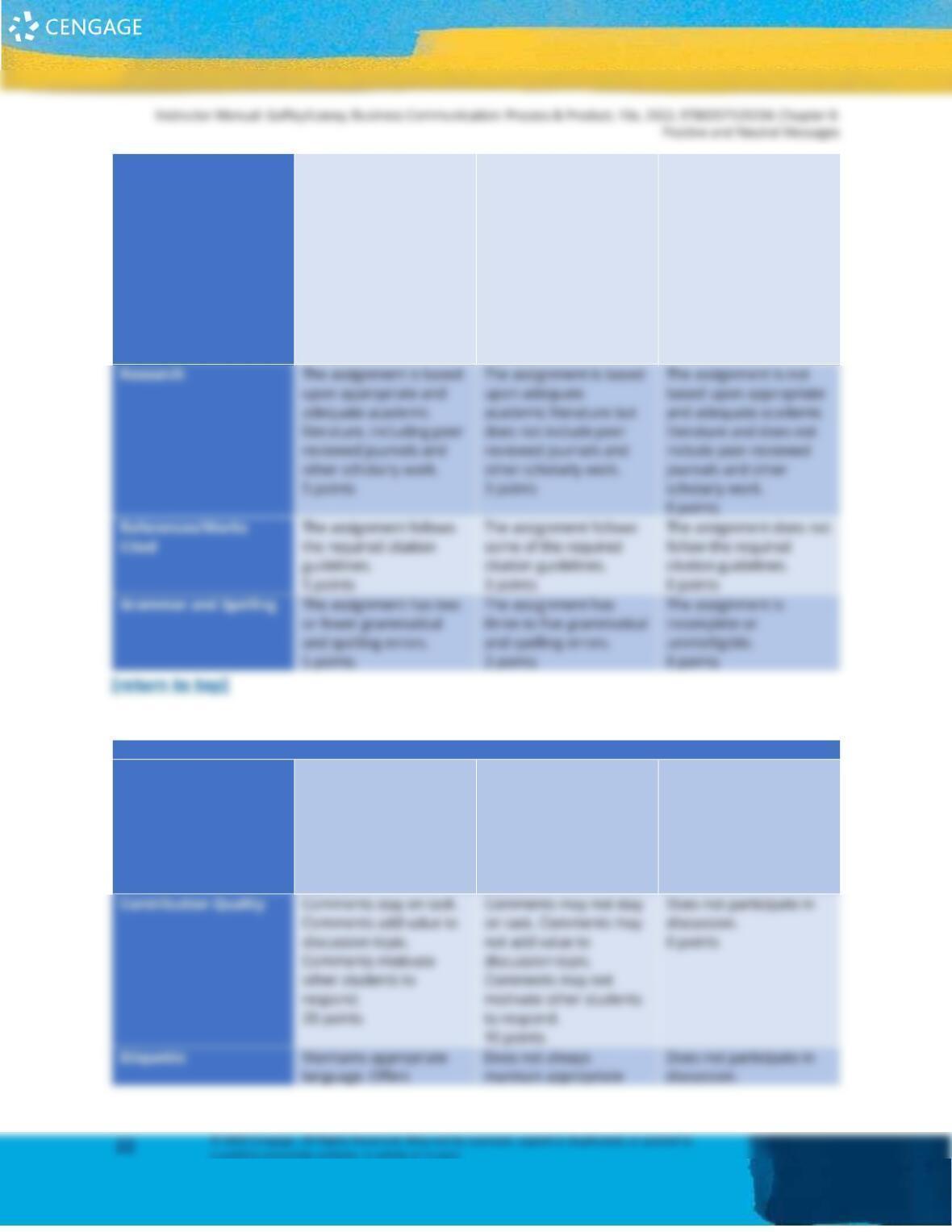
The assignment includes
an appropriate
introduction, content,
and conclusion.
Coverage of facts,
arguments, and
conclusions are logically
related and consistent.
10 points
organizational structure.
The assignment includes
an appropriate
introduction, content,
and conclusion.
Coverage of facts,
arguments, and
conclusions are mostly
logically related and
consistent.
7 points
The assignment includes
an introduction, content,
and conclusion, but
coverage of facts,
arguments, and
conclusions are not
logically related and
consistent.
0 points
upon appropriate and
adequate academic
literature, including peer
reviewed journals and
other scholarly work.
5 points
upon adequate
academic literature but
does not include peer
reviewed journals and
other scholarly work.
3 points
based upon appropriate
and adequate academic
literature and does not
include peer reviewed
journals and other
scholarly work.
0 points
The assignment follows
the required citation
guidelines.
5 points
The assignment follows
some of the required
citation guidelines.
3 points
The assignment does not
follow the required
citation guidelines.
5 points
3 points
0 points
Standard Discussion Rubric
Criteria
Meets Requirements
Needs Improvement
Incomplete
Participation
Participates in or
submits discussion by
the posted deadlines.
Follows instructions for
initial post and
responses.
5 points
Does not participate in
or submit discussion by
the posted deadlines.
Does not follow
instructions for initial
post and responses.
3 points
Does not participate in
discussion.
0 points
Comments add value to
discussion topic.
Comments motivate
other students to
respond.
20 points
on task. Comments may
not add value to
discussion topic.
Comments may not
motivate other students
to respond.
10 points
discussion.
0 points