i. Use incentives to motivate employees to solve business problems
ii. Solicit employee feedback
i. Businesses vary in their approaches to personal social media use.
i. Content shared by employees achieves greater engagement and re-
sharing than typical brand channels do.
j. Guidelines for safe social networking include (Figure 7.8):
i. Establish boundaries.
k. Dos:
i. Learn your company’s rules.
ii. Avoid sending personal e-mail, IMs, or texts from work machines
and devices.
l. Don’ts:
i. Don’t spread rumors, gossip, and negative, defamatory comments.
ii. Don’t download and share cartoons, video clips, photos, and art.
m. There is a dark side of technology and social media.
n. Privacy fears:
i. Location services allow users to be tracked with pinpoint precision.
ii. Personal data exist indefinitely in the cloud.
o. Disinformation and election tampering:
i. Echo chambers (like-minded individuals who confirm existing views)
result in polarization and make people vulnerable to
misinformation.
p. Deepfakes, doctored videos:
i. A post-truth era (objective facts are less influential in shaping public
opinion than appeals to emotion and personal belief) brings need
q. Incivility, trolling, and cyberbullying:
i. Trolls (users who fake their identity, provoke skirmishes, and disrupt
discussions on social media) thrive on denigrating others.
r. Data security concerns include the following:
i. Spyware
ii. Ransomware
iii. Phishing
t. Knowledge Check Activity: 15 minutes total. Key Terms Quiz
Have students fill in the blanks with the correct key term associated with the
definitions shown on the PPT slide.
• Public shaming and harassment by troll armies is called doxxing.
• Like-minded individuals who embrace narratives that confirm their
existing views while rejecting contradicting information are known
as echo chambers.
Discussion Questions
You can assign these questions several ways: in a discussion forum in your LMS; as whole-
class discussions in person; or as a partner or group activity in class.
1. Discussion: Social Media Are a Trap (Critical Thinking #1, 7-5, PPT Slide 56) Duration
30 minutes.
a. The eminent sociologist Zygmunt Bauman had this to say about social media:
“Most people use social media not to unite, not to open their horizons wider,
b. Do you agree?
c. Why or why not?
d. How do you use social media networks?
i. Answer: Many of our Critical Thinking questions and our ethics
situations could be staged as student debates. Such debates generate
2. Discussion: The Last Great Unowned Technology (Critical Thinking #2, 7-1,
PPT Slides 4–7) Duration 30 minutes.
a. You have seen that e-mail is not universally loved although it seems to be
experiencing a noticeable comeback, despite the advent of real-time chat
b. Interpret these statements. What points are they making, about openness in
particular?
i. Answer: This Critical Thinking question is testing students’ ability to do
a close reading of a short text. Students should focus on words and
ii. The fundamental idea underpinning these quotations is a free and
open Internet as a vast and largely unregulated democratic space
3. Discussion: When Technology Becomes Invasive (Critical Thinking #3, 7-5, PPT Slide 55)
Duration 40 minutes.
a. Consider the potential impact of gamification and wearable devices on your
career.
b. How do you feel about the tracking of employees and the monitoring of your
vital functions on the job and outside the workplace?
c. Can you think of other vulnerable technologies?
d. What advice would you give someone who is not sure how to handle invasive
technologies that may threaten privacy and security?
i. Answer: Student answers will vary. Ask how many students wear a
Fitbit device, a smart watch, or a similar wearable device. Do they feel
professional image are more important than ever. Also, it’s worth
pointing out that employees in the United States have far fewer
privacy rights at work than they do in their personal lives.
ii. Some research suggests that gamification is not optimal for
collection about each of us in cyberspace and offline.
iii. The latest threat to privacy is software used to detect workers’ mood
as it combs through e-mail and Slack messages. Touted as a means to
productivity, retention, and greater satisfaction on the job, the
sentiment-tracking technology could easily become invasive.
[Cutter, C., & Feintzeig, R. (2020, March 7). The Wall Street Journal.]
4. Discussion: NSFW (Critical Thinking #4, 7-2, PPT Slide 22) Duration 15 minutes.
a. Text messaging in a business setting can be highly efficient and effective
when done right.
b. Are conversational Internet acronyms and slang—such as AFAIK, G2G, HIFW,
ICYMI, and NSFW—as well as all-lowercase writing acceptable in e-mail,
texting, or instant messaging for business?
i. Answer: Like other electronic messages, instant messages and texts
may have secondary, unintended audiences potentially years later.
5. Discussion: The Ethics of Employing Botnets in Business (Critical Thinking #5, 7-5)
Duration 20 minutes.
a. Some marketers and individuals aspiring to becoming influencers employ
Internet bots—automated applications that run simple, repetitive tasks on
the Internet—to inflate the number of likes and fans online. So-called bot
networks (botnets) operate large numbers of fake accounts on Facebook,
Instagram, and Twitter. A rental agency based in Washington, D.C., went from
two fans to almost 15,000 within a few days.
b. How do you feel about companies and their brands pretending they have
actual traffic on their sites and buying likes?
i. Answer: Most upstanding marketers and Internet users find the
practice unethical. They point out that it violates the terms of use on
[return to top]
Additional Activities and Assignments
1. Case Study: Zooming In—Be Safe. Be Free. Be Authentic: Cybersecurity Firm
Averon on a Mission to Solve a Big Problem: In this case study, students will read
a description of Averon, the start-up that developed the world’s first fully automatic
and ultra-secure mobile identity and verification standard that works on Wi-Fi and
LTE. They are then asked to answer a series of critical-thinking questions.
a. How do you feel about log-in credentials and cybersecurity? How do you
handle your passwords, and do you believe they are safe? Have you ever
been hacked?
i. Answers will vary. Students may be able to share stories about
b. After studying teamwork in Chapter 2, you may be able to reflect on the
purposes of Averon’s offsite meetings. What effects might such periodic all-
staff gatherings in upscale hotels have for a small, dispersed team?
i. Calling an all-hands meeting in the pleasant environment of an
upscale hotel serves to foster team spirit and reward hard work, aside
ii. Wendell Brown, Averon founder and CEO, believes in team building:
“An African proverb says: ‘If you want to go fast, go alone. If you want
leader interview with Wendell Brown—CEO at Averon. Enterprise
Times.]
c. Microsoft is also working on passwordless solutions but is betting on
multifactor authentication (one-time codes, biometrics, hardware tokens,
and more). Rob Lefferts, corporate vice president for security at Microsoft,
has warned that “Cybersecurity is the central challenge of the digital age.
Without it, the most basic human rights like privacy cannot exist.” Aside from
lost privacy, what other threats may follow from weak cybersecurity?
i. Rob Lefferts, corporate vice president for security at Microsoft,
recognizes that the other major threat in addition to a loss of privacy
is cost: “Every day organizations take precious time and resources
2. Case Study: Zooming In—Your Turn: Applying Your Skills at Averon: In this case
study, students will read a description of an e-mail mishap that took place at
Averon. Students will take on the role of a member of a team of summer interns
who are on their first day in Averon’s San Francisco office. Break students into
groups of two or three and have them complete the assignment as a team. You may
wish to have students present their work to the class or submit their responses
electronically.
a. Jot down a list of the kind of information you would never include in any
work correspondence and share the finished product with all staff including
Mark Klein (Averon’s Chief Data Scientist, who is a digital nomad), who wants
to be kept in the loop.
d. Because Mark almost never visits the San Francisco office, what other
channels might you choose to communicate with him? What are their
advantages?
i. Students should write an e-mail or memo using the direct strategy
because the supervisor has specifically asked for the document. Any
of the following would be suitable to include:
(a) Anything of a proprietary nature regarding company strategy
or products
(b) Bigoted remarks about race, weight, age, nationality, or religion
(c) Both negative and positive comments about the appearance or
attractiveness of a coworker
ii. If the students decide to write a memo, they should attach it to a brief
cover e-mail or simply share the guidelines with Mark in a well-
organized direct e-mail message that puts the news first. Another
popular communication channel on the go is Facebook Messenger.
With international audiences, Facebook-owned WhatsApp is the
iii. Astute classes may question the security of using SIM cards in
smartphones as unique identification to replace typical log-in
credentials. What if the devices are stolen or lost? Wendell Brown, the
3. Chat About It: At the end of each chapter, you will find additional open-ended
questions related to the chapter material. You may assign these topics for
discussion in class, in an online chat room, or on an online discussion board. You
may also ask students to read and respond to postings made by their classmates.
Topic 1: In one failed gamification effort, United Airlines planned to end bonuses
rewarding at least a third of its 80,000 employees and replace them with
sweepstakes. Approximately 1,400 eligible workers could have won valuable
prizes such as Mercedes sedans, vacations, and cash. Why would United workers
rebel online and scuttle the plan? Why might United prefer a lottery?
Topic 4: What is your strategy to avoid sending a direct message, text, or tweet
that you might regret later?
4. Test Your Workplace Etiquette IQ: New communication platforms and casual
workplace environments have blurred the lines of appropriateness, leaving workers
wondering how to navigate uncharted waters. Have students check their workplace
etiquette IQ by deciding whether the following statements are true or false.
Scenario 1: You just received an e-mail from Seth that contains important
information that Kaitlyn should know. To save you the trouble of rekeying the
important parts, you should take advantage of the forwarding function by
sending the message on to Kaitlyn.
Answer: False. Never forward e-mail messages without first seeking the
Scenario 2: Because e-mail is not transmitted on letterhead stationery and is
rather casual, it doesn’t require you to apply the same formal standards that you
use for other office correspondence.
Answer: False. Contrary to what some believe, e-mails should be held to
Scenario 3: You just returned to the office from a terrific lunch. Your spicy fish
dish was tasty and enough for a second meal. Because everyone uses the office
fridge to store food, it’s appropriate to put it there so that you can warm it up for
tomorrow’s lunch.
Answer: False. Don’t make instant enemies by storing smelly food in a
Additional Resources
Cengage Video Resources
• MindTap Videos:
o Learn It: Chapter 07 Electronic Messages and Digital Media
▪ Learn It: Video Lesson 7-1
▪ Learn It: Video Lesson 7-2

Appendix
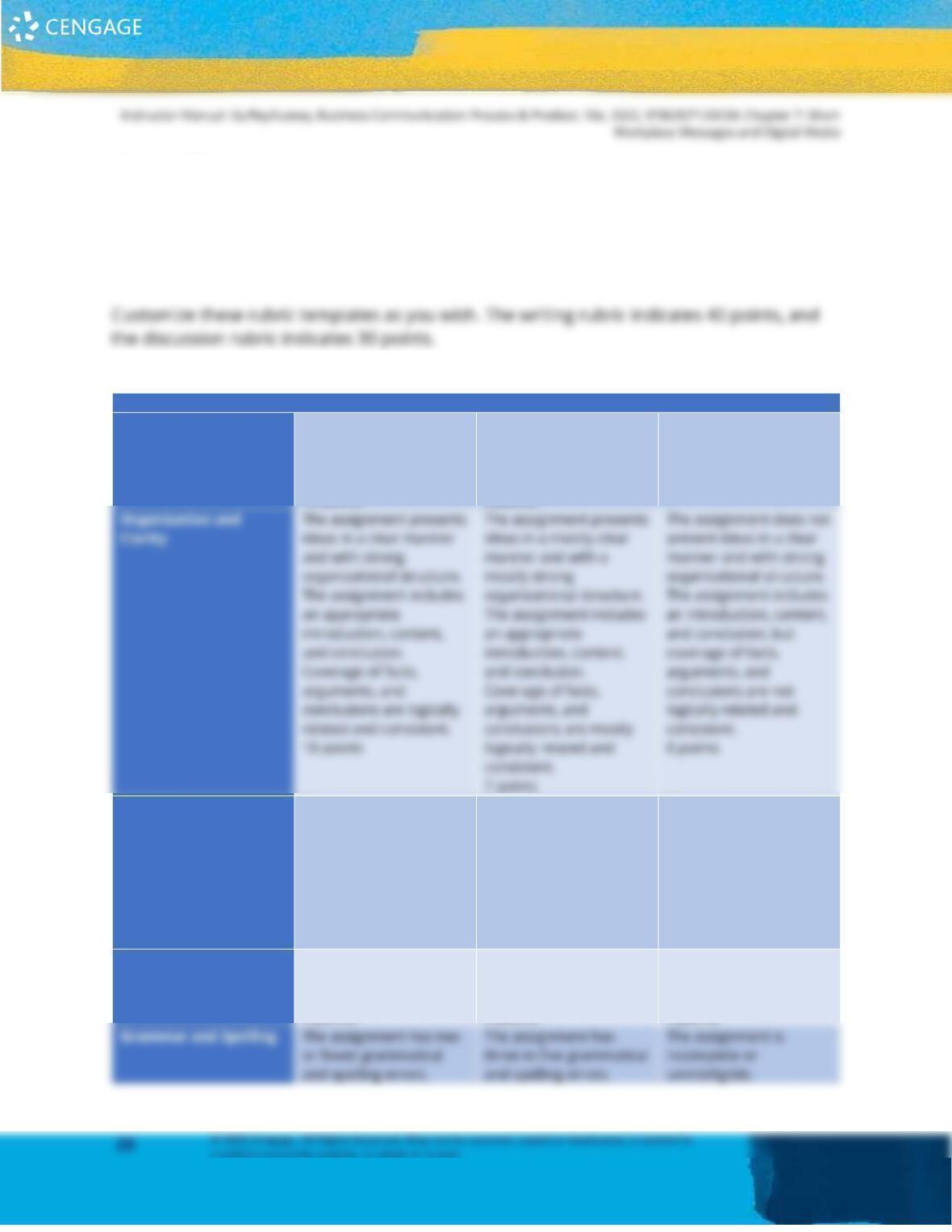
Generic Rubrics
Providing students with rubrics helps them understand expectations and components of
assignments. Rubrics help students become more aware of their learning process and
progress, and they improve students’ work through timely and detailed feedback.
Standard Writing Rubric
Criteria
Meets Requirements
Needs Improvement
Incomplete
Content
The assignment clearly
and comprehensively
addresses all questions
in the assignment.
conclusions are logically
related and consistent.
10 points
arguments, and
conclusions are mostly
logically related and
consistent.
7 points
logically related and
consistent.
0 points
The assignment partially
addresses some or all
questions in the
assignment.
The assignment does not
address the questions in
the assignment.
0 points
Research
The assignment is based
upon appropriate and
adequate academic
literature, including peer
reviewed journals and
other scholarly work.
5 points
The assignment is based
upon adequate
academic literature but
does not include peer
reviewed journals and
other scholarly work.
3 points
The assignment is not
based upon appropriate
and adequate academic
literature and does not
include peer reviewed
journals and other
scholarly work.
0 points
References/Works
Cited
The assignment follows
the required citation
guidelines.
5 points
3 points
0 points
The assignment follows
some of the required
citation guidelines.
The assignment does not
follow the required
citation guidelines.
5 points
3 points
0 points
[return to top]
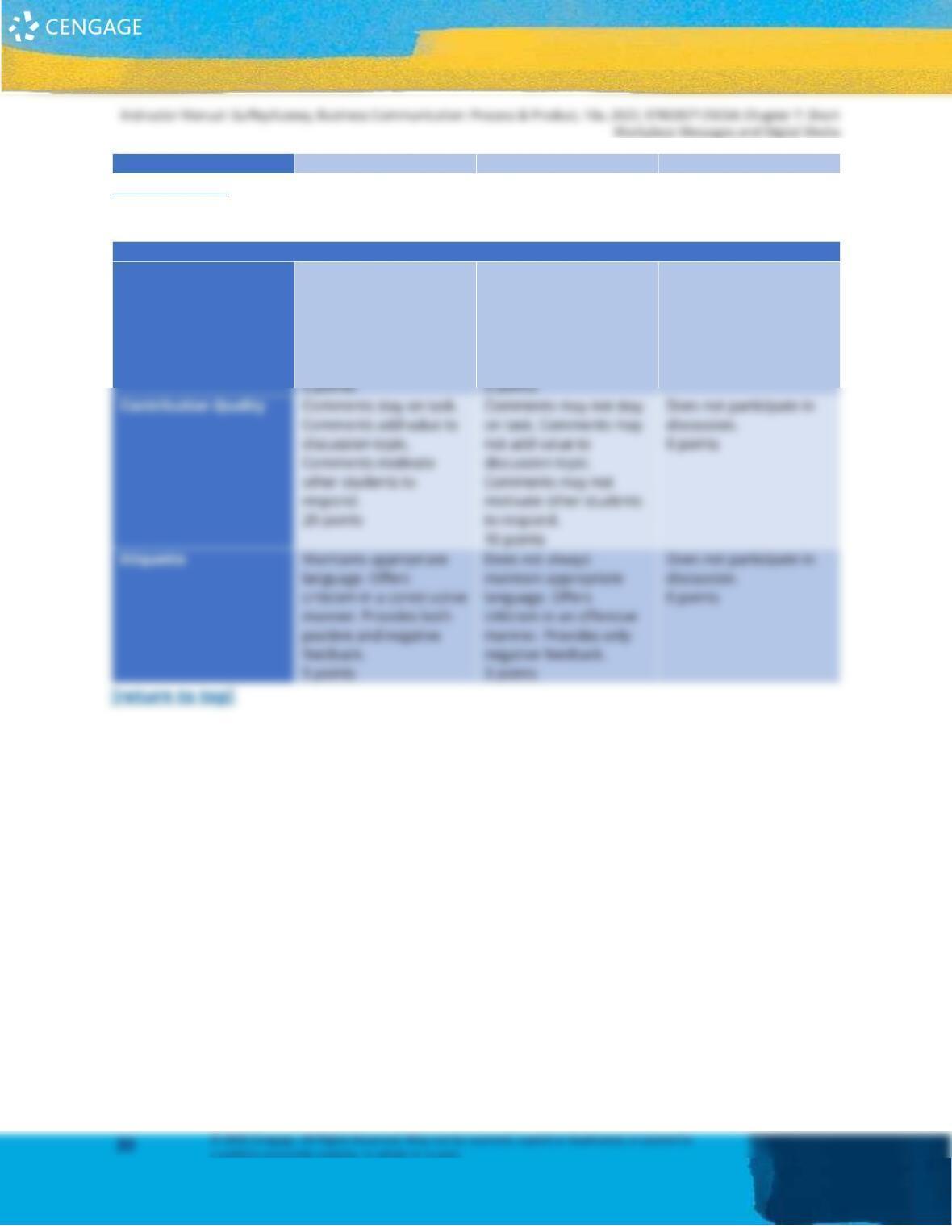
Standard Discussion Rubric
Criteria
Meets Requirements
Needs Improvement
Incomplete
Participation
Participates in or
submits discussion by
the posted deadlines.
Follows instructions for
initial post and
responses.
10 points
3 points
Does not participate in
or submit discussion by
the posted deadlines.
Does not follow
instructions for initial
post and responses.
Does not participate in
discussion.
0 points