
Solution and Answer Guide
Guffey/Loewy, Business Communication: Process & Product, 10e, 2022, 9780357129234;
Chapter 7: Short Workplace Messages and Digital Media
Table of Contents
Zooming In—Critical Thinking Answers …………………………………………………………………………… 1
Be Safe. Be Free. Be Authentic: Cybersecurity Firm Averon on a Mission to Solve a Big Problem ………… 1
Zooming In—Your Turn Solution ……………………………………………………………………………………. 3
Applying Your Skills at Averon ……………………………………………………………………………………………………. 3
Ethics Check Answers …………………………………………………………………………………………………….. 4
Bcc: Sneaky and Rude? ……………………………………………………………………………………………………………… 4
Pricing Blunder Amplified Online ………………………………………………………………………………………………… 4
Critical Thinking Answers ……………………………………………………………………………………………….. 5
Activities Solutions …………………………………………………………………………………………………………. 8
Zooming In—Critical Thinking Answers
Be Safe. Be Free. Be Authentic: Cybersecurity Firm Averon on a Mission to Solve a Big Problem
• How do you feel about log-in credentials and cybersecurity? How do you handle your
passwords, and do you believe they are safe? Have you ever been hacked?
Solution
Answers will vary. Students may be able to share stories about cumbersome and annoying
• After studying teamwork in Chapter 2, you may be able to reflect on the purposes of
Averon’s offsite meetings. What effects might such periodic all-staff gatherings in
upscale hotels have for a small, dispersed team?
Solution
Calling an all-hands meeting in the pleasant environment of an upscale hotel serves to foster
• Microsoft is also working on passwordless solutions but is betting on multifactor
authentication (one-time codes, biometrics, hardware tokens, and more). Rob
Lefferts, corporate vice president for security at Microsoft, has warned that
“Cybersecurity is the central challenge of the digital age. Without it, the most basic
human rights like privacy cannot exist.” Aside from lost privacy, what other threats
may follow from weak cybersecurity?
Solution
Rob Lefferts, corporate vice president for security at Microsoft, recognizes that the other
major threat in addition to a loss of privacy is cost: “Every day organizations take precious
time and resources away from their core business mission to defend against and recover
Zooming In—Your Turn Solution
Applying Your Skills at Averon
• Jot down a list of the kind of information you would never include in any work
correspondence and share the finished product with all staff including Mark Klein
(Averon’s Chief Data Scientist, who is a digital nomad), who wants to be kept in the
loop. Decide whether to send Mark an e-mail or write a memo. Determine how you
will organize the e-mail or memo and include eight to ten taboo topics. Because Mark
almost never visits the San Francisco office, what other channels might you choose to
communicate with him? What are their advantages?
Solution
Students should write an e-mail or memo using the direct strategy because the supervisor
has specifically asked for the document. Any of the following would be suitable to include:
• Anything of a proprietary nature regarding company strategy or products
If the students decide to write a memo, they should attach it to a brief cover e-mail or simply
share the guidelines with Mark in a well-organized direct e-mail message that puts the news
first. Another popular communication channel on the go is Facebook Messenger. With
international audiences, Facebook-owned WhatsApp is the preferred app for messaging or
Ethics Check Answers
Bcc: Sneaky and Rude?
• Some workers use Bcc (blind carbon copy) to copy their friends and colleagues on e–
mails when they don’t want the recipient to know that a third party will also read the
message. Do you believe that hiding copies from the recipient is harmless and
acceptable?
Solution
Today’s writers should use Cc to openly reveal all recipients of a message. Violating this
practice can become quite risky in the workplace if, for example, one of the hidden
recipients accidentally reveals knowledge of the content transmitted in the e-mail. Such
Pricing Blunder Amplified Online
• Arguably the world’s most famous department store, Harrods suffered an
embarrassing website blunder. The upscale UK retailer caused a run on its Aspinal of
London designer handbags once some of these luxury items, typically costing £250
($325) to £950 ($1,240), were advertised online for £2.13 ($2.80) to £8.08 ($10.54). The
upscale department store blamed a supplier’s computer pricing error for the glitch.
Representatives personally contacted customers to apologize “for any inconvenience
caused” but refused to deliver the merchandise at the incorrect price. Was Harrods
obligated to honor the offer?
Solution
A company does not have to honor an innocent mistake, such as an obvious typo or misprint
resulting in a glaring error in pricing. Businesses make mistakes, and they generally

Critical Thinking Answers
1. The eminent sociologist Zygmunt Bauman had this to say about social media: “Most
people use social media not to unite, not to open their horizons wider, but on the
contrary, to cut themselves a comfort zone where the only sounds they hear are the
echoes of their own voice, where the only things they see are the reflections of their
own face. Social media are very useful, they provide pleasure, but they are a trap.” Do
you agree? Why or why not? How do you use social media networks?
Solution
Many of our Critical Thinking questions and our ethics situations could be staged as student
debates. Such debates generate considerable engagement and create greater
comprehension and retention than do mere class discussions. Answers to this Critical
2. You have seen that e-mail is not universally loved although it seems to be
experiencing a noticeable comeback, despite the advent of real-time chat apps,
texting, and other workplace short–form messaging. “Email is the last great unowned
technology,” said the Harvard law professor Jonathan Zittrain, “and by unowned, I
mean there is no CEO of email… it’s just a shared hallucination that works.” Others
believe that e-mail, though much maligned, “is still a cornerstone of the open web.”
Interpret these statements. What points are they making about openness in
particular?
Solution
This Critical Thinking question is testing students’ ability to do a close reading of a short text.
Students should focus on words and phrases such as unowned, no CEO of e-mail, and open
web. E-mail knows no equivalent to Jeff Bezos, Sundar Pichai, Mark Zuckerberg, or Jack
3. Consider the potential impact of gamification and wearable devices on your career.
How do you feel about the tracking of employees and the monitoring of your vital
functions on the job and outside the workplace? Can you think of other vulnerable
technologies? What advice would you give someone who is not sure how to handle
invasive technologies that may threaten privacy and security?
Solution
Answers will vary. Ask how many students wear a Fitbit device, a smart watch, or a similar
wearable device. Do they feel any discomfort about producing so much data that could be
misused or lessen their chances of finding a job? Some students may seem unperturbed by
4. Are conversational Internet acronyms and slang—such as AFAIK, G2G, HIFW, ICYMI,
and NSFW—as well as all-lowercase writing acceptable in e-mail, texting, or instant
messaging for business??
Solution
Like other electronic messages, instant messages and texts may have secondary, unintended
audiences potentially years later. Don’t include abbreviations that are unprofessional,
inappropriate, and confusing. They do not save time if someone has to stop and think about
5. Some marketers and individuals aspiring to becoming influencers employ Internet
bots—automated applications that run simple, repetitive tasks on the Internet—to
inflate the number of likes and fans online. So-called bot networks (botnets) operate
large numbers of fake accounts on Facebook, Instagram, and Twitter. A rental agency
based in Washington, D.C., went from two fans to almost 15,000 within a few days.
How do you feel about companies and their brands pretending they have actual traffic
on their sites and buying likes?
Solution
Most upstanding marketers and Internet users find the practice unethical. They point out
that it violates the terms of use on platforms such as Instagram. Answers from students
Activities Solutions
7.1 Document for Analysis: Poorly Organized Request Requires Revision
Solution
Weaknesses:
• Fails to provide a clear subject line.
• Does not open directly with a statement summarizing the message or with the most
important question.
Revision:
To: Norberto Savala <nsavala@anchore.com>
From: Ryan.Adams <radams@anchore.com>
Subject: Please Answer Questions Re Possible Intern Program
Hi, Norberto,
Should we start an internship program here at Anchore? I’m asking you and other line
managers to consider the following questions and come to the next management meeting
prepared to express your views.
7.2 Document for Analysis: Weak Request Response Requires Your Revision
Solution
Weaknesses:
Note: Your students may find other weaknesses in addition to the following.
• Fails to include a meaningful subject line that summarizes the main idea.
• Does not organize the information for easy reading and comprehension. The five items
Revision:
To: Brian Drummond <brian.drummond@gmail.com>
From: Nadya DeAlba <Nadya.dealba@techsolutions.com>
Subject: Your Request for Examples of Annoying Tech Workplace Behavior
Hello, Brian,
I appreciate this opportunity to contribute to your upcoming blog for Online Voices on the
topic of co-worker tech habits that drive us crazy. You ask that I confine my remarks to five
main points, which I will try to do. However, I could share many more annoying habits that
• Jumbled threads. When writers fail to observe the conventions of threading their
comments on Slack or e-mail, the structure of the conversation becomes garbled. This
annoying behavior is one of many tech irritants that aggravate co-workers.
• Channel hopping. I’ve heard considerable complaining about co-workers who pursue
the intended recipient from channel to channel, following an e-mail with repeated Slack
messages or texts. It would be helpful if people let co-workers know their preferred
method for staying in touch.
Best,
Nadja DeAlba
[Full contact information]
7.3 Document for Analysis: Live Chat at a Local Auto Dealer
Solution
The flaws in this chat are many. Just to name a few, Jayden is unprofessional, too informal,
folksy, and chatty. He does not show the customer respect and asks inappropriate questions
7.4 Instant Messaging: Live Chat Training at TransGlobal Airlines
Solution
Representative 1 exhibits extreme carelessness; he is the superbly laid-back type.
Representative 2 sounds pompous, formal, and uncaring because much of this person’s
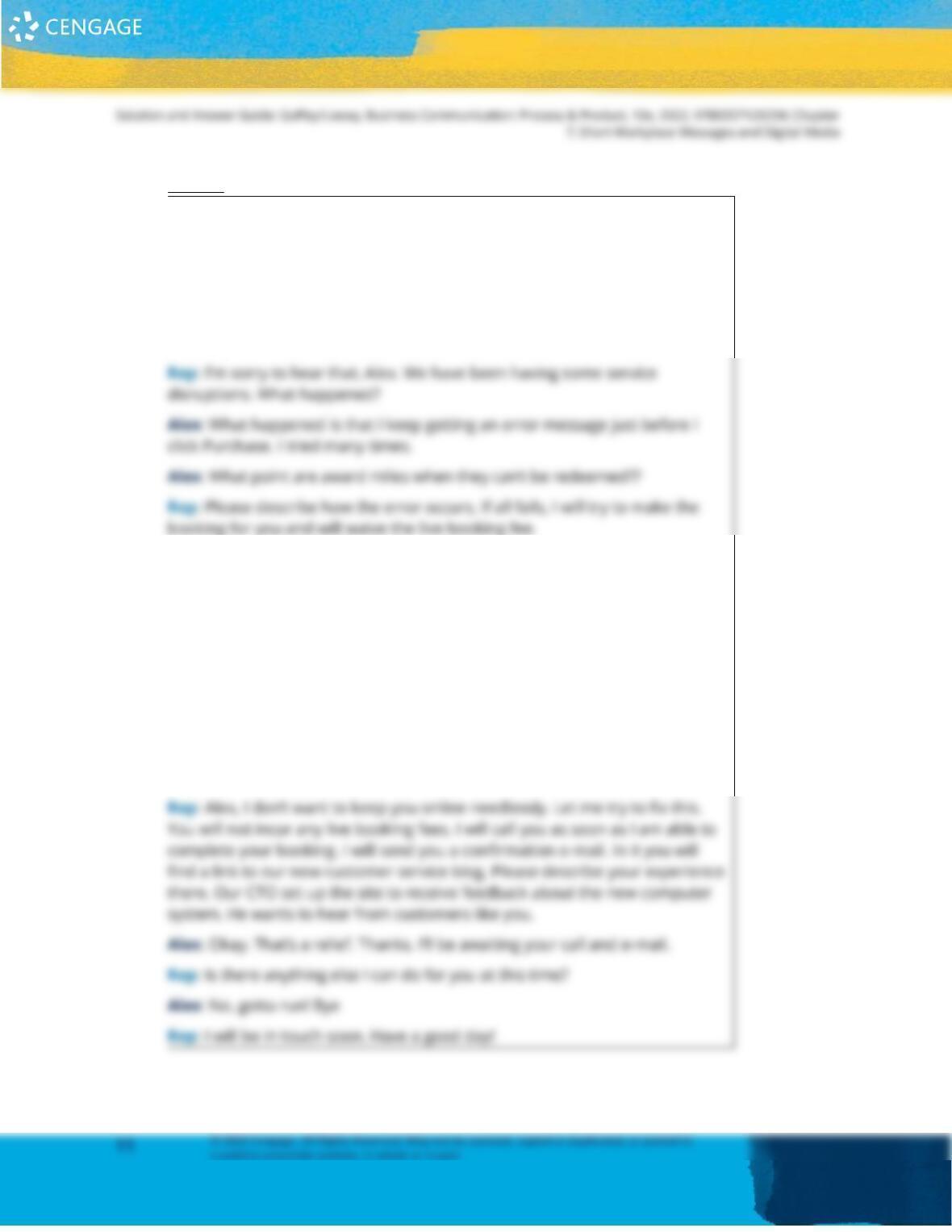
Revision:
Rep: Hello, Alex, thank you for calling TransGlobal Airlines. How are you
doing?
Alex: Hi, I’m okay.
Rep: I’m glad to hear that. How may I help you today?
Alex: Your award–travel system sucks!! I’m so tired of wasting time on your
website!
Alex: I am planning a business trip to London with some of my 500k frequent
flyer miles. Whenever I choose the itinierary, fill in payment information for
the taxes etc, hit Purchase and an Error !!! pops up. I can’t finish the booking.
So annoying! Who has the time??
Rep: Any visitor to our SuperMileage site is tracked. I can see your attempted
booking. Please let me try to make the reservation for you. [Pause]
Rep: I understand your frustration, Alex. I wasn’t able to complete the
booking on our new system, not even on the old one.
Alex: Why on earth do you roll out something that’s full of bugs, why waste
my time??
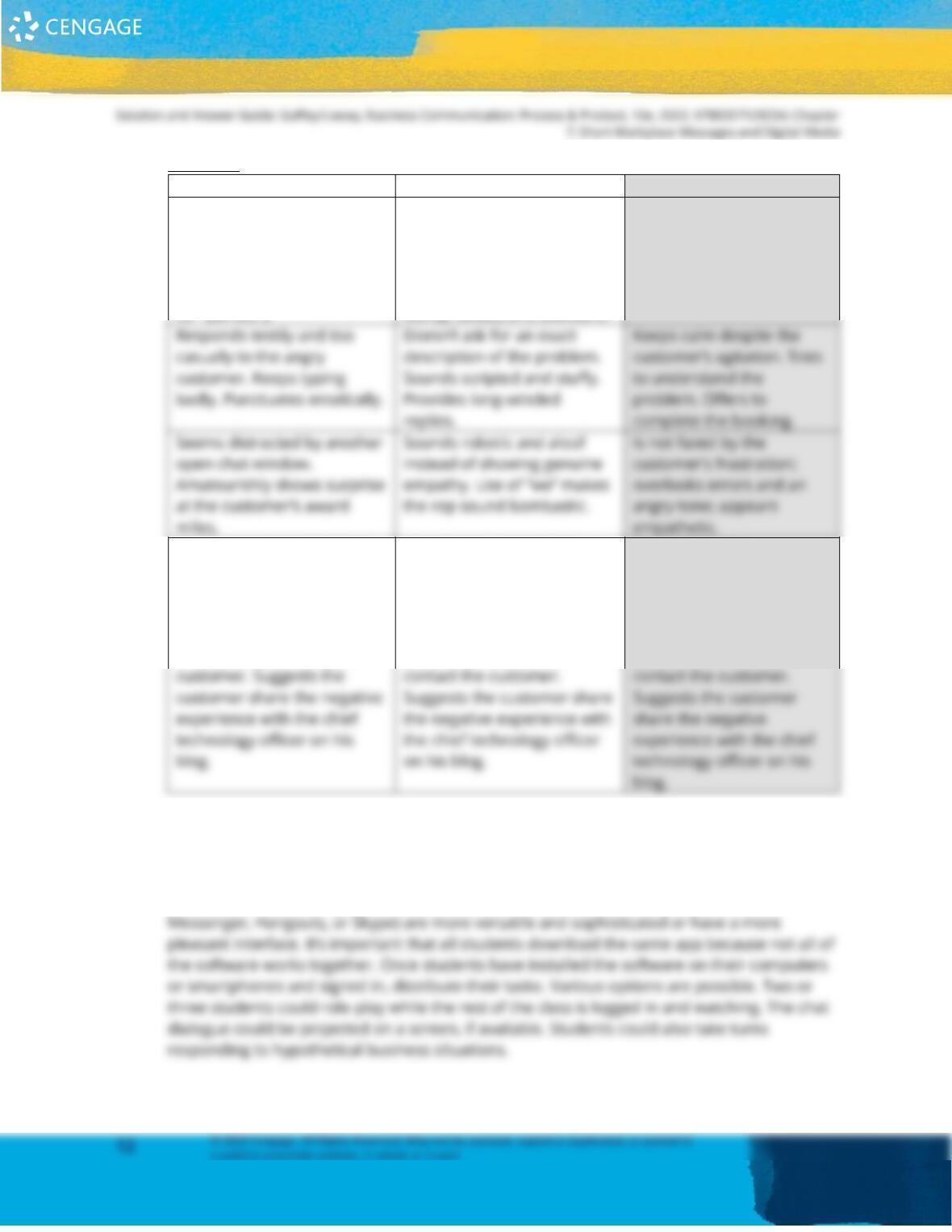
Discussion:
Representative 1
Representative 2
Revision
Adopts a very casual tone
and types carelessly
throughout. Offers an
unprofessional greeting.
Uses millennial slang (perf
badly. Punctuates erratically.
Provides long-winded
problem. Offers to
open chat window.
instead of showing genuine
the rep sound bombastic.
angry tone; appears
The tone is stuffy, overly
formal. The rep doesn’t
sound like a real human
being. The writing is
grammatically correct, but
The rep strikes the right
tone. After exchanging a
pleasantry, gets to the
point, wishing to be
helpful.
Uses more millennial slang.
Is not compassionate
enough. Seems to turn
against his own employer.
Offers to solve the problem
offline and to contact the
customer. Suggests the
experience with the chief
blog.
contact the customer.
the negative experience with
on his blog.
contact the customer.
share the negative
technology officer on his
Uses jargon, escalate for
“seeking help from a
supervisor.” Uses tired
clichés and customer service
lingo. Offers to solve the
problem offline and to
Is mindful of the
customer’s time.
Consistently maintains a
warm, compassionate
tone. Offers to solve the
problem offline and to
7.5 Instant Messaging: Practicing Your Professional Real–Time Chat Skills
Solution
This activity can also be accomplished with the help of the chat function in Blackboard or
Moodle, but the messaging tools mentioned in the activity (Slack, WhatsApp, Facebook
7.6 Discovering Your Favorite Business Podcast Series
Solution
Answers will vary. Most likely students will find some of the information in the chapter
validated as they analyze their chosen podcasts. E–mail responses to this assignment would
7.7 Analyzing a Podcast
Solution
Both Laura Adams and Mignon Fogarty are pros. Laura Adams’s show currently lists 600+
episodes while Mignon Fogerty’s show is closing in on 800 episodes, in addition to providing
competent advice on popular topics. One key feature is the hosts’ dynamic delivery and
7.8 Creating a Simple Business Podcast
Solution
Answers will vary. Help students select business topics and prepare brief scripts. Some of
these steps could be done in class in small groups or as a peer editing exercise. Students
could introduce a local company, explain a business idea, discuss a new piece of legislation
7.9 Reviewing Corporate Blogs
Solution
This assignment allows for a variety of activities. Students could evaluate a blog verbally or in
writing—in memo form, by e-mail, or as a blog entry. Additionally, Blackboard, another
course-management site, or a Facebook page dedicated to the course could be used to post
7.10 Composing a Personal Blog Entry
Solution
This assignment is purposely limited to a recent survey or study to ensure academic honesty
and discourage copying from the Internet. The added benefit is that students will become
acquainted with reliable sources of many useful statistics, not only for social media. The blog
7.11 Blogging: Learning From the Best
Solution
Answers will vary. As an alternative to a blog entry, students could be asked to analyze in a
memo or an e-mail the blogs of the professional bloggers they visited. Students could also
7.12 Epic Twitter Blunders
Solution
Answers will vary, but here are a few possibilities:
a. Sending hate tweets about the boss. The difference between venting around the
water cooler or over lunch to a close friend and trumpeting to the world one’s dislike for
a superior could not be more obvious. Twitter messages can be forwarded (retweeted)
and find their way to unintended recipients. Even deleted tweets can continue their
zombie existence in screen grabs on someone else’s Twitter feed.
d. Announcing the desire to quit. The wish to quit may come true, but prematurely so
and not according to plan. If you hate your job, complain to your pet or vent with your
friends over dinner, but don’t shout it out on Twitter. Smart workers leave a workplace
on good terms knowing that they may need references. They do not burn bridges,
especially publicly.
trouble.” [Rapacon, S. (2016, February 5). How using social media can get you fired. CNBC.]
7.13 Social Media: Quitting Cold Turkey
Solution
Answers will vary, but most students will probably agree that they would consider it a
hardship to relinquish their smartphones even for a day. In an early University of Maryland,
College Park, study, students felt that giving up their smartphones was the hardest part of
being media free for a full day. They felt less strongly about forgoing television. Some felt out
7.14 Social Media: Following the Top 10 Most Plugged–in CEOs
Solution
The answers will vary, of course. In general, students will find that high Brunswick survey
rankings don’t always translate into strong approval scores on Glassdoor. Perceptive
students may recognize that the public image a business leader presents on social media
may not match how that person is viewed internally by employees and managers.