
© 2022 Cengage. All Rights Reserved. May not be scanned, copied or duplicated, or posted to
a publicly accessible website, in whole or in part.
1
Instructor Manual
Guffey/Loewy, Business Communication: Process & Product, 10e, 2022, 9780357129234;
Chapter 7: Short Workplace Messages and Digital Media
Table of Contents
Purpose and Perspective of the Chapter …………………………………………………………………………. 2
Cengage Supplements …………………………………………………………………………………………………… 2
Chapter Objectives ………………………………………………………………………………………………………… 2
Complete List of Chapter Activities and Assessments ……………………………………………………… 3
Key Terms ……………………………………………………………………………………………………………………… 4
What’s New in This Chapter ……………………………………………………………………………………………. 6
Chapter Outline …………………………………………………………………………………………………………….. 6
Discussion Questions …………………………………………………………………………………………………… 18
Additional Activities and Assignments …………………………………………………………………………… 23
Additional Resources ……………………………………………………………………………………………………. 27
Cengage Video Resources ……………………………………………………………………………………………………….. 27
Appendix …………………………………………………………………………………………………………………….. 29
Generic Rubrics ……………………………………………………………………………………………………………………… 29
Standard Writing Rubric ………………………………………………………………………………………………………….. 29
Standard Discussion Rubric ……………………………………………………………………………………………………… 30
Purpose and Perspective of the Chapter
The purpose of this chapter is to explore short forms of workplace communication,
familiarizing students with workplace technologies and best practices that save time,
Cengage Supplements
The following product-level supplements provide additional information that may help you
in preparing your course. They are available in the Instructor Resource Center.
• Transition Guide (provides information about what’s new from edition to edition)
• Educator’s Guide (describes assets in the platform with a detailed breakdown of
activities by chapter with seat time)
Chapter Objectives
The following objectives are addressed in this chapter:
7-1 Examine the professional usage, structure, and format of e-mails and memos in
the digital era workplace.
7-2 Explain workplace messaging and texting including their liabilities and best
practices.
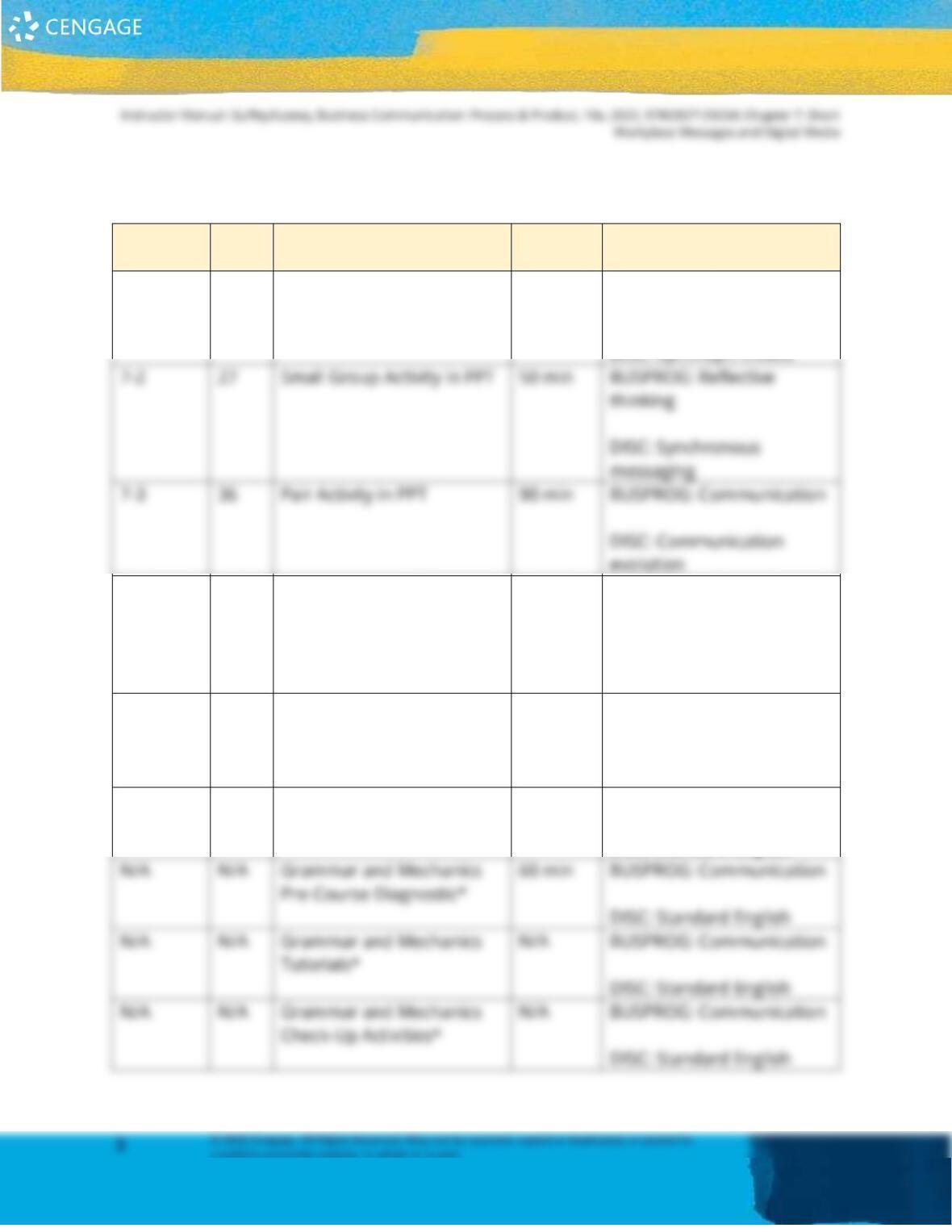
Complete List of Chapter Activities and Assessments
For additional guidance, refer to the Teaching Online Guide.
Chapter
Objective
PPT
Slide
Activity/Assessment
Duration
Certification Standard
7-1
15
Small Group Discussion in
PPT
30 min
BUSPROG: Reflective
thinking
DISC: Syn./Asyn. choice
7-3
36
Pair Activity in PPT
90 min
BUSPROG: Communication
7-4
45
Pair Activity in PPT
30 min
BUSPROG: Reflective
thinking
DISC: Communication
evolution
7-5
60
Knowledge Check in PPT
15 min
BUSPROG: Communication
DISC: Communication
evolution
7-1–7-5
61
Grammar and Mechanics
Quiz in PPT
30 min
BUSPROG: Communication
DISC: Standard English
N/A
N/A
Grammar and Mechanics
Tutorials*
N/A
BUSPROG: Communication
DISC: Standard English
N/A
N/A
Grammar and Mechanics
Check-Up Activities*
N/A
BUSPROG: Communication
DISC: Standard English

Chapters
7–10
N/A
Why Does Workplace
Communication Matter to
Me? (Unit 03 Workplace
Communication)**
5 min
N/A
N/A
Learn It: Chapter 07
Electronic Messages and
Digital Media
min
N/A
7-1–7-5
N/A
Video Presentation:
Communication Channels
for Business (Chapter 07
Electronic Messages and
Digital Media)
10 min
N/A
Digital Media
Workplace
Communication)***
* These activities appear before the student will begin the course.
** This activity appears at the beginning of Unit 3.
*** This activity appears at the end of Unit 3.
[return to top]
Key Terms
Blog: A website or social media platform with journal entries usually written by one person
with comments added by others.
Instructor Manual: Guffey/Loewy, Business Communication: Process & Product, 10e, 2022, 9780357129234; Chapter 7: Short
Workplace Messages and Digital Media
Cyberbullying: A form of bullying committed with digital devices aimed at scaring,
angering, or shaming victims.
Echo chambers: Online communities of like-minded people who embrace narratives
confirming their existing views.
Evangelize: To advocate for brands and services in exchange for compensation and perks.
Instant messaging (IM): Enables two or more individual to use the Internet or an intranet
to chat in real time by exchanging brief text-based messages.
Monetization: The ability of bloggers or podcasters to make money off their blogs and
podcasts.
Viral marketing: The rapid spread of messages online, much like infectious diseases that
spread from person to person.
Virtual private network (VPN): Secure access to an organization’s information from any
location in the world that provides an Internet connection.
[return to top]
What’s New in This Chapter
The following elements are improvements in this chapter from the previous edition:
• Created a current opening case featuring cybersecurity firm Averon that shows
students the dangers of lax digital security and ill-conceived e-mails on the job.
• Rewrote large sections of the chapter to reflect many new trends in contemporary
communication technology, including workplace messaging, real-time chats,
blogging, podcasting, and enterprise social media platforms.
[return to top]
Chapter Outline
In the outline below, each element includes references (in parentheses) to related content.
“CH.##” refers to the chapter objective; “PPT Slide #” refers to the slide number in the
PowerPoint deck for this chapter (provided in the PowerPoints section of the Instructor Resource
Center); and, as applicable for each discipline, accreditation or certification standards (DISC).
Introduce the chapter and review learning objectives for Chapter 7. (PPT Slide 2).
I. Communicating in the Digital Age With E-Mails and Memos (7-1, PPT Slides 3–16,
DISC: Communication evolution; Synchronous messaging; Syn./Asyn. choice)
a. New technologies are transforming the way we exchange information and
conduct business.
i. Businesspeople are increasingly connected 24/7.
iv. Transformation from one-on-one conversations to one-to-many
transmissions
b. E-mail is still going strong 50 years later.
i. Most business messages are now e-mail based.
ii. E-mail mostly replaced paper memos for internal communication
and letters for external audiences.
v. Useful statistics include:
(a) Ninety-six percent of Americans own a cell phone.
(b) Smartphone ownership increased from 35 percent to 81
percent within just nine years.
vi. Common complaints about e-mail include the following:
(a) Messages can be confusing and poorly written.
vii. It’s important to consider the permanence of digital messages.
(a) E-mail should be used only when appropriate.
(b) Short, informal messages may be sent via text, instant
messenger, or chat.
c. To compose a professional e-mail, follow these guidelines
(Model Document 7.1):
i. Draft a compelling but concise subject line.
d. To keep your inbox in check, follow these tips:
i. Check your e-mail at set times and not more than two to three times
a day.
e. Use down-editing to reply efficiently.
i. Down-editing – inserting your responses into parts of the incoming
message
(a) Delete message headers, signature, and other unnecessary
parts.
f. Better e-mail can be achieved by applying best practices to your
communications. (Figure 7.1)
g. Use interoffice memos for important internal communication that:
i. Is too long for e-mail,
ii. Requires a permanent record,
h. Memos and e-mails are similar in that they both:
i. Convey nonsensitive information;
i. Model Document 7.2 illustrates how interoffice memos are formatted and
how they can be created to improve readability with lists and white space.
j. Use this checklist for professional e-mail and memos:
i. Subject line
(a) Summarize the central idea.
ii. Opening
(a) State the purpose for writing.
iii. Body
(a) Explain details.
(d) Be cautious.
iv. Closing
(a) Request action.
k. Small Group Discussion Activity: 30 minutes total. Face-to-Face Meetings
vs. Electronic Messages
Break class into groups of three to five students. Have students read through
the discussion question on the PPT slide. Instruct groups to collectively
choose the most compelling answer to the question and be prepared to
share their findings with the larger group.
I. Messaging and Texting at Work (7-2, PPT Slides 17–28, DISC: Communication
evolution; Synchronous messaging)
a. Instant messaging – enables two or more individuals to communicate in real
time by exchanging brief text-based messages
bots handle routine customer inquiries.
b. Text messaging – popular means for exchanging brief messages in real time,
usually via smartphone
c. Fueled by online security and legal compliance concerns, large enterprises
have bundled multiple communication and collaboration functions behind
corporate firewalls. (Figure 7.2)
d. The benefits of instant messaging and texting include:
i. Real-time communication
e. There are also risks associated with messaging apps and texting.
i. Can be an unnecessary distraction
f. Consider compliance requirements and security concerns:
i. Must meet SEC and other regulatory body requirements
g. Be aware of the liability burden, as accidents due to distraction and
harassment expose employers to expensive legal liability.
h. Best practices for instant messaging and texting include the following:
i. Comply with company policies and don’t disclose sensitive
information.
ii. Avoid harassment and discriminatory content.
iii. Be aware of the appropriateness and security of content.
i. While texting can be quick and unobtrusive, it is important to use proper
etiquette.
i. Effective alternative to a phone call or e-mail
j. All major technology companies now provide instant messaging solutions,
with Slack outperforming all the major players (10 million daily users).
i. The upside:
(a) Declutters e-mail inboxes while increasing camaraderie and
collaboration
ii. The downside:
(a) Can be a workplace distraction and may intrude on home life
(b) Informality can be “an incubator for misbehavior.”
k. Slack etiquette includes the following:
i. Don’t use slang or acronyms with swear words in them and curb the
emojis.
ii. Avoid talking about sensitive or personal topics.
l. Small Group Activity: 50 minutes total. Activity 7.4—Instant Messaging: Live
Chat Training at TransGlobal Airlines
Break class into groups of three to five students. Have students review the
live chat log found in the activity at the end of the chapter and then discuss
II. Making Podcasts Work for Business (7-3, PPT Slides 29–37, DISC: Communication
evolution)
a. The growth in smartphone use and other technological advances have
boosted the reach and popularity of podcasting.
i. Podcasts – digital audio programs resembling radio shows (the
words broadcasting and iPod combined to create the word podcast)
b. Corporations and other businesses:
i. Offer independence from social media algorithms and
diversification of media channels
ii. Modest investment required attractive to businesses
c. Entrepeneurs and enterprising individuals:
i. Well-known businesspeople, TV personalities, and celebrities attract
listeners. (Figure 7.5)
d. News and media organizations:
i. Often distribute several podcast series
e. Education podcasts:
i. Used by some educators to facilitate accessible learning for auditory
learners and students with disabilities
f. Can podcasts make money, and do they last?
i. Podcasts with sizable audiences attract advertisers.
g. These general tips were adapted from Doree Shafrir (a podcast host and the
author of Startup) and are a good place to start:
i. Consistency: Commit to a consistent release schedule.
listeners.
iv. Audience building: Build an audience through guest appearances on
other shows and by using social media to promote your podcast.
h. Pair Activity: 90 minutes total. Activity 7.6—Discovering Your Favorite
Business Podcast Series
Break class into pairs and have each student pair complete the activity found
at the end of the chapter. Instruct students to create an informative but brief
social media post for an audience that doesn’t know the podcast series or
tweet an intriguing tidbit about the show.
• Were you able to find an interesting business-related podcast?
III. Telling Stories With Blogs and News Sites (7-4, PPT Slides 38–46,
DISC: Communication evolution)
a. Companies can use blogs and news sites to tell stories.
i. Keep customers, employees, and the public informed
b. Public relations and customer relations:
i. Up–to-date company information or latest news related to
technology
c. Engagement and viral marketing:
d. Online communities:
i. Loyal followers are drawn by product updates, offers, freebies, and
other news.
e. Internal communication and recruiting:
i. Virtual teams keep on track by staying in touch and sharing updates.
f. These seven tips can help you master blogging:
i. Craft a catchy but concise title.
ii. Ace the opening paragraph.
vii. Respond to posts respectfully.
g. The five journalistic Ws can and should be applied to blog creation.
(Figure 7.6)
h. Pair Activity: 30 minutes total. The Act of Unplugging
Break students into pairs and have them discuss the questions posed on the
PPT slide.
• How many of you have unplugged for a period of time?

a. Social media enable businesses to connect with customers and employees,
share company news, promote goods and services, and exchange ideas.
b. 72 percent of American adults use some type of social media.
i. YouTube: 73 percent
ii. Facebook: 69 percent
c. Where businesses go social [numbers indicate monthly active users (MAUs)]:
i. Facebook: 2.5 billion (95 percent of Fortune 500 companies are now
on Facebook)
ii. Instagram: 1 billion
v. LinkedIn: 310 million
d. On Facebook, the top three product brands with the most fans are Facebook
itself (215 million), Samsung (160 million), and Coca-Cola (107 million).
(Figure 7.7)
e. Enterprise social networking sites mirror those of social media sites but are
securely located behind corporate firewalls.
i. Ultimate goal is greater employee engagement and productivity
f. Nimble damage control and responding to grievances:
i. Quickly respond to disasters and prepare for future disaster needs
g. Connecting dispersed workers:
i. Match up dispersed workers by their skills
h. Crowdsourcing employees to achieve buy-in: