DeVito Interpersonal Messages, 4e Instructor’s Manual
1
Chapter 6: Nonverbal Messages
Chapter Overview
The chapter will discuss nonverbal communication—communication without words—
through body gestures and appearance, facial messages, eye messages, spatial and
territorial communication, artifactual communication, touch communication,
paralanguage, silence, time, and smell communication.
Body gestures are categorized as: (1) emblems (which rather directly translate
words or phrases), (2) illustrators (which accompany and literally “illustrate”
Body appearance encompasses a person’s physical features such as height,
weight, color of skin and hair, and includes aspects of a person’s personality.
Facial movements may communicate a variety of emotions. The most frequently
studied are happiness, surprise, fear, anger, sadness, and disgust/contempt.
Eye movements may seek feedback, invite others to speak, signal the nature of a
relationship, or compensate for physical distance.
Spatial and territorial communication and the study of proxemics focuses on four
major distances in nonverbal communication, including: (1) intimate distance,
Artifactual communication consists of messages conveyed by objects or
arrangements created by humans; for example, by the use of color, clothing,
body adornment, or space decoration.
DeVito Interpersonal Messages, 4e Instructor’s Manual
2
relatedness. Touch avoidance is the desire to avoid touching or being touched by
others.
Paralanguage has to do with the vocal but nonverbal dimension of speech. It
includes rate, pitch, volume, resonance, and vocal quality as well as pauses and
hesitations. Based on paralanguage we make judgments about people, sense
conversational turns, and assess believability.
Time communication or chronemics consists of messages communicated by our
treatment of time. Cultural variations in nonverbal communication vary. Different
cultures, for example, assign different meanings to gestures, facial expressions
and colors, have different spatial rules, and treat time very differently.
Smell communication or olfactory communication, projects two particularly
important messages: attraction and identification, and is often used to create an
image or an identity for a product.
Chapter Objectives
1. Explain the six major ways verbal and nonverbal messages interact with each other.
3. Apply the encoding and decoding suggestions in your own nonverbal interactions.
Student Objectives
Content Objectives:
To realize the breadth of the world of nonverbal communication
To explain the ways nonverbal messages can be sent and received
To recognize the cultural differences in nonverbal communication
Skills Objectives:
DeVito Interpersonal Messages, 4e Instructor’s Manual
3
Skills Evaluation
1. Objective: To send and receive nonverbal messages more effectively. Assign
2. Objective: To send and receive nonverbal messages more effectively. Use the
Skill Building Exercise “Choosing the Right Seat” at the end of the chapter that
3. Objective: To use nonverbal signals more effectively in intercultural
situations. Assign a different country or culture to students in pairs, and ask them to
research its business practices and provide a brief summary to the class.
Chapter Outline
I. Principles of Nonverbal Communication
A. Nonverbal Messages Interact with Verbal Messages
1. Accent
3. Contradict
5. Repeat
6. Substitute
B. Nonverbal Messages Help Manage Impressions
1. To be liked
3. To excuse failure
5. To hide faults
7. To confirm self-image and to communicate it to others
C. Nonverbal Messages Help Form Relationships
D. Nonverbal Messages Structure Conversation
E. Nonverbal Messages Can Influence and Deceive
F. Nonverbal Messages Are Crucial for Expressing Emotions
II. The Channels of Nonverbal Message
A. Body Gestures
1. Emblems
3. Affect displays
5. Adaptors
DeVito Interpersonal Messages, 4e Instructor’s Manual
4
B. Body Appearance
C. Facial Messages
1. Facial management
3. Culture and facial expression
D. Eye messages
2. Eye avoidance
3. Culture, gender, and eye messages
E. Spatial Messages
1. Proxemic Distances
2. Territoriality
F. Artifactual Messages
1. Color
3. Space decoration
4. Smell
G. Touch Messages
1. The meanings of touch
3. Culture and touch
H. Paralanguage Messages
2. Judgments about communication effectiveness
I. Silence Messages
J. Time Messages
1. Psychological time
3. Cultural time
III. Nonverbal Communication Competence
A. Encoding skills
B. Decoding skills
Teaching Strategies
Hiring on Appearances. Teams of students collect pictures of possible job
applicants for several positions. These pictures are given to a different team who
Nonverbal Communication in Physical Context. Have students visit and
describe several locations in regard to the artifactual communication observed. A
list of locations is included on the worksheet, entitled Nonverbal Communication
DeVito Interpersonal Messages, 4e Instructor’s Manual
5
Cultural Meanings of Color. Student teams design a product’s label as it should
appear in China, Thailand, Malaysia, Europe, Japan, Korea, France, the United
Vignette
These examples, from Edward and Mildred Hall, illustrate how important nonverbal
messages can be.
Bob leaves his apartment at 8:15 AM and stops at the corner drugstore for
breakfast. Before he can speak, the server working the counter says, “The
George is talking to Charley’s wife at a party. Their conversation is entirely trivial,
José Ybarra and Sir Edmund Jones are at the same party, and it is important for
them to establish a cordial relationship for business reasons. Each is trying to be
warm and friendly yet they will part with mutual distrust, and their business
Comments: These three examples illustrate the powerful messages communicated
Activities for Student-Based Learning
Nonverbal First Impressions
It is known that nonverbals can affect our perceptions of other people. For this exercise,
bring in a guest that no one in class knows. Ask students to describe this person. For
instance, ask students to judge this person based on his or her nonverbal
DeVito Interpersonal Messages, 4e Instructor’s Manual
6
communication, and describe this person’s background, personality, music interests,
Nonverbal Invader
Ask students to divide into pairs. Have each pair decide who will be the reporter and
who will be the nonverbal invader. Ask the nonverbal invaders to think of something that
they typically would not consider as appropriate or normal. For instance, standing really
close to someone when they talk or maybe constantly touching a stranger to ask for
The Artist
The 2011 movie The Artist is a silent film that demonstrates the power of nonverbal
messages. Have students watch part or all of the film and document nonverbal
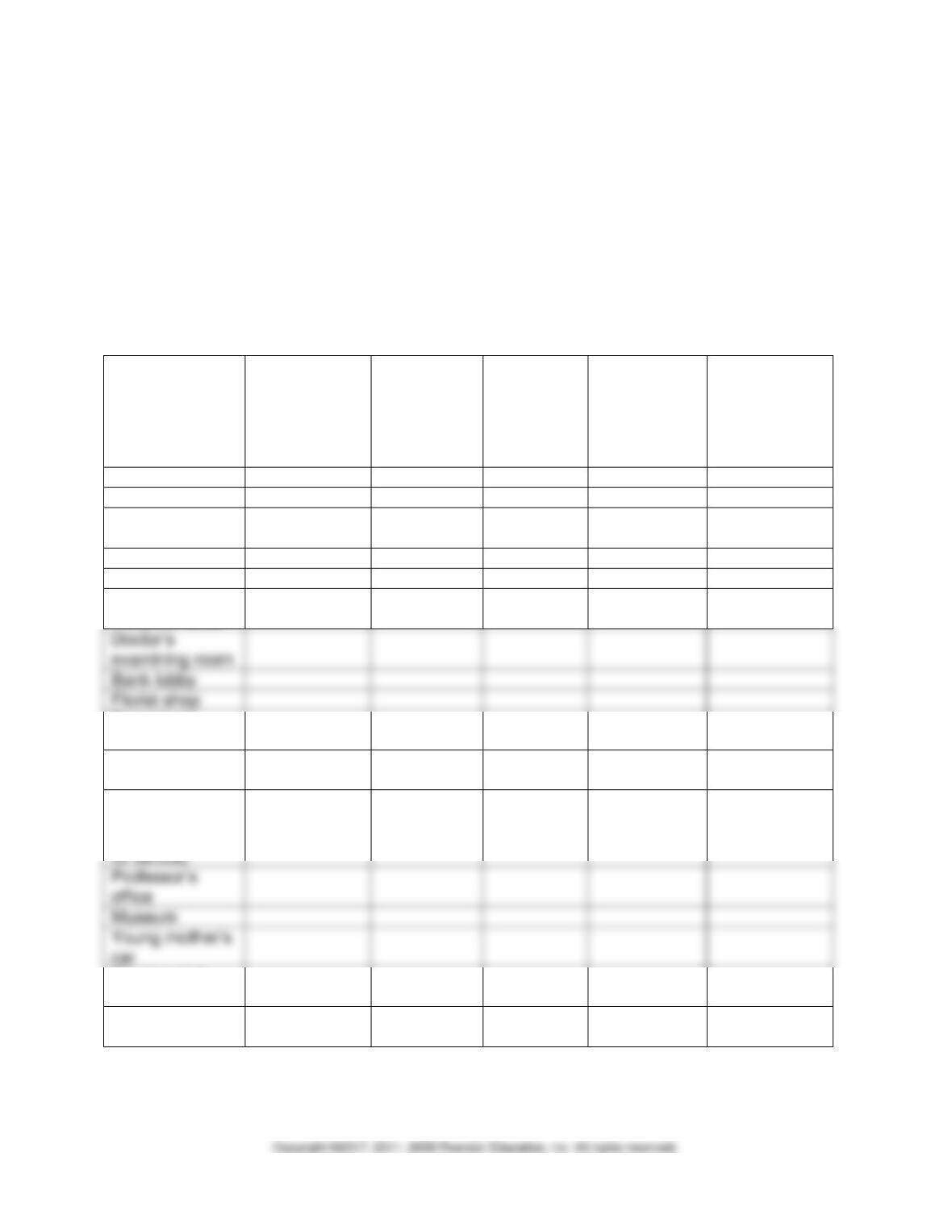
DeVito Interpersonal Messages, 4e Instructor’s Manual
7
Nonverbal Communication Exercise
Name: ___________________________________________ Date: _______________
Class: ____________________ Section: ____________
Directions: Complete the following table using at least ten of the locations listed below.
Write a one-page paper comparing two of the locations and giving your interpretations
of the nonverbal messages you observed. If you do not observe evidence pertinent to
any area, fill in the square with “NA” for not applicable.
Artifactual
Messages
(color, clothing,
and space
decoration)
Time
Messages
(use of and
respect for
time)
Olfactory
Messages
Spatial
Messages
(proxemic
distances and
territoriality)
Tactile
Messages
(haptics,
meaning of
touch, touch
avoidance)
Library
U.S. Post Office
Child day-care
center
Artist’s studio
Gym
Doctor’s
reception area
Doctor’s
examining room
Bank lobby
Florist shop
Executive’s
office
Fast food eat-in
restaurant
office
Museum
Young mother’s
car
“Slow Food”
Restaurant
(assigned seating
Country club
parking lot
Hospital
admissions area