f. Communicators should avoid these three common sentence faults:
i. Fragment – a broken-off part of a complex sentence
g. Reader comprehension drops as sentences become longer, so follow these
tips:
i. Construct sentences that average 20 words.
h. Knowledge Check Activity: 15 minutes total. Identifying Sentence Types
For each of the sentences displayed on the PPT slide, have students choose
the number that identifies its type.
a) Americans pride themselves on their informality.
o 1—Simple sentence
b) When Americans travel abroad on business, their informality may
be viewed negatively.
o 3—Complex sentence
V. Mastering Four Skillful Writing Techniques (5-5, PPT Slides 27–36, DISC: Standard
English; Patterns; Rhetorical considerations)
a. Without verbal and nonverbal clues, when writing you must rely on other
ways to inform readers about which ideas are more important than others.
Instructor Manual: Guffey/Loewy, Business Communication: Process & Product, 10e, 2022, 9780357129234; Chapter 5:
Organizing and Drafting Business Messages
c. To achieve emphasis through mechanics:
i. Use underlining, italics, boldface, and font changes.
d. To achieve emphasis through style:
i. Use vivid words.
ii. Label the main idea.
e. Sometimes it is necessary to de-emphasize content.
i. Use the active voice—the subject (the actor) performs the action—
for clear expression.
ii. Use the passive voice—the subject receives the action—to:
f. Parallelism – sentences written so their parts are balanced, or parallel
i. Writers should use similar structure to express similar ideas,
matching nouns with nouns, verbs with verbs, and clauses with
clauses.
g. Communicators should also avoid dangling and misplaced modifiers:
i. Dangling modifier – when the word or phrase the modifier describes
is missing from its sentence
h. Writing Improvement Activity: 30 minutes total. Activities 5.4 and 5.5—
Active Voice and Passive Voice
Have students complete the two writing improvement exercises related to
active voice and passive voice found at the end of the chapter. Students
should revise the sentences according to the instructions found within each
exercise.
• Answers for Activity 5.4—Active Voice:
a) Artificial intelligence (AI) has made applying for jobs easier.
b) Hiring companies are programming chatbots, another form of
AI, to conduct interviews either by text or voice.
• Answers for Activity 5.5—Passive Voice:
a) A serious error was made in our annual tax figures.
b) The error was discovered too late to correct the annual report.
VI. Building Well-Organized Paragraphs (5-6, PPT Slides 37–47, DISC: Patterns;
Rhetorical considerations; Purpose; Audience)
a. Paragraph – a group of sentences about one idea
b. Topic sentence – expresses the primary idea of the paragraph; often, but not
always, comes first in a paragraph
c. Supporting sentence – illustrates, explains, or strengthens the primary idea
Instructor Manual: Guffey/Loewy, Business Communication: Process & Product, 10e, 2022, 9780357129234; Chapter 5:
Organizing and Drafting Business Messages
i. Direct paragraph plan – used to define, classify, illustrate, or
describe
g. The pivoting paragraph plan:
i. Pivoting paragraph plan – used to compare and contrast
h. The indirect paragraph plan:
i. Indirect paragraph plan – used to explain and persuade
ii. Begins with supporting sentences and concludes with topic
sentence
i. Paragraphs are coherent when ideas cohere—that is, when the ideas stick
together and when one idea logically leads to the next.
j. To build coherence:
i. Sustain the key idea by repeating a key expression or use a similar
one throughout a paragraph.
ii. Dovetail sentences – when an idea at the end of one connects with
an idea at the beginning of the next
k. Small Group Discussion Activity: 40 minutes total. Generating Ideas
Have the students read through the discussion question on the PPT slide and
then explore the Internet for idea-generating techniques. Students should
select the method that appeals to them, and then share their findings with
the larger group.
• What idea-generating techniques did you find in your Internet
research?
• What method appeals to you?
• Why would it be effective?
[return to top]
Discussion Questions
You can assign these questions several ways: in a discussion forum in your LMS; as whole-
class discussions in person; or as a partner or group activity in class.
1. Discussion: College Graduate Preparedness (Critical Thinking #1, 5-1–5-5)
Duration 15 minutes.
a. A survey from PayScale, the compensation data software website, revealed a
surprising gap in perception between managers and new grads. “Overall, the
b. What could explain this gap in perception between managers and new
grads?
i. Answer: The gap might be explained by a difference in standards.
ii. Critics of such studies as that of PayScale contend that managers
frequently do not know how to judge “writing proficiency.” Managers
may think that a misspelled or mistyped word reveals poor language
skills. However, employers have a right to expect college graduates to
be well trained.
2. Discussion: Bad Writing Wastes Valuable Time (Critical Thinking #2, 5-1–5-5)
Duration 15 minutes.
a. How can bad writing waste a businessperson’s time? A researcher asked that
question of workers who read business material an average of 25 hours per
week (about half of which was e-mail).
b. What writing flaws do you think they named?
i. Answer: Of the 547 businesspeople interviewed in this study, 81
c. Should new employees be trained in writing effectively on the job?
i. Answer: The author of the study claimed that “entry-level employees
get little training in how to write in a brief, clear, and incisive way.
3. Discussion: Selecting an Organizational Strategy (Critical Thinking #3, 5-3,
PPT Slides 15–17) Duration 10 minutes.
a. In order to effectively organize ideas, communicators should first analyze
their audience.
b. Why is audience analysis so important in the selection of the direct or
indirect strategy of organization for a business message?
i. Answer: Audience analysis is important because it helps the writer
decide whether the receiver will react positively or negatively to the
4. Discussion: Ethics and the Passive Voice (Critical Thinking #4, 5-5, PPT Slide 33)
Duration 10 minutes.
a. Now that you have studied the active and passive voice, what do you think
when someone in government or business says, “Mistakes were made”?
b. Is it unethical to use the passive voice to avoid specifics?
Additional Activities and Assignments
1. Case Study: Zooming In—Your Turn: Applying Your Skills at MyEvent.com: In
this case study, students will take on the role of an intern at MyEvent.com. In that
role, they are asked to generate ideas about how college and university students
2. Chat About It: At the end of each chapter, you will find additional open-ended
questions related to the chapter material. You may assign these topics for
discussion in class, in an online chat room, or on an online discussion board. You
may also ask students to read and respond to postings made by their classmates.
Topic 1: In the “Let’s Get Personal” Ethics Check, you learned that executives who
Topic 2: This chapter describes brainstorming and brainwriting as techniques for
generating ideas. Explore the Internet for other methods such as freewriting,
looping, listing, clustering, and reporters’ questions. Select a method that appeals
to you, and explain why it would be effective.
Topic 4: In your opinion, how many business managers know what a comma
splice is? If some managers don’t know what a comma splice is, then is it critical
that you avoid comma splices in your writing?
Topic 5: If the ideal length of a sentence is 20 words, why not make all sentences
that length?
[return to top]
Additional Resources
Cengage Video Resources
• MindTap Videos:
o Learn It: Chapter 05 Organizing and Drafting Business Messages
▪ Learn It: Video Lesson 5-1
▪ Learn It: Video Lesson 5-2
Appendix
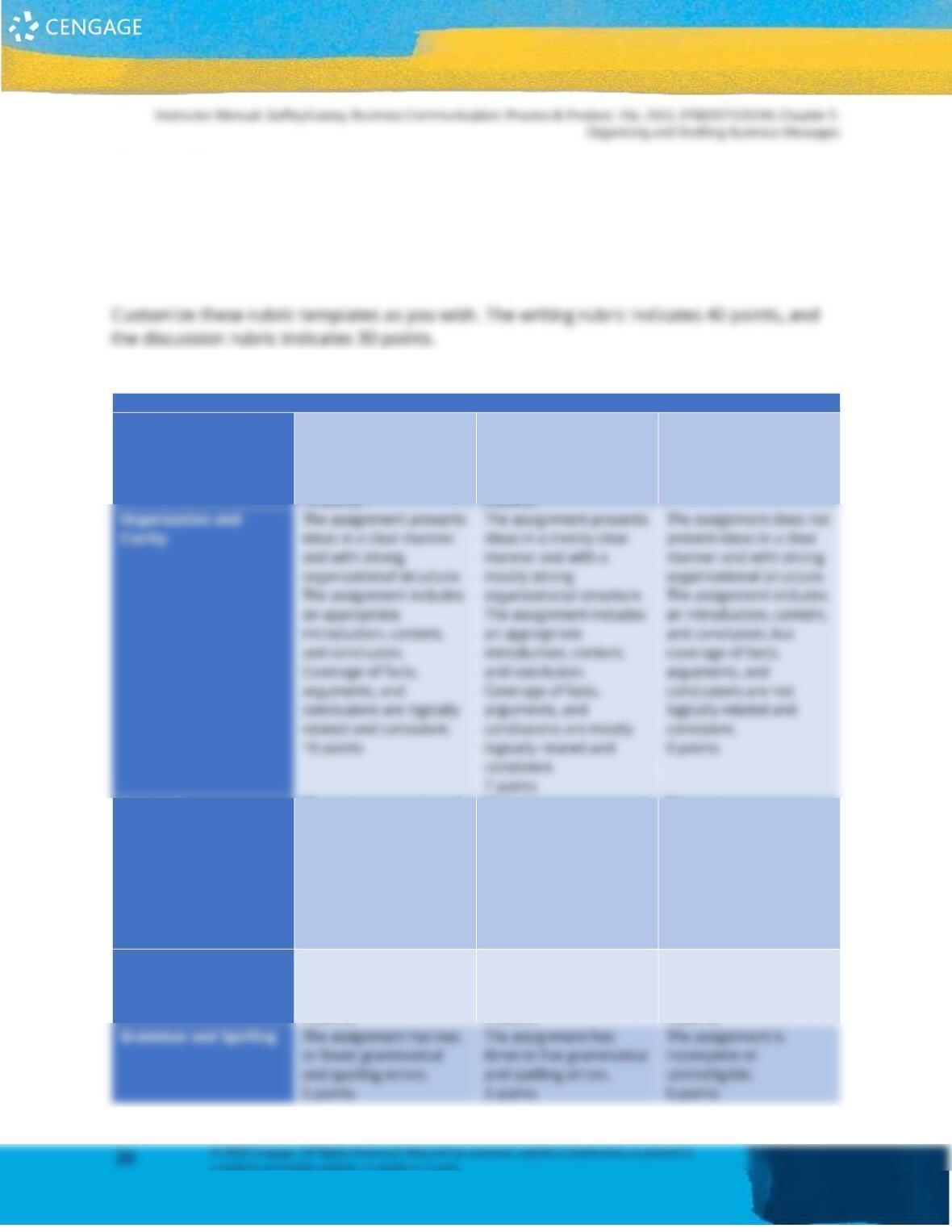
Generic Rubrics
Providing students with rubrics helps them understand expectations and components of
assignments. Rubrics help students become more aware of their learning process and
progress, and they improve students’ work through timely and detailed feedback.
Standard Writing Rubric
Criteria
Meets Requirements
Needs Improvement
Incomplete
Content
The assignment clearly
and comprehensively
addresses all questions
in the assignment.
conclusions are logically
related and consistent.
arguments, and
conclusions are mostly
logically related and
consistent.
7 points
logically related and
consistent.
0 points
The assignment partially
addresses some or all
questions in the
assignment.
The assignment does not
address the questions in
the assignment.
0 points
Research
The assignment is based
upon appropriate and
adequate academic
literature, including peer
reviewed journals and
other scholarly work.
5 points
The assignment is based
upon adequate
academic literature but
does not include peer
reviewed journals and
other scholarly work.
3 points
The assignment is not
based upon appropriate
and adequate academic
literature and does not
include peer reviewed
journals and other
scholarly work.
0 points
References/Works
Cited
The assignment follows
the required citation
guidelines.
5 points
3 points
0 points
and spelling errors.
and spelling errors.
unintelligible.
The assignment follows
some of the required
citation guidelines.
The assignment does not
follow the required
citation guidelines.
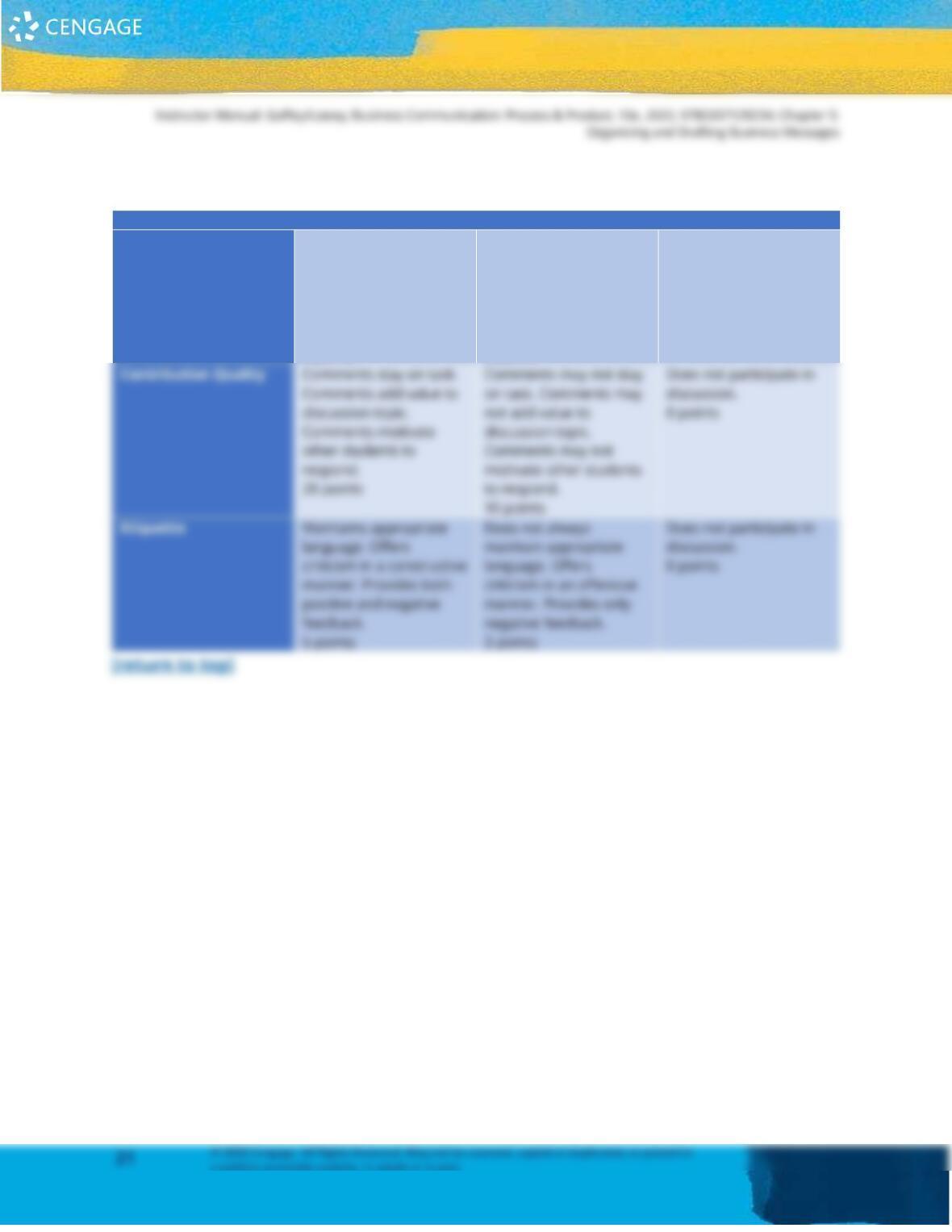
Standard Discussion Rubric
Criteria
Meets Requirements
Needs Improvement
Incomplete
Participation
Participates in or
submits discussion by
the posted deadlines.
Follows instructions for
initial post and
responses.
Comments add value to
discussion topic.
on task. Comments may
not add value to
discussion.
0 points
Does not participate in
or submit discussion by
the posted deadlines.
Does not follow
instructions for initial
post and responses.
Does not participate in
discussion.
0 points