higher executive, so you should be sure to fill in details
and use fairly formal language
IV. Employing Expert Writing Techniques to Adapt to Your Audience (4-4 PPT Slides 28–
35, DISC: Audience; Rhetorical considerations)
a. Adaptation is the process of creating a message that suits the audience.
b. Skilled communicators employ expert writing techniques (listed below and
illustrated in the two versions of an e-mail shown as Model Document 4.1).
i. Focus on audience benefits
ii. Cultivate a “you” view
c. “To be good, it ought to have a tendency to benefit the reader.” – Ben
Franklin
d. “You” view – emphasize second-person pronouns (you, yours) instead of first-
person pronouns (I/we, us, our)
e. Avoid the passive voice (“You will be given”) and use the active voice (“We will
give you”).
l. Soften the tone of your message by using words like please and thank you.
m. Avoid gender, age, and disability biased language by following these tips:
i. Use plural nouns and pronouns or choose gender-free words.
ii. Specify age only when relevant and avoid expressions that are
demeaning.
o. Use precise, vigorous words: Strong verbs and concrete nouns give receivers
more information and keep them interested.
p. Knowledge Check Activity: 15 minutes total. Activity 4.6—Precise, Vigorous
Words
Have students complete the writing improvement exercise found at the end
of the chapter by choosing the most precise, vigorous words from the
choices in parentheses.
a) If you receive two job offers at once, you can probably negotiate a
better deal.
V. Collaborating on Team Projects (4-5, PPT Slides 36–43, DISC: Teamwork)
a. Team writing is often necessary for the following:
i. Big projects
ii. Projects with short deadlines
iii. Projects that require the expertise or consensus of many people
b. Team-written documents provide the following benefits:
i. Produce a better product
c. Team-written documents may be divided as follows (Figure 4.6):
i. Phase 1 (Prewriting)
(1) Group develops procedures and identifies purpose, audience,
content, organization, and design.
(2) Assignments are made to individual team members.
d. Sharing the entire writing process means that all team members contribute
their skills during the three phases.
e. Using the following tools can improve efficiency in team writing and
collaboration:
i. Slack
f. To edit team-written documents without making enemies, follow these tips:
i. Begin remarks with a positive statement. What can you praise?
ii. Do you understand the writer’s purpose? If not, be specific in
explaining what you don’t understand.
g. Pair Activity: 30 minutes total. Team Projects
Break class into pairs and have each student pair discuss the question
regarding team projects. Students should share their experiences with their
partners and then be prepared to discuss their responses with the larger
group.
• Think back to the last time you were involved in a team project. What
[return to top]
Discussion Questions
You can assign these questions several ways: in a discussion forum in your LMS; as whole-
class discussions in person; or as a partner or group activity in class. (Critical Thinking #3
can be found in the chapter outline above as a PPT activity.)
1. Discussion: The Image of Bad Writing (Critical Thinking #1, 4-1–4-4)
Duration 15 minutes.
a. A wise observer once said that bad writing makes smart people look stupid.
b. Do you agree or disagree? Why?
i. Answer: Bad writing conveys the impression that the writer is
2. Discussion: The Case for Plain Language (Critical Thinking #2, 4-4, PPT Slide 34)
Duration 15 minutes.
a. Have you ever read something complex and blamed yourself for not
b. Do you agree? If so, how can writers do this?
i. Answer: Writers can avoid dense and ponderous language by using
3. Discussion: The Case for Short, Familiar, Simple Words (Critical Thinking #4, 4-4,
PPT Slide 34) Duration 15 minutes.
a. Experts agree that by substituting everyday, familiar words for unfamiliar
ones, you help your audience comprehend your ideas more quickly.
b. Why should business writers strive to use short, familiar, simple words? Does
this dumb down business messages?
i. Answer: Using short, familiar, simple words increases the likelihood
4. Discussion: Team Project Freeloaders (Critical Thinking #5, 4-5, PPT Slide 39)
Duration 20 minutes.
a. After a workplace project was completed, you were rightfully upset. You and
two other team members did all of the work, but two freeloaders are sharing
in the credit. This probably wouldn’t have happened in college team
assignments.
b. Should you report the freeloaders to the manager?
i. Answer: In college team assignments, members of the project are
often graded on their contributions. Fellow team members evaluate
[return to top]
Additional Activities and Assignments
1. Case Study: Zooming In—Words Matter! VisibleThread Strives to Improve
Readability in Corporate Writing: In this case study, students will read an overview
of the company VisibleThread (founded by Fergal McGovern), which helps financial
organizations and money managers improve the readability of their websites and
documents by using plain language. They are then asked to answer a series of
critical-thinking questions.
a. Why do you think Fergal McGovern is motivated to focus so intensely on
readability in documents and websites in the financial industry?
i. Fergal McGovern founded VisibleThread to sell his services to money
managers and financial institutions. He identifies wordiness, complex
b. Technology has changed the way people read, McGovern contends. Today’s
readers have short attention spans and gather information by skim reading.
Why is readability particularly important for online readers who are reading
quickly to find information?
i. Readers will leave a site if they don’t find answers to their questions
c. McGovern suggests that low readability scores in financial documents may
result from a desire to impress clients with a lofty tone. Does inflated
language encourage or damage trust? Why is it critical that financial
institutions offer readable documents that build trust?
i. Students will probably agree that high-sounding words and inflated
language are more likely to cause consternation than trust. McGovern
2. Case Study: Your Turn: Applying Your Skills at VisibleThread: In this case study,
students will be asked to take on the role of an intern at VisibleThread who has
been asked to rewrite a wordy test paragraph in order to gauge their writing skills.
Students should revise the paragraph and then compose an e-mail message to the
To: Fiona.McBride@vthread.com
From: Your name
Subject: Revision of Wordy Security Message
Dear Ms. McBride:
As you requested, here is my improved version of the wordy security message:
Dear Customer:
Attached is information about increasing security at your business. For
after-hours security, we suggest defensive indoor and outdoor lighting,
3. Chat About It: At the end of each chapter, you will find additional open-ended
questions related to the chapter material. You may assign these topics for
discussion in class, in an online chat room, or on an online discussion board. You
may also ask students to read and respond to postings made by their classmates.
Topic 1: Psychologist Heidi Halvorson, presented earlier in a Reality Check,
cautions communicators to think twice: “The next time you catch yourself
thinking ‘I didn’t expressly say that to Bob, but it should be obvious . . .’ STOP.
Nothing is ever obvious unless you made it obvious by spelling it out.” She
further admonishes speakers to banish from their vocabularies the phrase “It
goes without saying.” Think about a time when you thought you were absolutely
clear, but you were misunderstood. How could you have been better
understood?
Topic 4: Think about a time when someone had to reveal bad news to you. Did
you feel that the best communication channel was used to deliver that news?
What channels are richest? Should they always be used to reveal bad news or to
Additional Resources
Cengage Video Resources
• MindTap Videos:
o Learn It: Chapter 04 Planning Business Messages
▪ Learn It: Video Lesson 4-1
▪ Learn It: Video Lesson 4-2
▪ Learn It: Video Lesson 4-3
[return to top]
Appendix
Generic Rubrics
Providing students with rubrics helps them understand expectations and components of
assignments. Rubrics help students become more aware of their learning process and
progress, and they improve students’ work through timely and detailed feedback.
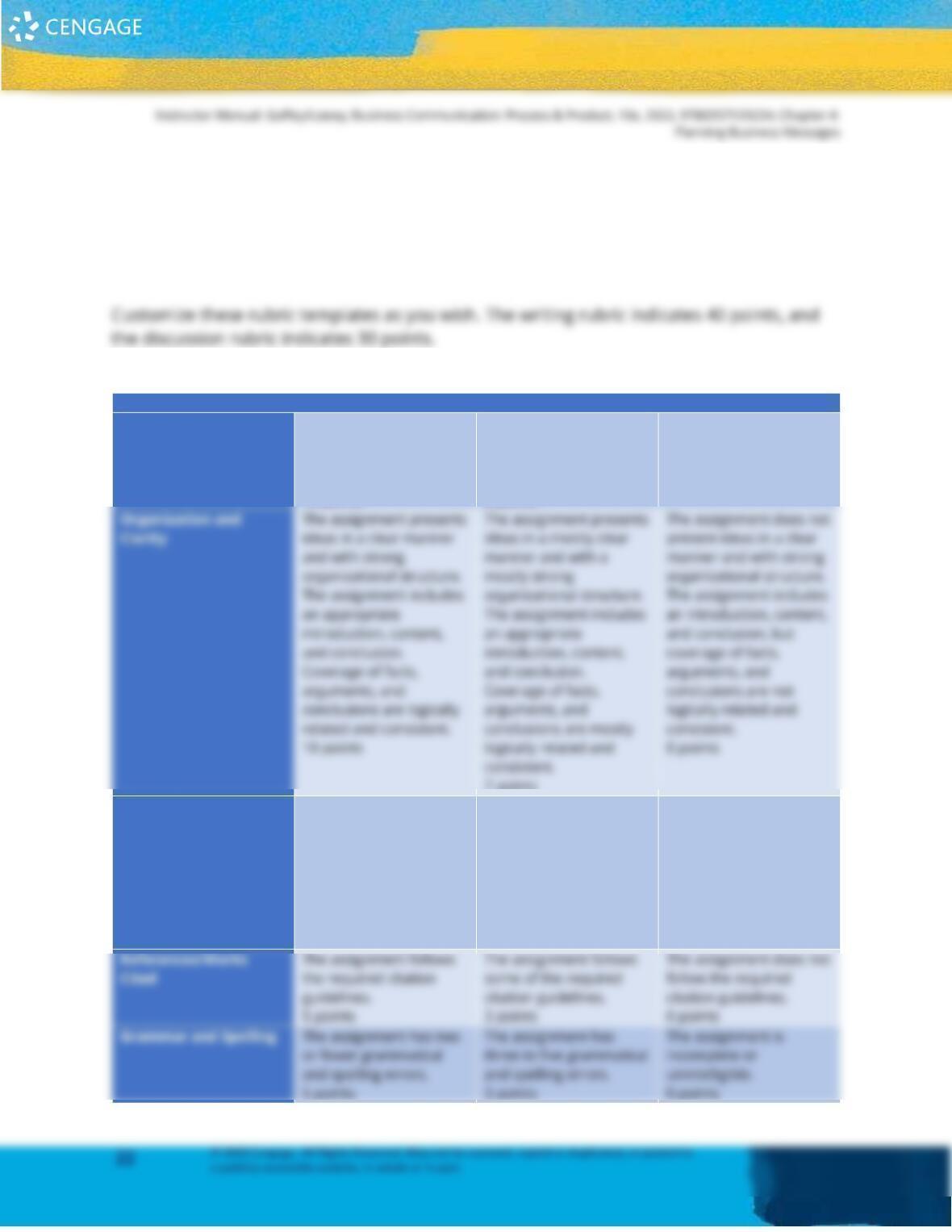
Standard Writing Rubric
Criteria
Meets Requirements
Needs Improvement
Incomplete
Content
The assignment clearly
and comprehensively
addresses all questions
in the assignment.
conclusions are logically
related and consistent.
10 points
arguments, and
conclusions are mostly
logically related and
consistent.
logically related and
consistent.
0 points
The assignment partially
addresses some or all
questions in the
assignment.
The assignment does not
address the questions in
the assignment.
0 points
7 points
Research
The assignment is based
upon appropriate and
adequate academic
literature, including peer
reviewed journals and
other scholarly work.
5 points
The assignment is based
upon adequate
academic literature but
does not include peer
reviewed journals and
other scholarly work.
3 points
The assignment is not
based upon appropriate
and adequate academic
literature and does not
include peer reviewed
journals and other
scholarly work.
0 points
The assignment follows
the required citation
guidelines.
5 points
The assignment follows
some of the required
citation guidelines.
3 points
The assignment does not
follow the required
citation guidelines.
0 points
and spelling errors.
and spelling errors.
unintelligible.
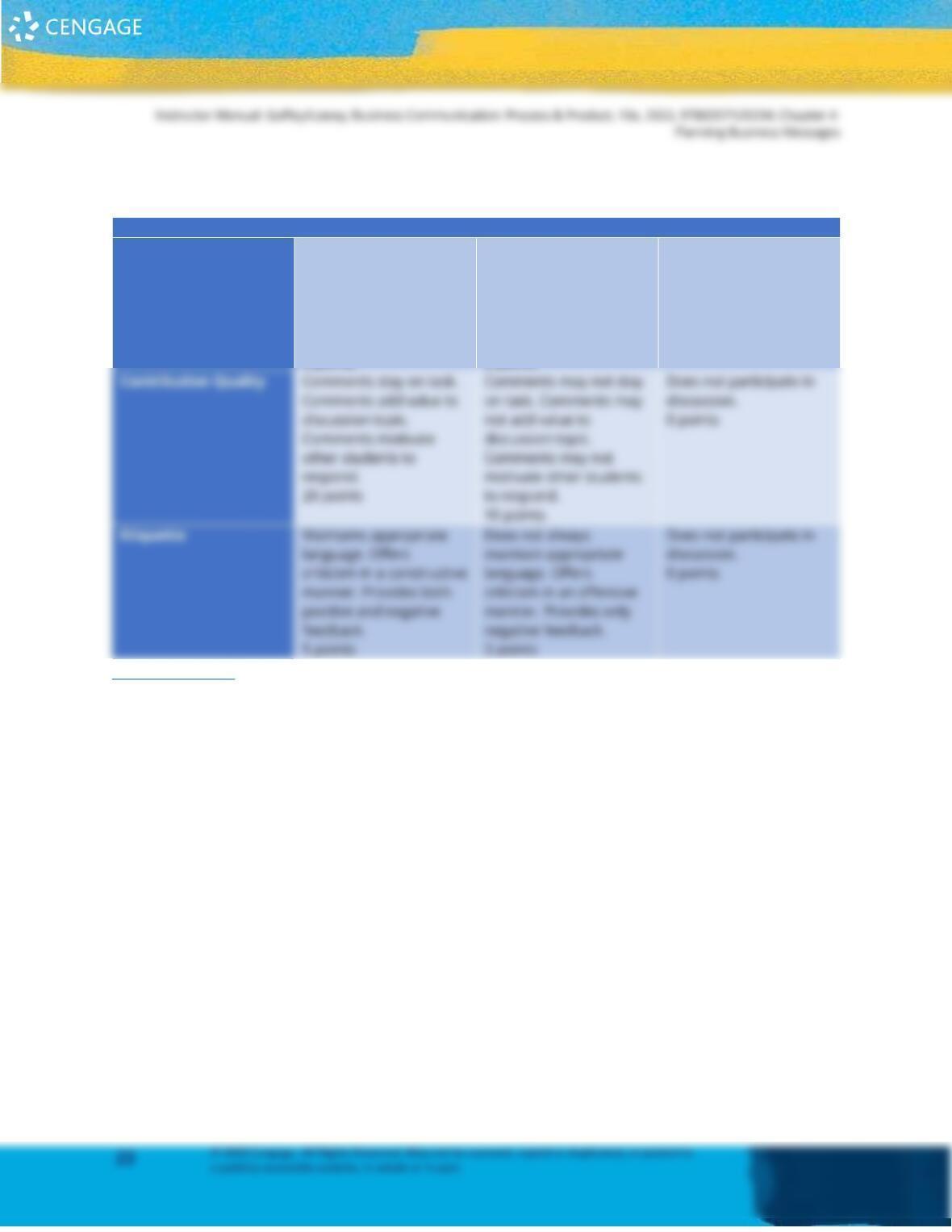
Standard Discussion Rubric
Criteria
Meets Requirements
Needs Improvement
Incomplete
Participation
Participates in or
submits discussion by
the posted deadlines.
Follows instructions for
initial post and
responses.
Comments motivate
other students to
respond.
20 points
discussion topic.
Comments may not
motivate other students
to respond.
Does not participate in
or submit discussion by
the posted deadlines.
Does not follow
instructions for initial
post and responses.
Does not participate in
discussion.
0 points
[return to top]