© 2022 Cengage. All Rights Reserved. May not be scanned, copied or duplicated, or posted to
a publicly accessible website, in whole or in part.
15
ii. Harmful pesticides may be used because crops would otherwise be
consumed by insects.
g. Doing the right thing can result in serious economic consequences, but
fighting corruption may offer tangible rewards such as the recovery of lost
tax revenues and the restoration of public trust.
h. Use these suggestions to acknowledge different values while emphasizing
moral initiative:
i. Broaden your view.
ii. Create virtuous incentives for staff.
i. When faced with an intercultural ethical dilemma, use the five-question test
from Chapter 1, Figure 1.14:
i. Is the action legal?
j. Small Group Activity: 90 minutes total. Activity 3.13—Gifts and
Entertainment Limits: What Is Nominal Value?
Break class into groups of three. Have each small group complete the activity
found at the end of the chapter and be prepared to share their answers with
other organizations. In particular, they should find comparison information
on gifts, gratuities, kickbacks, and entertainment limits.
• What companies or organizations did you choose?
V. Evaluating Benefits and Challenges of Workplace Diversity (3-5, PPT Slides 42–48,
DISC: Cultural imperatives; Gender differences)
a. Workplace diversity has many dimensions—race, ethnicity, age, religion,
gender, national origin, physical ability, sexual orientation, and others.
d. As society and the workforce become more diverse, successful interactions
and communication among identity groups bring distinct advantages in three
areas: consumers, work teams, and business organizations.
i. Diverse teams are better equipped to respond to diverse consumer
demands.
ii. Team members with different backgrounds and perspectives may
result in more innovative and effective solutions.
e. Diversity may also lead to divisiveness, discontent, and clashes.
i. Women face the glass ceiling (invisible barrier of attitudes,
prejudices, and old boy networks blocking them from reaching
important corporate positions).
f. Organizations must commit to diversity.
g. How companies deal with diversity will determine how well they compete in
a global environment.
h. Organizations can use these suggestions to improve communication and
interaction among diverse workers:
i. Seek training.
i. Small Group Discussion Activity: 60 minutes total. Chat About It Topic #1:
“It’s Time for ‘They’”
Break class into small groups of three to five students. Have students read
the New York Times opinion piece titled “It’s Time for ‘They’“ referenced at
• What does the author of the opinion piece mean?
• What might be the response from the perspective of a gender-
nonconforming person?
[return to top]
Discussion Questions
You can assign these questions several ways: in a discussion forum in your LMS; as whole-
class discussions in person; or as a partner or group activity in class.
I. Discussion: Intercultural Blunders (Critical Thinking #1, 3-3, PPT Slides 24 & 28)
Duration 15 minutes.
a. When Procter & Gamble launched its Pampers brand in Japan, the diaper
package confused and disturbed customers. As in the United States, the
b. Can you explain what may have caused the intercultural blunder?
i. Answer: Procter & Gamble’s misstep shows a lack of preparation on
c. How could Procter & Gamble have avoided it?
i. Answer: A simple way to prevent it would have been to test the
packaging with Japanese audiences before launching Pampers in the
Japanese market.
II. Discussion: Being an Effective Ambassador When Abroad (Critical Thinking #2, 3-3,
PPT Slide 24) Duration 15 minutes.
a. When we travel or work abroad, we tend to be perceived not so much as
policy, military actions, and economic influence.
b. How can you ensure that you function as an effective ambassador of your
country when working and traveling overseas?
i. Students may need to learn that when traveling or working abroad,
they will be perceived as representative of the larger U.S. culture and
ii. Answer: The best way to proceed when challenged abroad is to avoid
being dragged into arguments, remain genial and friendly, and
III. Discussion: Stereotypes (Critical Thinking #3, 3-3, PPT Slide 25) Duration 20 minutes.
a. A stereotype is an oversimplified perception of a behavioral pattern or
characteristic applied to entire groups. For example, the Swiss are
hardworking, efficient, and neat; Germans are formal, reserved, and blunt;
and tolerant; Asians are gracious, humble, and inscrutable.
b. In what way are such stereotypes harmless or harmful?
i. Answer: These attitudes may or may not accurately describe cultural
norms. As we have seen, stereotypes often do contain a grain of truth
because they originate as observations leading to generalizations.
After all, generalizations help us make sense of the world we live in.
IV. Discussion: Inappropriate Cultural Jokes (Critical Thinking #4, 3-5, PPT Slide 45)
Duration 20 minutes.
a. You know that it’s not acceptable to make ethnic jokes, least of all in the
workplace, but a colleague of yours keeps invoking the worst ethnic and
racial stereotypes.
b. How do you respond?
c. What other options do you have in dealing with such a coworker?
d. Consider whether your answer would change if the offender were your boss.
i. Answer: Answers will vary. Students will probably realize that they will
V. Discussion: Cultural Differences in Ethics (Critical Thinking #5, 3-4, PPT Slide 39)
Duration 30 minutes.
a. Transparency International, the global antibribery watchdog, severely
b. Can you explain why using one’s connections to receive preferential
treatment may cause harm?
i. Answer: On its website, Transparency International explains why
wasta is harmful to the Arab societies that practice it. The NGO argues
treatment.
ii. Wasta reinforces economic inequality. According to the World Bank,
more than half of the labor force in many Arab countries is
unemployed, because wasta is a major hurdle to getting a job. Skills,
education, and experience are unimportant. When surveyed, 60
percent of young people in the region agreed that knowing someone
in a position of power is key to obtaining employment. [Transparency
International. (2019, December 11). Wasta: How personal connections
are denying citizens opportunities and basic services.]
favoritism is at work in the United States or in the countries they may
hail from, if they are international students or immigrants.
iv. It may also be valuable to address cultural relativism, an important
sociological idea. It is the concept that morals are all equal, and that
[return to top]
Additional Activities and Assignments
1. Case Study: Zooming In—Walmart: Global Expansion Marred by Intercultural
Blunders and Legal Woes: In this case study, students will read a description of
a. The late marketing guru Theodore Levitt, who coined the term globalization,
argued that the customer is central to all business endeavors. However, his
most provocative assertion, debated to this day, is that the “global
corporation” of the future would sell standardized consumer products, not
cater to local differences in taste. Walmart’s JP Suarez believes that all
customers want the same. Should companies stick to a standardized
approach or adapt to local markets?
i. Many of our Critical Thinking questions and Ethics situations could be
ii. Levitt stirred a huge controversy by arguing that global markets would
run on standardized goods at low prices due to economies of scale,
making the localization of products unnecessary. He conceded that a
different in each market.
iii. Some analysts believe that multinational companies with a proven
business model, such as Walmart’s discounting strategy, will be most
successful if they implement the techniques that made them
iv. An example of a company striking a balance between global and local
might be KFC, currently the largest fast-food enterprise in China,
which supplements its standard menu with local food items. Another
example is IKEA. The Swedish furniture behemoth has successfully
b. What domestic and global changes enable the international expansion of
companies such as Walmart?
i. Like Walmart, many domestic as well as multinational companies are
expanding their operations overseas. This expansion is largely
motivated by a desire to increase profits. As domestic markets mature
c. What other businesses have merged with overseas companies or expanded
to become multinational or global? Have you heard of any notable successes
or failures?
i. Students should be able to name many U.S. companies that are
multinational, such as Apple, Comcast, Dole Food Company, IBM,
Johnson & Johnson, Mattel, Microsoft, Procter & Gamble, The Walt
2. Case Study: Zooming In—Your Turn: Applying Your Skills at Walmart: In this
case study, students will read a description of Walmart’s evolving image. They are
then asked to take on the role of a member of a team working to improve the image
of the global retailer and create a communication plan that addresses a specific
question. Break students into groups of three to five and have them complete the
assignment as a team. You may wish to have students present their work to the
class or submit their responses electronically.
a. As a junior member of a task force assembled by EVP for Corporate Affairs at
Walmart, Dan Bartlett, you are working to improve the image of the global
retailer. Despite many praiseworthy initiatives, Walmart is still viewed by
i. Walmart has struggled with image problems at home and abroad,
mainly as a result of its cost-cutting approach, strong-arming of
suppliers, displacing local businesses, conservative human resources
policies, low wages, lack of health insurance, and what some perceive
as corporate hubris.
ii. Whatever its motives, the company has launched significant green
initiatives and encouraged others to collaborate on making global
consumption more sustainable. Thanks to its immense size, Walmart
3. Chat About It: At the end of each chapter, you will find additional open-ended
questions related to the chapter material. You may assign these topics for
discussion in class, in an online chat room, or on an online discussion board. You
may also ask students to read and respond to postings made by their classmates.
(Topics #1–3 can be found in the Chapter Outline above as PPT activities.)
Topic 4: Netflix is admired for a lengthy manifesto that describes its culture.
Workers are asked to be “curious about how our different backgrounds affect us
at work, rather than pretending they don’t affect us.” “You recognize we all have
biases, and work past them. You intervene if someone else is being
marginalized.” How do you interpret these statements? What do they mean?
4. Test Your Workplace Etiquette IQ: New communication platforms and casual
workplace environments have blurred the lines of appropriateness, leaving workers
wondering how to navigate uncharted waters. Have students check their workplace
etiquette IQ by deciding whether the following statements are true or false.
Scenario 1: The best way to show confidence and friendliness when greeting
people in other countries is by shaking hands and making direct eye contact.
Answer: False. Americans tend to assume that others around the world
Intercultural Communication
© 2022 Cengage. All Rights Reserved. May not be scanned, copied or duplicated, or posted to
a publicly accessible website, in whole or in part.
26
Scenario 2: When representing your organization abroad on business, you
should show your enthusiasm and friendliness with expansive gestures and first–
name conversations.
Answer: False. When abroad, it’s wise to remember that Americans are
Scenario 3: If you are traveling abroad, open doors and allow older
businesspeople to enter a room and be seated before you.
Additional Resources
Cengage Video Resources
• MindTap Videos:
o Learn It: Chapter 03 Intercultural Communication
▪ Learn It: Video Lesson 3-1
[return to top]
Appendix
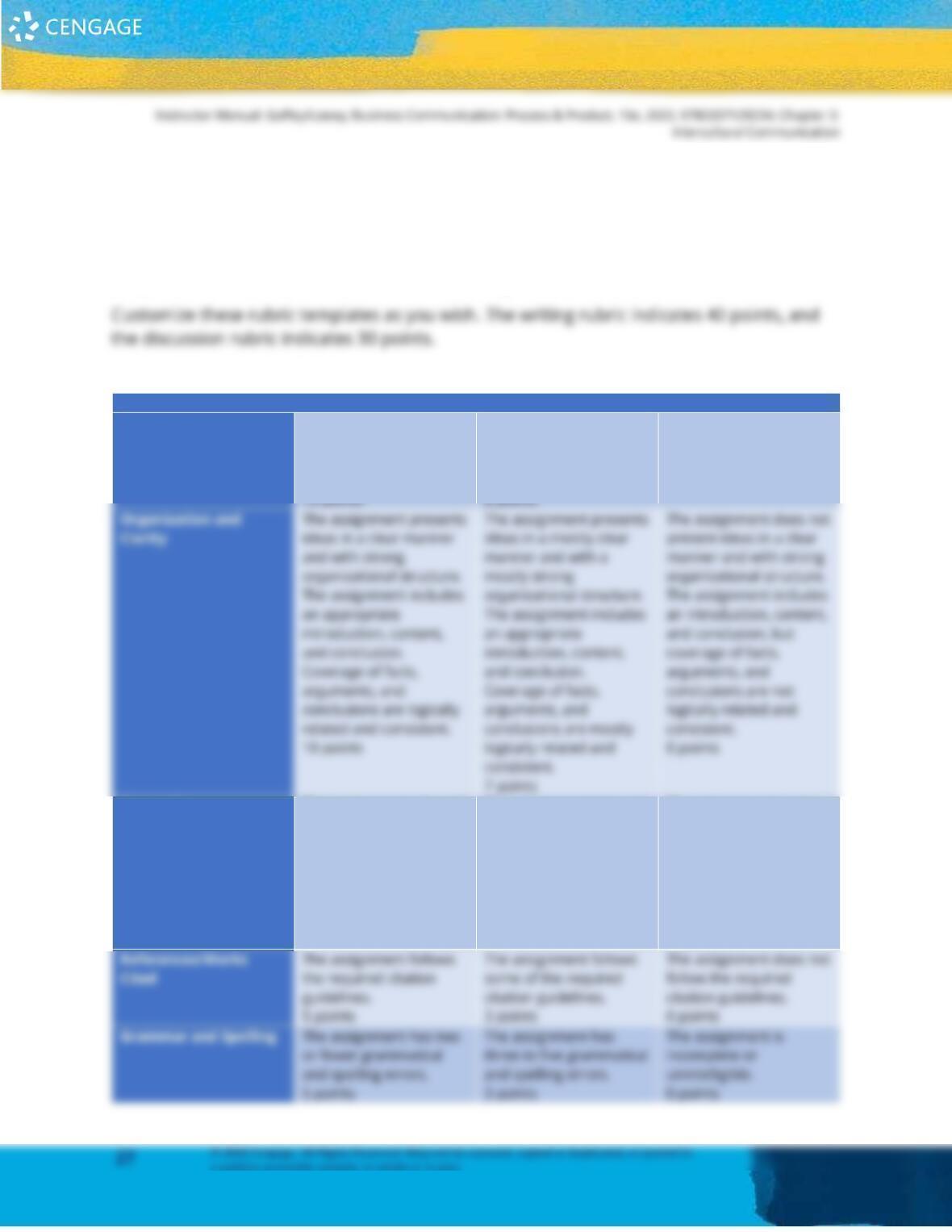
Generic Rubrics
Providing students with rubrics helps them understand expectations and components of
assignments. Rubrics help students become more aware of their learning process and
progress, and they improve students’ work through timely and detailed feedback.
Standard Writing Rubric
Criteria
Meets Requirements
Needs Improvement
Incomplete
Content
The assignment clearly
and comprehensively
addresses all questions
in the assignment.
conclusions are logically
related and consistent.
arguments, and
conclusions are mostly
logically related and
consistent.
7 points
logically related and
consistent.
0 points
The assignment partially
addresses some or all
questions in the
assignment.
The assignment does not
address the questions in
the assignment.
0 points
Research
The assignment is based
upon appropriate and
adequate academic
literature, including peer
reviewed journals and
other scholarly work.
5 points
The assignment is based
upon adequate
academic literature but
does not include peer
reviewed journals and
other scholarly work.
3 points
The assignment is not
based upon appropriate
and adequate academic
literature and does not
include peer reviewed
journals and other
scholarly work.
0 points
The assignment follows
the required citation
guidelines.
5 points
The assignment follows
some of the required
citation guidelines.
3 points
The assignment does not
follow the required
citation guidelines.
0 points
and spelling errors.
and spelling errors.
unintelligible.
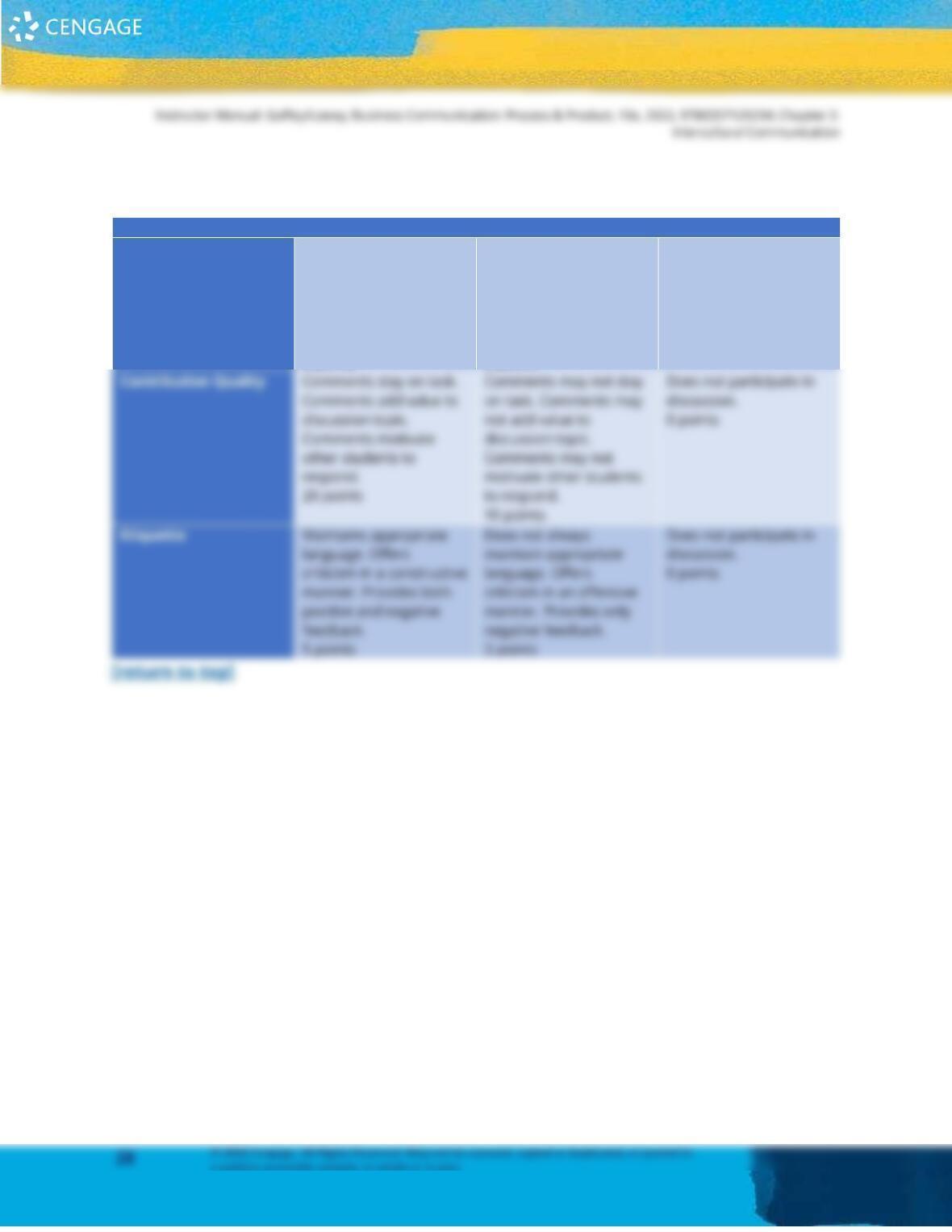
Standard Discussion Rubric
Criteria
Meets Requirements
Needs Improvement
Incomplete
Participation
Participates in or
submits discussion by
the posted deadlines.
Follows instructions for
initial post and
responses.
Comments motivate
other students to
respond.
20 points
discussion topic.
Comments may not
motivate other students
to respond.
Does not participate in
or submit discussion by
the posted deadlines.
Does not follow
instructions for initial
post and responses.
Does not participate in
discussion.
0 points