h. Self-Assessment Activity: 20 minutes total. Activity 2.9—How Good a
Listener Are You?
Have students review the activity found at the end of the chapter and then
score themselves on each question using a scale of 1 to 5 as indicated in the
activity instructions. Share an interpretation of their results with your
students.
• The higher your score, the lower your listening skills. The closer your
score is to 45, the highest possible score, the more strongly you
probably need a skills upgrade. By contrast, the lower your score is,
• In addition to the best practices for more effective listening presented
in the text, students could be asked to look for reputable articles or
IV. Communicating Nonverbally (2-4, PPT Slides 37–44, DISC: Purpose; Cultural
imperatives)
a. Nonverbal communication includes all unwritten and unspoken messages,
whether intended or not.
d. Your body sends silent messages.
i. Eye contact – Show attention and respect and reveal sincerity,
confidence, and truthfulness.
e. Time, space, and territory send silent messages:
i. Time – Arrive on time, stay on task, and give amply of your time.
f. Appearance sends silent messages:
i. Eye appeal of business documents – Avoid sloppy communication
and use the appropriate appearance and format to convey
messages.
g. Tips for building strong nonverbal communication skills in the workplace are
as follows (Figure 2.11):
i. Establish and maintain eye contact.
ii. Use posture to show interest.
iii. Reduce or eliminate physical barriers.
h. Pair Activity: 60 minutes total. Activity 2.14—Nonverbal Communication
Around the World
Break class into pairs and have each student pair complete the activity found
at the end of the chapter. Students should be prepared to share their results
with the larger group.
• What are the ten gestures you chose?
• How are their meanings different in other countries?
b. There are costs associated with incivility:
c. Projecting and maintaining a professional image can make a real difference
in helping you obtain and retain the job of your dreams. (Figure 2.12)
d. Use these pointers to polish your social competencies:
i. Use polite words.
ii. Express sincere appreciation and praise.
iii. Be selective in sharing personal information.
ix. Disagree agreeably.
e. There are six main dimensions of professional behavior that will ease your
entry into the world of work. (Figure 2.13)
f. Knowledge Check Activity: 15 minutes total. Test Your Workplace Etiquette
IQ
Have students check their workplace etiquette IQ by deciding whether the
statements are true or false and then discuss the answers with the class.
• You are attending a business function designed to help people
• When a business meeting is long and you are not directly involved, it
is acceptable for you to perform minor grooming tasks such as
combing your hair, applying lipstick, or clipping your fingernails—as
business meeting.
[return to top]
Discussion Questions
You can assign these questions several ways: in a discussion forum in your LMS; as whole-
class discussions in person; or as a partner or group activity in class.
1. Discussion: Multitasking (Critical Thinking #1, 2-1) Duration 20 minutes.
a. Cal Newport, computer scientist and author, blames open-office layouts and
relentless collaboration for a decline in concentrated deep thinking. He cites
task.
b. Are you easily distracted? What techniques help you concentrate?
i. Answer: Students’ answers will vary. Many will probably dispute that
2. Discussion: Beware of Meetings (Critical Thinking #2, 2-2, PPT Slide 24)
Duration 15 minutes.
a. Evaluate the following humorous analogy between the murder of a famous
b. Is the comparison fitting? What might the author of the article have wanted
to convey?
i. Answer: The author of this article who is critical of meetings uses
humor to mock meetings, which are almost universally disliked. He
opens his article with this rather incongruous comparison between a
3. Discussion: Listening as Executives and Managers (Critical Thinking #3, 2-3, PPT Slide
31) Duration 5 minutes.
a. Good listeners make good managers.
b. Why do executives and managers spend more time listening than do
workers?
i. Answer: Before they can make decisions, executives must listen to
4. Discussion: Is Body Language a Science? (Critical Thinking #4, 2-4, PPT Slide 39)
Duration 10 minutes.
a. Understanding messages often involves more than merely listening to
we don’t use words. The eyes, face, and body convey meaning without a
single syllable being spoken.
b. What arguments could you give for or against the idea that body language is
a science with principles that specialists can interpret accurately?
i. Answer: Although few would argue that body language does send
silent messages, no scientific principles have evolved explaining
[return to top]
Additional Activities and Assignments
1. Case Study: Zooming In—Uplifting Others: Collaboration and Team-
Orientation at Lyft: In this case study, students will read a description of Lyft’s
approach to strategic partnerships, hiring, and teams. They are then asked to
answer a series of critical-thinking questions.
a. Why is Lyft partnering with much larger organizations?
i. As Lyft is growing rapidly and competing with its much larger rival,
Uber, it is forming strategic partnerships, especially in capital-
b. Why does Lyft test new-hires for their culture fit, and why is it valuable for
employer and employee?
i. A company culture, or its personality, includes its corporate values,
c. What attitudes and behaviors contribute to effective teams?
i. Highly effective team members are committed to a common outcome
and attain it by adopting a positive attitude. Individuals in successful
2. Case Study: Your Turn: Applying Your Skills at Lyft: To prepare for this case
study, students will be asked to watch a six-minute video on YouTube that illustrates
Lyft’s one–of-a-kind corporate headquarters and also to use the Internet to explore
a. Student responses should include the components that make face-to-face
and virtual meetings productive: determining a purpose, selecting
participants, using a digital calendar app for scheduling, and distributing an
agenda and other information. Virtual meetings require additional skills and
practices to prevent technology glitches, to schedule across time zones, and
to overcome language challenges.
c. Being aware of time zones and logging in early. Encourage students to indicate
the time difference between San Francisco and Munich in Coordinated
e. Explaining how questions may be asked and answered. It’s wise to determine
turn-taking among 15 people on the one end and ten on the other. The
agenda outlines the meeting. Because this virtual meeting is for welcoming
the new team, all team members should briefly introduce themselves.
i. As for the element of fun, more worldly students might caution that humor
doesn’t always translate well and that Lyft’s freewheeling corporate culture
might bewilder the Germans who are used to a more formal business
environment, even in tech. In addition, the age of the engineers was not
disclosed. It might be relevant to know how to relate to them. Other students
might mention diversions such as wearing various Lyft-branded items, such
as pink mustaches, or bringing in a pet. You may be surprised at how creative
3. Chat About It: At the end of each chapter, you will find additional open-ended
questions related to the chapter material. You may assign these topics for
discussion in class, in an online chat room, or on an online discussion board. You
may also ask students to read and respond to postings made by their classmates.
Topic 1: Research by the late communication expert Clifford Nass suggests that
young people are spending so much time looking at screens that they are losing
the ability to read nonverbal communication and learn other skills necessary for
one-on-one interactions. Have you observed social awkwardness in your own
life? Would the loss of social skills be worrisome?
Topic 4: Consider a situation in your family, in your circle of friends, in high
school, at college, during an internship, or at work that shows the potential risks
of poor listening skills. How could the resulting misunderstandings or other
negative consequences have been prevented? Which techniques would have
helped avert the undesirable outcome?

© 2022 Cengage. All Rights Reserved. May not be scanned, copied or duplicated, or posted to
a publicly accessible website, in whole or in part.
22
Additional Resources
Cengage Video Resources
• MindTap Videos:
o Learn It: Chapter 02 Professionalism: Team, Meeting, Listening, Nonverbal,
and Etiquette Skills
▪ Learn It: Video Lesson 2-1
[return to top]
Appendix
Generic Rubrics
Providing students with rubrics helps them understand expectations and components of
assignments. Rubrics help students become more aware of their learning process and
progress, and they improve students’ work through timely and detailed feedback.
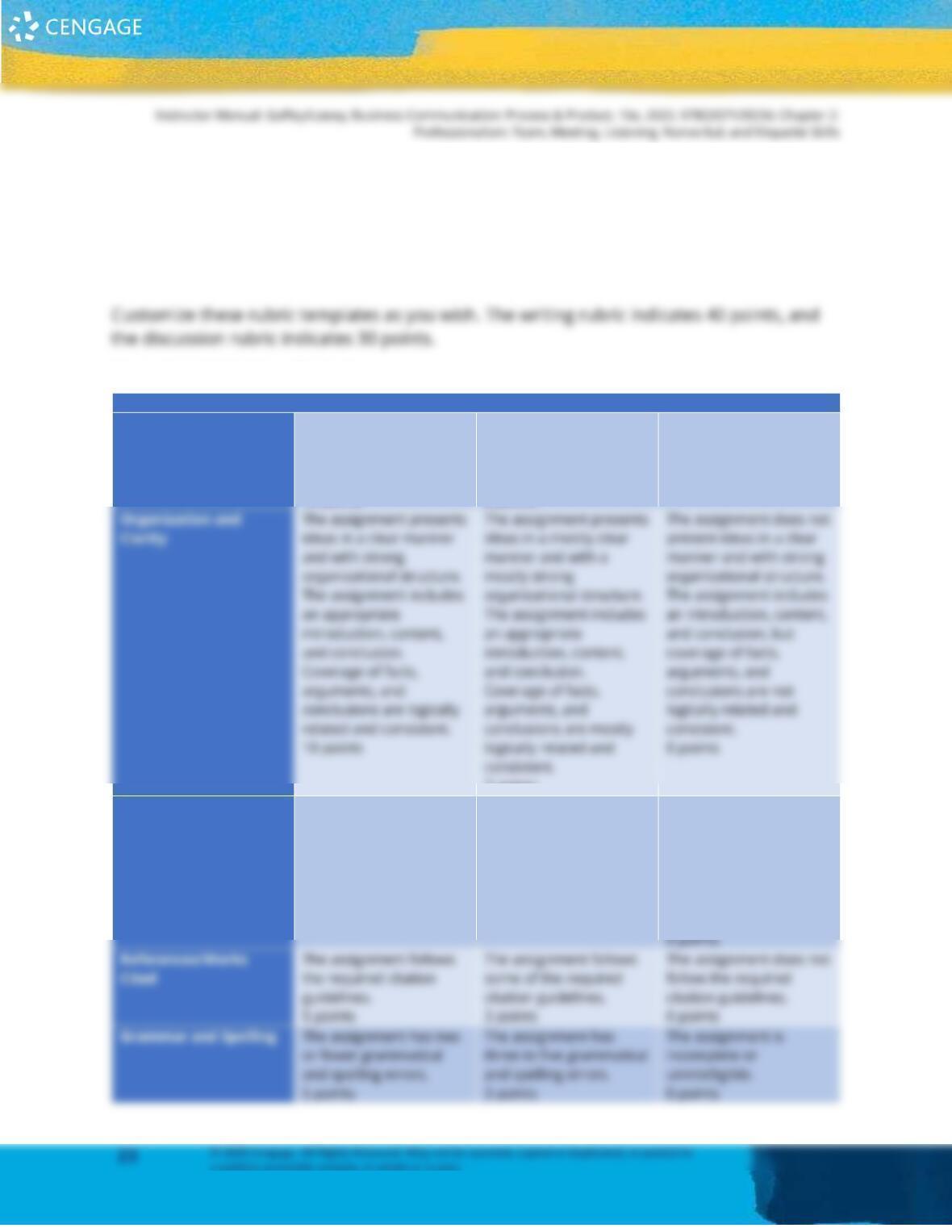
Standard Writing Rubric
Criteria
Meets Requirements
Needs Improvement
Incomplete
Content
The assignment clearly
and comprehensively
addresses all questions
in the assignment.
conclusions are logically
related and consistent.
10 points
arguments, and
conclusions are mostly
logically related and
consistent.
logically related and
consistent.
0 points
The assignment partially
addresses some or all
questions in the
assignment.
The assignment does not
address the questions in
the assignment.
0 points
7 points
Research
The assignment is based
upon appropriate and
adequate academic
literature, including peer
reviewed journals and
other scholarly work.
5 points
The assignment is based
upon adequate
academic literature but
does not include peer
reviewed journals and
other scholarly work.
3 points
The assignment is not
based upon appropriate
and adequate academic
literature and does not
include peer reviewed
journals and other
scholarly work.
0 points
The assignment follows
the required citation
guidelines.
5 points
The assignment follows
some of the required
citation guidelines.
3 points
The assignment does not
follow the required
citation guidelines.
0 points
and spelling errors.
and spelling errors.
unintelligible.
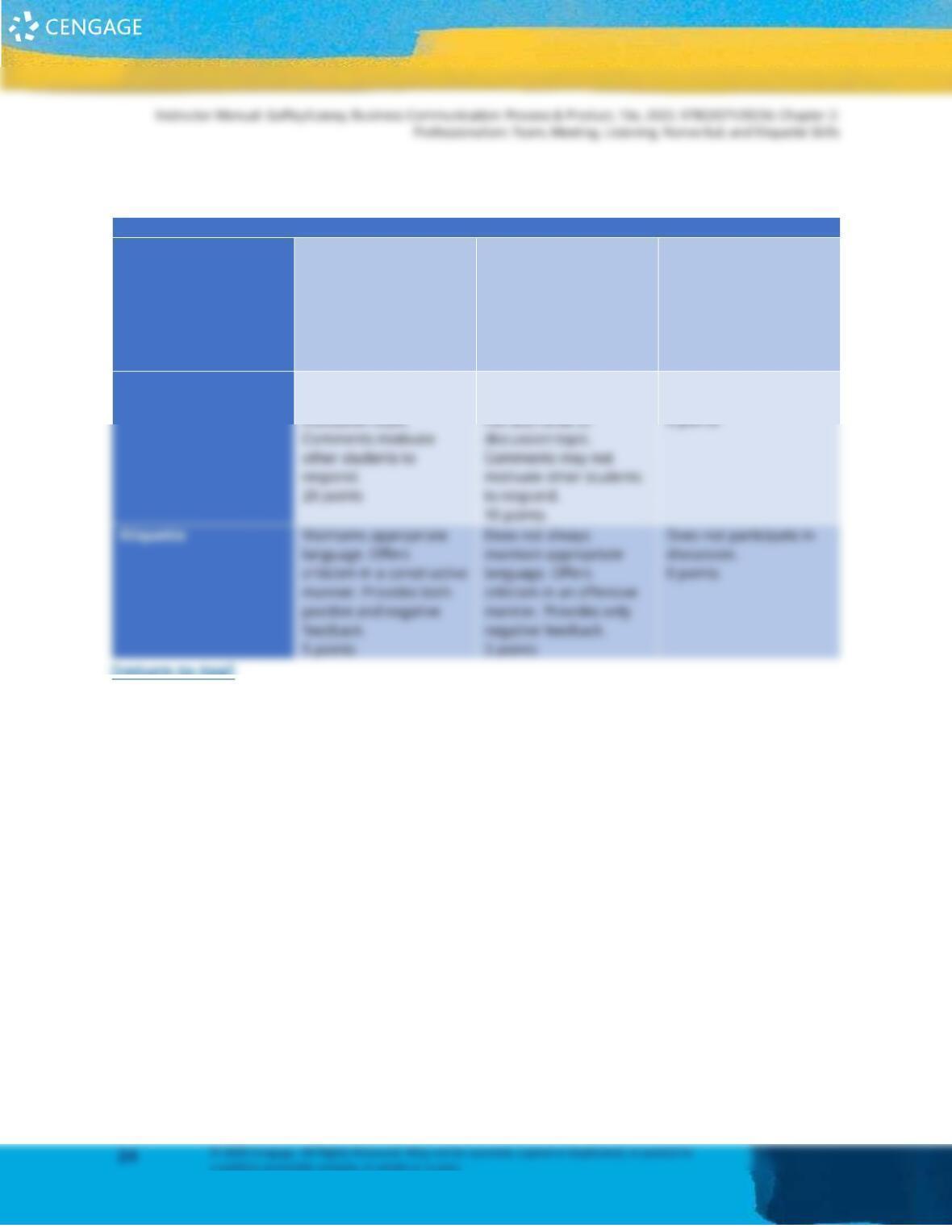
Standard Discussion Rubric
Criteria
Meets Requirements
Needs Improvement
Incomplete
Participation
Participates in or
submits discussion by
the posted deadlines.
Follows instructions for
initial post and
responses.
5 points
Does not participate in
or submit discussion by
the posted deadlines.
Does not follow
instructions for initial
post and responses.
3 points
Does not participate in
discussion.
0 points
Contribution Quality
Comments stay on task.
Comments add value to
Comments motivate
other students to
respond.
20 points
discussion topic.
Comments may not
motivate other students
to respond.
10 points
Comments may not stay
on task. Comments may
Does not participate in
discussion.
[return to top]