V. Using Digital Tools to Boost Your Job Search (15-5, PPT Slides 42–50, DISC:
Communication evolution; Theory application)
a. The first reader of your résumé may be an ATS. The higher your résumé
ranks when it is evaluated, the more likely it is that it will be reviewed by a
recruiter.
b. The following techniques can boost the probability that your résumé will
rank high enough to qualify for review by a human reader:
i. Include specific keywords or phrases in context.
c. Using a career e-portfolio—a collection of electronic files, images,
multimedia, blog entries, and hyperlinks that demonstrate a writer’s talents,
accomplishments, and technical skills—can spotlight a candidate’s
qualifications. (Figure 15.8)
d. A job seeker’s chances may be expanded with a video résumé:
i. A video résumé enables a job candidate to present their experience,
e. Prepare one basic print-based traditional résumé formatted to maximize
readability.
f. Customize your résumé for various job prospects and formats.
i. Group Discussion Activity: 45 minutes total. Activity 15.11—Consider a
Twitter Mini Résumé as a LinkedIn Alternative
Have students complete the activity found at the end of the chapter.
Students should be prepared to share their mini résumés with the group for
discussion and feedback.
VI. Cover Messages—Do They Still Matter? (15-6, PPT Slides 51–59, DISC: Purpose;
Theory application)
a. A cover letter or letter of application (cover message that introduces your
résumé) is less significant for recruiters using online recruiting and ATS.
c. When creating a customized cover message, follow these tips:
i. Opening: Captures attention; introduces the message; identifies the
position
d. It’s important to gain attention in the opening of a cover message.
i. Address the reader by name or replace salutation with a descriptive
subject line.
e. When applying to an opening for a solicited job (Model Document 15.7):
i. Refer to the name of an employee in the company.
f. If you are unsure whether a position actually exists (unsolicited jobs), you
might use a more persuasive opening (Model Document 15.8):
i. Demonstrate an interest in and knowledge of the reader’s business.
g. Use the body of a cover message to promote a candidate’s strengths:
i. Explain how your preparation and experience fulfill the stated
requirements.
h. To motivate action in the closing, use these techniques:
i. Ask confidently for an interview.
i. The following are common ways to send a résumé and cover message:
i. Submit both your cover message and résumé in an e-mail message.
Convert both to plain text.
j. Consider these final tips for successful cover messages (Model Document
15.9):
i. Revise to avoid too many sentences that begin with “I,” making
activities and outcomes the subjects of sentences.
ii. Strive for a comfortable style; don’t write unnaturally.
k. Writing Improvement Activity: 45 minutes total. Activity 15.2—Document
for Analysis: Poor Cover Letter
Have students complete the activity found at the end of the chapter.
• Detailed feedback for this activity—including a revised cover letter
sample—can be found in the Solutions Manual.
• Document weaknesses include:
o Fails to use the receiver’s name in the salutation.
o Neglects to identify the position title and specifically where the
announcement appeared.
[return to top]
Discussion Questions
You can assign these questions several ways: in a discussion forum in your LMS; as whole-
class discussions in person; or as a partner or group activity in class.
1. Discussion: To Gig or Not to Gig? (Critical Thinking #1) Duration 5 minutes.
a. When asked if they would pass up a traditional job for full-time gig work,
b. What is it about gig work that appeals to young people and others? What
disadvantages do you see?
i. Answer: One would have to know how the survey question was
2. Discussion: Should Job Boards Be a Jumping-Off Point? (Critical Thinking #2, 15–2,
PPT Slides 13–16) Duration 5 minutes.
a. “If you are starting your job search with Monster.com, CareerBuilder, or
similar search tools, then you are starting at the end of the chain,” claims job–
search author Ryan Guina.
b. What do you think he means?
i. Answer: Writing from experience, job-search author Ryan Guina
3. Discussion: The Hidden Job Market (Critical Thinking #3, 15-3, PPT Slides 21–25)
Duration 10 minutes.
a. Why do you think some businesses avoid advertising job openings?
i. Answer: Companies avoid advertising because doing so brings a flood
b. If jobs are unlisted, how can candidates locate them?
i. Answer: To locate jobs that are not listed (the hidden market),
4. Discussion: Is LinkedIn a Waste of Time? (Critical Thinking #4, 15-3, PPT Slide 23)
Duration 10 minutes.
a. LinkedIn has 675 million registered users, but only 310 million are active
each month. Although it is highly recommended that new grads complete a
b. As a job candidate, would you post your résumé information at LinkedIn?
Why or why not?
i. Answer: Supporters say that LinkedIn lets people connect with others
in their industry. Your résumé can be seen by recruiters everywhere.
c. How could candidates make better use of LinkedIn?
i. Answer: To take advantage of LinkedIn, candidates should keep their
5. Discussion: The Ethics of Phantom Job Listings (Critical Thinking #5, 15-2)
Duration 10 minutes.
a. Phantom job listings are announcements for jobs that have already been
filled through informal networking processes. The public job posting is
boards or career sites. Often, hiring managers have already selected
candidates for these phantom jobs.
b. Do you believe it is ethical to advertise jobs that are not really available?
i. Answer: From a job candidate’s view, it seems reasonable and fair that
all jobs be advertised. From a company’s view, such a requirement
[return to top]
Additional Activities and Assignments
1. Case Study: Zooming In—Is Job Searching Like Dating?: In this case study,
students will learn more about a prominent career coach’s thoughts on job
searching in today’s world. They are then asked to answer a series of critical-
thinking questions.
a. Amanda Augustine feels strongly that networking is the most effective way to
find a job. What if you don’t like networking and are uncomfortable pushing
yourself into awkward conversations that you find distressing?
i. Are you hesitant to network because it seems pushy and self-serving?
b. What do you know about the hidden job market, and how does networking
help a new grad find a job in this elusive market?
i. Most students know that all available jobs are not advertised or
posted on websites. Many jobs are filled in-house, through employee
referrals, or from an existing talent pool. Some jobs are even created
c. Career expert Amanda Augustine encourages job applicants to develop their
own “brands.” You may object that you are not a car or a line of sneakers.
What does “branding” mean to you, and why is it essential in a competitive
job market?
i. Student responses will vary on what branding means to them. You
can guide the discussion by pointing out that branding is a form of
2. Case Study: Zooming In—Your Turn: Applying Your Skills With Amanda
Augustine: In this case study, students will take on the role of an intern to career
coach Amanda Augustine. Students are asked to provide input for an article
Amanda plans to write that targets recent college graduates. Break students into
3. Chat About It: At the end of each chapter, you will find additional open-ended
questions related to the chapter material. You may assign these topics for
discussion in class, in an online chat room, or on an online discussion board. You
may also ask students to read and respond to postings made by their classmates.
Topic 1: A recent survey of millennial managers revealed that 75 percent of
respondents felt that constantly changing jobs advanced their careers. This
survey of 1,000 managers and mid- to executive-level executives between the
ages of 18 and 36 was conducted by employee experience platform Akumina “to
understand the needs of millennials in the rapidly changing workplace.” How do
you think changing jobs frequently advances one’s career? Does this seem
ethical?
Topic 3: Why do you think it is important to customize your résumé for each
employer and each job for which you apply? How do you think employers will
respond to a customized résumé versus a generic résumé? Is creating a
customized résumé for each position worth your time and effort? Share your
opinions with your classmates.
© 2022 Cengage. All Rights Reserved. May not be scanned, copied or duplicated, or posted to
a publicly accessible website, in whole or in part.
23
Additional Resources
Cengage Video Resources
• MindTap Videos:
o Learn It: Chapter 15 The Job Search, Résumés, and Cover Letters in the Digital
Age
▪ Learn It: Video Lesson 15-1
▪ Learn It: Video Lesson 15-2
Appendix
Generic Rubrics
Providing students with rubrics helps them understand expectations and components of
assignments. Rubrics help students become more aware of their learning process and
progress, and they improve students’ work through timely and detailed feedback.
Standard Writing Rubric
Criteria
Meets Requirements
Needs Improvement
Incomplete
Content
The assignment clearly
and comprehensively
addresses all questions
in the assignment.
15 points
The assignment partially
addresses some or all
questions in the
assignment.
8 points
The assignment does not
address the questions in
the assignment.
0 points
conclusions are logically
related and consistent.
arguments, and
conclusions are mostly
logically related and
consistent.
logically related and
consistent.
0 points
7 points
Research
The assignment is based
upon appropriate and
adequate academic
literature, including peer
reviewed journals and
other scholarly work.
5 points
The assignment is based
upon adequate
academic literature but
does not include peer
reviewed journals and
other scholarly work.
3 points
The assignment is not
based upon appropriate
and adequate academic
literature and does not
include peer reviewed
journals and other
scholarly work.
0 points
The assignment follows
the required citation
guidelines.
5 points
The assignment follows
some of the required
citation guidelines.
3 points
The assignment does not
follow the required
citation guidelines.
0 points
and spelling errors.
and spelling errors.
unintelligible.
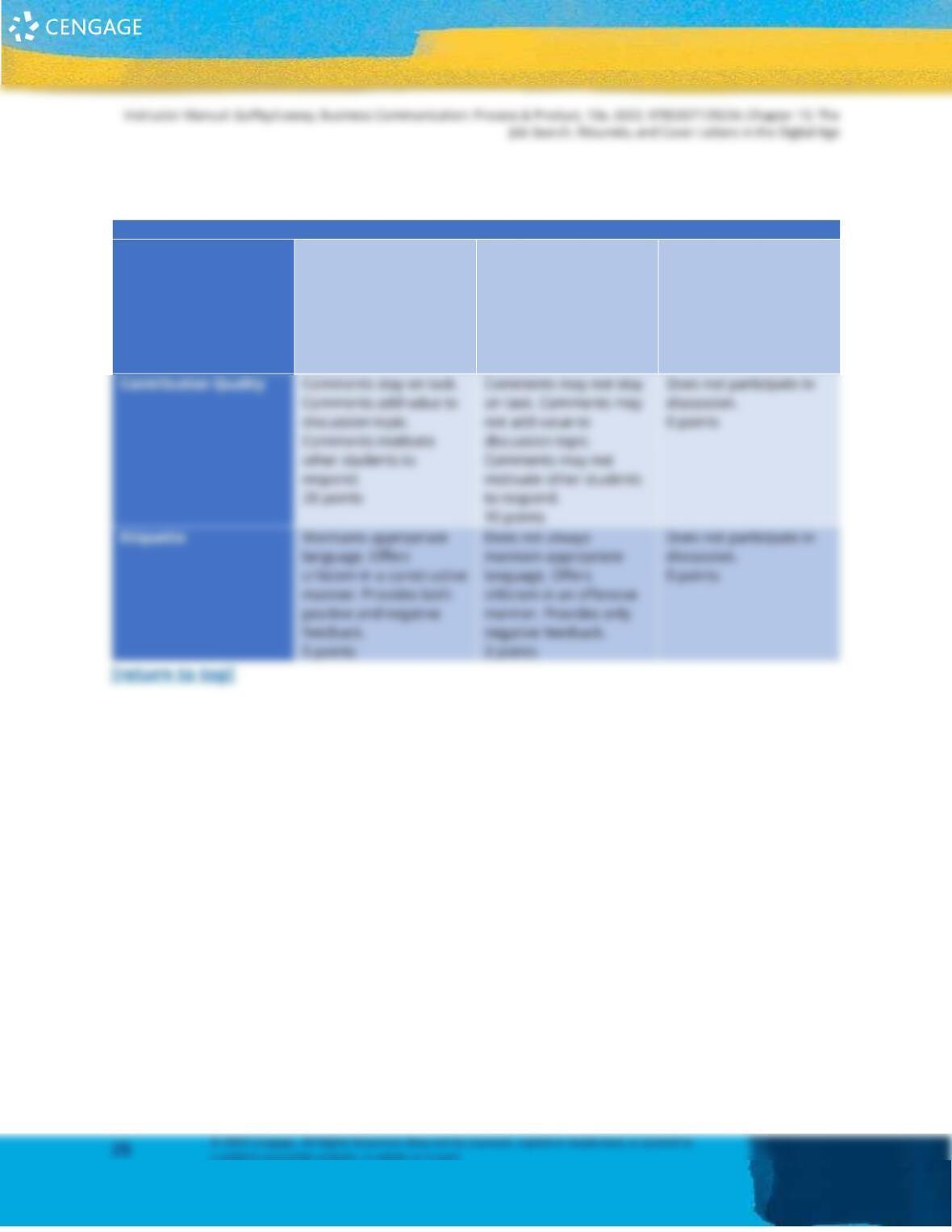
Standard Discussion Rubric
Criteria
Meets Requirements
Needs Improvement
Incomplete
Participation
Participates in or
submits discussion by
the posted deadlines.
Follows instructions for
initial post and
responses.
5 points
Does not participate in
or submit discussion by
the posted deadlines.
Does not follow
instructions for initial
post and responses.
3 points
Does not participate in
discussion.
0 points
Comments add value to
discussion topic.
on task. Comments may
not add value to
discussion.
0 points
5 points
3 points