CHAPTER 12
SOLUTIONS
Business Presentations
Critical Thinking Discussion Guide
11. Why should even practiced speakers plan their presentations when addressing a
business audience instead of just “winging it”?
Very few people can speak off the cuff competently. Without a plan, it’s very easy to ramble
12. Communication expert Dianna Booher claims that enthusiasm is infectious and
“boredom is contagious.” What does this mean for you as a presenter? How can
you avoid being a boring speaker? (L.O. 2, 4, 5)
If you wish to stay in control during the talk, build credibility, and engage the audience, you
13. Why do many communication consultants encourage businesspeople to move
beyond bullet points? What do they recommend instead and why? (L.O. 3)
PowerPoint is omnipresent in business. Millions of poorly designed and poorly delivered
presentations have tarnished PowerPoint’s reputation as an effective communication tool.
14. How can you prevent multimedia presentation software from stealing your thunder?
(L.O. 4)
You can avoid being upstaged by not relying totally on your slides or canvas. Help the
15. General Motors CEO Mary Barra inherited a mess when she ascended to the top post
in her beleaguered company. Several GM car models had exhibited problems with
their ignition switches, which turned off engines at highway speeds, causing 124
deaths and 275 injuries. As early as 2001, company insiders knew about the problem,
but ultimately took no action. Even as the scandal broke, GM first underreported the
casualties. Mary Barra pulled no punches. In a town hall meeting, she unflinchingly
addressed a global audience. Applying lessons learned in this chapter, what would
you advise chief executive Mary Barra to do when she communicates with the public
about the scandal? What could Barra say to restore trust in the company? (L.O. 1–3)
Mary Barra was largely praised for her handling of the ignition switch scandal. After many
years of secrecy and obfuscation at GM, Barra knew she had to embrace transparency and
Activities and Cases
12.1 Analyzing the Audience (L.O. 2, 4)
Be prepared to set your parameters for defining “recent issue” and also for limiting or not
limiting the resources students can use. You could further stipulate that they search for
12.2 Examining Iconic Speeches (L.O. 1, 2, 5)
12.3 Inviting a Professional Speaker (L.O. 1, 2, 4, 5)
In teams or individually, students will have the opportunity to practice some of the
12.4 Following a Business Tycoon on Twitter (L.O. 1–5)
Students who don’t yet have a Twitter account must create a profile to be able to follow a
businessperson of their choice. Twitter is still not as popular as Facebook and other
12.5 Conquering the Fear of Public Speaking (L.O. 5)
This activity could help students come to grips with their fears. After completing this

12.6 Anticipating Speaking in Your Field (L.O. 1)
You may want students to discuss this activity in groups of three or four and then have
12.7 Creating an Outline for an Oral Presentation (L.O. 1, 2)
12.8 Examining a TED Talk (L.O. 1–5)
Answers will vary. TED talks are consistent in their quality because the organizers invite
12.9 Showcasing Your Job (L.O. 1–5)
Students should present a three- to five-minute talk about the duties of a current or a
12.10 Honing a Perfect Elevator Pitch (L.O. 1, 2)
12.11 Making Sense of Fortune Lists (L.O. 1, 2)
This assignment provides students with an opportunity to broaden their awareness of the
best companies in the world. You may want to choose the lists your students research.
a. Fortune 500. Since this annual ranking of America’s largest corporations based on sales
revenues was first published in 1955, 1,857 companies have appeared. Many of them
d. World’s Most Admired Companies. This list was first published in 1997. With the help
of Fortune’s research partner Korn Ferry Hay Group, this study evaluates corporate
12.12 Presenting an Intriguing Business Topic (L.O. 1–3)
12.13 Advocating for a Cause (L.O. 1–5)
12.14 Selecting a Topic for an Oral Presentation (L.O. 1, 2, 5)
You can treat Activity 12.7 and this activity as a unit. Students could first be required to
submit an outline of their chosen topic. Then they would prepare a presentation with
effective visual aids.
Instructor: See model slides for Activity 12.15 at www.cengagebrain.com on the
Instructor’s Companion Site in the Chapter Solutions folder.
12.15 Creating a Multimedia Presentation (no additional research required) (L.O. 1–5)
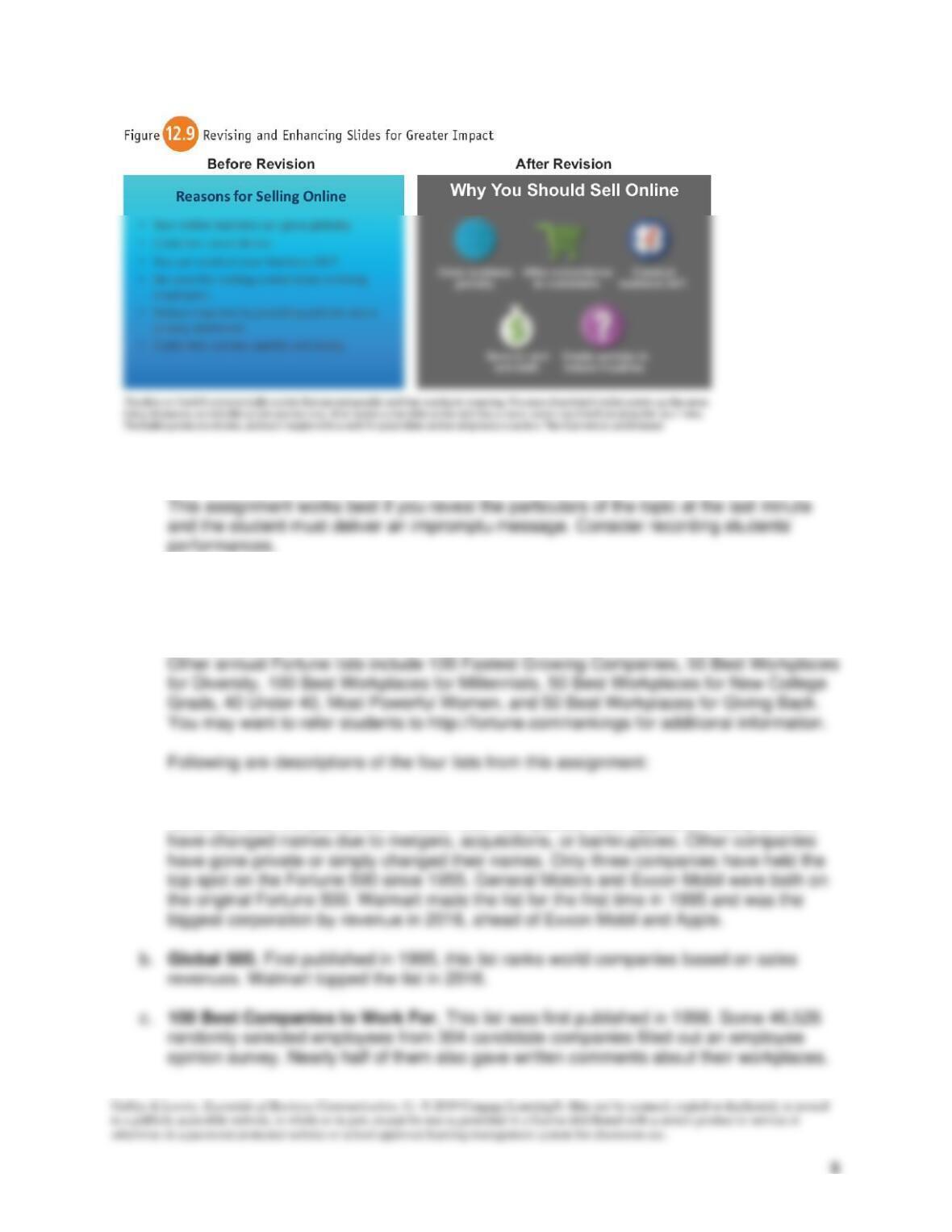
Use this exercise as (a) a graded assignment; (b) an ungraded learning experience in
information will be especially helpful if you are grading this assignment. One point to
emphasize to all students, regardless of their level of PowerPoint expertise, is that they
need to be careful not to turn their slides into speaker’s notes. Everything they will be
saying should not be printed on slides. Only key points should appear on slides.
1. Slide 1 uses AutoShapes on the Drawing toolbar to highlight the two choices.
COMMUNICATION WORKSHOP: Working Well Together
Effective and Professional Team Presentations
Whether a team produces written reports, multimedia presentations, or oral presentations,
individuals generally have considerable control over how each project is organized and
Before any group begins to talk about a specific project, members should get together and
establish basic ground rules. One of the first tasks is naming a leader to conduct meetings, a
recorder to keep a record of group decisions, and an evaluator to determine whether the group
is on target and meeting its goals. The group should decide whether it will be governed by
consensus (everyone must agree), by majority rule, or by some other method.
The most successful teams make meetings a top priority. They compare schedules to set up the
best meeting times, and they meet often, either in person or virtually. They avoid other
responsibilities that might disrupt these meetings. Today’s software and mobile apps make
Once teams have established ground rules, members are ready to discuss the target document
or presentation. During these discussions, they must be sure to keep a record of all decisions.
Next, the team should develop a work plan, assign jobs, and set deadlines. If time is short,
members should work backward from the due date. For oral presentations, teams must
When a project progresses into the organizing and writing stages, a team may need to modify
some of its earlier decisions. Members may review the proposed organization of the document