e. Business reports may be informal or formal depending on their purpose,
audience, and setting (Figure 11.5):
i. An informal writing style is conversational and appropriate for
f. Typical report formats include the following:
i. Digital formats and PDF files
ii. Digital slide decks (Figure 11.6)
g. Knowledge Check Activity: 30 minutes total. Activity 11.8—Report Functions,
Strategies, and Formats
Have students complete the activity found at the end of the chapter.
a. Function: analytical; Strategy: direct; Format: manuscript and/or slide
deck
b. Function: analytical; Strategy: indirect; Format: manuscript with cover
letter, most likely e-mailed or submitted online as a PDF document
IV. Documenting Information (11-4, PPT Slides 35–47, DISC: Plagiarism)
a. Documentation describes the practice of giving credit to your information
sources.
c. Avoid charges of plagiarism by knowing what to document and developing
good research habits.
d. Documentation is critical in the academic world, but business
communicators may find that authorship is unimportant, and assignment of
individual credit is not practiced.
iv. Paraphrases of another person’s spoken or written words
v. Visuals, images, and any kind of electronic media
g. Excellent notes help ensure you know whose ideas you are using.
h. Good research habits include the use of paper note cards and/or digital
records.
i. Paraphrasing is defined as restating an original passage in your own words
and in your own style.
j. To effectively paraphrase research material, follow these steps:
i. Read the original material intently to comprehend its full meaning.
k. Use direct quotations for these three purposes:
i. To provide objective background data and establish the severity of a
l. When using a long quotation, try to summarize and introduce it in your own
words and only use quotation marks to enclose the exact quotation.
m. The U.S. Copyright Act of 1976 protects authors of published and
unpublished works.
p. To avoid copyright infringement, follow these guidelines:
i. Assume that all intellectual property is copyrighted.
q. Common citation formats such as the MLA (Modern Language Association) or
the APA (American Psychological Association) are used to direct readers to
sources using parenthetical notes inserted into the text accompanied by
bibliographies or works-cited and reference lists.
r. Writing Improvement Activity: 30 minutes total. Activity 11.10—Plagiarism,
Paraphrasing, and Citing Sources
Have students complete the activity found at the end of the chapter.
technologies so advanced that understanding them and their risks
exceeds our intelligence “by more than ours exceeds that of snails.”
b. This colorful quotation from Edward Tufte’s classic book Envisioning
Information [Cheshire, CT: Graphics Press, 1990, p. 34] is difficult to
paraphrase and would most likely be cited verbatim.
c. Weaknesses: The paraphrased passage repeats the same flow and
sentence structure as the original. It also substitutes synonyms for
V. Creating Meaningful Graphics (11-5, PPT Slides 48–52, DISC: Purpose;
Data conversion; Numbers in visual display; Translation; Conclusion; Truthfulness;
Ethics and morals)
a. Meaningful graphics create visual interest and clarify data.
b. Graphics simplify complex ideas and emphasize key data, making
information easier to remember.
e. Typical graphics types include tables (Figure 11.8); bar charts (Figures 11.9,
11.10, 11.11, and 11.12); line charts (Figures 11.13, 11.14, and 11.15);
pie charts (Figure 11.16); flowcharts (Figure 11.17); organization charts; and
pictures in the form of photographs, maps, or illustrations.
f. An infographic combines words, figures, and graphics to transform complex
information quickly and clearly using visually appealing pictures.
g. To effectively incorporate graphics in reports, follow these tips:
i. Evaluate the audience.
h. Knowledge Check Activity: 30 minutes total. Activity 11.12—Selecting
Graphics
Have students complete the activity found at the end of the chapter.
a. Flowchart
b. Table for exact absolute numbers; line chart for trends
Discussion Questions
You can assign these questions several ways: in a discussion forum in your LMS; as whole-
class discussions in person; or as a partner or group activity in class.
1. Discussion: Information Credibility (Critical Thinking #1, 11-2, PPT Slide 23)
Duration 15 minutes.
a. Why do researchers trust the reliability of information obtained from
scholarly journals, major newspapers, and well-known magazines?
i. Answer: Information obtained from professional journals and
b. Why should researchers use caution when accessing information from
anonymous blogs, Wikipedia, and other crowdsourced content?
i. Answer: Anyone can publish on the Web, and the “information” may
be propaganda or advertising or worse. Users should also realize that
2. Discussion: Infographics (Critical Thinking #2, 11-5, PPT Slide 49)
Duration 10 minutes.
a. An infographic is far more effective at conveying statistics than any bar graph
or pie chart, claims Dallas marketing firm Frozen Fire.
b. Do you agree or disagree?
c. How could infographics be useful in your field?
i. Answer: Infographics have become popular because they often
present complex information clearly and creatively. Engaging
infographics (a) grab a reader’s attention; (b) communicate ideas
more quickly than traditional text can; (c) may combine traditional bar
charts, diagrams, and pie charts in one information graphic; and (d)
also include information about the history of green marketing.
3. Discussion: To Footnote or Not? (Critical Thinking #3, 11-4, PPT Slide 38)
Duration 10 minutes.
a. Some people say that business reports never contain footnotes.
b. If you were writing your first report for a business and you did considerable
research, what would you do about documenting your sources?
i. Answer: Although some people do assert that business reports never
contain documentation, it’s dangerous to avoid revealing sources. The
best plan is to check with a supervisor or look in the files to see how
4. Discussion: The Value of Informational Reports (Critical Thinking #4, 11-3,
PPT Slide 28) Duration 5 minutes.
a. Of what use is a business report that is merely informational? That is, it does
not present analysis, conclusions, or recommendations.
i. Answer: Informational reports are often important to decision makers
accurately but without the writer’s opinions or viewpoint.
5. Discussion: A Case for Why Students Hate Writing Essays (Critical Thinking #5)
Duration 15 minutes.
a. Consider this logical appeal under the heading “Reasons Students Hate
Writing Essays or Term Papers” and evaluate its validity and ethics:
Three term papers due tomorrow with three major tests from three of the classes
as well as a long math assignment. What should a student do? This problem while
in [sic] exaggeration often happens to students. It is like all the teachers decide to
overwhelm the students in their classes with not only tests on the same day but
also term papers, essays, or other writing assignments. This is the reason most
students hate writing term papers or other types of writing. Other reasons for
disliking writing assignments are poor English classes in high school, often
instructors fail to explain different writing styles, unsure of topics to write, and
instructors fail to read the writing assignments.[…] Don’t be afraid to reach out
and get help if it’s needed! CustomPapers.com can assist you.
i. Answer: The poor, suspicion-inducing prose aside, the anonymous
writer of the passage from the website of a paper mill is making a
Additional Activities and Assignments
1. Case Study: Zooming In—Your Turn: Applying Your Skills at Seventh
Generation: In this case study, students are asked to take on the role of an intern at
Seventh Generation working for the senior public relations manager. Students will
conduct research on B corporations to expand their knowledge and provide facts
for an upcoming presentation their manager has been asked to make. Break
students into groups of three to five and have them complete the assignment as a
team.
a. Students should locate at least seven Internet articles on the topic of B
corporations.
b. What are they, why are they important, and how does a company become
certified?
2. Chat About It: At the end of each chapter, you will find additional open-ended
questions related to the chapter material. You may assign these topics for
discussion in class, in an online chat room, or on an online discussion board. You
may also ask students to read and respond to postings made by their classmates.
Topic 1: As you know, college students are required to locate information and
then analyze and present their findings either orally or in writing. A recent
Topic 2: Research suggests that colleges with strong, explicit ethics codes and
zero tolerance of cheating have the lowest incidence of academic dishonesty.
Find the student handbook on your portal (or check the university catalog) for
rules of conduct regarding cheating. Are they clear? Does your school make
students pledge not to cheat? How do you feel about such efforts?
Topic 3: The Internet has brought the paper mills to the masses. Some students
pay to have their papers written by shady authors online. Discuss the views in
your class regarding this practice and how it could be harmful to honest
students. Is any harm done to colleges and universities? Society?
3. Test Your Workplace Etiquette IQ: New communication platforms and casual
workplace environments have blurred the lines of appropriateness, leaving workers
wondering how to navigate uncharted waters. Have students check their workplace
etiquette IQ by deciding whether the following statements are true or false.
Scenario 1: If your cell phone rings in today’s workplace, answer it and head
toward the nearest empty conference room or phone room to conduct your
conversation.
Scenario 2: If you have been invited to attend a meeting of a group you have
never met before, you should enter the room and take an empty seat without
Scenario 3: Giving a personal gift to your boss is acceptable if the gift is tasteful
and expensive.

© 2022 Cengage. All Rights Reserved. May not be scanned, copied or duplicated, or posted to
a publicly accessible website, in whole or in part.
25
[return to top]
Additional Resources
Cengage Video Resources
• MindTap Videos:
o Learn It: Chapter 11 Report Writing Basics
▪ Learn It: Video Lesson 11-1
▪ Learn It: Video Lesson 11-2
Appendix
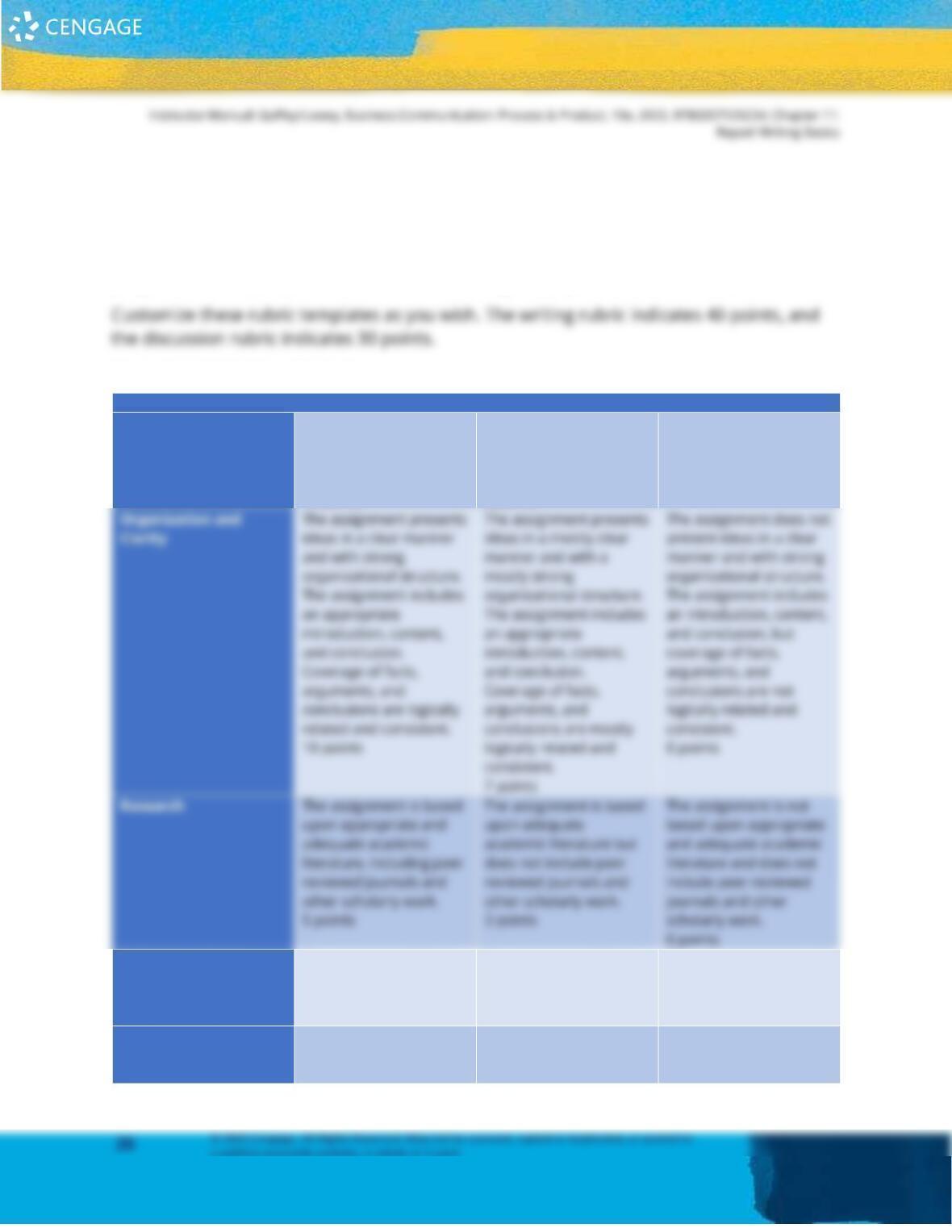
Generic Rubrics
Providing students with rubrics helps them understand expectations and components of
assignments. Rubrics help students become more aware of their learning process and
progress, and they improve students’ work through timely and detailed feedback.
Standard Writing Rubric
Criteria
Meets Requirements
Needs Improvement
Incomplete
Content
The assignment clearly
and comprehensively
addresses all questions
in the assignment.
conclusions are logically
related and consistent.
10 points
arguments, and
conclusions are mostly
logically related and
consistent.
7 points
logically related and
consistent.
0 points
0 points
The assignment partially
addresses some or all
questions in the
assignment.
The assignment does not
address the questions in
the assignment.
0 points
References/Works
Cited
The assignment follows
the required citation
guidelines.
5 points
The assignment follows
some of the required
citation guidelines.
3 points
The assignment does not
follow the required
citation guidelines.
0 points
Grammar and Spelling
The assignment has two
or fewer grammatical
and spelling errors.
The assignment has
three to five grammatical
and spelling errors.
The assignment is
incomplete or
unintelligible.
5 points
3 points
0 points
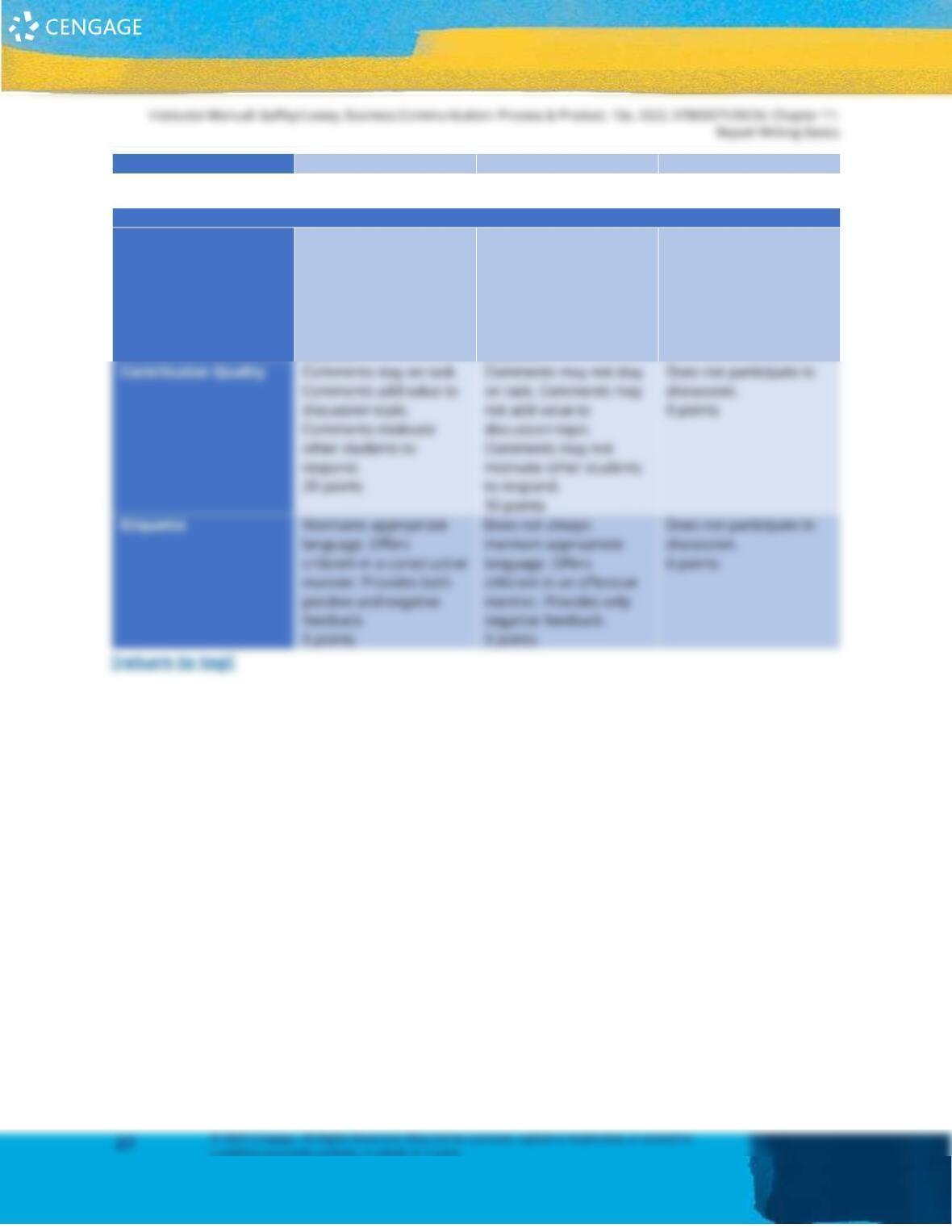
Standard Discussion Rubric
Criteria
Meets Requirements
Needs Improvement
Incomplete
Participation
Participates in or
submits discussion by
the posted deadlines.
Follows instructions for
initial post and
responses.
5 points
Does not participate in
or submit discussion by
the posted deadlines.
Does not follow
instructions for initial
post and responses.
3 points
Does not participate in
discussion.
0 points
Comments add value to
discussion topic.
respond.
20 points
on task. Comments may
not add value to
motivate other students
to respond.
10 points
discussion.
0 points
Etiquette
Maintains appropriate
language. Offers
positive and negative
feedback.
5 points
Does not always
maintain appropriate
manner. Provides only
negative feedback.
3 points
Does not participate in
discussion.