Instructor Manual
Guffey/Loewy, Business Communication: Process & Product, 10e, 2022, 9780357129234;
Chapter 10: Persuasive and Sales Messages
Table of Contents
Purpose and Perspective of the Chapter …………………………………………………………………………. 2
Cengage Supplements …………………………………………………………………………………………………… 2
Chapter Objectives ………………………………………………………………………………………………………… 2
Complete List of Chapter Activities and Assessments ……………………………………………………… 3
Key Terms ……………………………………………………………………………………………………………………… 4
What’s New in This Chapter ……………………………………………………………………………………………. 6
Chapter Outline …………………………………………………………………………………………………………….. 6
Discussion Questions …………………………………………………………………………………………………… 19
Purpose and Perspective of the Chapter
The purpose of this chapter is to explore the concept of persuasion in the workplace. First,
we define persuasion and explore digital age persuasion and techniques for persuasive
Cengage Supplements
The following product-level supplements provide additional information that may help you
in preparing your course. They are available in the Instructor Resource Center.
• Transition Guide (provides information about what’s new from edition to edition)
• Educator’s Guide (describes assets in the platform with a detailed breakdown of
activities by chapter with seat time)
Chapter Objectives
The following objectives are addressed in this chapter:
10-1 Identify digital age persuasion as well as time-proven techniques in persuasive
messages online and in print.
10-2 Describe the traditional four-part AIDA strategy for creating successful and ethical
persuasive messages.
Complete List of Chapter Activities and Assessments
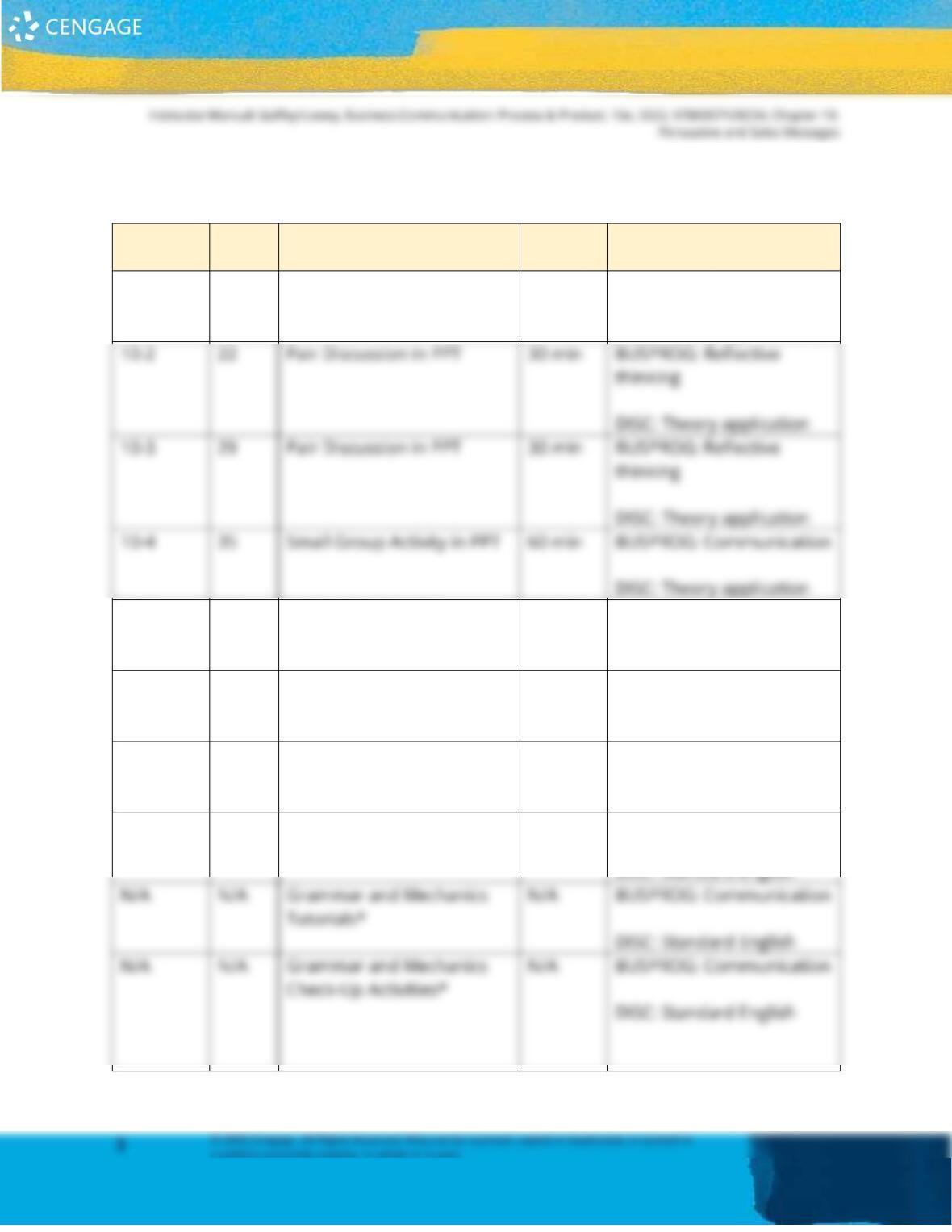
For additional guidance, refer to the Teaching Online Guide.
Chapter
Objective
PPT
Slide
Activity/Assessment
Duration
Certification Standard
10-1
14
Small Group Activity in PPT
60 min
BUSPROG: Communication
DISC: Theory application
thinking
DISC: Theory application
10-4
35
Small Group Activity in PPT
60 min
BUSPROG: Communication
DISC: Theory application
10-5
50
Pair Activity in PPT
50 min
BUSPROG: Ethics
DISC: Theory application
10-6
56
Writing Improvement
Activity in PPT
50 min
BUSPROG: Communication
DISC: Theory application
10-1–10-6
57
Grammar and Mechanics
Quiz in PPT
30 min
BUSPROG: Communication
DISC: Standard English
N/A
N/A
Grammar and Mechanics
Pre-Course Diagnostic*
60 min
BUSPROG: Communication
DISC: Standard English
Tutorials*
DISC: Standard English
Chapters
7–10
N/A
Why Does Workplace
Communication Matter to
Me? (Unit 03 Workplace
Communication)**
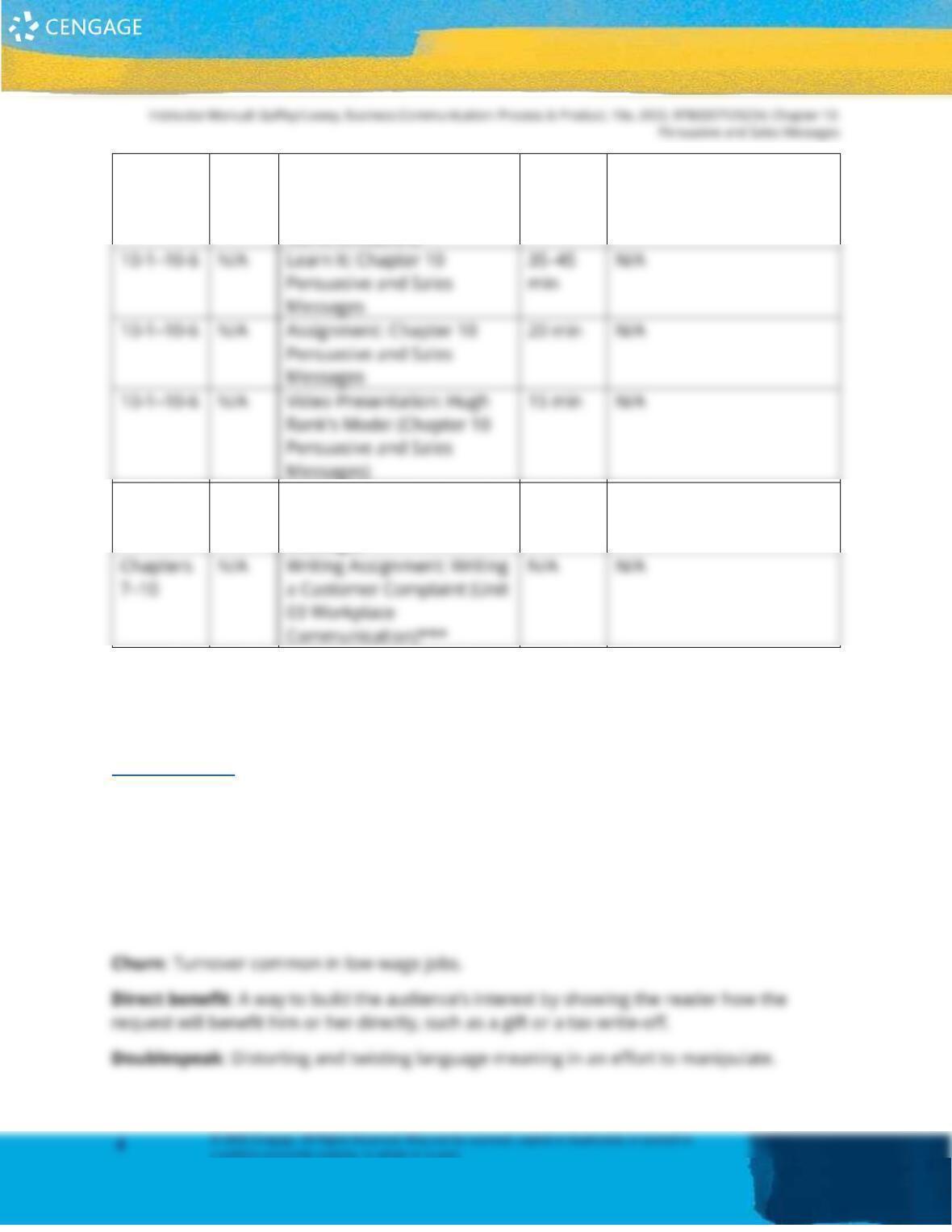
10-1–10-6
N/A
Learn It: Chapter 10
Persuasive and Sales
Messages
35–45
min
N/A
Rank’s Model (Chapter 10
Persuasive and Sales
Messages)
5 min
N/A
10-1–10-6
N/A
Practice Quiz: Chapter 10
Persuasive and Sales
Messages
25–30
min
N/A
Chapters
N/A
Writing Assignment: Writing
a Customer Complaint (Unit
03 Workplace
Communication)***
N/A
N/A
* These activities appear before the student will begin the course.
** This activity appears at the beginning of Unit 3.
*** This activity appears at the end of Unit 3.
[return to top]
Key Terms
AIDA strategy: Four-part indirect strategy (Attention, Interest, Desire, Action) for
overcoming resistance and crafting successful persuasive messages.
Benefit: In a sales message the presentation of product features showing how the
audience can use them to their advantage.
Holacracy: A method of decentralized management, in which authority and decision-
making are distributed among self-organizing teams rather than resting on a management
hierarchy.
Indirect benefit: A way to build the audience’s interest by showing readers and listeners
how a request will benefit them indirectly, such as the ability to help others.
Microtargeting: Controversial practice adopted by some advertisers who want to
sweettalk Internet users into letting them harvest their personal data in exchange for ads
tailored to their lifestyles and preferences; strategy of narrowly focused political ads.
Rational appeal: A persuasive technique that appeals to reason and intellect.
Reactance: Defensive strategy of resistance that humans adopt when feeling cornered,
robbed of their autonomy, or restricted in their options by others.
What’s New in This Chapter
The following elements are improvements in this chapter from the previous edition:
• Conducted extensive research to provide a thought-provoking opening case
scenario about e-cigarette startup Juul and its controversial marketing campaign
believed to have targeted teenagers, becoming a rousing success among that young
demographic and demonstrating the power of influence.
• Introduced new authentic model documents and figures to demonstrate to readers
persuasive e-mail marketing messages and present-day sales letters.
• Updated coverage of puffery and misleading advertising claims in persuasive
marketing messages to instruct students in the importance of ethical sales
practices.
Chapter Outline
In the outline below, each element includes references (in parentheses) to related content.
“CH.##” refers to the chapter objective; “PPT Slide #” refers to the slide number in the
PowerPoint deck for this chapter (provided in the PowerPoints section of the Instructor Resource
Center); and, as applicable for each discipline, accreditation or certification standards (DISC).
Introduce the chapter and review learning objectives for Chapter 10. (PPT Slide 2).
I. Understanding Persuasion in the Contemporary Workplace (10-1, PPT Slides 3–15,
DISC: Patterns; Purpose; Communication evolution; Audience; Ethics and morals)
a. Solid persuasive skills are more important than ever within the workplace
due to:
i. Flatter hierarchies
c. Perloff’s definition of persuasion has five components:
i. Persuasion Is a Symbolic Process: Words, signs, or images can all be
infused with rich meaning.
ii. Persuasion Involves an Attempt to Influence: It is a conscious effort to
persuade someone in order to achieve a specific outcome.
d. Robert B. Cialdini outlined these six psychological triggers that prompt us to
act and believe (Figure 10.1:
i. Reciprocation: When someone does us a favor, we feel obligated to
return it.
ii. Commitment: Once we make a choice, we stay consistent with that
decision.
e. Experts estimate the average American consumer today endures as many as
5,000 advertising impressions a day, up from around 500 per day 50 years
ago.
e. Persuaders play on emotions using flattery, empathy, nonverbal cues, and
likability appeals.
f. Marketers study target groups and mine data to microtarget (highly
customize) appeals to a narrow subset of the intended audience.
g. Listeners and readers will be more inclined to accept what you are offering if
you follow these important strategies (Figure 10.2):
i. Establish credibility: Show you are truthful, experienced, and
knowledgeable, using expert opinions to support your position.
to all parties, listening to others and creating buy-in
f. The 3-x-3 writing process can be applied to persuasive messages.
i. Analyzing the purpose: knowing what you want to achieve (Model
Document 10.1)
g. The AIDA (Attention, Interest, Desire, Action) strategy is used to craft
persuasive messages and overcome resistance. (Figure 10.3)
i. Attention: Gain your audience’s attention in the opening of your
message.
h. Small Group Activity: 60 minutes total. Activity 10.6—Persuasive Strategies—
Applying Hugh Rank’s Model
Break class into groups of three to five students and have them complete the
activity found at the end of the chapter. Using Hugh Rank’s persuasive model
illustrated in Figure 10.7, groups should find examples to test Rank’s model
II. Applying Four Essential Principles to Successful Persuasive Messages (10-2,
PPT Slides 16–23, DISC: Purpose; Patterns; Audience; Ethics and morals)
a. Successful persuasive messages blend the four steps of the AIDA strategy
into a seamless whole. (Figure 10.4)
b. To gain attention, make a brief, relevant, and engaging opening statement
using one of these examples:
i. Present a capsule of the problem your proposal will help solve.
ii. Open with an unexpected statement that gets readers thinking
immediately.
c. A persuasive request must convince the audience that the request is
reasonable. Build interest using one of these methods:
i. Provide facts and statistics.
d. The best persuasive requests anticipate audience resistance and are
prepared for their arguments. Consider following these tips:
i. Reduce resistance with finesse.
e. Once you’ve gained attention, built interest, elicited desire, and reduced
resistance, you’ll need to inspire your receptive audience to act.
(Model Document 10.2)
i. Know what action you favor and make a specific request.
ii. Project confidence without seeming pushy.
f. To be an ethical persuader, follow these guidelines:
i. Be truthful and believable.
ii. Don’t manipulate, mislead, or exaggerate.
g. Pair Discussion Activity: 30 minutes total. Strategies of Persuasion
Break class into pairs and have each student pair discuss their own
experiences with persuasion, using the questions found on the PPT slide as a
guide for their discussion. Students should be prepared to share their
experiences with the larger group.
• Who did you need to persuade?
DISC: Purpose; Audience; Rhetorical considerations)
a. Individuals and organizations comply with persuasive requests for a variety
of reasons (Model Document 10.2):
i. A sincere interest
b. Use the direct strategy for straightforward adjustment requests.
c. Use the indirect strategy if a past request has been refused or ignored or you
anticipate a reluctance to comply.
d. To develop a logical argument, follow these guidelines:
i. Open with sincere praise, an objective statement of the problem, a
point of agreement, or a quick review.
e. When writing a persuasive claim, use a moderate tone.
i. Don’t suggest the receiver intentionally deceived you or deliberately
f. Complaints deliver bad news.
g. If the goal is to change something, persuasion is necessary.
h. An effective claim message (Model Document 10.3):
i. Makes a reasonable and valid request
i. Pair Discussion Activity: 30 minutes total. Channels of Complaint
Break class into student pairs and have students discuss their own
experiences with complaints and how they would improve their method in
the future, using the questions on the PPT slide as a guide for their
discussion. Students should be prepared to share their experiences with the
larger group.
IV. Writing Persuasive Messages in Digital Age Organizations (10–4, PPT Slides 31–36,
DISC: Communication evolution; Audience)
a. Lines of authority have blurred, and roles of executives have changed.
b. Managers expect creativity and flexibility instead of adherence to rigid
instructions.
e. Employers use persuasive downward messages to encourage employees to
(Model Document 10.4):
i. Join programs to stop smoking, lose weight, or start exercising
ii. Volunteer for charity projects
h. Pay close attention to facts, figures, and evidence.
i. Emphasize the benefits in monetary terms when possible.
j. Present ideas confidently and fairly, including both sides of the argument.
• What are the advantages of a four-day workweek?
• What organizations have already tried it?
Persuasive and Sales Messages
• What appeals could be used to persuade management to adopt a
four-day workweek?
V. Creating Effective Sales Messages in Print and Online (10-5, PPT Slides 37–51,
DISC: Patterns; Purpose; Audience; Communication evolution)
a. The 3-x-3 writing process can be applied to sales messages.
b. Analyzing the product:
i. What do you know about the product?
c. Determining the purpose of a sales message:
i. What do you want your reader to do?
ii. How does your central selling point achieve your intended reader
response?
d. Adapting a sales message to its audience:
e. Direct mail is used to make sales, generate leads, boost retail traffic, solicit
donations, and direct consumers to websites.
i. Seventy-seven percent of millennials pay attention to direct mail,
surpassing other generations.
f. Technology connects digital leads and direct-mail appeals through
retargeting, the act of targeting again the consumers who have previously
visited a brand’s site.
i. Tracking technology matches website visitors to their name and
postal address.
g. The most effective sales messages follow the AIDA strategy.
h. The opening paragraph of a sales message should be short (one to five lines),
honest, relevant, and stimulating. To catch the reader’s attention, use an
opener device.
i. You can build interest with rational and emotional appeals.
i. Rational appeals are associated with reason and intellect (making or
saving money, increasing efficiency, or making the best use of
resources).
j. To overcome resistance, you should anticipate objections and questions and
translate those objections into selling points. Be sure the claims you make
are accurate.
k. Consider the following techniques to overcome resistance and prove the
credibility of your product:
i. Demonstrate savings to the reader.