IV. Communication Channels in Organizations and Media Richness (1-4, PPT Slides 32–
44, DISC: Communication evolution; Asynchronous messaging; Synchronous
messaging; Purpose)
a. Social media and flatter hierarchies are causing a major shift away from one–
sided, slow forms of communication to interactive, instant, and less paper-
based communication.
d. The revolution in mobile communication includes smartphones, tablets,
notebooks, and wearable technology such as the Apple Watch, activity
trackers, and Google Glass. Of the 7.7 billion people worldwide, 5.1 billion are
mobile device users who own 8.5 billion smart electronic gadgets.
e. Figure 1.8 shows a side-by-side comparison between the traditional one-
directional business communication model and today’s hyperconnected,
many-to-many social media communication model.
h. Business communicators must be able to choose from a wide range of
communication channels the one most suitable to get the job done—that is,
most likely to elicit the desired outcome. Daft and Lengel’s media richness
theory and the concept of social presence are particularly useful for
evaluating the effectiveness of old and new media in a given situation.
j. Social presence has come to mean the degree to which people are engaged
online and ready to connect with others. Social presence is greater in
synchronous communication (live chat, IM) than in asynchronous
communication that is rather impersonal (e-mail, forum post).
m. Information flowing upward begins with nonmanagement employees and
moves to management. This information, in the form of phone messages, e-
mail, memos, reports, department meetings, and suggestion systems, guides
managers in making decisions. Upward communication includes product
feedback, customer data, progress reports, suggestions, problems, and
requests for clarification.
q. To improve the upward flow of information, some companies are hiring
communication coaches to train employees, asking employees to report
customer complaints, encouraging regular staff meetings, cultivating an
environment of trust, and offering incentive programs that encourage
employees to collect and share valuable feedback.
r. To improve horizontal communication, companies are training employees in
teamwork and communication technologies, establishing reward systems
based on team achievements, and encouraging full participation in team
functions.
s. The grapevine can be a powerful, pervasive source of information,
accounting for as much as two thirds of an employee’s information. Studies
t. Small Group Activity: 30 minutes total. Activity 1.11—Speaking or Writing:
Explore Media Richness
Break class into groups of three students. Have students complete the
activity found at the end of the chapter. After consulting the media richness
diagram in Figure 1.9, students should consider how rich the medium must
be in a variety of communication situations to convey the message most
appropriately and reliably and then describe the advantages and
disadvantages of each choice.
• What media channel did you choose for each example found in the
activity?
V. Ethics in the Workplace Needed More Than Ever (1-5, PPT Slides 45–54, DISC: Ethics
and morals; Personal, corporate, legal, and ethical responsibilities)
a. Ethics refers to conventional standards of right and wrong that prescribe
what people should do. These standards usually consist of rights, obligations,
and benefits to society.
h. Traditionally, it has been argued that the best advice in ethical matters is
contained in the Golden Rule: Treat others the way you wish to be treated.
However, more recently, author Tony Alessandra proposed the Platinum
Rule: “Treat others as they wish to be treated.”
j. Poll Activity: 20 minutes total. Poll—Probing Active Social Media Users’
Attitudes Toward Ethics
Have students answer the questions posed on PPT Slide 53. Then have
students review their answers against the poll results found in Figure 1.15. As
• Do some seem pretty harmless?
• Why or why not?
Discussion Questions
You can assign these questions several ways: in a discussion forum in your LMS; as whole-
class discussions in person; or as a partner or group activity in class.
1. Discussion: Communication and Career Success (Critical Thinking #1, 1-1, PPT Slide 5)
Duration 20 minutes.
a. All this talk about interpersonal skills and future-proofing your career may
make you nervous, especially if your communication skills are shaky.
b. Do you think workers today can be successful if they lack communication
skills and write poorly?
i. Answer: Each of us probably knows at least one example of a highly
successful dyslexic person or a poor writer who is admired and thrives
2. Discussion: Technology and Critical Thinking (Chat About It Topic 5, 1-2, PPT Slide 12)
Duration 20 minutes.
a. Some experts believe that although computer technology is improving our
lives in many ways, it might be impairing our ability to think critically by
putting answers at our fingertips.
b. What do you think?
i. Answer: Student answers will vary. With answers available at any time
3. Discussion: Guarding Your Credibility (Critical Thinking #2, 1-2, PPT Slide 15)
Duration 20 minutes.
a. Sharing various digital media impulsively can lead to embarrassment and
worse.
b. Have you or has someone you know ever regretted posting a comment,
photo, or other media online?
i. Answer: Student answers will vary. Some students may be too
4. Discussion: Work-Life Balance (Critical Thinking #3, 1-3, PPT Slide 24) Duration 20
minutes.
a. Despite laws dictating a 40-hour workweek, many young Chinese tech
workers work the dreaded 9-9-6 schedule: 9 a.m. to 9 p.m., six days a week.
b. How do you feel about work-life balance?
c. What effects on your health and personal life do you anticipate?
i. Answer: Student answers will vary. Most students are probably aware
that being constantly tethered to their jobs with smart mobile
5. Discussion: Lean Media Channels and Tone (Critical Thinking #4, 1-4, PPT Slide 36)
Duration 20 minutes.
a. Critics complain that texting and instant messaging lead to textspeak, poor
writing characterized by acronyms, abbreviations, and emoticons. Others
b. What do you think?
i. Answer: The author of The Atlantic article cites a sociolinguist who says
that emoticons and emoji are revolutionizing language and add
6. Discussion: The Golden Rule vs. The Platinum Rule (Critical Thinking #5, 1-5,
PPT Slide 51) Duration 20 minutes.
a. Author and entrepreneur Dave Kerpen believes that doing unto others as we
would want done to us is insufficient. He prefers the Platinum Rule: Do unto
others as they would want done to them. “The Golden Rule, as great as it is,
b. Do you agree?
c. Why does Kerpen think the Platinum Rule beats the Golden Rule?
i. Answer: The Golden Rule is an ancient moral principle; therefore, it
may feel odd that someone would question it. However, Kerpen—and
Additional Activities and Assignments
1. Case Study: Zooming In—Your Turn: Applying Your Skills at Nordstrom: In this
case study, students will take on the role of an intern in the User Experience and
Optimization division of Nordstrom. They are asked to study Facebook interactions
among customers and Nordstrom representatives to learn about the friendly,
casual tone employed in such virtual encounters. Students are then asked to answer
a series of questions and summarize their observations in an e-mail.
a. Answers will vary, but generally Nordstrom’s interactions with customers are
warm, compassionate, and casual. They seem to be driven by a genuine
desire to help, answer queries, resolve problems, or commiserate.
b. One of the social media use guidelines admonishes users to be humble,
meaning that Nordstrom employees should deliver excellent customer
service but not brag about it because mistakes do happen. More advanced
2. Chat About It: At the end of each chapter, you will find additional open-ended
questions related to the chapter material. You may assign these topics for
discussion in class, in an online chat room, or on an online discussion board. You
may also ask students to read and respond to postings made by their classmates.
Topic 2: Do you think that always being plugged in can erode performance, as
some executives have claimed in a recent survey? One leader pointed out that
3. Test Your Workplace Etiquette IQ: New communication platforms and casual
workplace environments have blurred the lines of appropriateness, leaving workers
wondering how to navigate uncharted waters. Have students check their workplace
etiquette IQ by deciding whether the following statements are true or false.
Scenario 1: The boss is traveling, and fellow worker Cole begs you to sign the
boss’s name on an application that he insists must be mailed immediately. As
the boss’s assistant, you should sign the boss’s name because you think he
wouldn’t mind, and it would help Cole immensely.
Answer: False. Never sign anyone’s name to a document without
Scenario 2: As you begin a leisurely weekend at home, you receive an e-mail from
your product manager asking for information. Because it’s not urgent, the best
plan is to respond early on Monday.
Answer: True. Much depends on the relationship with your manager, but
Scenario 3: McKayla is your go-to colleague with all the answers, but she’s on
vacation. You need to ask her a quick question that you’re sure she could
answer—if you could just reach her. Because she has a cell phone connected to
work e-mail, it’s perfectly acceptable to give her a quick call.
Answer: False. Should you phone your vacationing coworker with a work
[return to top]

Business Communication in the Digital Age
Additional Resources
Cengage Video Resources
• MindTap Videos:
o Learn It: Chapter 01 Business Communication in the Digital Age
▪ Learn It: Video Lesson 1-1
Appendix
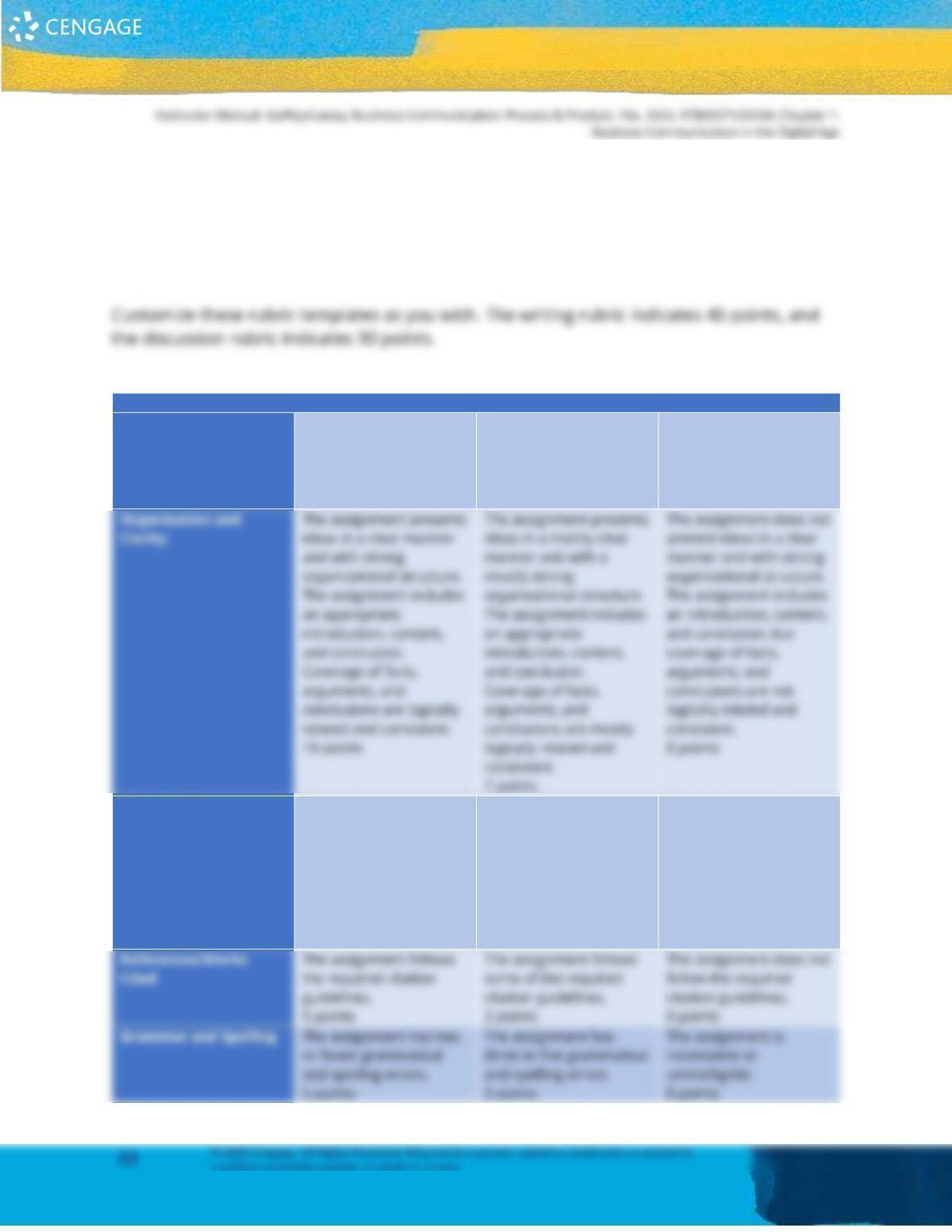
Generic Rubrics
Providing students with rubrics helps them understand expectations and components of
assignments. Rubrics help students become more aware of their learning process and
progress, and they improve students’ work through timely and detailed feedback.
Standard Writing Rubric
Criteria
Meets Requirements
Needs Improvement
Incomplete
Content
The assignment clearly
and comprehensively
addresses all questions
in the assignment.
15 points
The assignment partially
addresses some or all
questions in the
assignment.
8 points
The assignment does not
address the questions in
the assignment.
0 points
conclusions are logically
related and consistent.
10 points
arguments, and
conclusions are mostly
logically related and
consistent.
7 points
logically related and
consistent.
0 points
Research
The assignment is based
upon appropriate and
adequate academic
literature, including peer
reviewed journals and
other scholarly work.
5 points
The assignment is based
upon adequate
academic literature but
does not include peer
reviewed journals and
other scholarly work.
3 points
The assignment is not
based upon appropriate
and adequate academic
literature and does not
include peer reviewed
journals and other
scholarly work.
0 points
The assignment follows
the required citation
guidelines.
5 points
The assignment follows
some of the required
citation guidelines.
3 points
The assignment does not
follow the required
citation guidelines.
0 points
and spelling errors.
and spelling errors.
unintelligible.

Standard Discussion Rubric
Criteria
Meets Requirements
Needs Improvement
Incomplete
Participation
Participates in or
submits discussion by
the posted deadlines.
Follows instructions for
initial post and
responses.
Comments motivate
other students to
respond.
20 points
discussion topic.
Comments may not
motivate other students
to respond.
Does not participate in
or submit discussion by
the posted deadlines.
Does not follow
instructions for initial
post and responses.
Does not participate in
discussion.
0 points