
Inquiry in Action: Interpreting Scientific Papers, Key to Questions
Inquiry in Action: Interpreting Scientific Papers
by Ruth Buskirk and Christopher M. Gillen
Key to Questions
Article 1
Inquiry Figure 16.11: Does DNA Replication Follow the Conservative, Semiconservative,
or Dispersive Model?
Key to Questions
1. Meselson and Stahl, California Institute of Technology
4.
density-gradient centrifugation: separation of a mixture of macromolecules, placed in a
concentrated solution of cesium chloride, according to their density in a centrifuge

Inquiry in Action: Interpreting Scientific Papers, Key to Questions
2
5. Heavy nitrogen isotopes, N15
7. (a) About one-half; (b) by 4.3 hours, the band of DNA begins to narrow; and by 19.2 hours,
the band was fairly narrow; (c) middle.
9. They added the growing bacteria culture to a growth medium containing a tenfold excess of
N14H4Cl.
10. The density of DNA varies directly with the fraction consisting of N15. Therefore, the relative
11. (a) 0.81 hours for experiment 1 and 0.85 hours for experiment 2; (b) about 3.5 hours for 4
Inquiry in Action: Interpreting Scientific Papers, Key to Questions
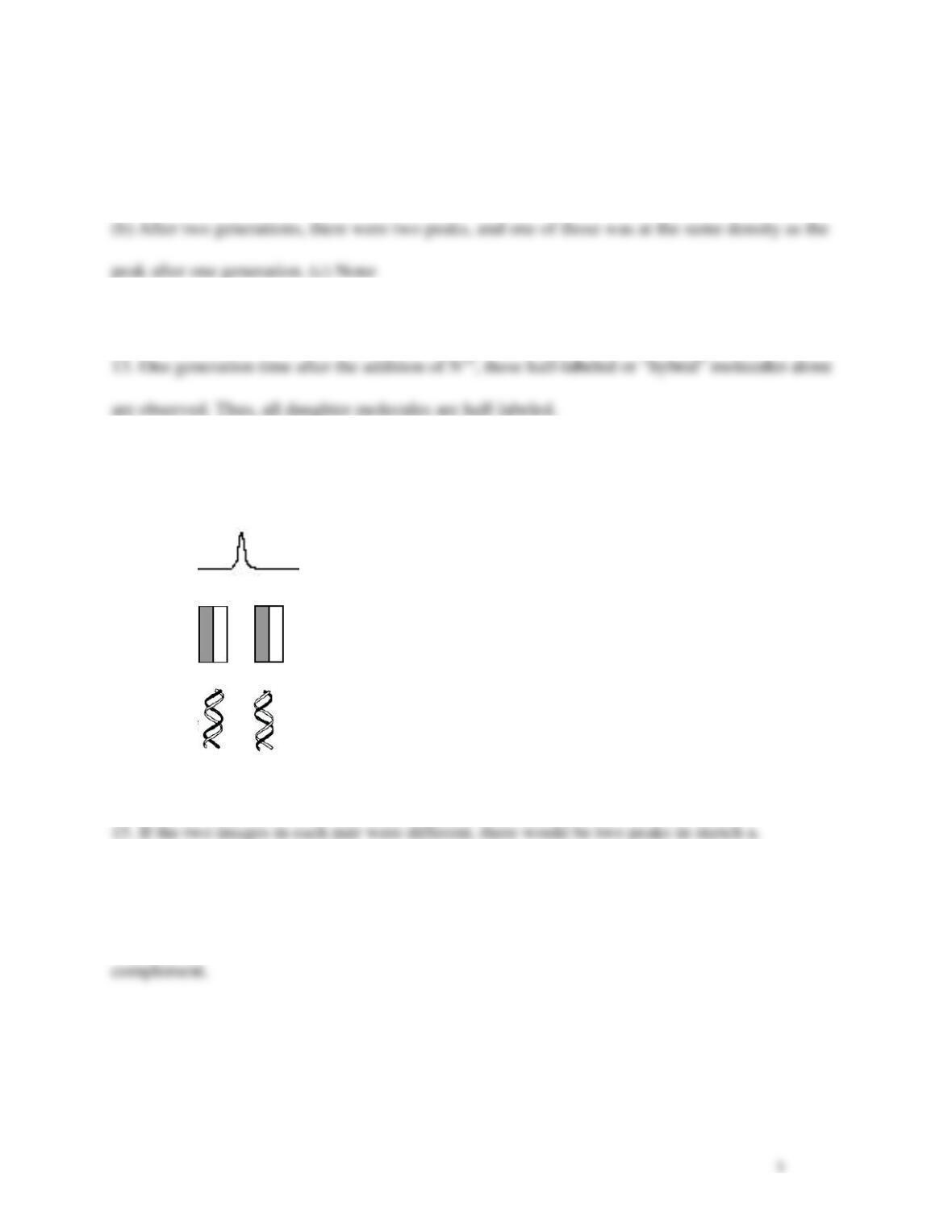
12. (a) After 1.0 generation, the peak DNA density was lower than the density of initial DNA.
14.
(a)
(b)
(c)
16. The two chains separate, then each chain serves as the template for the synthesis of its

Inquiry in Action: Interpreting Scientific Papers, Key to Questions
4
17. (a) Bases (purines and pyrimidines); (b) You could label the phosphate with a radioisotope of
18. In “conservative” replication, all the atoms of the original DNA molecule would be together
19. As long as the pairs of nitrogen bases are present in the DNA fragments, we can still see the
20. You could label a different part of the DNA molecule, as suggested in question 16, and see if

Inquiry in Action: Interpreting Scientific Papers, Key to Questions
Article 2
Inquiry Figure 23.16: Do Females Select Mates Based on Traits Indicative of “Good
Genes”?
Key to Questions
1. Welch; University of Missouri; NSF, NIMH, and Sigma Xi
3.
fitness (evolutionary): the relative contribution of an individual to the gene pool of the next
generation
4. Gray tree frog, Hyla versicolor; abbreviated as H. versicolor (with just the initial of the genus)

Inquiry in Action: Interpreting Scientific Papers, Key to Questions
5. The “good genes” model predicts that females can use male courtship displays to select mates
6. This separates the effect of direct benefit to the female from the indirect (genetic) benefit of
good mate choice.
7. In the field, females freely initiate matings with calling males and do not always choose the
8. Males that produce long calls spend less time calling per night and attend fewer choruses per
season.
9. Long calls appeared to be more costly to the males than short calls, because long-calling males
10. With maternal half-sibships, maternal effects would be controlled. The offspring would share

Inquiry in Action: Interpreting Scientific Papers, Key to Questions
7
12. Long-callers had 10.1 more pulses per call and called 0.69 seconds longer than short-callers.
The difference in pulses per call was statistically significant at the level of p < 0.001. According
13. Calling effort is the proportion of time in the frog chorus that the individual was producing
14. Investigators reared 538 tadpoles in 1995 and 384 in 1996, individually in laboratory
containers with 1.0 liter of water. They used two food levels because environmental conditions
15. Performance parameters: larval growth, larval period, metamorphic mass (size at the stage of
16. Experimental study

8
17. Lab study
19. There is genetically based variation in call duration among males. Males with longer calls
20. There is genetically based variation in call duration among males. Males with longer calls
21. Many field and lab studies are possible with this research system. For example, you could do
more tests on the effects of rearing tadpoles at different resource levels. You could test whether

Inquiry in Action: Interpreting Scientific Papers, Key to Questions
9
Article 3
Inquiry Figure 41.4: Can Diet Influence the Frequency of Birth Defects?
Key to Questions
1. The Lancet, 1980
3.
amniocentesis: a prenatal diagnosis technique in which amniotic fluid is extracted from the
uterus and tested for certain genetic and congenital conditions in the fetus
4. Nutritional factors
5. Women who previously had one or more NTD infants and were planning another pregnancy

Inquiry in Action: Interpreting Scientific Papers, Key to Questions
10
7. One hundred eighty-five mothers were in the fully supplemented group. They received a
8. The investigators did not include data on those women in this study. (They kept the
information and included it in their larger analysis.)
9. (a) Pairs were matched by number of previous NTD infants, estimated date of conception, and
10. In the supplemented group, there were 140 infants without NTD and 1 with NTD. In the

11. (1) The mothers who volunteered and participated in the supplement study might
unknowingly have had a lower risk of NTDs. (2) Mothers receiving vitamin supplementation
12. Despite the alternative explanations mentioned, the observed difference is sufficient to
conclude that vitamin supplementation can prevent NTDs in this group of women. Results can
13. (a) In randomized trials, the decision of which women to place in the control group and
which to place in the treatment group would be based on a random draw rather than on any
defined characteristics. (b) A placebo is an inert substance that is not physiologically active but

Inquiry in Action: Interpreting Scientific Papers, Key to Questions
12
14. Many responses are possible here; for instance, one could repeat the analysis with pairs of
control and supplemented mothers who are matched for one of the uncontrolled variables

Inquiry in Action: Interpreting Scientific Papers, Key to Questions
Article 4
Inquiry Figure 56.14: What Caused the Drastic Decline of the Illinois Greater Prairie
Chicken Population?
Key to Questions
1. Science, 1998
3. Tympanuchus cupido pinnatus, grassland
4.
extinction vortex: a downward population spiral leading to extinction
microsatellite markers: highly variable DNA sequences, not associated with gene loci coding for
specific proteins, that are used to estimate genetic diversity

Inquiry in Action: Interpreting Scientific Papers, Key to Questions
5. Low genetic variation decreases fitness and also makes a population less able to respond to
6. Loss of habitat suitable for reproduction
8. The y–axis label is “Eggs hatched (%)”; circles. High, 100%; and low, 38%. Vertical bars
9. Factors include abandoned nests, researcher disturbance, nest parasitism by ring-necked
10. Managers started a translocation program, moving 271 male and female prairie chickens
from large populations in Minnesota, Kansas, and Nebraska to Jasper County, Illinois. Poor

Inquiry in Action: Interpreting Scientific Papers, Key to Questions
11. After each year, 25%–67% of the transplanted prairie chickens survived and integrated into
12. (a) The number of males was between 5 and 20 in 1987–1989 and around 30 in 1995–1997.
13. Probably (a) number of males is a better indicator of the population size, because it
14. Rainfall that is excessive or too low, flooding
16. Field study
17. Observational study. The translocation of individuals could be viewed as a manipulation, but

Inquiry in Action: Interpreting Scientific Papers, Key to Questions
16
18. They concluded that sufficient genetic diversity was more important, because the percentage
19. One possible way is to study for comparison prairie chicken reproduction in Minnesota or
20. Some examples: You could acquire data on reproduction in prairie chickens in Minnesota or
Nebraska where populations are larger. In the Illinois population, you could follow the history of

Inquiry in Action: Interpreting Scientific Papers, Key to Questions
Article 5
Inquiry Figure 1.27: Does the Presence of Venomous Coral Snakes Affect Predation Rates
on Their Mimics, Kingsnakes?
1. Nature, 2001
3.
Batesian mimicry: palatable species that resemble dangerous species are protected from
4. Snakes: Micrurus fulvius, eastern coral snake; Lampropeltis triangulum, scarlet kingsnake;
6. Pre-colored plasticine threaded onto a wire

Inquiry in Action: Interpreting Scientific Papers, Key to Questions
7. At each site, investigators placed ten triplets of one ringed, one striped, and one plain brown
snake models.
9. Figure 1a: x-axis latitude and y–axis “proportion of total attacks on ringed replicas.” Figure 1b:
10. In North Carolina and South Carolina, coral snakes are present at latitudes south of 35°N and
11.
(a) Lower
12.
(a) No difference

Inquiry in Action: Interpreting Scientific Papers, Key to Questions
14. Yes
16. (B)
18. Yes
20. (B)
22. Field study

Inquiry in Action: Interpreting Scientific Papers, Key to Questions
20
24. If predators cannot recognize a snake subspecies as being similar to coral snake, the replicas
of such poor mimics will be attacked more often than the ringed replicas.

Inquiry in Action: Interpreting Scientific Papers, Key to Questions
Article 6
Inquiry Figure 2.2: What Creates “Devil’s Gardens” in the Rain Forest?
Key to Questions
1. Nature, 2005
3.
allelopathy: the local inhibition of plant growth by another plant
domatia: hollow, swollen stems
4. Myrmelachista schumanni; Latin names are italicized or underlined because they are in a
foreign language.
5. D. hirsuta

22
7. (a) The ants poison all plants except their host species. (b) Host trees inhibit growth of other
plants by allelopathy.
9. Tree damage was measured as (a) initial leaf tissue necrosis; (b) leaf loss within five days.
11. A, Yes; B, Yes; C, No; D, No
13. Greatest leaf necrosis in treatment number 1—planted inside a devil’s garden, ants not

23
14. Yes, these results agree with the predictions under hypothesis 1. Yes, you reject the null
hypothesis.
16. In a separate experiment, the authors treated leaves with formic acid, and all plants tested
developed leaf necrosis.
18. Field study
19. When plants of other species begin to grow near a Duroia tree with an ant colony, the ants
20. Different answers are possible. One experiment would be to see whether ants will attack

Inquiry in Action: Interpreting Scientific Papers, Key to Questions
Article 7
Inquiry Figure 37.14: Does the Invasive Weed Garlic Mustard Disrupt Mutualistic
Associations Between Native Tree Seedlings and Arbuscular Mycorrhizal Fungi?
Key to Questions
2. Stinson, Harvard University
4.
allelopathy: the inhibition of plant growth by chemicals, known as allelochemicals, from another
species
arbuscular mycorrhizal fungi (AMF): symbiotic fungi (microbes) that form branching threads

Inquiry in Action: Interpreting Scientific Papers, Key to Questions
25
5. Exotic plants may become invasive because they are free from limiting enemies, because they
6. Alliaria petiolata, garlic mustard, Eurasia
7. In Eurasia, it is abundant in forest edges, semishaded floodplains, and other disturbed areas. In
8. High densities of garlic mustard had been associated with low ability of native plants to be
10. Soils were collected from garlic mustard–invaded locations and garlic mustard–free locations
11. In Figure 1A, the x-axis of the histogram has categories for red maple from invaded soils and

Inquiry in Action: Interpreting Scientific Papers, Key to Questions
12. The mean is the arithmetic average of a set of values. The standard error is a statistical
13. Red maple seedlings grown in uninvaded soil had a higher percentage of mycorrhizal
colonization.
14. In Figure 1B, the y-axis shows percentage increase in plant biomass. Plants (one seedling per
15. In this 4 × 3 design, the 4 represents four soil groups (combinations of invaded or uninvaded
and sterile and nonsterile) and the 3 represents three different tree species. Some of the
16. Each factor was tested with ten replicates. A replicate is a repeat of the same test with a new plant

Inquiry in Action: Interpreting Scientific Papers, Key to Questions
17. Hypothesis B should be rejected, because seedlings in sterile invaded soil grew no more than
18. The control treatment was water alone.
19. For 3A: No tree seedlings formed mycorrhizal associations when grown in soil to which
garlic mustard extract had been added. In contrast, seedlings of all three tree species formed
20. Predictions will vary, but here is an example: I predict that growth of native tree seedlings
would not be as much affected by garlic mustard, because it is probable that garlic mustard’s

Inquiry in Action: Interpreting Scientific Papers, Key to Questions
28
21. The two types of fungi were Glomus and Acaulospora. Both types of fungi had zero AMF
spore germination in plates containing the garlic mustard extract. If the two fungal species were
23. Lab study
25. Many answers are possible; here are a few: I would plant tree seedlings in the field at

Inquiry in Action: Interpreting Scientific Papers, Key to Questions
Article 8
Inquiry Figure 9.15: Is the Rotation of the Internal Rod in ATP Synthase Responsible for
ATP Synthesis?
1. Hiroyasu Itoh
3. Nature, January 2004
5. “Here we present direct evidence for the chemical synthesis of ATP driven by mechanical
energy.”
6.
chemiluminescence: release of light from a chemical reaction

Inquiry in Action: Interpreting Scientific Papers, Key to Questions
8. (a) Anticlockwise—B (ATP hydrolyzed); (b) clockwise—A (ATP synthesized)
10. The magnetic bead is larger. Investigators caused the ~G end of the complex to rotate by
using magnets.
12. The y– axis represents the number of photons detected. This is an indicator of the rate of ATP
synthesis produced by the rotation.
14. The experiments indicated by broken lines differed because phosphate was omitted from the
medium. Omission of phosphate served as a control because all other conditions for ATP

Inquiry in Action: Interpreting Scientific Papers, Key to Questions
31
15. Rotation of the ~G subunit in ATPase is the mechanism for ATP synthesis, and rotation of
16. They want to exploit the mechanism in artificial ways, improving the coupling efficiency

Inquiry in Action: Interpreting Scientific Papers, Key to Questions
Article 9
Inquiry Figure 30.14: Can Flower Shape Influence Speciation Rate?
1. Proceedings of the Royal Society of London, B; 2004
3. National Sciences and Engineering Research Council of Canada
4.
actinomorphy: radial symmetry in flower structure
zygomorphy: bilateral symmetry in flower structure
5. Such changes have allowed efficient pollination by specialist insect pollinators and thus lower

Inquiry in Action: Interpreting Scientific Papers, Key to Questions
6. The specialized flower traits include nectar guides, nectar spurs, bilateral symmetry, and
7. Mimulus, Aauilegia
8. The pollen-position hypothesis states that the restricted direction of pollinator access in
zygomorphic flowers increases the specificity of placement of pollen by the pollinator.
10. A null hypothesis is a statement of no relationship between the dependent and independent
11. The investigator used multiple sister lineages of animal-pollinated plant families and tested
12. (a) 19 (b) Violaceae, Passifloraceae, Tumeraceae, Malesherbiaceae (c)The brackets indicate
that Turneraceae and Malesherbiaceae are most closely related to each other. The next closest

Inquiry in Action: Interpreting Scientific Papers, Key to Questions
13. The results of sister-group comparisons showed that zygomorphic clades have more species
14. The conclusion that zygomorphic clades are more species rich is consistent with field
15. Bumblebees may prefer zygomorphic flowers over actinomorphic flowers. Bees might be
inefficient pollinators of actinomorphic flowers. Evolutionary reversals to actinomorphy in a
16. (a) Zygomorphy might be correlated with a different trait that is actually driving
diversification. (b) The presentation of secondary pollen, on floral structures other than the

Inquiry in Action: Interpreting Scientific Papers, Key to Questions
presentation. (d) Secondary pollen presentation is not strongly correlated with zygomorphy, so it
17. The analysis does not permit distinction between the changes in species diversity due to
18. If zygomorphic flowers are pollinated more efficiently, then those species could reproduce
19. (a) This study documents the correlation through statistical treatment of multiple sister-group
comparisons. (b) Although the author points out other studies on the precision of pollen
20. A possible follow-up would be to look at smaller clades within one large and diverse plant
family that includes both zygomorphic and actinomorphic species and to see if similar patterns