b 137
As with all the cases in this book, please read the preface if you have not
already done so. In the preface you will find suggestions about using Investigative
Case–Based Learning (ICBL) in different instructional situations such as starting a
history. Pandemic Flu (Possible) uses current maps to introduce students to the
H5N1 avian inuenza A strain currently in the headlines. There are four strands
in this chapter:
• StructureandfunctionoftheH5N1variant
• Theimmunesystem
Seven investigations accompany Pandemic Flu (Past and Possible). Five
are “core” investigations relating directly to the facts of the case, and two
are additional investigations that extend the case to other applications.
TableIG9.1describeswhatstudentswillgainfromeachinvestigation.Seethe
Chapter 9:
Pandemic Flu
(Past and Possible)
InstruCtor’s GuIde
M09_REEC4164_04_IE_CH09.indd 137 25/01/14 3:30 PM
138 a BIoloGICal InquIry: A Workbook of Investigative Cases
I. Exploring Flu Anti-
gens, Genetics, and
Introduction to the roles and structures of the
H and N viral surface proteins. Students use
• making inferences
table IG9.1 Pandemic Flu Case overview.
Investigation learning Goals Inquiry skills used
Core Investigations
II. Pandemic Flu (Pos-
sible): The Spread of
H5N1 Avian Influenza
Students use the three maps provided as a vi-
sual data set to begin investigating the spread
of H5N1 avian influenza. Students will see
how data on the spread of disease in humans,
poultry, and wild birds are relevant and that
understanding migration patterns may be a
clue in understanding the epidemiology of this
influenza.
• observing of visual data
• detecting patterns
• drawing inferences
• evaluating various types
of map data (static versus
interactive)
• posing questions
• calculating death rates
V. Using Data to
Explore Pandemic Flu
(Past and Possible)
Excel tools for data
Data from the 1918 pandemic is provided for
students to graphically represent and investi-
gate relationships among age, sex, race, loca-
tion, and flu mortality in 1918.
• graphing data and evalu–
ating methods of data
presentation
• interpretating output from
M09_REEC4164_04_IE_CH09.indd 138 25/01/14 3:30 PM
Case narrative
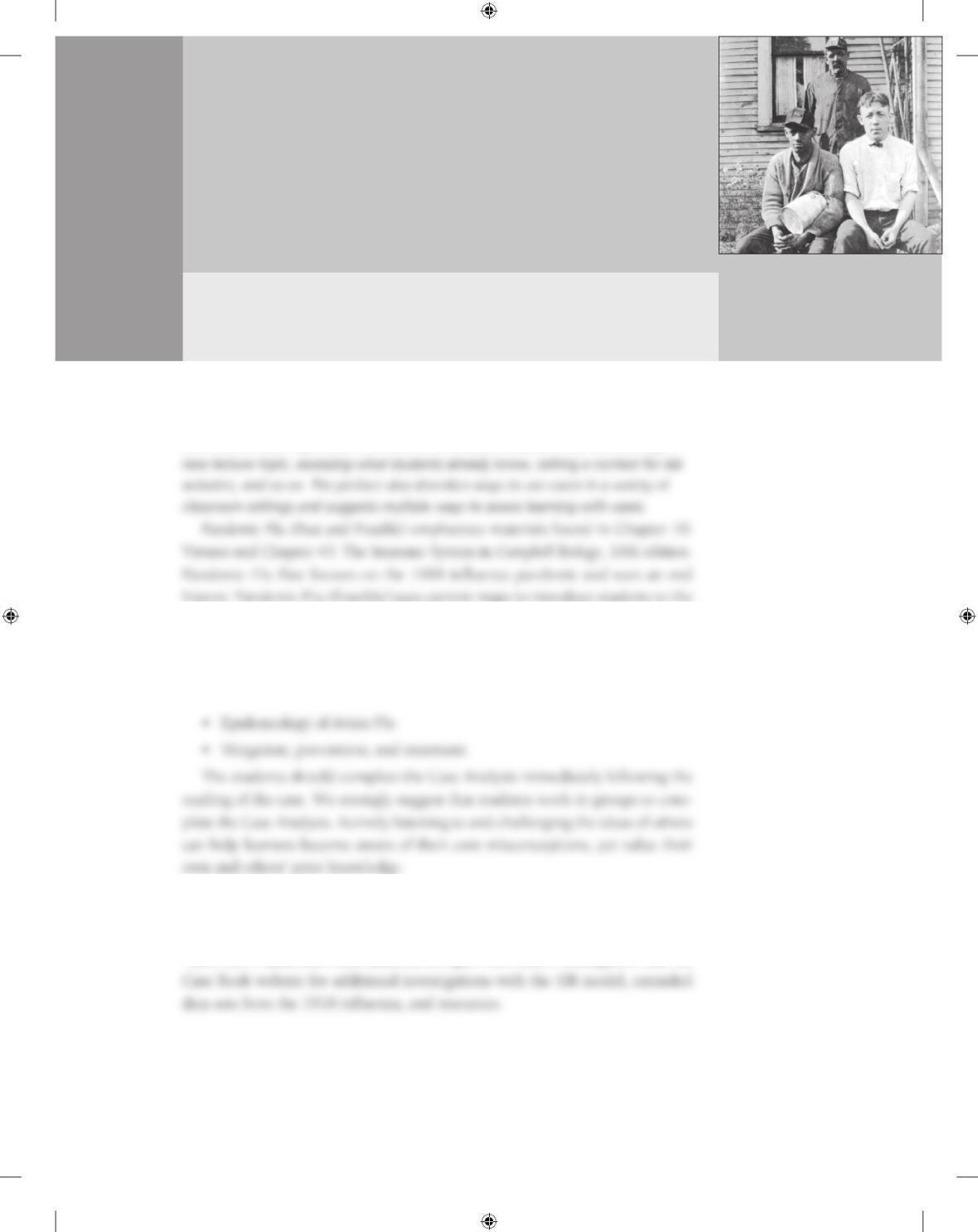
Pandemic Flu (Past): An Oral History by Teamus
Bartley, Recorded by Nyoka Hawkins, 1987
T.BARTLEY:...Youain’toldenoughtoremem–
ber the year the flu struck the people so bad in
this . . . in this country, do you?
HAWKINS: No.
T. BARTLEY: That was in 1918.
HAWKINS:Yeah,Ithinkthatbothmy...
bothmygreat-grandparentsdiedinthat.
ChaPter 9: Pandemic Flu (Past and Possible) b 139
VI. Pandemic Planning A list of issues and concerns being consid–
ered by pandemic planners is presented.
• communicating scientific
information to
additional Investigations
hisfamilytookdownwithit.It...what did
they call it?Theu?Yeah.Eight-...1918 flu.
AndwhenI’dgetoverthere,I’dridemyhorse
andgooverthereofaevening,I’dstaywithmy
brother about three hours and do what I could
to help them and every one of them was in the
bed and sometimes Dr. Preston would come
while I was there. He was the doctor. And he
said, “I’m trying to save their lives, but I’m
afraid I ain’t going to.” They was so bad off.
M09_REEC4164_04_IE_CH09.indd 139 25/01/14 3:30 PM
140 a BIoloGICal InquIry: A Workbook of Investigative Cases
suggested answers for Case analysis
1. Recognize potential issues and major topics in the case.Whatis this case about?Underline
termsorphrasesthatseemtobeimportanttounderstandingthiscase.Thenlist3–4biology-related
topics or issues in the case.
2. What specific questions do you have about these topics?Byyourself,orbetteryet,inagroup,
makealistofwhatyoualreadyknowthatisrelatedtothecaseinthe“WhatDoIKnow?”column.
Listquestionsyouwouldliketolearnmoreaboutinthe“WhatDoINeedtoKnow?”column.
What do I Know? What do I need to Know?
• There was a pandemic of u in 1918. • Did soldiers/sailors bring the u from
• It killed many people. elsewhere?
• It interrupted work; mines closed. • Was there u in other countries besides the
• Some people lived in camps. United States?
3.Putacheckmarkby1–3questionsorissuesinthe“WhatDoINeedtoKnow?”listthatyouthink
aremostimportanttoexplore.
M09_REEC4164_04_IE_CH09.indd 140 25/01/14 3:30 PM
4. What kinds of references or resources would help you answer or explore these questions?
Identifytwodifferentresourcesandexplainwhatinformationeachresourceislikelytogivethatwill
helpyouanswerthequestion(s).Choosespecicresources.
Websites such as that of the World Health Organization, the United Nations, the U.S. Department
suggested answers for Core Investigations
I. Exploring Flu Antigens, Genetics, and Replication
The transcript in the case is an oral history told by a survivor of the deadly flu pandemic (global epi–
demic) of 1918. It is estimated that this flu was responsible for at least 40 million deaths worldwide.
Both H1N1 from 1918 and today’s closely monitored avian flu virus, H5N1, are classified as influenza
A viruses.
1.WhatmoleculedoestheHstandforinthenameofbothviruses,whereistheHmoleculelocated
on the virus, and what role does the H molecule play in the life cycle of the virus?
2.WhatmoleculedoestheNstandfor,whereisitlocated,andwhatisitsfunctioninthevirallife
cycle?
N stands for neuraminidase, a viral surface protein (envelope protein) that triggers the breakdown of
ChaPter 9: Pandemic Flu (Past and Possible) b 141
M09_REEC4164_04_IE_CH09.indd 141 25/01/14 3:30 PM
3.Thevirususesthehostcelltoproducemorecopiesofitself.AstheviralRNAreplicatesinthehost,
mutationsarisemuchmorefrequentlyintheviralgenomethaninthehostgenome(whichrepli–
catesDNA).Whydomoremutationsoccurinthevirusthaninthehost?
There is no error checking with RNA replication as in DNA replication.
In addition to mutation (antigenic drift), influenza A viruses can also exchange RNA with other strains of
4.Dependingonthestrain,inuenzaAisfoundinavarietyofanimalhostsincludinghumans,pigs,
birds,cats, dogs, or even whales.ManyinuenzaA viruses are notspecicfora single kind of
animalhost.Inthediscussionthatfollows,“PandemicFlu(Possible),”mapsshowingthecurrent
spreadofH5N1includethedensityofchickenfarmsandpigfarmsaswellashumanpopulations.
Whydoyouthinkthesethreepopulationsarebeingtrackedbyepidemiologistslookingfornew
strains of avian u?
Pigs are a good mixing ground (antigenic shift) for inuenza viruses. They can become coinfected with
5. Suppose a human host suffering from seasonal inuenza A (readily transmitted from human to
human)comesdownwithavianuatthesametime.Whatseriousconsequencesmightresult?
6.TheimmunesystemrespondsspecicallytotheexactcombinationoftheHandNsurfaceproteins
foundinauvirusparticle.Currently,16antigenicallydistinctgroupsofHmoleculesand9dis–
tinctgroupsofNmoleculeshavebeenidentied.Howmanypossibleantigenicallydistinctcombi–
nations of H and N could occur?
There are 16 kinds of H proteins and 9 kinds of N proteins. The possible H and N protein combinations
are 16 3 9 or 144 combinations.
142 a BIoloGICal InquIry: A Workbook of Investigative Cases
M09_REEC4164_04_IE_CH09.indd 142 25/01/14 3:30 PM
ChaPter 9: Pandemic Flu (Past and Possible) b 143
7. a. ExplainhowthelocationofhumanglycoproteinreceptorsforH1,H2,andH3inuenzaAanti–
gensfacilitatestransmissionofthesestrainsamonghumans.
b. ExplainhowthelocationofhumanglycoproteinreceptorsforH5inuenzaAantigenshascon–
tributedtothefailure—sofar—ofthisvirustobereadilytransmittedamonghumans.
Because these receptors are deeper inside people, the H5N1 virus has to be breathed in deeply. And
8.TheWorldHealthOrganizationGlobalInuenzaProgrammeisdeveloping“pre-pandemic”can–
didate vaccines based on H5N1 viruses from infected humans. These pre-pandemic vaccines are
neededforpreparednessplanningandareusedinstudiesthatinformdosage,cross-reactivity,and
cross-protection.Theyarealsoavailableforgovernmentstorequestforpilotvaccineproduction
(WorldHealthOrganization,2007).
Doyouthinkthatthesepre-pandemicvaccineswillbeeffectiveagainstanH5N1inuenzathat
becomeshuman-to-humantransmissible?Whyorwhynot?
h1, h2, and h3 human Flu h5 avian Flu
Receptors are host cell–surface glycoproteins that Receptors are host cell–surface glycoproteins whose
table 9.1 Comparing hemagglutinin receptors in humans and Birds.
9. AnewstrainofH5N1avianucouldemergethatwouldresultinhuman-to-humantransmission.
a. Whyisvaccinedevelopmentnotthehighestpriorityrightnow?
The new strain would be different from what is around right now. Any vaccine made now might
b. Onceanepidemichasstarted,vaccinedevelopmentwillbeahighpriority.Epidemicsoftenoc–
curin“waves”ofillness,withdifferentsegmentsofthepopulationbecomingilleachtime.Three
wavesofdisease,eachlastingweeks,arenotrareinauepidemic.Whydoescreatingavaccine
inpreparationforasecondwaveofanepidemicmakethemostsense?
10. ReviewthereplicationcycleforuvirusesinChapter19.Pharmaceuticalcompanieswishtopro–
duceantiviraldrugtherapiesthatcaninterrupttheviralreplicationcyclewhilecausingminimal
adverse effects on the host cells. Several classes of drugs are known to interrupt inuenza A
replication.
Oseltamivir(Tamiu)andzanamivir(Relenza)aredrugsthatinhibittheactionoftheNprotein.
Oseltamivirhasbeenusedsuccessfullyinsomecasesbutonlyduringtherst36–48hourspost-
exposure.Whatpartofviralreplicationisaffectedbythesetwodrugs?Whyisearlytreatment
needed?
11. ResistanceofavianinuenzaAtooseltamivirhasalreadybeenobserved.Forexample,aresistant
H5N1inuenzaAmutanthasbeenisolatedfromahuman.Therewasasubstitutionofasingle
aminoacidatposition274,inwhichatyrosinereplaceshistidine(deJongetal.,2005).Explain
howresistancetoadrugincreasesthetnessofthevirus.
144 a BIoloGICal InquIry: A Workbook of Investigative Cases
II. Pandemic Flu (Possible): The Spread of H5N1 Avian Influenza
While the 1918 “Spanish flu” pandemic is long over, its lessons have been critical to understanding sub–
sequent u pandemics (in 1957 and 1968) as well as for preparing for future pandemics. The current
H5N1 avian influenza is a different type of flu virus than those that have infected humans in the past. At
the time of this publication, H5N1 has been only avian-to-human transmissible, but it is frequently deadly
in the people who contract it from birds. In this investigation, you will be making observations from the
maps that follow, detecting patterns, and drawing inferences about the occurrence and spread of H5N1
avian influenza.
Use the maps in Figures 9.2a, b, and c to learn more about the H5N1 avian influenza A.
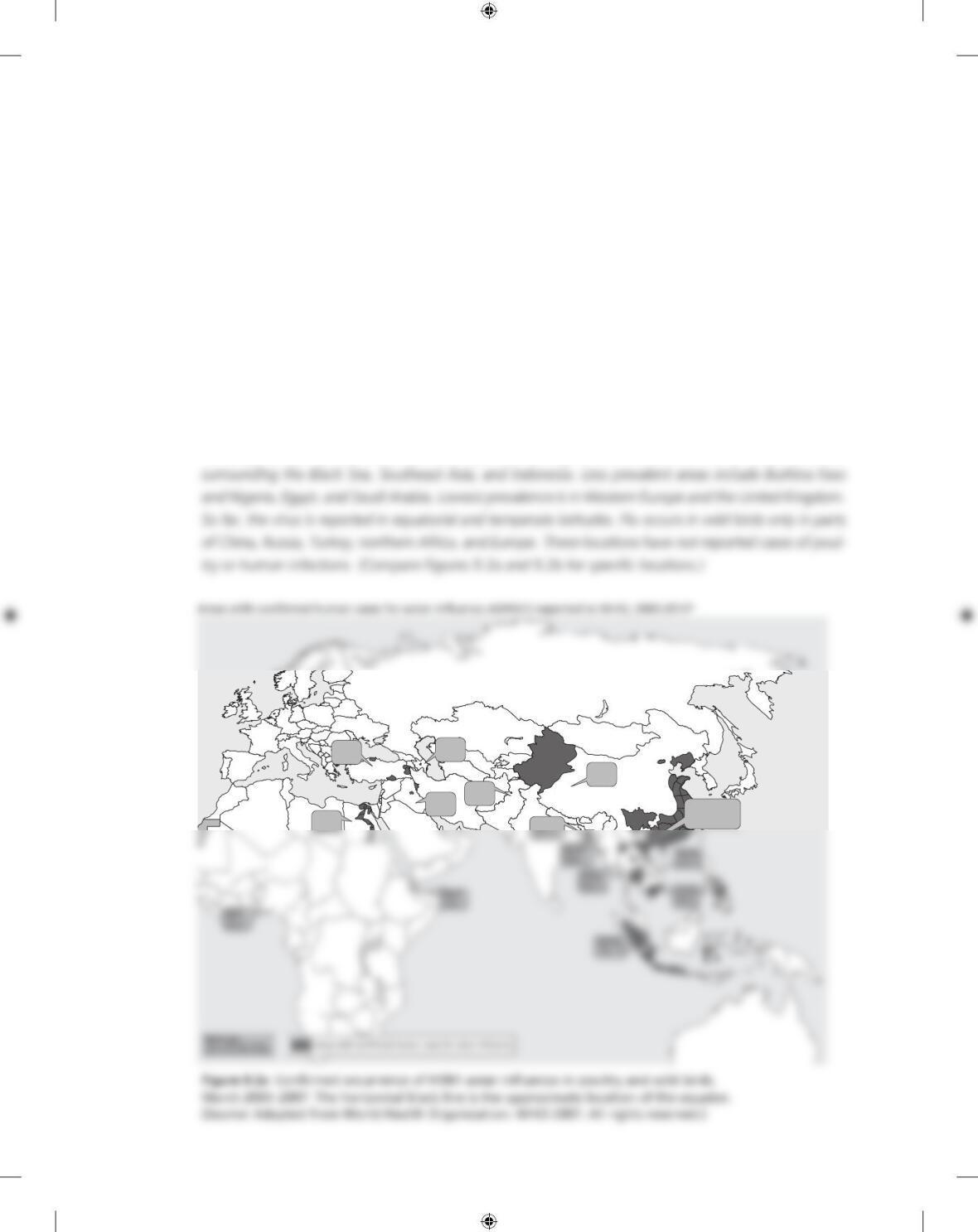
1.ExamineFigure9.2a.In3–4sentences,describethegeneralpatternofH5N1avianuthatisshown
inthismap.Tellwhatcontinentsandapproximatelatitudesareaffected,wheretheuseemstobe
most common in poultry, and where wild birds are the only cases reported so far.
China by far has the most bird u in poultry, followed by central Russian Federation, India, countries
ChaPter 9: Pandemic Flu (Past and Possible) b 145
China
Cases: 43
Deaths: 28
Azerbaijan
Cases: 8
Deaths: 5
Turkey
Cases: 12
Deaths: 4
Iraq
Cases: 3
Deaths: 2
Egypt
Cases: 169
Deaths: 60
Lao People’s
Democratic Republic
Cases: 2
Deaths: 2
Pakistan
Cases: 3
Deaths: 1
Bangladesh
China
Cases: 43
Deaths: 28
Azerbaijan
Cases: 8
Deaths: 5
Turkey
Cases: 12
Deaths: 4
Iraq
Cases: 3
Deaths: 2
Egypt
Cases: 169
Deaths: 60
Lao People’s
Democratic Republic
Cases: 2
Deaths: 2
Pakistan
Cases: 3
Deaths: 1
Bangladesh
M09_REEC4164_04_IE_CH09.indd 145 25/01/14 3:30 PM
RUSSIAN FEDERATION
SWEDEN
FRANCE
ITALY
SWITZERLAND
UNITED KINGDOM
OF GREAT BRITIAN
AND NOTHERN IRELAND
CZECH REP.
SLOVAKIA
ROMANIA
U K R A I N E
GEORGIA
AZERBAIJAN
AUSTRIA
HUNGARY
CROATIA
NETHERLANDS
DENMARK
GERMANY
POLAND
M O N G O L I A
BULGARIA
K A Z A K H S T A N
M09_REEC4164_04_IE_CH09.indd 146 25/01/14 3:30 PM
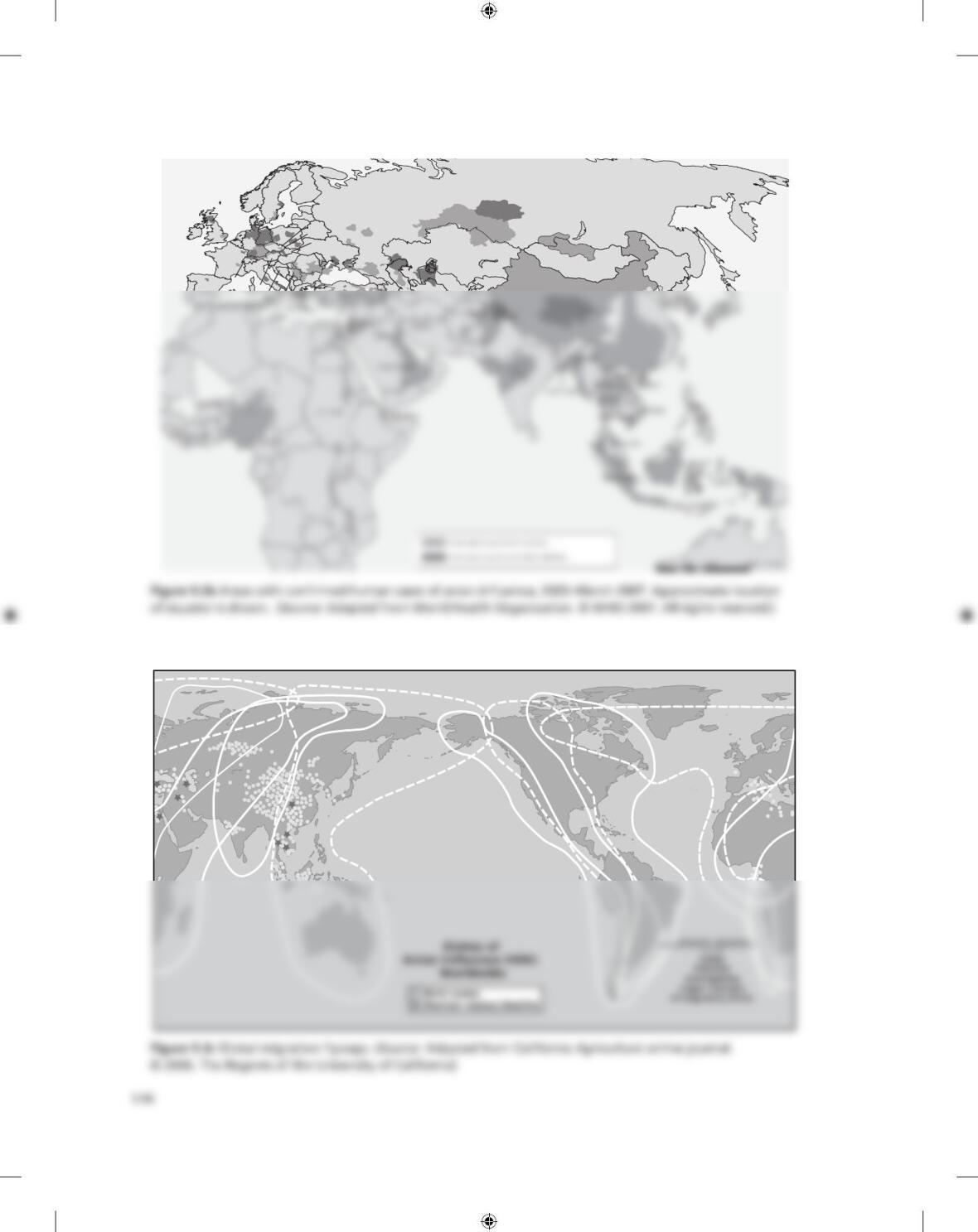
2.NextexamineFigure9.2b.Howdoesthedensityofhumancasescomparewiththedistributionof
the H5N1 u in poultry? In wild birds?
3.What inferences can you draw from these data about how avian u is transmitted to humans?
Explaineachone,referringtothedatayouusedindevelopingthatinference.
Answerswillvary.Herearethreeexamples.
Avian u appears to be transmitted to humans from infected domestic poultry. There are no cases of
4.UpdateFigure9.2bwiththemostrecentdataonthemap.Gotothewebsitehttp://gamapserver
.who.int/mapLibrary/ and search for most recent map. Data in Table 9.2 are from the World
ChaPter 9: Pandemic Flu (Past and Possible) b 147
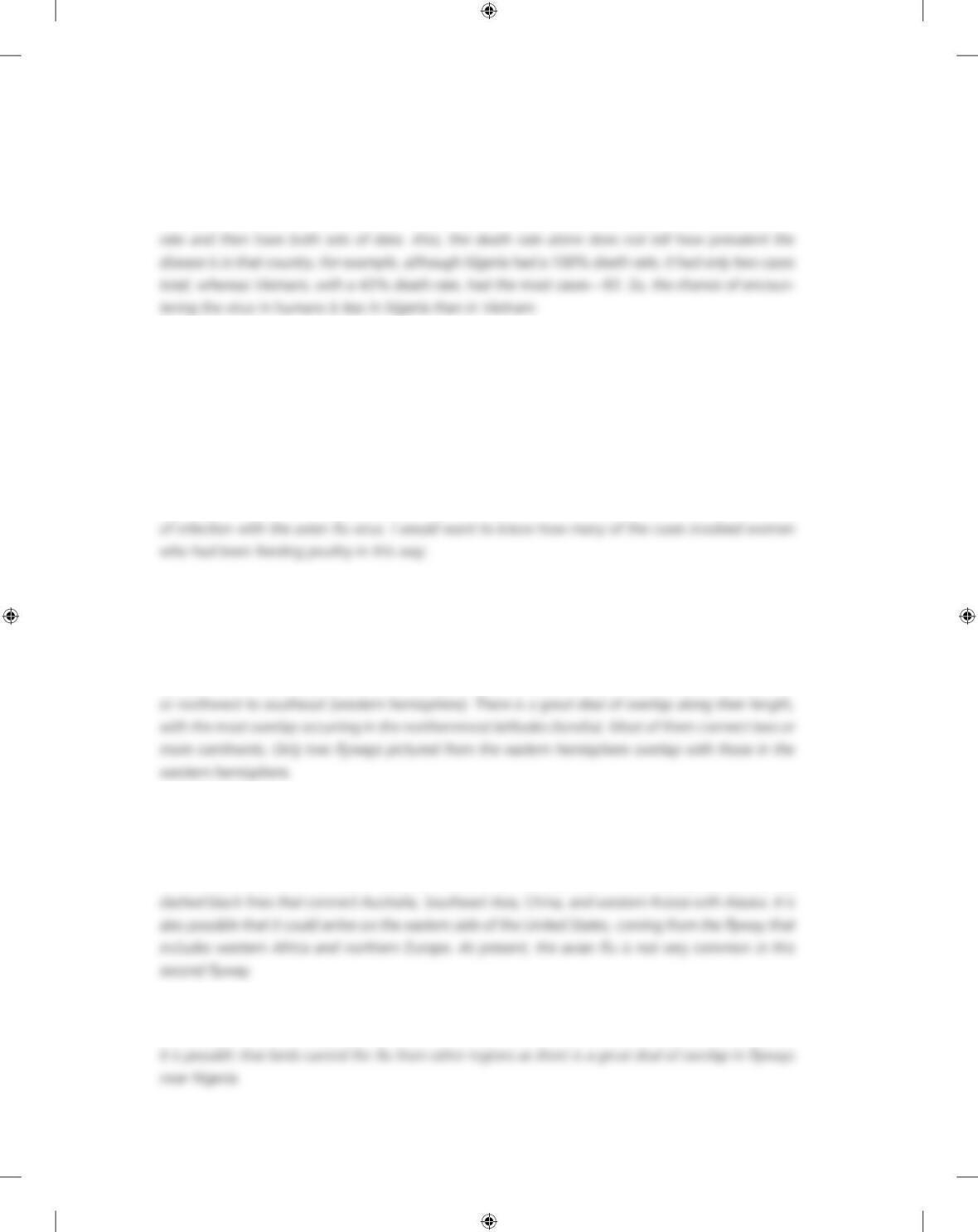
table 9.2 Incidence of avian Influenza h5n1 in humans,
april–June 7, 2007.
5.Use the updatedFigure9.2b tocalculatethe death ratedueto birdufor Indonesia, Vietnam,
China,andEgypt.
Deathrate=(numberdead/totalcases)3100%.Roundtonearest0.1%.
Country 2007
Cases deaths
Cambodia 13 9
M09_REEC4164_04_IE_CH09.indd 147 25/01/14 3:30 PM
6. Ifyouwereplanningatriptooneofthecountrieslistedinnumber5,wouldyouratherbetold
thedeathrateorthenumberofcasesanddeathsineachcountry?Explain.
I would prefer the raw data of number of cases and deaths because I can use it to calculate the death
7. EgyptreporteditsrstcasesofavianinuenzainhumansinDecember2006.Intherst3months
of2007,therewere14morehumancasesofavianu,withthreedeathsinthatquarteryear.Like
peopleinmuchoftheworld,mostEgyptianhouseholdskeepsmallnumbersofchickens.How–
ever,atraditionuniquetoEgyptisthattheirpoultryarefedmouthtomouthbywomenwhorst
chewgrainandthenblowthepowderedfeedintothemouthsoftheirbirds.
WhatdoesthisinformationfurthersuggestaboutthewaysavianinuenzaH5N1spreadsto
humans?Whatadditionalinformationwouldyouwantinordertoconrmyouridea?
This suggests that close contact with poultry, especially with the mouth, is related to very high rates
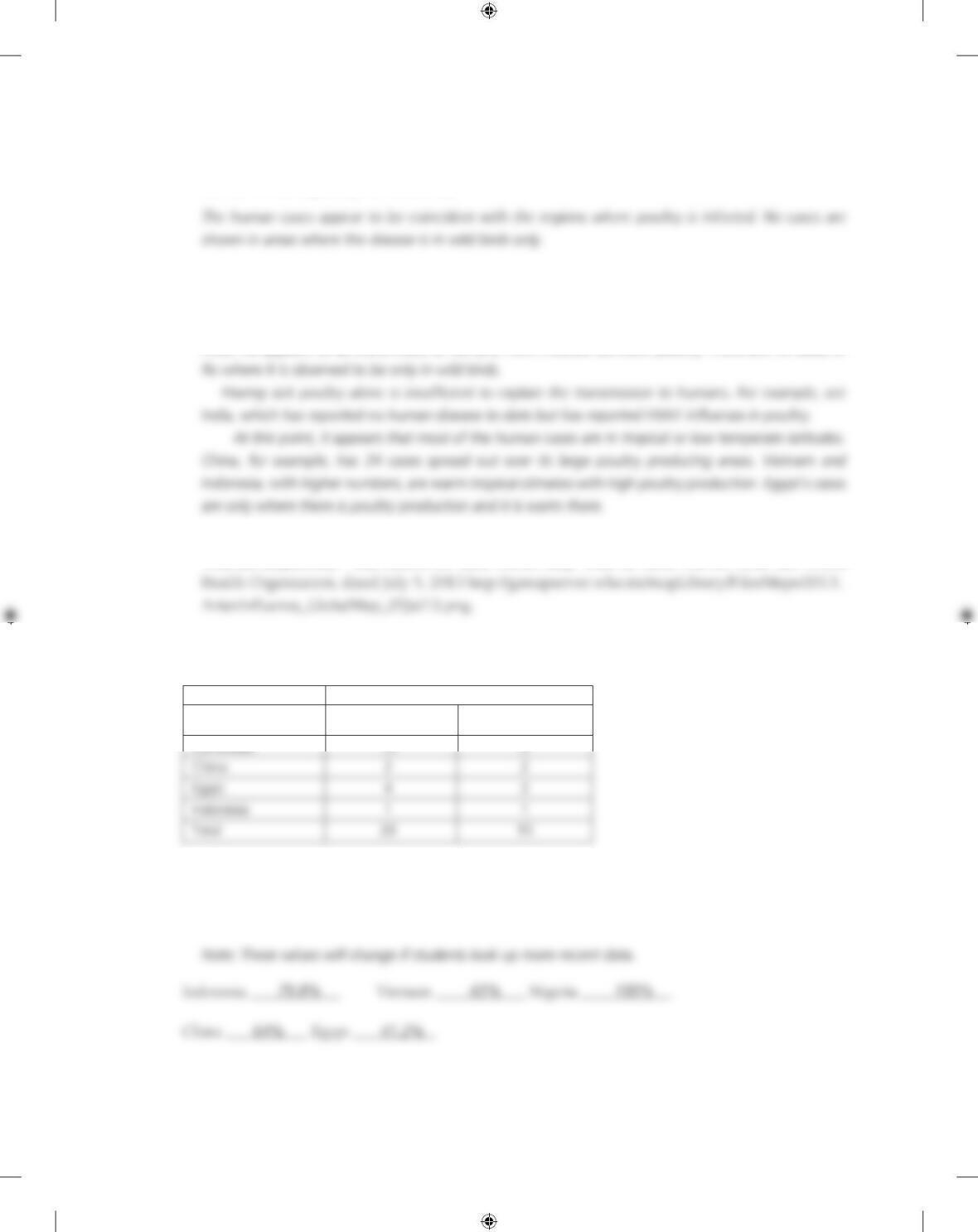
8. As you know, many wild birds y to different parts of the earth as they follow their annual
cycles of migration, mating, nesting, and overwintering. Examine the major yways shown in
Figure9.2c.Inafewsentences,describethepatternsyouseeintheseyways.Includedescriptors
suchasthedegreetowhichtheyoverlap,theirgeneraldirectionalorientations,andtheirextent.
Flyways are oriented mainly over land and generally northeast to southwest (eastern hemisphere)
9. Givenwhatyounowknowaboutthelocationofavianinuenzaandbirdmigration,makean
inferenceaboutwhereyouthinkthisdiseaseismostlikelytoberstdetectedintheUnitedStates.
Explainyourreasoning.
It will most likely arrive in Alaska first. The avian u is more prevalent in the yway surrounded by
10. FromwhichpartoftheworlddoyouthinkavianucametoEgypt?Explain.
Most likely from the Turkey-Egypt area. Two yways connect Nigeria to those regions quite directly.
148 a BIoloGICal InquIry: A Workbook of Investigative Cases
M09_REEC4164_04_IE_CH09.indd 148 25/01/14 3:30 PM
11. Extendingthisinvestigation:Visitoneofthemanyinteractivemapsonavianinuenza.Twopar–
ticularlygoodonesareofferedbytheBritishBroadcastinggroupintheUnitedKingdom:http://
news.bbc.co.uk/1/shared/spl/hi/world/05/bird_u_map/html/1.stm
a. Tell which map you viewed and at least two new bits of information you learned.
BBC map shows (1) the temporal spread of u in birds and humans and (2) indicates which coun–
b. Writetwoquestionsthatyouareabletoanswerwiththeinformationontheinteractivemap
thatyoucouldnotanswerwiththestaticmapsprovidedinthisinvestigation.
Answers will vary but should include reference to some feature of the interactive maps that is
lacking in the static map. For example:
III. Critical Reading: The Body’s Defenses Against the Flu
Before delving further into this investigative case, you should be familiar with the structure and reproduc-
tion of viruses, especially influenza. If you have not already read Chapter 19: Viruses, you should do so
now as background.
Innate Immunity: all animals
1.Onceapathogen(abiologicalagentthatcausesdisease)managestogetpastananimal’sphysical
barriers,thereisaverygoodchancethatitwillbedetectedbytheanimal’simmunesystem.Atthe
molecularlevel,howdoesananimaldetectthepresenceofapathogenanddeterminethatitisan
intruder and nonself?
Recognition occurs within the animal’s body using molecular receptors that specifically bind to mol–
2.AsinglevirusparticleofinuenzaAisinsufcienttoinitiatediseaseinhumans.Itisestimatedthat
between 100 and 1,000 inuenza A virus particles are necessary to cause the u in an individual. A
singledropletsneezedfromaninfectedpersonislikelytocontainsufcientvirusparticlestoinitiate
the disease.
Explainwhyasinglevirusparticleisinsufcient.Todothis,describeboththebarrierandthecellular
ChaPter 9: Pandemic Flu (Past and Possible) b 149
M09_REEC4164_04_IE_CH09.indd 149 25/01/14 3:30 PM
a. Barrier defenses such as skin, mucous membranes, enzymes in saliva and tears, stomach acid, and
secretions on skin that low pH may deactivate or prevent entrance of the virus particles.
A recent summary of clinical findings in people infected with the avian H5N1 influenza A showed that
elevated levels of interferons, various interleukins, tumor necrosis factor (TNF), and monocyte attractant
protein were higher in patients who died than in those who survived. These strong cellular responses of the
acquired Immunity: Vertebrates only
In vertebrates, once the innate immune response fails to prevent host invasion, the acquired immune re–
sponse takes over. In contrast to the more general innate immunity, acquired immunity is a response to
3. Intheacquiredimmuneresponse,twotypesoflymphocytes,BcellsandTcells,arethekeyplayers.
Review Concepts 43.2 and 43.3 and Figures 43.9 and 43.10.
a. CompareandcontrasttheantigenreceptorsofBandTcells.
Both B and T cells have thousands of copies of glycoprotein antigen receptors, all of them identical on a
single cell. Both T and B antigen receptors are made of protein subunits that have constant and variable
150 a BIoloGICal InquIry: A Workbook of Investigative Cases
M09_REEC4164_04_IE_CH09.indd 150 25/01/14 3:30 PM
c. WherearetheantigenslocatedthatthetwokindsofTcellscandetect?IncludetheroleoftheMHC
in your answer.
T cells can bind only to antigen fragments that are presented on the major histocompatability complex
4.ExamineFigure43.20andfocusontheacquiredimmunesystemeventsfollowingrstexposureto
anantigen.Thiswasthecaseforthesailors,coalminers,andeveryoneelseinfectedin1918.
a. Howaretheinnateandtheacquiredimmunesystemslinked?Howdoesonesysteminformthe
otherofaninvasionbyaforeignparticle?
At the start of an infection, signals from phagocytic cells carrying out innate immune responses acti-
b. Intheacquiredimmuneresponse,whichcellsundergoclonalselectiononcetheirreceptorshave
joinedwithoneoftheantigens?
Helper T cells, cytotoxic T cells, and B cells undergo clonal selection once activated by binding to an
antigen.
c. Whyisclonalselectionakeyeventinwhetherornottheacquiredimmuneresponseissuccessful?
Clonal selection means that clones are formed by activated B and T lymphocytes. This rapid prolif-
d. BplasmacellsareeffectorBcellsthatghtofftheinfectiondifferentlythancytotoxicTcellsdo.
Explain.
B plasma cells are those that produce antibodies, which are a form of the antigen receptor lacking
e. AlthoughnotafactorindiseasecausedbyinuenzaA,whatwouldbetheeffectontheacquired
immuneresponseifthehelperTcellswereremovedfromthesystem?(Theviruscausingthe
currentAIDSpandemictargetssuchTcells.)
Helper T cells are one way the innate immune system communicates with the acquired immune sys-
ChaPter 9: Pandemic Flu (Past and Possible) b 151
M09_REEC4164_04_IE_CH09.indd 151 25/01/14 3:30 PM
5.Immunization against common strains of human-to-human transmissible inuenza A is needed
every year because the seasonal u mutates readily. In the case of the 1918 u, immunization was
Intheacquiredimmunesystem,howdoesanimmunizationprotectapersonfromadiseaselikeu?
The inoculation stimulates the immune response in the same way that first exposure to an intact
pathogen stimulates it. Thus, innate response cells, such as dendritic and macrophage cells, engulf
the inoculum, break down the antigen proteins, and present them on their MHC proteins. These are
IV. Internet Activity: Influenza in the Media
The communication of biological information is an essential service for our global society. It is not unex-
pected that a current concern like the avian u is frequently reported on in the media, but the 1918 u
is also still in the news.
In early 2007, several articles cited Sir Mark Sykes, a victim of the Spanish flu epidemic, who died at the
age of 39 in a hotel room in February 1919 while attending the Paris peace conference following World
War I. Because the British diplomat was buried in a sealed lead coffin, researchers were hopeful that well-
preserved body samples could be obtained.
1. Aftertheuvirusisretrievedfromthediplomat’sremains,whatislikelytobedonewiththesample?
Nucleic acid will be extracted from the lung tissues. RT-PCR will be used to isolate and amplify the
2.Consideringthatithasbeen90yearssincetheoutbreakofthe1918u,areyousurprisedbythe
currentscienticinterest?(Whenisscienticinvestigationdone?)
Some students may find this investigation into the past surprising. Science is never finished as new
152 a BIoloGICal InquIry: A Workbook of Investigative Cases
M09_REEC4164_04_IE_CH09.indd 152 25/01/14 3:30 PM
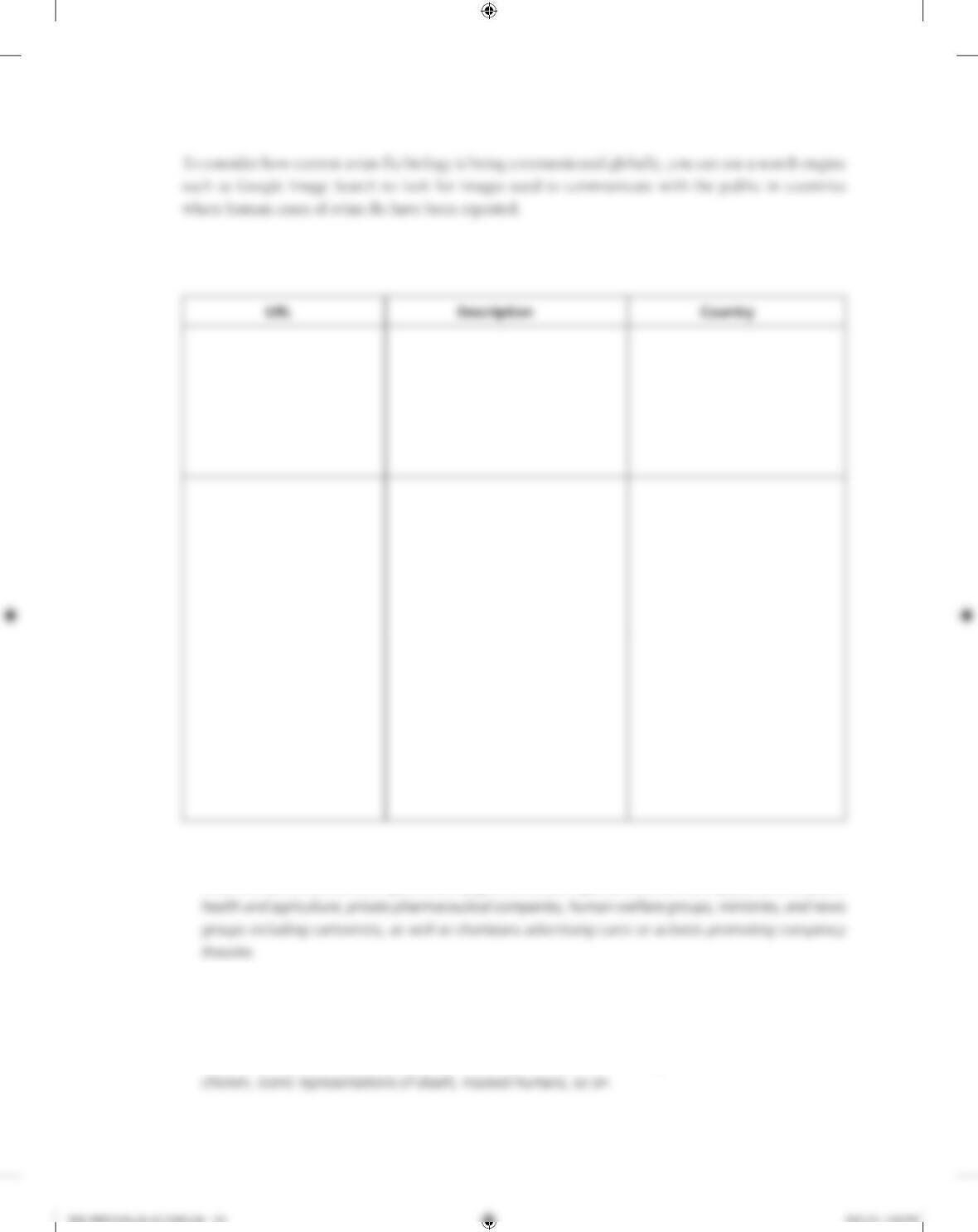
3.Choosethreeimagesthatyoufeelarehelpfulinpresentingbirdufacts.Recordyourinformation
inthefollowingchart.
ChaPter 9: Pandemic Flu (Past and Possible) b 153
4.Whatkindsoforganizationsproducethewebsitescontainingthemediathatyouhavelisted?
Posters or advertisements are generated by governmental organizations such as departments of public
5.Briey describethe biological images usedand how eachrelates to theavian u—for example,
amaskedandgloved(topreventviralinfection)workerexaminingpoultry(potentialcarriersof
H5N1).
For this example, images of chickens, the H5N1 virus, human looking worried or ill, well-cooked
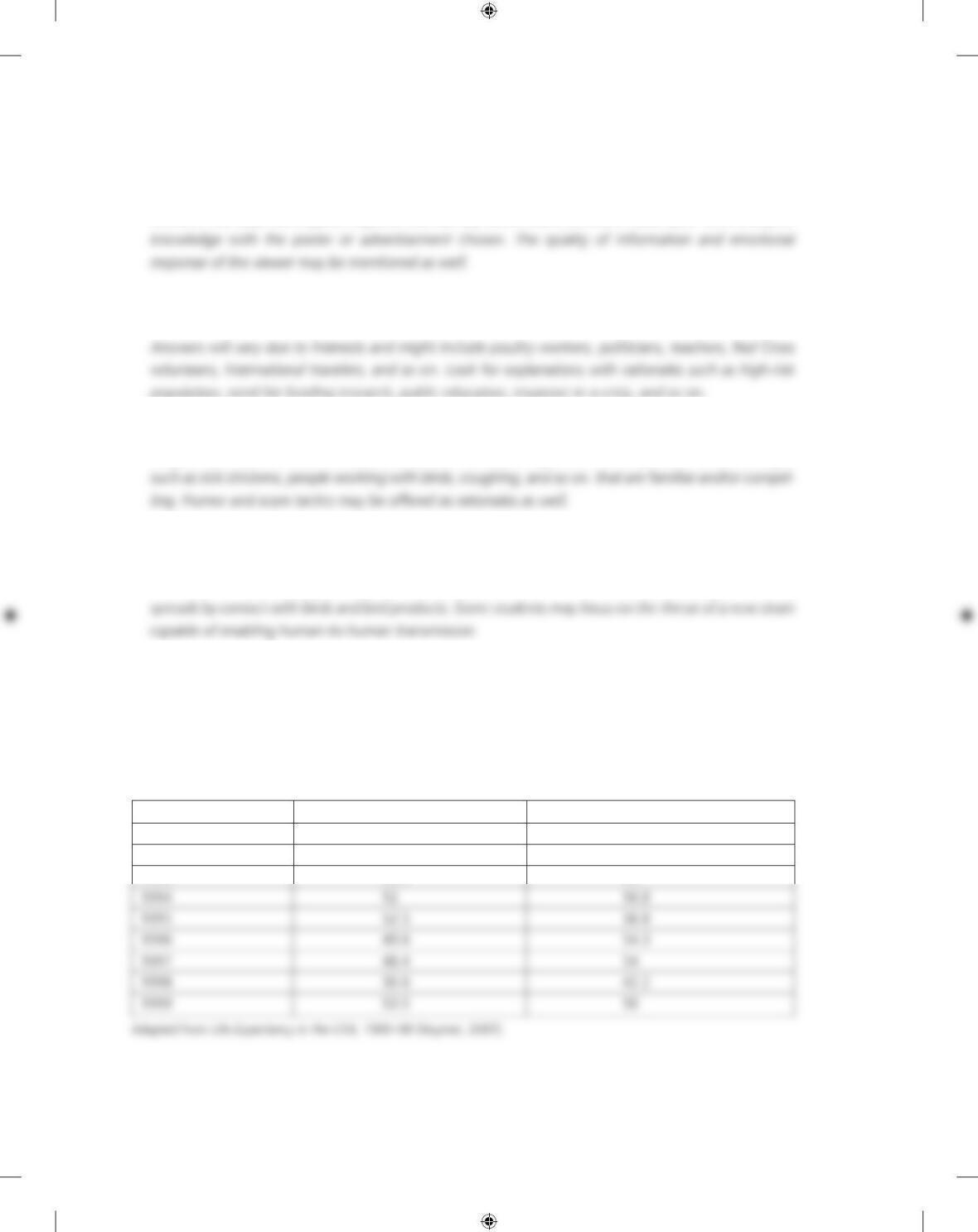
6.Whichofyourthreemediachoiceswouldbethemostusefulforconvincingyourclassmatesthat
avianuisarealbiologicalconcern?Explain.
Answers will vary, but a good response will identify connections between classmates’ lives and prior
7.Ifyouwereaskedtoproduceabrochuretoadviseasegmentofthepublicinyourcountryaboutthe
risksofavianu,whatgroupwouldyouselectasthetargetaudience?Explainyourchoice.
8.Whatimageswouldyouincludeinyourbrochure?Why?
Images must connect with the specific audience. Rationale might include using H5N1-relevant images
9. Describe at least three examples of biological information you would include for this particular
group.
Answers will vary, but a good answer would include that H5N1 is a new, potentially fatal virus that
V. Using Data to Explore Pandemic Flu (Past and Possible)
a. Working with tables and Graphs on Mortality statistics
Consider the data in Table 9.3.
154 a BIoloGICal InquIry: A Workbook of Investigative Cases
year Male Female
1911 50.9 54.4
1912 51.5 55.9
1913 50.3 55
table 9.3 average age at death in the united states, 1911–1919.
M09_REEC4164_04_IE_CH09.indd 154 25/01/14 3:30 PM
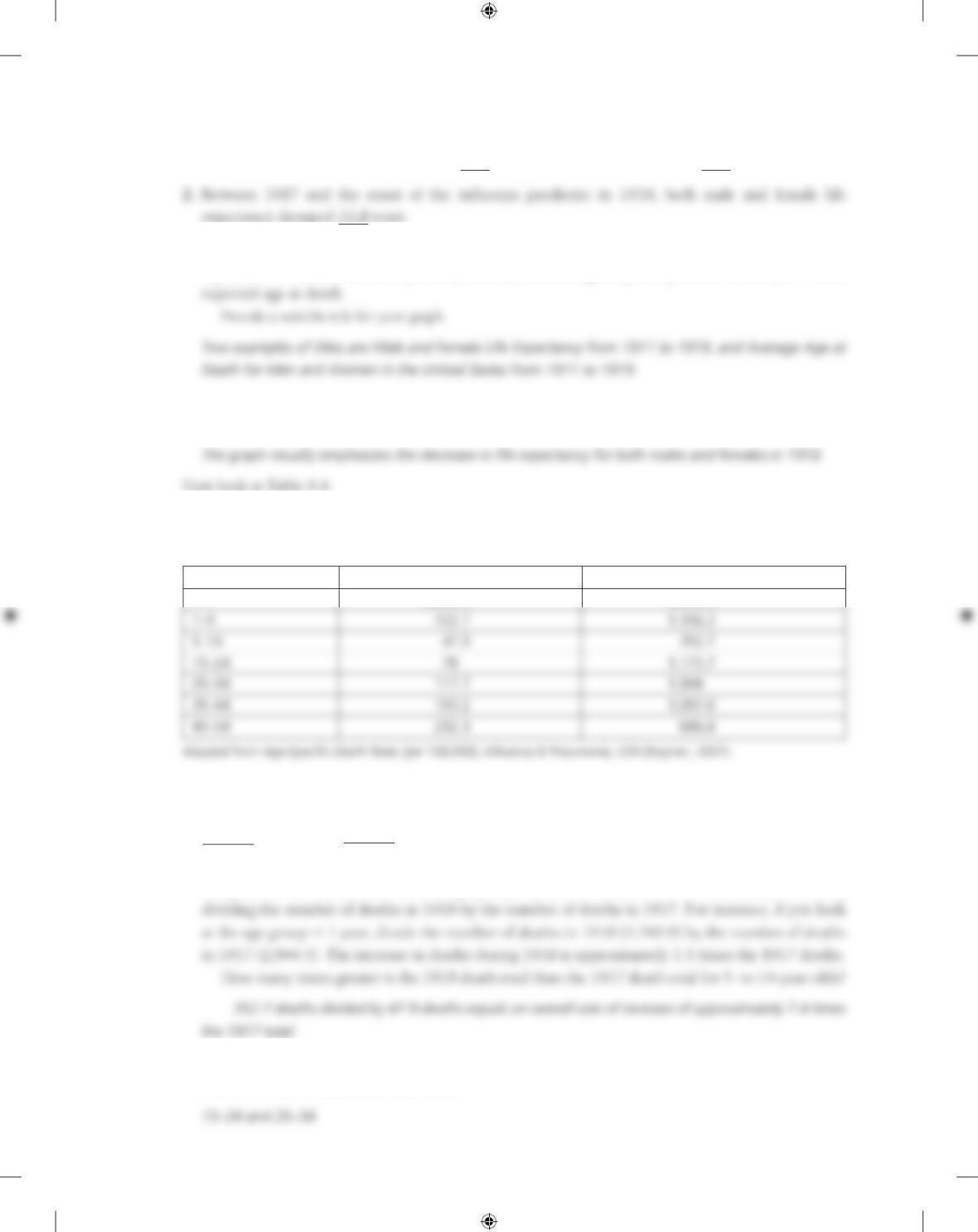
1.In1915,amancouldexpecttolivefor52.5 years. In 1918, this dropped to 36.6.
3.Constructagraphwith1911to1919onthex-axisand0to60yearsofageontheyaxis.Show
separatemaleandfemalelifeexpectancylinesbyconnectingthepointsplottedforeachyearversus
4.Whichismoreeffectiveatquicklyconveyingtheimpactofthe1918inuenzapandemic,thetable
oryourgraph?Why?
ChaPter 9: Pandemic Flu (Past and Possible) b 155
age 1917 1918
,1 2,944.5 4,540.9
table 9.4 u.s. deaths per 100,000 attributed to Influenza
and Pneumonia, during 1917–1918.
5.Whichagegrouphadthehighestnumberofinuenza-andpneumonia-relateddeathsin1917?
Age , 1 In 1918? Age , 1
6.Anotherwayoflookingatthedataistoconsiderthespecicincreaseinthenumberofinuenza-
andpneumonia-relateddeathsinoneagegroupbetween1917and1918.Youcancalculatethisby
7. Whichtwoagegroupsexperiencedthehighestincreaseinthenumberofinuenza-andpneumonia-
relateddeathsbetween1917and1918?
M09_REEC4164_04_IE_CH09.indd 155 25/01/14 3:30 PM
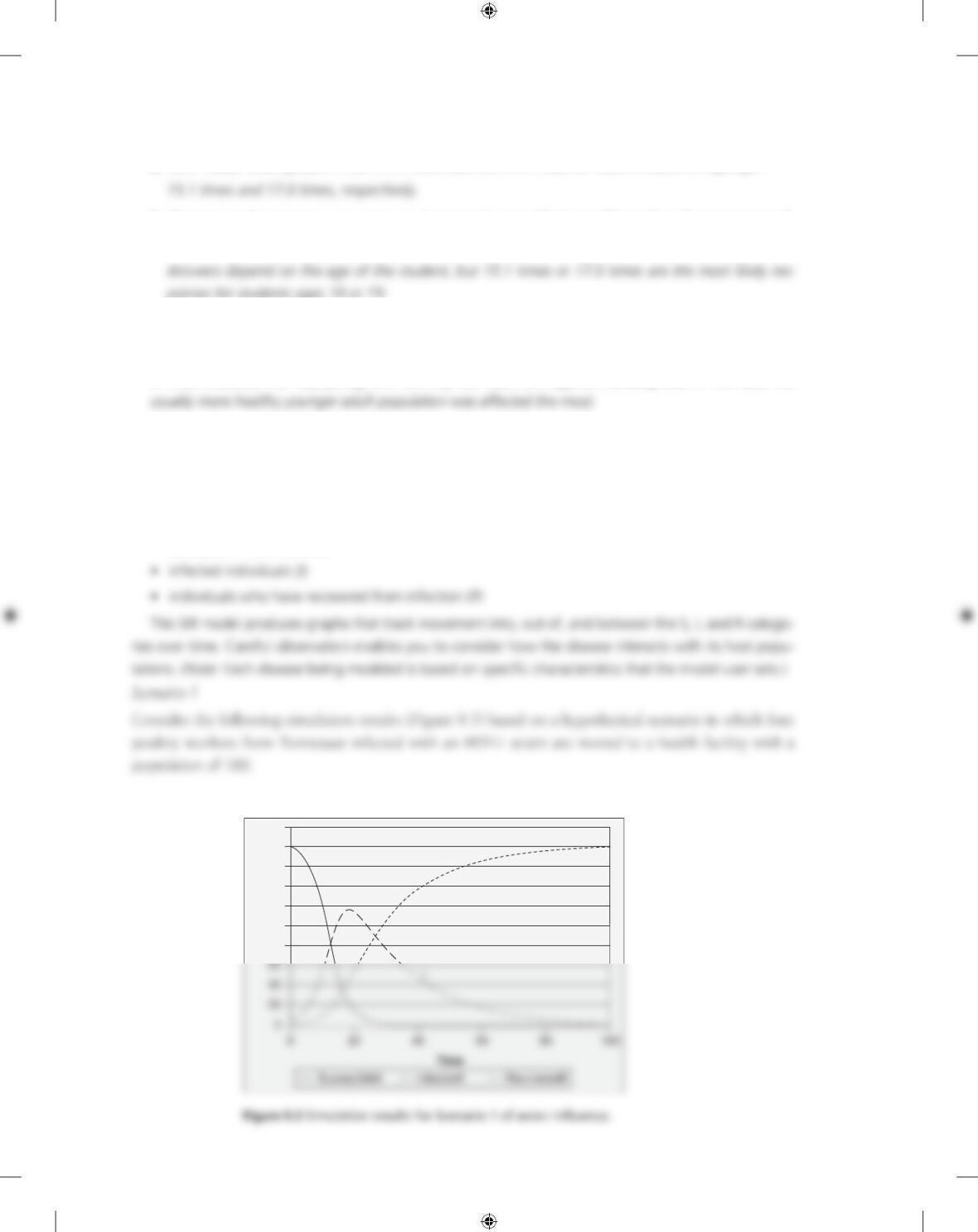
a. Howmanytimesgreateristhe1918totalthanthe1917totalforeachofthesetwogroups?
b.Ifyouwerethesameageyouarenow,howmuchmorelikelywouldyouhavebeentosuccumb
fromaninuenza-orpneumonia-relateddeathin1918thanin1917?
8.Scientistswerepuzzledwhythe1918uresultedinincreaseddeathsinspecicagegroups.What
wassounexpected?
In most diseases, the very young and the very old have the highest mortality, but in this case the
B. Working with a sIr Model to Investigate avian Influenza h5n1
Models help investigators ask questions as well as predict possible outcomes. In this activity, you will use
an Excel model (Weisstein, 2007) to simulate disease spread throughout a population. The model divides
the host population into three categories:
• susceptible individuals (S)
156 a BIoloGICal InquIry: A Workbook of Investigative Cases
200
180
160
140
120
100
80
# People
S
R
M09_REEC4164_04_IE_CH09.indd 156 25/01/14 3:30 PM
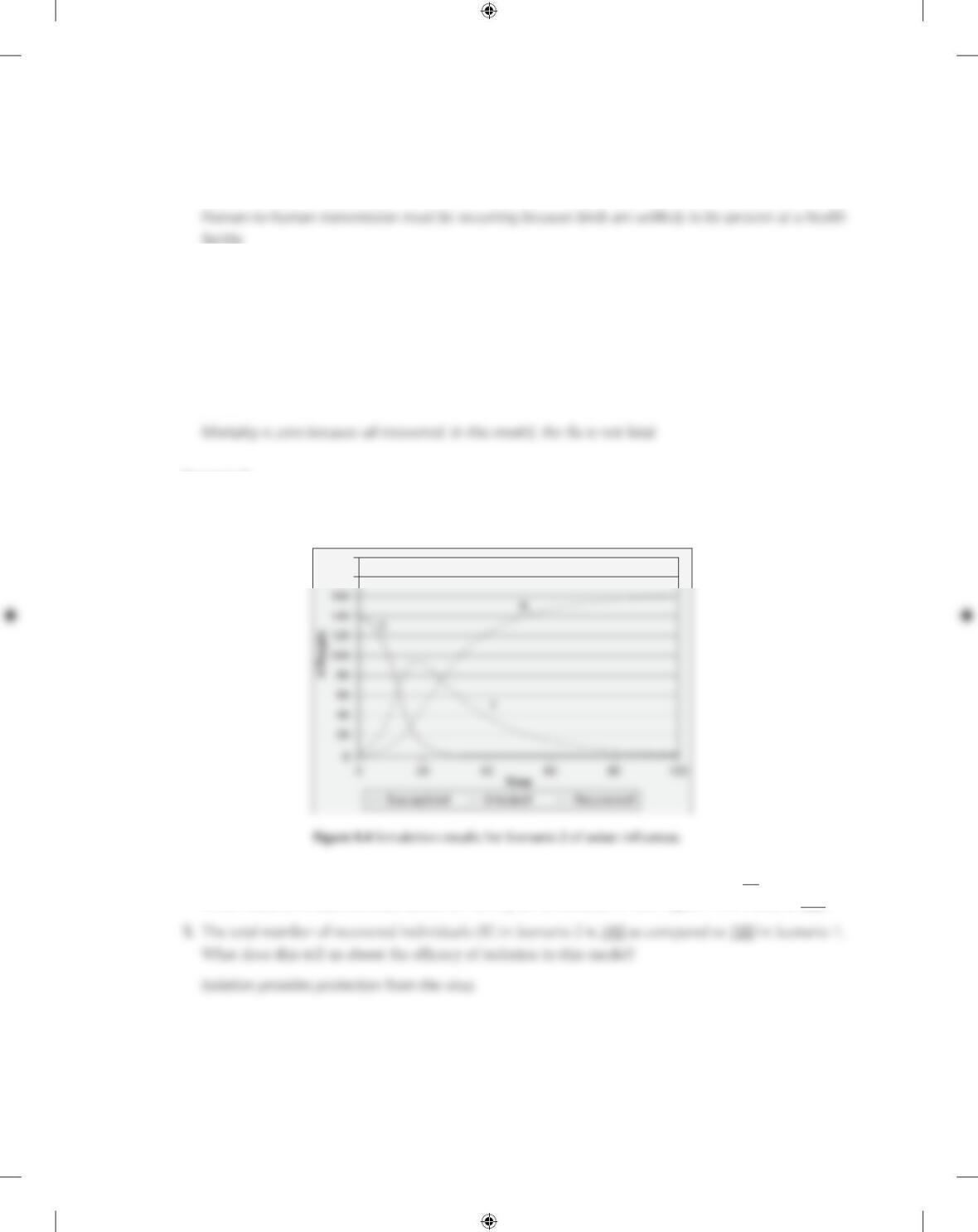
1.Isthismorelikelytobeastrainofthevirusthatistransmittedonlyfromaviantohumanorastrain
thatistransmittedfromhumantohuman?Explain.
2.About how many individuals remained healthy? What is the transmission rate in this model?
Transmission=(R)recovered/(S)susceptible
All individuals got the disease. The transmission rate is 180/180 or 100%.
3.All infected individuals (I) eventually become recovered individuals (R). What does this tell us
about the severity of the viral disease in this model—that is, what is the mortality rate observed
here?
Scenario 2
Thisisthesamehypotheticalsituationexceptthat40peopleareisolatedinaspecialwardatthefacility
beforetheycanbeexposedtotheavianinuenzastrain.
ChaPter 9: Pandemic Flu (Past and Possible) b 157
200
180
4.Thenumberofinfectedindividuals(I)onDay20inScenario2(seeFigure9.4)is90 as compared
tothenumberofinfectedindividuals(I)onDay20inScenario1(seeFigure9.3),whichis120.
Scenario 3
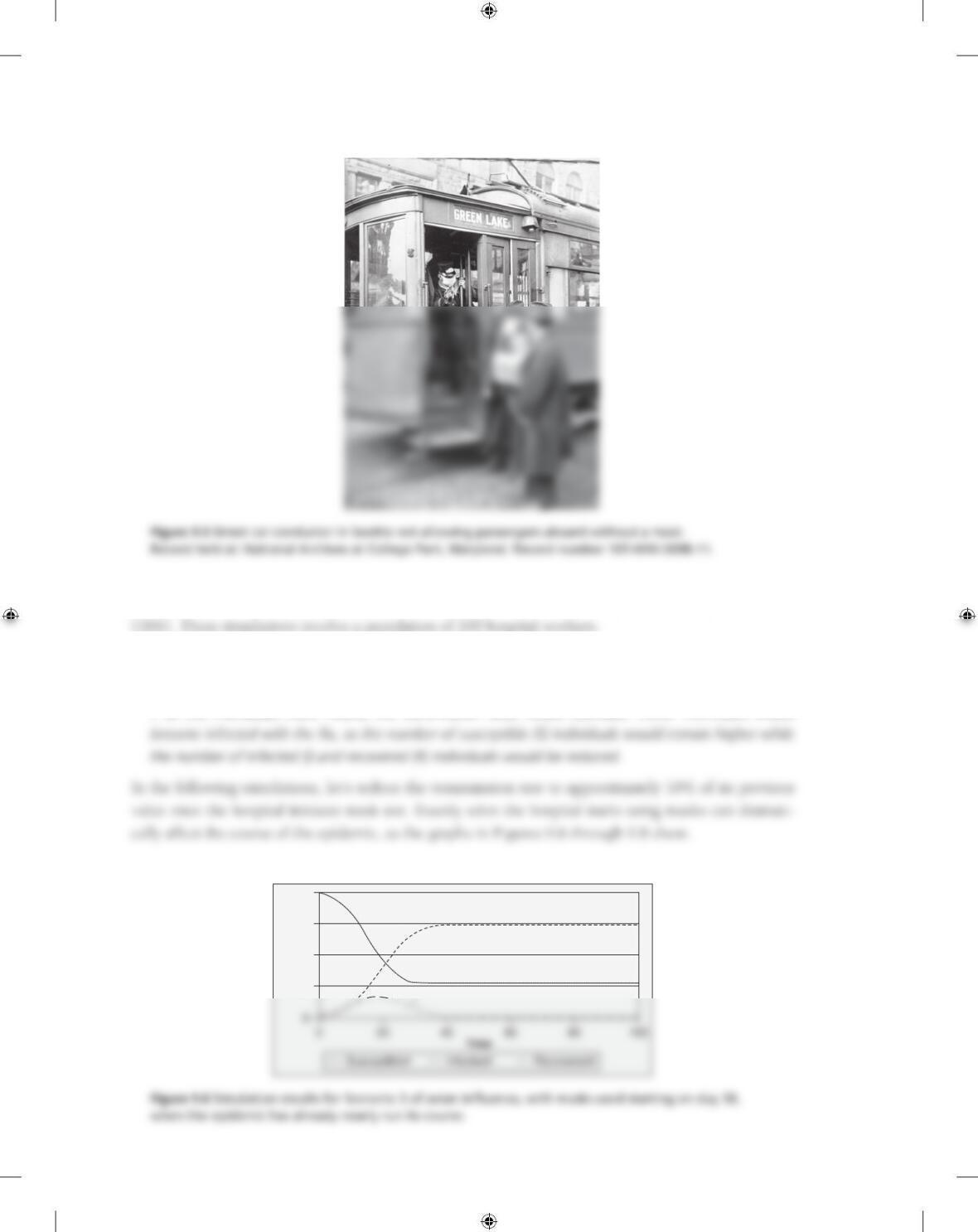
In1918,nooneknewwhatcausedinuenzaandvaccineswerenotavailable.Nevertheless,itwas
understoodthatcoughingandsneezingcontributedtothespreadofthedisease.Atthattime,Seattle
publichealthofcialsrequiredallpassengersandemployeesofmasstransitsystemstowearmasks
(Figure9.5).Spittingwasalsoprohibitedinmanycities.
M09_REEC4164_04_IE_CH09.indd 157 25/01/14 3:30 PM
158 a BIoloGICal InquIry: A Workbook of Investigative Cases
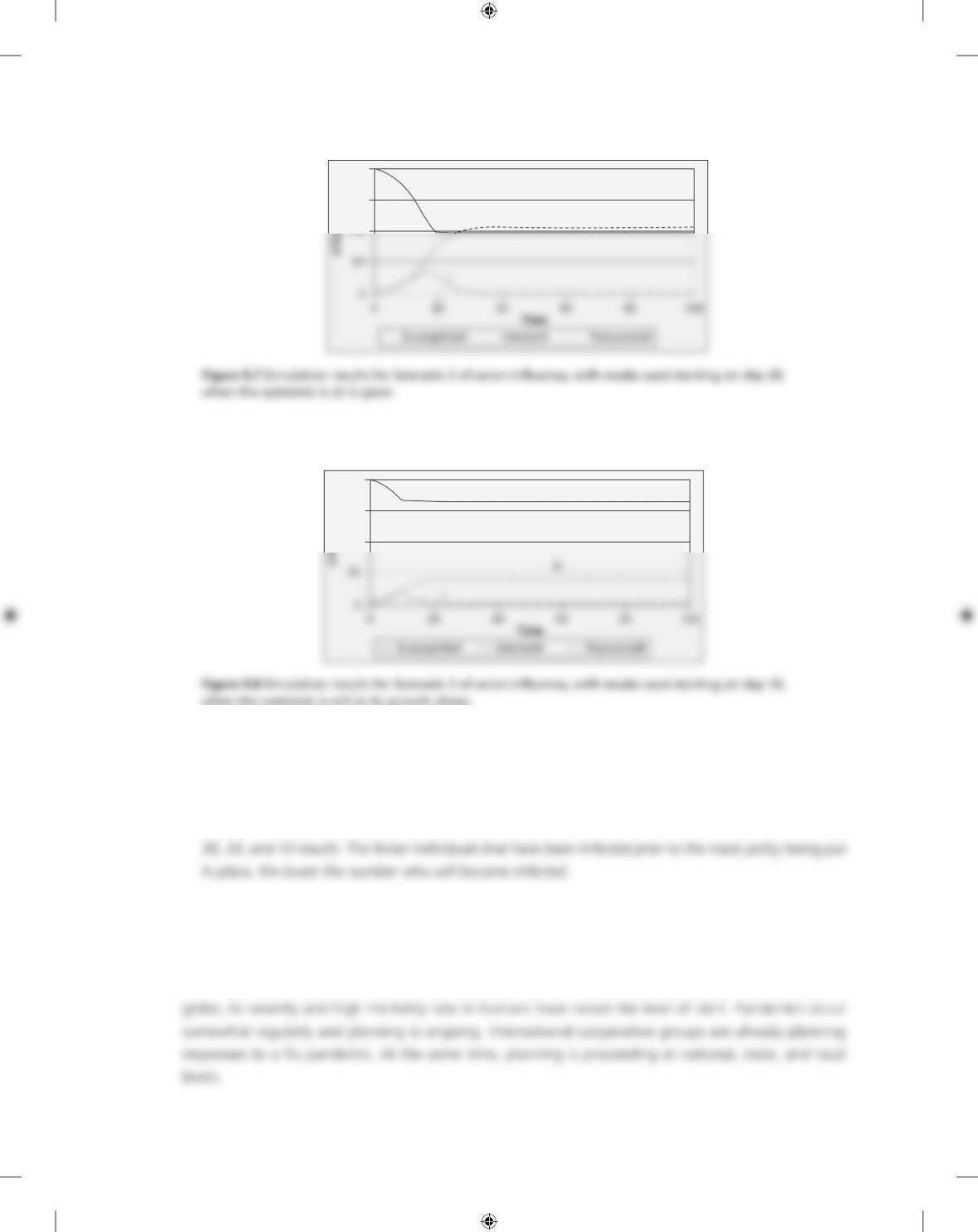
Inthefollowingsimulations,considertheimpactofindividualswearingmasksduringexposureto
6.Predictgenerallywhatyou’dexpecttoseeintheSIRmodelresultswithrespecttoS,I,andRindi–
viduals.(Considerhowtheseresultswoulddifferfromnotwearingmasks.)
If all the individuals wore masks, the transmission rates would decrease. Fewer individuals would
200
150
100
50
# People
S
R
M09_REEC4164_04_IE_CH09.indd 158 25/01/14 3:30 PM
ChaPter 9: Pandemic Flu (Past and Possible) b 159
200
150
S
R
200
150
100
S
7. Usingyour observationsof Figures9.6 through9.8, defenda policythatmakeswearing masks
mandatoryduringtheearlydaysofanepidemicsuchasthe1918u.
The answers may vary, but a good answer will address the number of recovered individuals in the day
suggested answers for additional Investigations
VI. Pandemic Planning
While the H5N1 avian influenza A strain may not be the next virus that causes an epidemic around the
M09_REEC4164_04_IE_CH09.indd 159 25/01/14 3:30 PM
Address one or more of these concerns from the perspective of one of the following stakeholder
groups: public health (including CDC and WHO); medicine-pharmacology; media and public informa–
tion; agriculture; local, state, and national governing bodies; departments of state; and consumers and
taxpayers.
Your instructor may ask you to write a paper, prepare an informational poster or a 30-second radio
spot informing the public, conduct a simulated pandemic planning meeting, or prepare some other form
of response to these issues and perspectives.
1.Surveillanceandmonitoringofhumanandaviancases
4.Prevention,limitingspread,andethics
a. Pharmacologicinterventions—efcacy,availability,compliance
i. Vaccination
5. Treatment and ethics
6.Disposalofbodiesifpandemicisextreme
7.Continuationofgovernanceduringapandemic
9.Economicimpact(shortterm)andethics
a. Connedanimalfeedingoperations(CAFOS)—placementandregulation
160 a BIoloGICal InquIry: A Workbook of Investigative Cases
10. Long-termeffectsonaffectedcountriesandethics
a. Economiceffects
some suggested resources related to Pandemic Planning
• u.gov
VII. open-ended Investigations
TheExcel-basedSIRmodelusedinInvestigationVisfreelyavailableonlineathttp://bioquest.org/
icbl/casebook/avian.Considerdevelopingyourownscenarios(morevirulentu,differentmitigationefforts,
etc.)andseeingtheireffectivenessonthespreadofdisease.
References
deJong,MennoD.,TranTanThanh,TruongHuuKhanh,VoMinhHien,GavinJ.D.Smith,NguyenVinh
Chau,BachVanCam,PhanTuQui,DoQuangHa,YiGuan,J.S.MalikPeiris,TranTinhHien,and
JeremyFarrar.2006.OseltamivirresistanceduringtreatmentofinuenzaA(H5N1)infection.NEJM
353(25):2667–2672.
Noymer,Andrew.2007.Rawdataset:Agespecicdeathrates(per100,000).Inuenza and Pneumonia,
USA.Availableonline(April2007)athttp://www.demog.berkeley.edu/~andrew/1918/
gure1.html
ChaPter 9: Pandemic Flu (Past and Possible) b 161
M09_REEC4164_04_IE_CH09.indd 161 25/01/14 3:30 PM
Maps
162 a BIoloGICal InquIry: A Workbook of Investigative Cases
M09_REEC4164_04_IE_CH09.indd 162 25/01/14 3:30 PM