As with all the cases in this book, please read the preface if you have not al–
ready done so. In the preface you will find suggestions about using Investigative
Case–Based Learning (ICBL) for different instructional purposes such as start–
ing a new lecture topic, assessing what students already know, setting a context
• Behavior
• Alternativesforcontrolofgulls
• Populationdynamics
• LinkbetweenthehumanpopulationandthehealthoftheChesapeakeBay
Students should complete the Case Analysis immediately following the
reading of the case. We strongly suggest that students work in groups to com–
Chapter 8:
Back to the Bay
INSTRUCTOR’S GUIDE
b 121
M08_REEC4164_04_IE_CH08.indd 121 24/01/14 6:31 PM
122 a BIOlOGICal INqUIRy: A Workbook of Investigative Cases
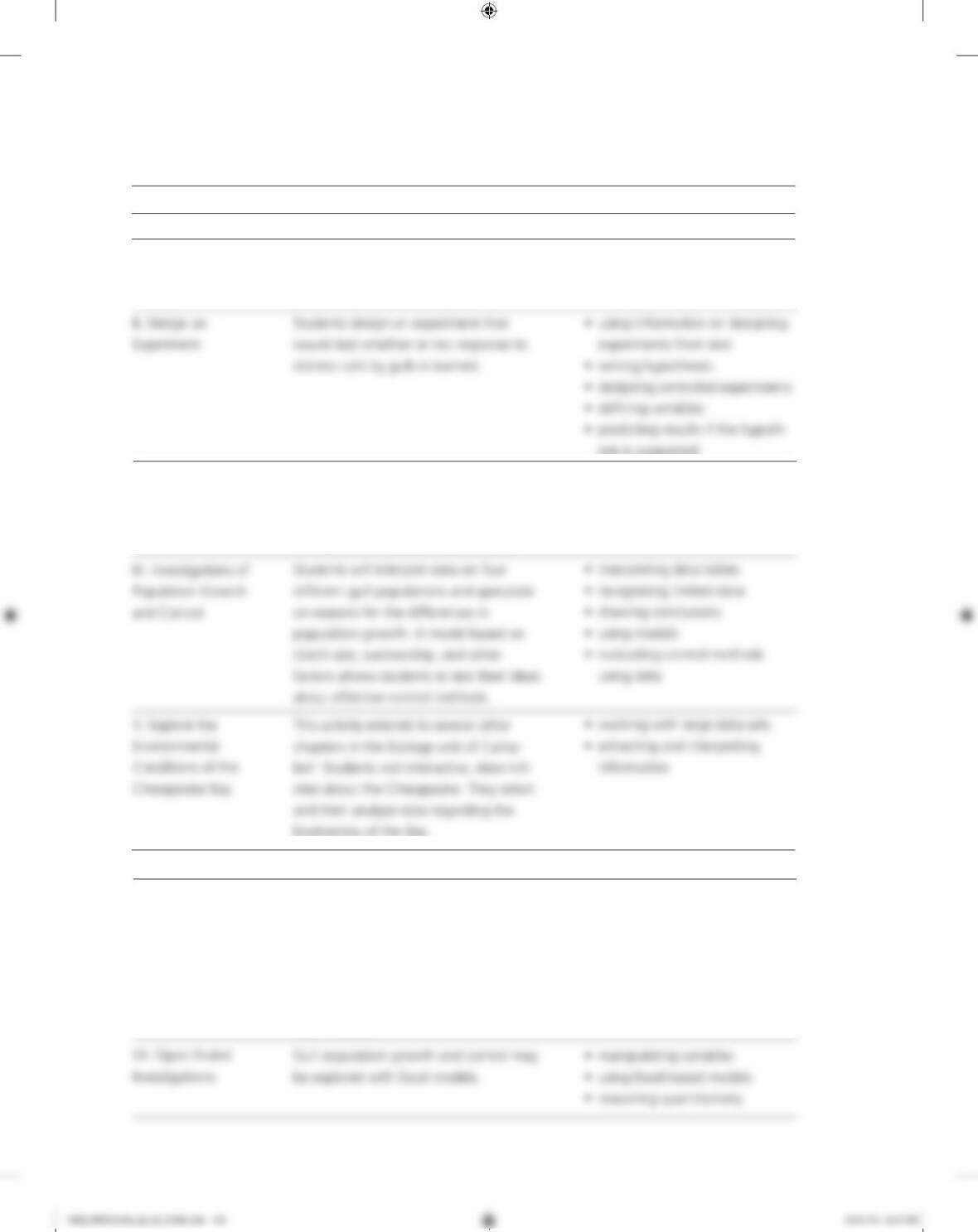
Table IG8.1 Back to the Bay Case Overview.
Investigation learning Goals Inquiry Skills Used
I. Critical Reading
III. Investigation
of Gull Call
Advertisement
Students use Chapter 51 for information
to support their speculations on types of
behaviors described in the case.
Students examine an advertisement for
a hypothetical product and are asked
to think critically and scientifically about
biological claims in the advertisement.
biodiversity of the Bay.
• developingideasbasedon
evidence and resources
esis is supported
• applyingsciencetoadvertising
claims
additional Investigations
VI. Ethics Paper on
Gull and Human
Interactions
Students are given a list of interactions
between gulls and humans to research.
The suggested student product is a
1-or 2-page paper. A second option
is for the more business-minded. Both
options use links located on the Case
Book website.
• summarizinginformation
• writingconciselyaboutbiologi–
cal situations
• consideringtheethicaldimen–
sions of human-gull interactions
Core Investigations
ChapTER 8: Back to the Bay b 123
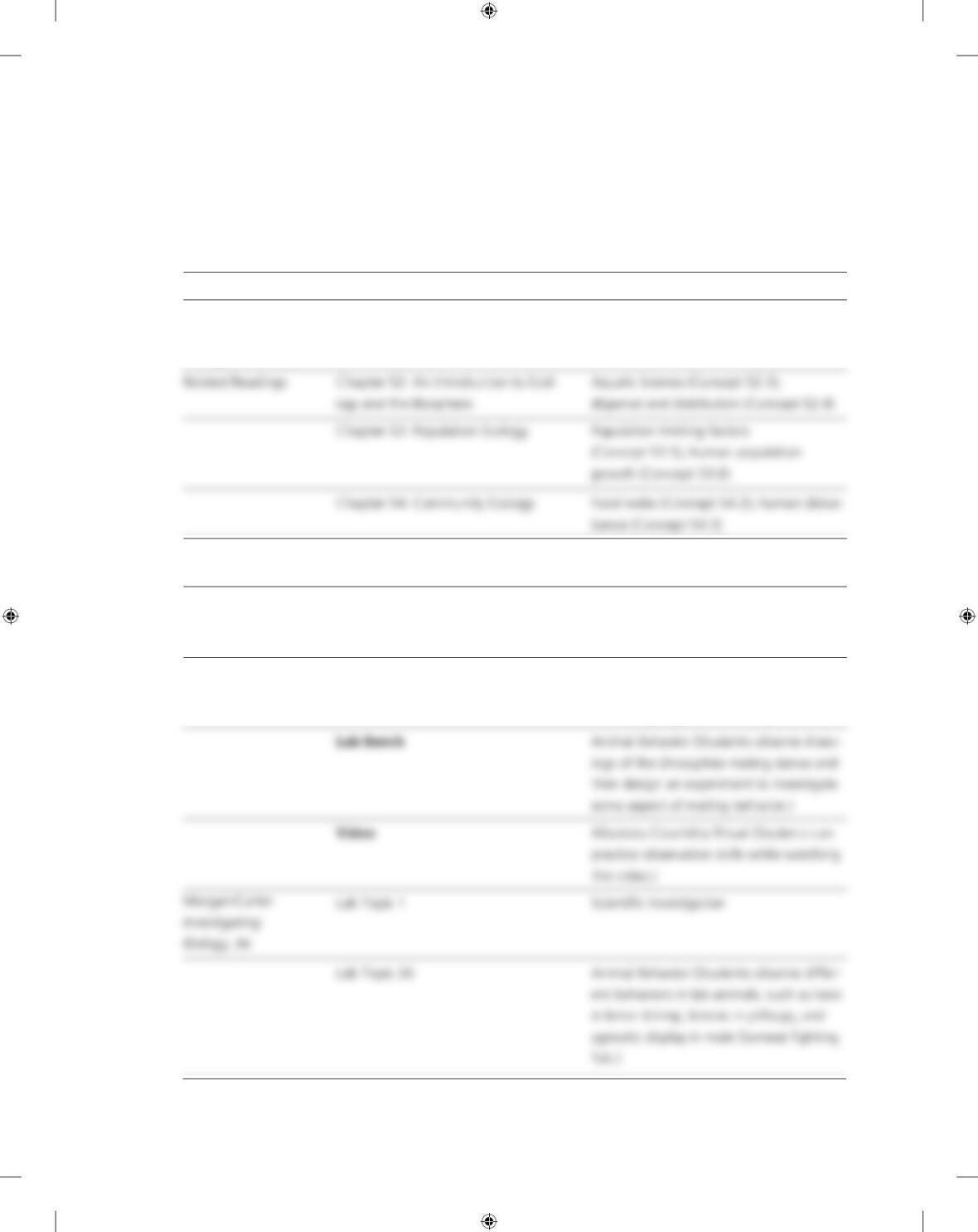
TableIG8.2containsseveralresourcesrelatedtoCampbell Biology,10thedition,thatwillhelpyour
students further their understanding of this case. Note that chapter readings and activities are listed in
order of importance in regard to the case.
Table IG8.2 Campbell-Related Resources.
Resource Chapter/activity Topics Covered/activity Titles
Critical Reading
from Campbell
Biology, 10th edition
MasteringBiology
Chapter 51: Animal Behavior
Chapter 55: Ecosystems and
Restoration Ecology
Chapter 56: Conservation Biology
and Global Change
Chapter 51 Investigation
Entire chapter
Nutrientcycling(Concept55.4)
Biodiversity and human welfare, human
threatstobiodiversity(Concept56.1);
extinctionvortex(Concept56.2)
How Can Pillbug Responses to Environ-
mentsBeTested?(Thiswillhelpstudents
withdesigningcontrolledexperiments.)
M08_REEC4164_04_IE_CH08.indd 123 24/01/14 6:31 PM
124 a BIOlOGICal INqUIRy: A Workbook of Investigative Cases
Case Narrative
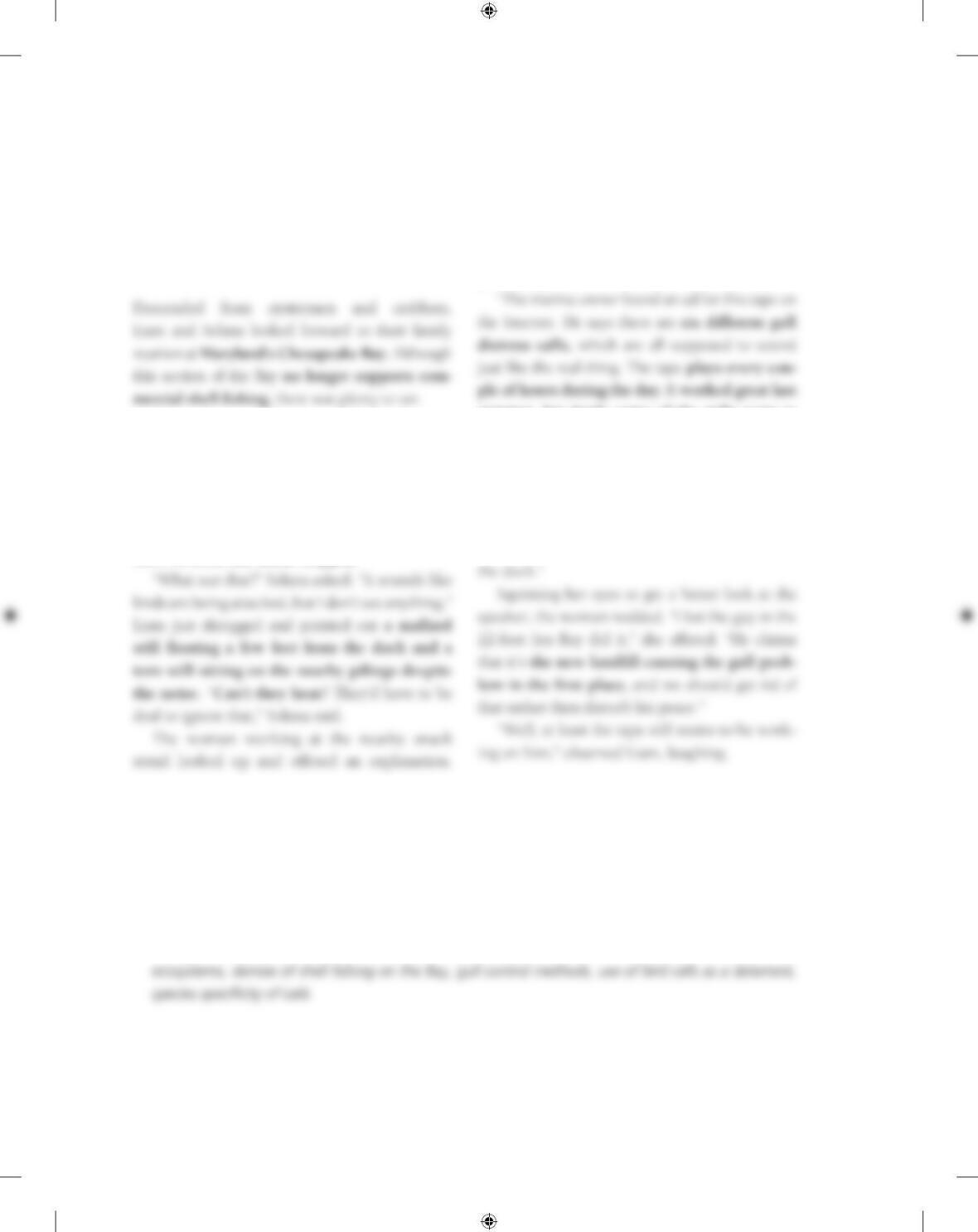
Students were asked to underline terms or phrases
in the introductory narrative that they think are
important to understanding the case. Suggested
terms and phrases that students might have cho-
sen are in bold type.
While waiting in line to purchase tickets for
aboattourofthebay,LiamandSolanahearda
series of screeches. They scanned the docks for
the source of the mayhem. A large gull that had
settled on a covered boat hurriedly flew away
midway through the screeches. After several
moreseconds,the noise stopped.
“Well,it’s a tape the marina owner is using
to scare the gulls away. Seems like there’s
more every year. Gull droppings cause holes
in the boat covers if they aren’t cleaned
quickly. We’ve tried everything to keep the
gulls away.
summer, but lately some of the gulls seem to
ignore it.
“The owner of the next marina over even keeps
a few dead gulls out on the dock. He claims it
keeps the tapes working, but I . . .”
“Look at that,” Liam interrupted. “Someone
usedducttapetoblockthespeakeratthisendof
Suggested answers for Case analysis
1. Recognize potential issues and major topics in the case.Whatisthiscaseabout?Underline
andlisttermsorphrasesthatseemtobeimportanttounderstandingthiscase.Thenlist3–4
biology-relatedtopicsorissuesinthecase.
Biology-related topics or issues: rapidly increasing gull populations, human interactions with natural
M08_REEC4164_04_IE_CH08.indd 124 24/01/14 6:31 PM
ChapTER 8: Back to the Bay b 125
2. What specific questions do you have about these topics?Byyourself,orbetteryet,inagroup,
makealistofthethingsyoualreadyknowaboutthiscaseinthe“WhatDoIKnow?”column.List
questionsyouwouldliketolearnmoreaboutinthe“WhatDoINeedtoKnow?”column.
There are many possible answers, depending on the experiences of your students. Some likely
responses follow.
3.Putacheckmarkby1–3questionsorissuesfromthe“WhatDoINeedtoKnow?”listthatyou
think are most important to explore.
4. What kinds of references or resources would help you answer or explore these questions?
Identifytwodifferentresourcesandexplainwhatinformationeachresourceislikelytogivethatwill
help you answer the question(s). Choose specic resources.
Accept any reasonable resource (e.g., text, other book, Internet sites, maps, data tables, and so on)
What Do I Need to Know?
• What does the gull distress call sound like?
• Howdogulldistresscallsworkundernatural
conditions? As a gull control?
What Do I Know?
• The Chesapeake is in Maryland (perhaps some
students will have visited the area and can add
more here).
126 a BIOlOGICal INqUIRy: A Workbook of Investigative Cases
Suggested answers for Core Investigations
I. Critical Reading
Read Chapter 51: Animal Behavior, which discusses several kinds of animal behavior. Listed below
aredescriptionsofvariousresponsesdisplayedbybirdsinthecase.Answerthequestionsthatfollow
each response. Provide examples from Chapter 51 to support your answers. As you complete this
exercise, note that, behaviorally speaking, distress calls are similar to the alarm calls you read about
in the text.
1. Only one species of gull leaves the area when the tape plays.
a. Explain the gulls’ response.
b. Do you think this response is primarily learned or primarily genetic? Explain.
We can’t tell if this response is primarily learned or genetic without more information on how
c. Couldthecallbecategorizedasasignal?Explain.
2.Ayearlater,thesamespeciesofgullremainswhenthetapeplays.
a. What might account for the change in the gulls’ response?
b. Do you think this response is primarily learned or primarily genetic? Explain.
c. Speculateonwhatkindsofbehaviorthisresponsemightbe.
This might be habituation.
d.Howdoesthisbehaviorexemplifythe“crywolf”effect?Explainthisintermsofacost-benet
analysis.
In this case, the gulls stop responding to a distress call when no evidence of distress accompanies
M08_REEC4164_04_IE_CH08.indd 126 24/01/14 6:31 PM
3. The same species of gull resumes its response to the tape when dead gulls are displayed in the
immediate area of the sound.
a. What might account for the change in the gulls’ response?
b. Do you think this response is primarily learned or primarily genetic? Explain.
This would suggest that gulls are capable of learning, of processing information and distinguishing
c. Howdoesthisbehaviorreectassociativelearning?Isitnegativeorpositivereinforcement?
This may be a way to overcome the cry wolf effect, as the birds observe that real danger exists,
d.Canthisbehaviorbeinterpretedasaltruistic?Explain.
This situation may be an example of altruistic behavior. One gull gives the alarm signal and the oth-
4. Birds other than this gull species ignore the taped distress calls.
a. Whatmightaccountfortheobservedbehaviorintheotherbirds?
b.Researchersswitchedyoungofonespeciesofbirdwiththoseofanother.Theyoungbirdsre–
sponded to the signals of the new species. Do you think this response is primarily learned or pri–
marily genetic? Explain.
Learned.Itvariesbyage.
c. What evidence do you have from the case to support the idea that calls are species specic?
The lack of response by the mallard and the tern suggests that the calls on the tape are species-
5.Youobservethatsomegullscontinuetorespondtotapeddistresscallswhenno danger is pres–
ent. Do you think that these gulls are more or less t than those that stop responding to such
calls? Explain.
The gulls that continue to respond are less fit. The gulls that ignore the false calls (become habituated)
128 a BIOlOGICal INqUIRy: A Workbook of Investigative Cases
II. Design an Experiment
Designanexperimenttoexaminethefollowingquestion.Istheresponsetodistresscalls(movingaway
fromthearea)learnedinherringgulls?
Materials: You will have access to newly hatched, juvenile, and adult herring gulls. You also will have a
tape of herring gull distress calls.
1.Restatethequestionbeingstudiedasatestablehypothesis.
2.Describetheexperiment.
a. Whatwillthetreatment(s)be?Whichanimalswillreceiveeachtreatment?
Note:Therearemanypossibleexperimentaldesignswiththesematerials.Lookforwell-controlled
b. What will you measure as the response to the treatment?
3.List3variablesthatyouwillcontrol.
Age of the birds when subjected to the tapes, where the tapes are played, the loudness and duration
4.Describetheexperimentalresultsthatwouldsupportyourhypothesis.
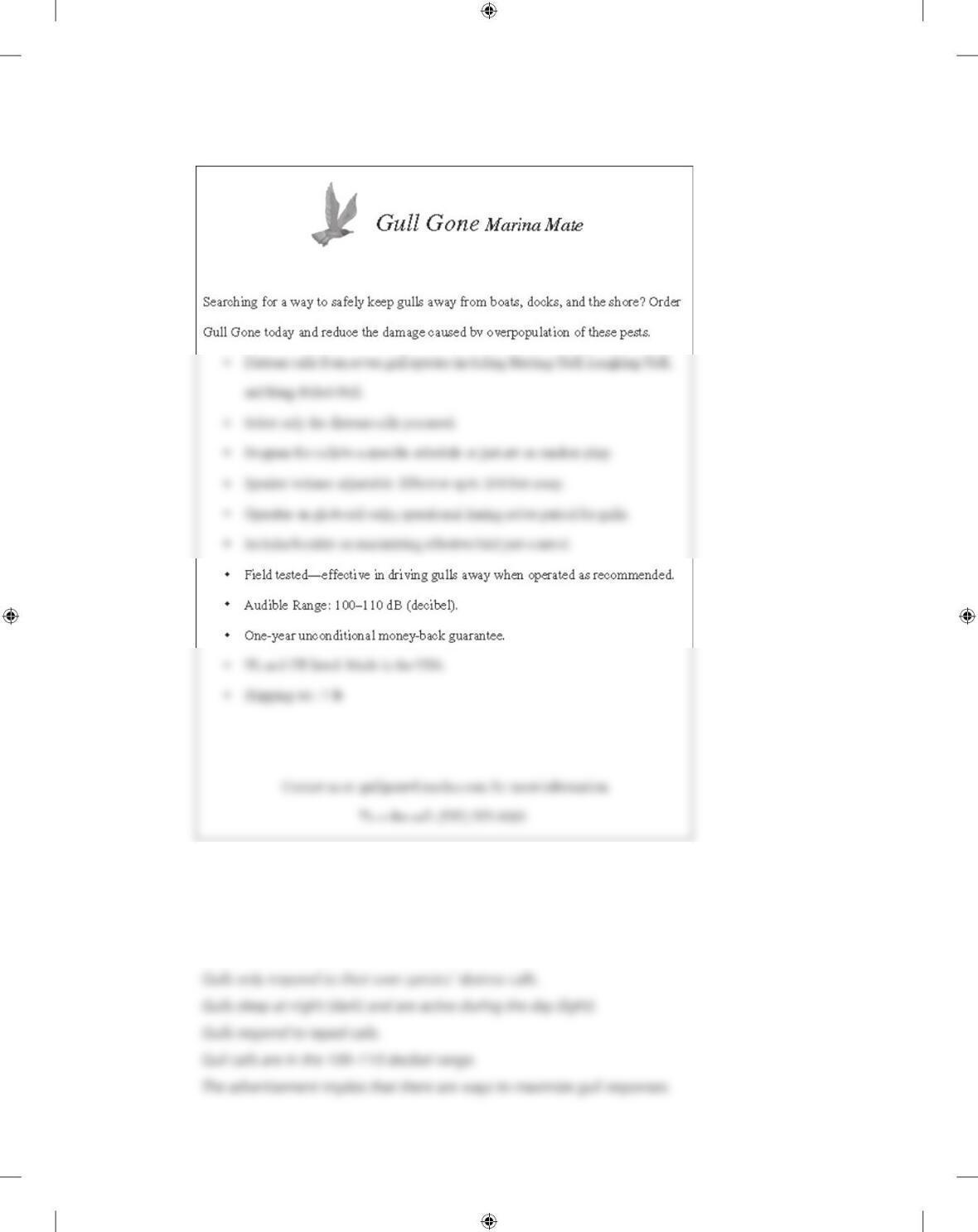
III. Biology in Advertising
ExaminetheadvertisementforagulldistresscallrecordinginFigure8.2andanswerthe
following questions.
M08_REEC4164_04_IE_CH08.indd 128 24/01/14 6:31 PM
ChapTER 8: Back to the Bay b 129
Figure 8.2 Advertisement for “Gull Gone.”
1.Whatarethreebiologicalclaimsinthisadvertisement?
Different species of gulls have different distress calls.
M08_REEC4164_04_IE_CH08.indd 129 24/01/14 6:31 PM
130 a BIOlOGICal INqUIRy: A Workbook of Investigative Cases
2. Chooseoneoftheclaimsandbrieydescribeanexperimentthatwouldtestitsvalidity.
There are many possible answers. A good answer will describe at least one experimental and one
controlcondition,aswellaswhatisbeingmeasured.Herearesomeexamples:
• In order to find out if gull responses to distress calls are species-specific, use a distress call from a
different species and observe gull reaction.
3.Isthereanybehavioralsignicancetotheproduct’sfeaturethatallowsforplayingdistresscallsin
random sequence?
The gulls do not have the opportunity to associate intermittent calls with specific times of the day.
IV. Investigations of Population Growth and Control
a. Gull population Growth (Refer to Chapter 53 in your text for help with this exercise.)
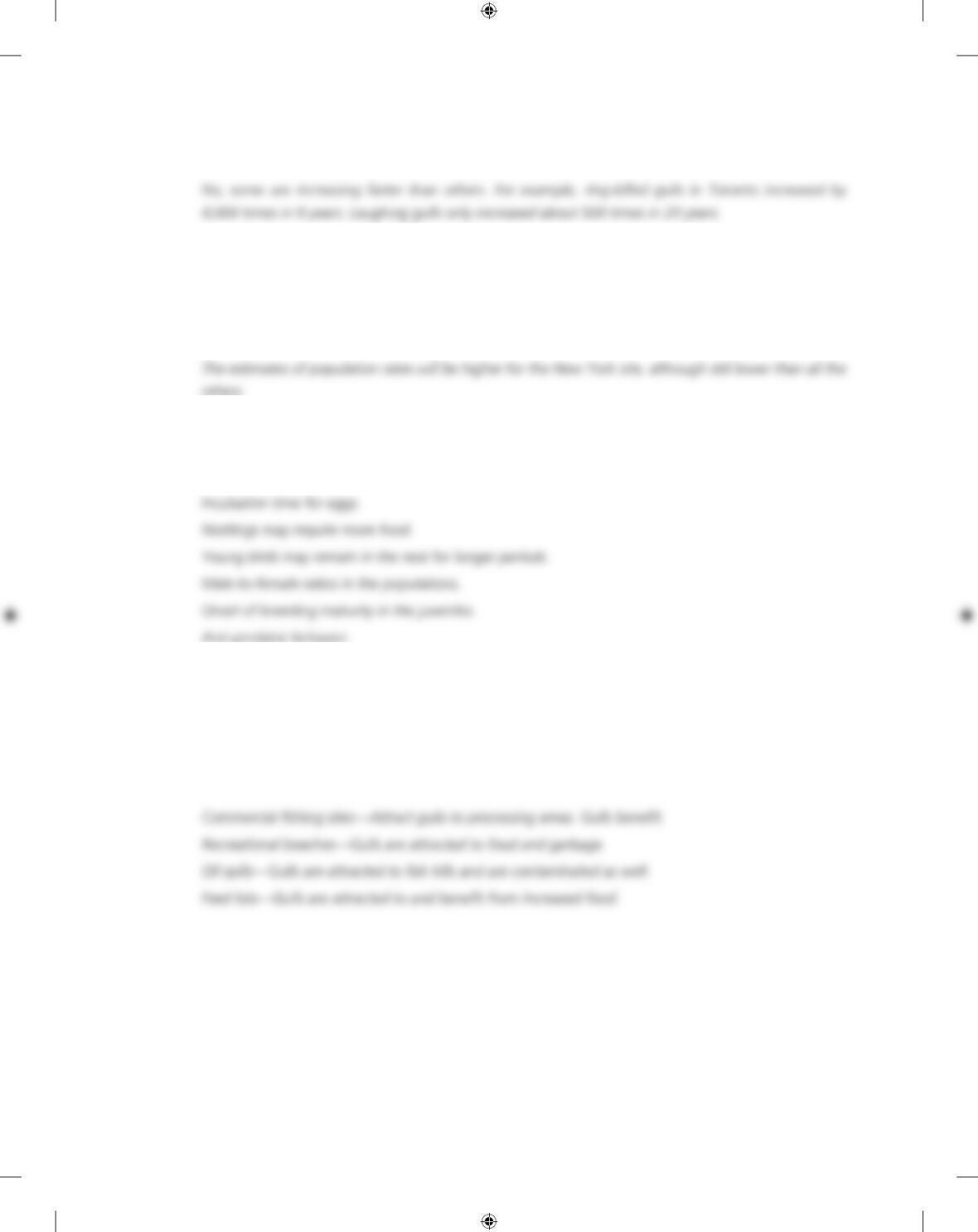
1.ReviewthedatainTable8.1.
Table 8.1 Increase in Number of Gull Mating pairs
inSelected locations.
locations Initial Observation Final Observation Gull Species
Mating pairs/year Mating
pairs/year
Kennedy Airport, 15 pairs/1970 7,600 pairs/1990 Laughing Gull
New York, United
States
M08_REEC4164_04_IE_CH08.indd 130 24/01/14 6:31 PM
ChapTER 8: Back to the Bay b 131
a. Are the four gull populations all increasing in size at the same rate? Explain.
b. Which rates are the most similar?
In the populations of silver gulls and of ring-billed gulls.
c. Whiledoingfurtherresearchongullpopulations,youdiscoverthatin1985therewere15,000pairs
oflaughinggullslivinginthevicinityofJohnF.KennedyInternationalAirportinNewYorkCity.How
doesthisknowledgechangeyouranswersto1aand1b?
2.Considerreasonswhydifferencesinthesegullpopulationsoccur.Listthreewaysthattheenviron–
mentinwhichthebirdslivecouldaffecttheirratesofreproduction.
Gullsmayhavedifferentclutchsizes(eggspernest).
3.Populationgrowthisgreatlyinuencedbyenvironmentalfactors.Theactivitiesofahumanpopula–
tionimpactnearbygullpopulations.Forexample,thepotentialforcollisionsbetweenaircraftand
gulls ensures that ofcials at John F. Kennedy International Airport implement gull population
controlmeasures.Listatleastthreeotherexamplesofhuman-gullinteractions.Foreachexample,
explainwhetherthegullpopulationbenets.
Landlls—Gullpopulationgrowsuntilcontrolmeasuresoccur,thenpopulationdecreases.
B. Control of Bird populations: The Chicken or the Egg? If the ultimate goal at an airport
location is to reduce gull population size to ensure human safety, should gull nests and eggs or
adult gulls be removed? In this exercise, you will use a model to compare the effectiveness of
these two methods.
M08_REEC4164_04_IE_CH08.indd 131 24/01/14 6:31 PM
132 a BIOlOGICal INqUIRy: A Workbook of Investigative Cases
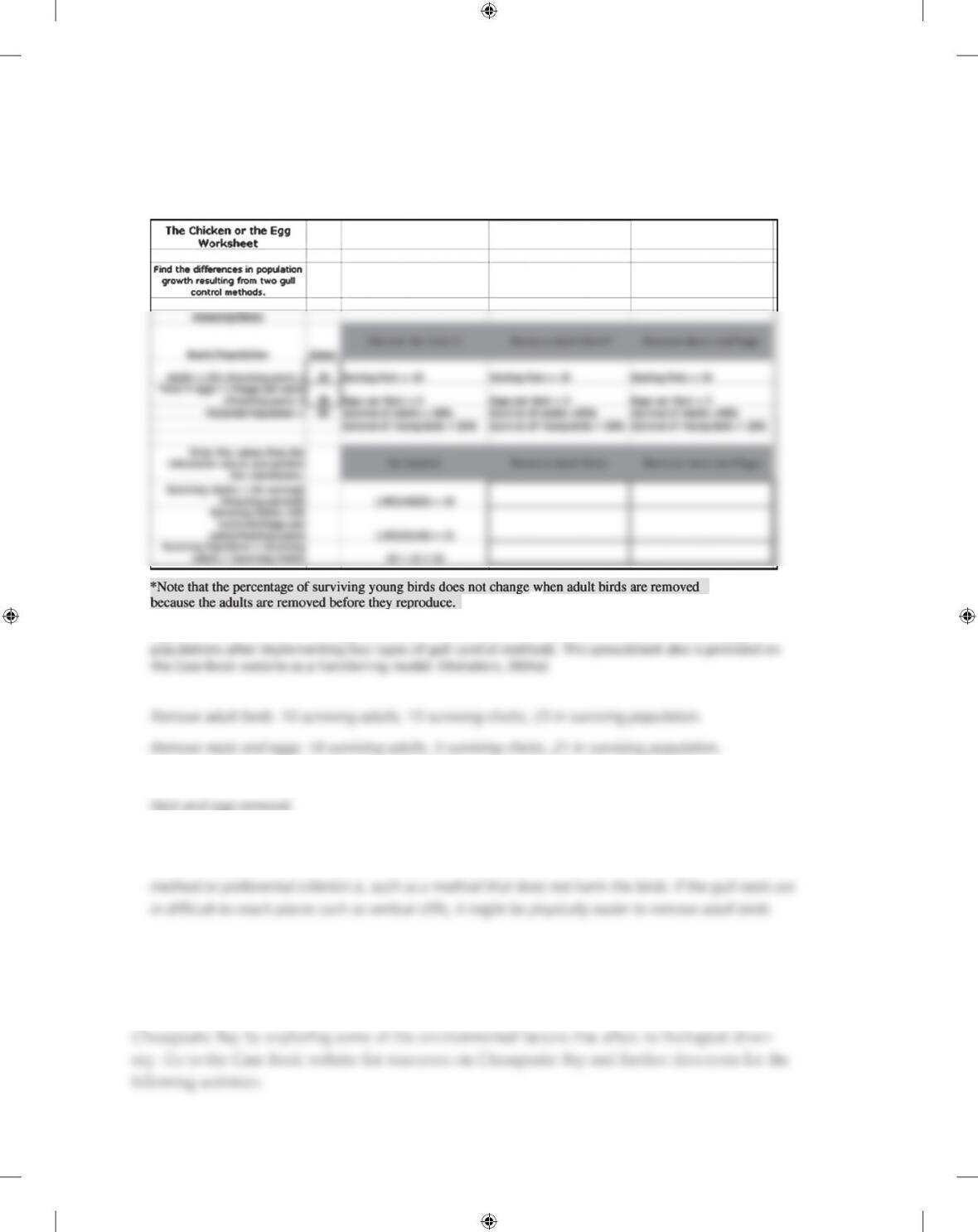
1.FillintheworksheetinFigure8.3toestimatetherelativeeffectivenessofthesetwo
different population control methods.
Figure 8.3 The Chicken or the Egg Worksheet. Use the provided equations to calculate surviving gull
2. Which of these gull control methods is more effective?
3. Which of these two control methods would you advocate? Explain your choice.
Expect this answer to be subjective. Students may choose on the basis of what the most effective
V. Explore the Environmental Conditions of the Chesapeake Bay
LiamandSolanaspent4hoursontheirboattouroftheChesapeakeBay,learningaboutits
history,ecology,andgeology.Inthisinvestigation,youwilltakeabrief“armchairtour”ofthe
M08_REEC4164_04_IE_CH08.indd 132 24/01/14 6:31 PM
ChapTER 8: Back to the Bay b 133
A. Stressors on the Bay. Examinetheanimation.Listthreeimportantstressorsonthe
Chesapeake(seetheStressorsontheBaylinkontheCaseBookwebsite).
B. Cutter Marina. ExaminetheinformationaboutCutterMarina,includingthedatachartsand
interpretationofeachofthewaterqualityvariablesmeasured.Describeandprovidethevalues
forthreevariablesthatindicateahealthybay.
Students may have described three of the following variables:
• Dissolvedoxygenabove5mg/L.
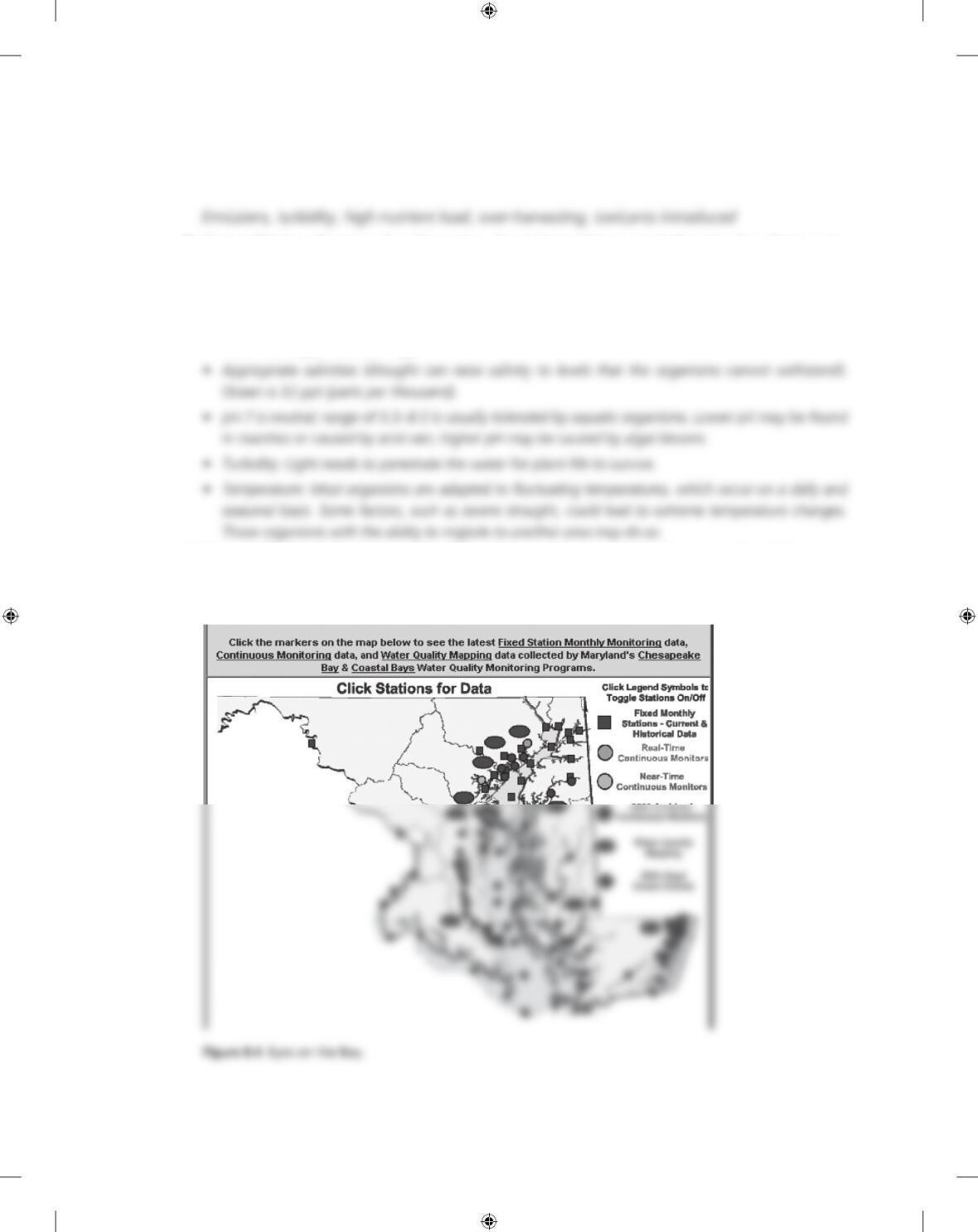
C. Eyes on the Bay. The water quality of the Chesapeake is sampled daily at more than 100
sampling stations. All of these data are reported and compiled online at “Eyes on the Bay”
(Figure8.4)whoselinkislistedontheCaseBookwebsite.
M08_REEC4164_04_IE_CH08.indd 133 24/01/14 6:31 PM
134 a BIOlOGICal INqUIRy: A Workbook of Investigative Cases
1.At the Eyes on the Bay website, examine differences in salinity across the Chesapeake Bay by
rstswitching to “full-screen map” and then running your cursor over the red square icons and
reading the salinity data that appear on the left side of the screen.
a. Describewhathappenstosalinityasyoumovefromopenocean(therightandloweredgesofthe
map) to the top of the Chesapeake Bay.
2.Choosedatafromtwostations,onefromtheupperChesapeakeBayandonefromthelower
ChesapeakeBayneartheocean.Clickontheicontoopenthestation’ssite.Lookatthefol–
lowingvariablesduringAugust:dissolvedoxygen,watertemperature,pH,andwaterclarity.
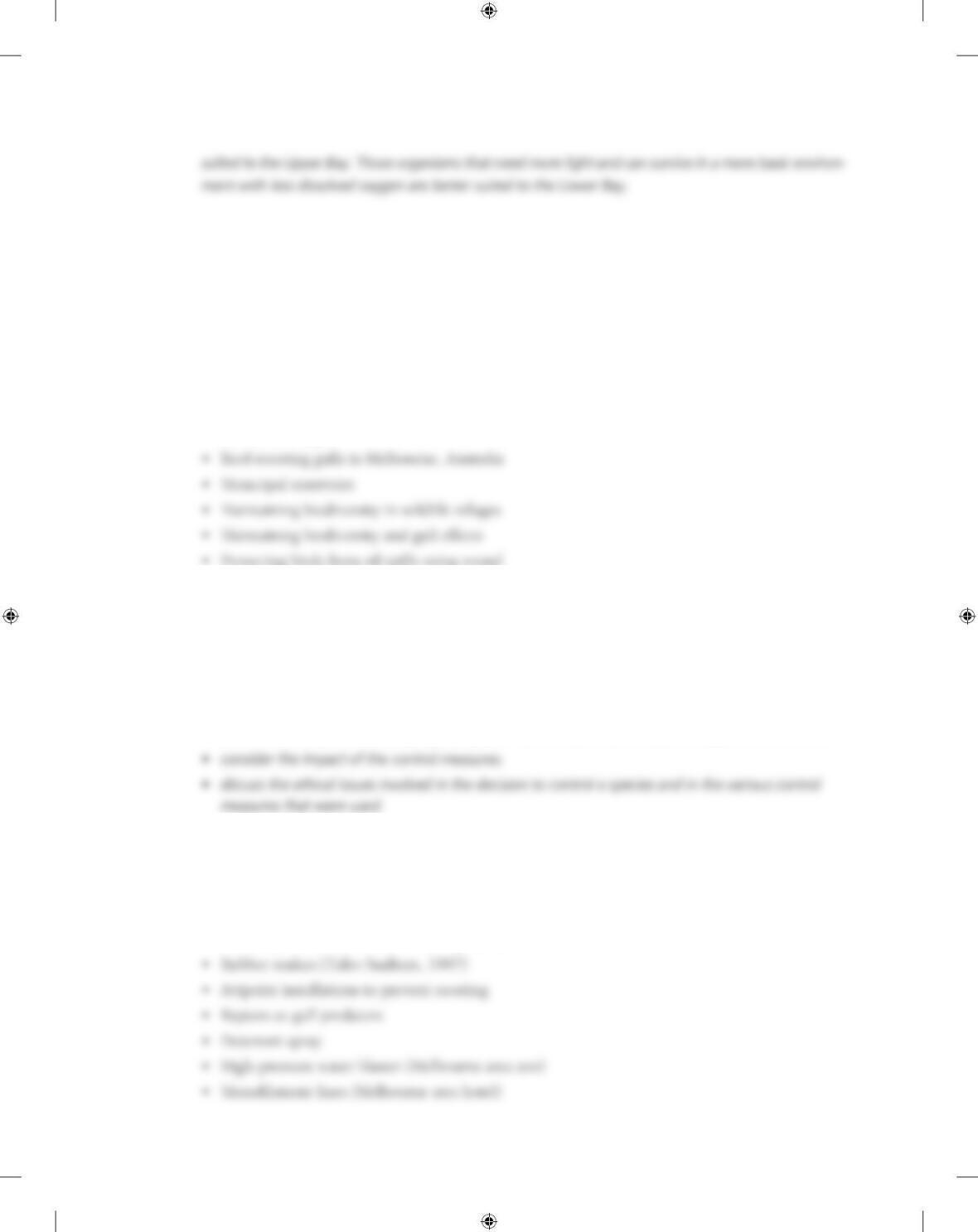
EnterthedataforeachstationinTable8.2.
Table IG8.3 Student answers to Table 8.2
Year: e.g.,2002
Month: August
Lower Bay station name: Upper Bay station name:
Point No Point Turkey Point
Students were told to choose data from stations in the upper Chesapeake and lower Chesapeake. The
valuesforthestationsPointNoPointandTurkeyPointarefoundinTableIG8.3.
3. Studieshaveshowntherearemajordifferencesintypesoforganismsinhabitingdifferentareasofthe
Bay.HowdothedatayourecordedinTable8.2helptoexplainthisnding?
While temperature average is the same for both stations, the Upper Bay station has more dissolved
M08_REEC4164_04_IE_CH08.indd 134 24/01/14 6:31 PM
ChapTER 8: Back to the Bay b 135
Suggested answers for additional Investigations
VI. Ethics Paper on Gull and Human Interactions
(Students were told to choose A or B.)
Go to the Case Book website for links to information about many of these topics.
A. Choose one of the following situations in which humans and gulls interact.
• Landlls
• Airports
• Offshoreoilrigs
• Protectingbirdsfromoilspillsusingsound
Researchthesituationexaminingcontrolmethodsusedandoutcomes.Considertheimpact
ofthelargegullpopulationsontheenvironment,otherspecies,andhumans.Thenconsider
the impact of the control measures. Discuss the ethical issues involved in the decision to
control a species and in the various control measures that were used.
A list of situations in which humans and gulls interact is included in the student investigation.
Research resources are included on MasteringBiology. In their papers, students should:
• considertheimpactofthelargegullpopulationsontheenvironment,otherspecies,andhumans.
B. Choose three of the following methods of gull control. Evaluate each for its effectiveness in
controllinggulls,itsexpense,andtheethicsofbothusingandsellingthesemethods.Describe
yourndingsina1-to2-pagepaper.
• Modelaircraft(Melbournearea)
• Owlefgies(LouisianaLandandExploration)
M08_REEC4164_04_IE_CH08.indd 135 24/01/14 6:31 PM
VII. Open-Ended Investigations
You may explore gull population and control using either the “logistic growth” or “control and
cost”Excelmodels(Weisstein,2004band2004c)athttp://bioquest.org/icbl/casebook/
gullcontrol.
References
136 a BIOlOGICal INqUIRy: A Workbook of Investigative Cases
M08_REEC4164_04_IE_CH08.indd 136 24/01/14 6:31 PM