Chapter 7:
Galloper’s Gut
InstruCtor’s GuIde
As with all the cases in this book, please read the preface if you have not already
done so. In the preface you will find suggestions for using Investigative Case–Based
Learning (ICBL) in different instructional situations such as starting a new lecture
topic, assessing what students already know, setting a context for lab activities, and
• Structureandfunctionofselectedmammaliandigestivesystems
• Nutritionforhorses
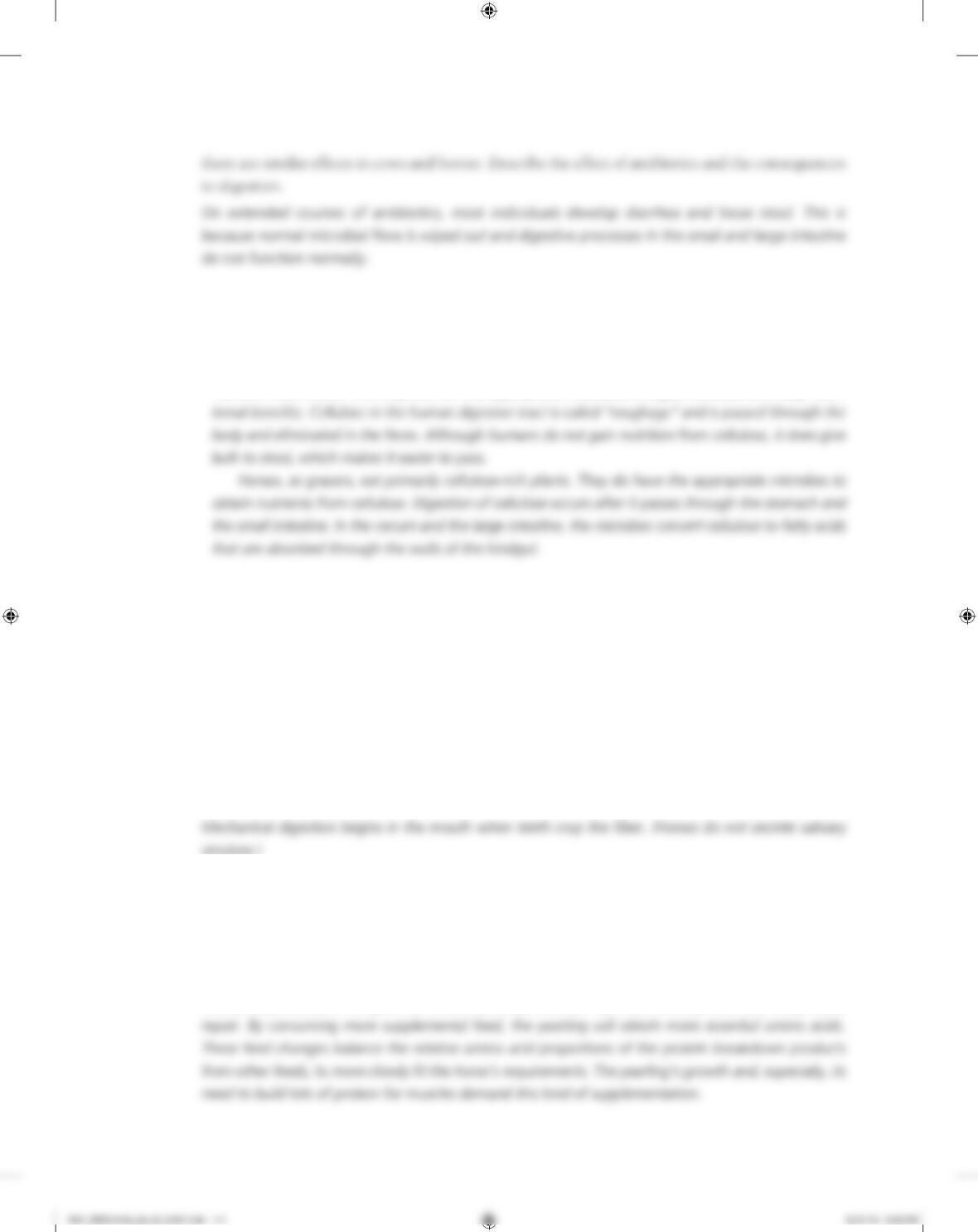
• Issuesinreproduction
• Horseevolution
investigation.
b 103
M07_REEC4164_04_IE_CH07.indd 103 24/01/14 6:28 PM
104 a BIoloGICal InquIry: A Workbook of Investigative Cases
table IG7.1 Galloper’s Gut Case overview.
Investigation learning Goals Inquiry skills used
Core Investigations
I. Critical Reading Students learn about diges- • observation
tive system structure and • inference
function in different types of
mammals. Emphasis is on
postgastric fermenters (horses
and humans) and ruminants.
additional Investigations
III. Reproduction in Mammals Students create graphs with • generating hypotheses
their own collected data • consideration of data to collect
related to gestation periods. • displaying data graphically
They evaluate whether two
species that can produce
hybrids should be considered
the same species.
M07_REEC4164_04_IE_CH07.indd 104 24/01/14 6:28 PM
table IG7.2 Campbell-related resources.
resource Chapter/activity topics Covered/activity title
Critical Reading from Chapter 41: Animal Four main feeding mechanisms
Campbell Biology, Nutrition of animals; Figure 41.2: Roles of essential
10th edition nutrients (Concept 41.1); main stages
of food processing (Concept 41.3);
the mammalian digestive system;
Figure 41.9: The human digestive system
(Concept 41.4); Ruminant digestion
(Concept 41.4)
Case narrative
Students were asked to underline terms or phrases
in the introductory narrative that they think are
important to understanding the case. Suggested
terms and phrases that students might have cho-
sen are in bold type.
well. We have to keep him in the barn all the
time to control his feed.”
“The grass here is not like the grass we had in
Kentucky,” Jim declared. “We have to give the
horses extra minerals.”
“The soil in the pasture is a problem,” Gina
agreed. “But we are replanting with both alfalfa
Chapter 7: Galloper’s Gut b 105
106 a BIoloGICal InquIry: A Workbook of Investigative Cases
Gina added, “The mare is lactating now, so
she is on a different ratio of hay, grain, and
supplements than the others.”
“So, do the horses need to go out to the pas-
turetofeedatall?”Leahasked.
“Yes, unless you leave a lot of good-quality hay
for them to get at in the barn,” Gina explained.
falo?”Leahasked.
“Yes.Hehastoomanyanimalsinthatspace.
Hisbuffaloaredefinitelytoosmall,and I’d bet
they need to be wormed,” Gina answered.
“Hey,let’sgetstartedwiththeyearlingbefore
we try to solve the buffalo problem,” Jim said.
suggested answers for Case analysis
1. Recognize potential issues and major topics in the case. Whatisthis caseabout? Underline
terms or phrases that seem to be important to understanding this case. Then list 3 or 4 biology-
2. What specific questions do you have about these topics? By yourself, or better yet,
in a group, make a list of what you already know about this case in the “What Do I Know?”
column.Listquestionsyouwouldliketolearnmoreaboutinthe“WhatDoINeedtoKnow?”
column.
M07_REEC4164_04_IE_CH07.indd 106 24/01/14 6:28 PM
3. Put a check mark by 1–3questionsorissuesfromthe“WhatDoINeedtoKnow?”listthatyou
think are most important to explore.
4. What kinds of references or resources would help you answer or explore these questions?
Identifytwodifferentresourcesandexplainwhatinformationeachresourceislikelytogivethatwill
help you answer the question(s). Choose specific resources.
Accept any reasonable resource (e.g., text, other book, Internet sites, maps, data tables, and so on)
Chapter 7: Galloper’s Gut b 107
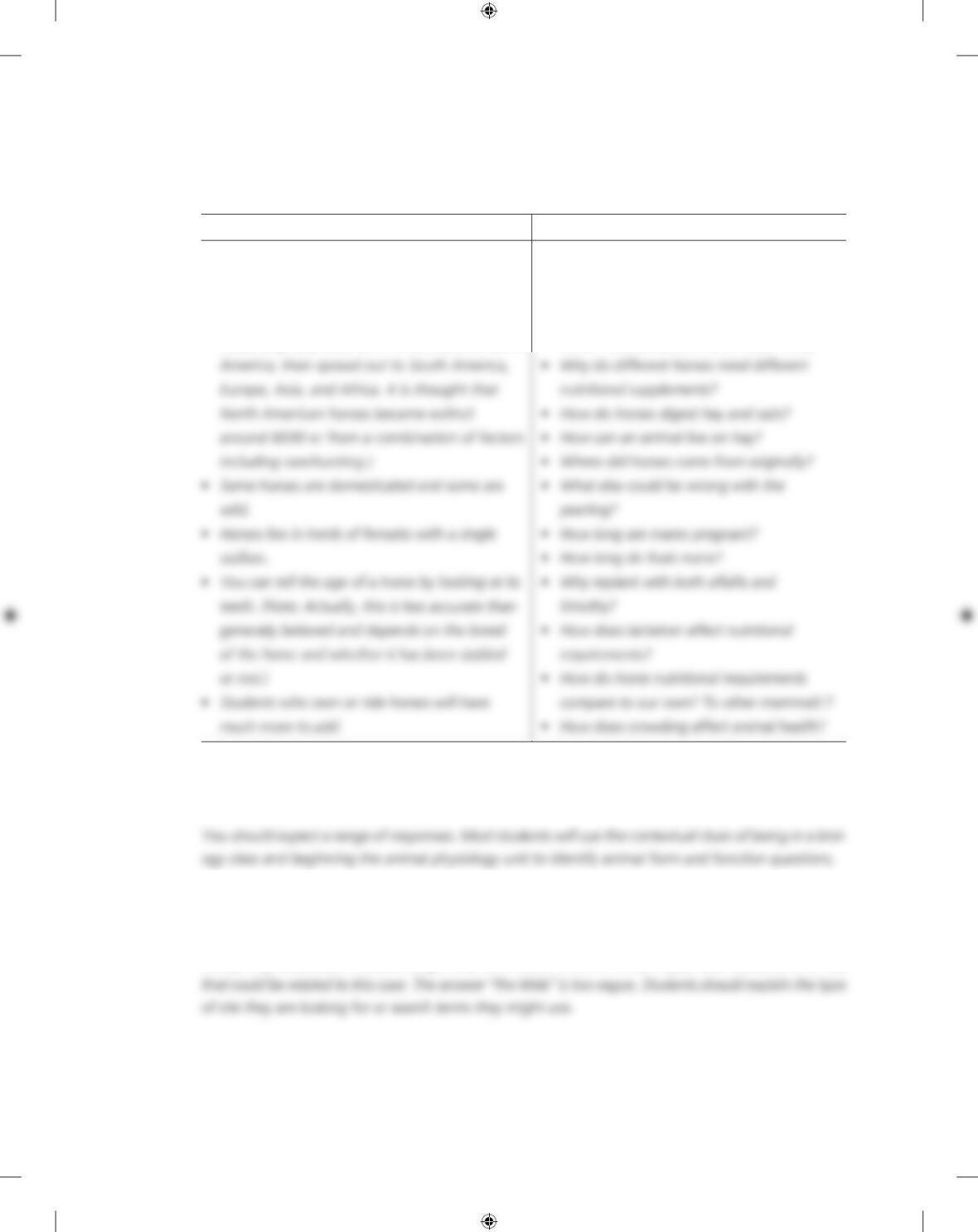
What do I Know? What do I need to Know?
• Horsesgrazeinpasturesandeathay.
• HorseswerebroughtherebytheSpanishin
the 1500s. (Note: While this is so, horses ac–
tually originally evolved in what became North
• Whatisthefungusinthefescue?Doesit
affecthorses?
• Whatissupplementalfeed?
• Whatmineralsdoesahorseneed?Why?
There are many possible answers, depending on the experience of your students. Some likely responses
follow.
M07_REEC4164_04_IE_CH07.indd 107 24/01/14 6:28 PM
suggested answers for Core Investigations
I. Critical Reading
Before beginning the investigations, read Chapter 41: Animal Nutrition in your text. You may also have
to refer to other chapters in Unit Seven and Chapter 24: The Origin of Species to learn the most from
this investigative case.
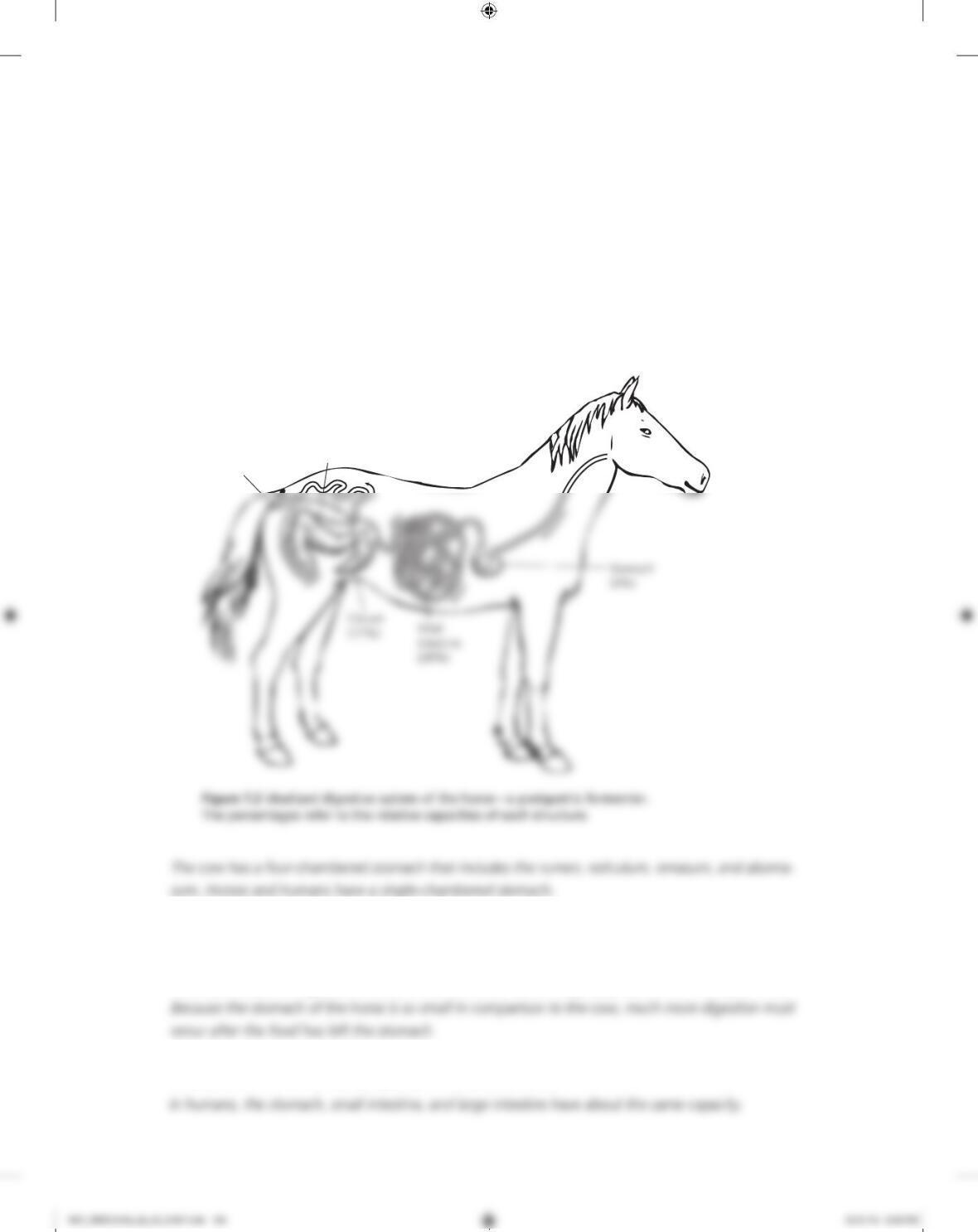
1. Compare the digestive systems of cattle (in this instance a cow), horses, and humans using
Figure7.2,aswellasFigure41.19and41.9inyourtext.
a. Howdoesthestructureofthestomachinthesethreeorganismsdiffer?
108 a BIoloGICal InquIry: A Workbook of Investigative Cases
Large intestine
(46%)
Rectum
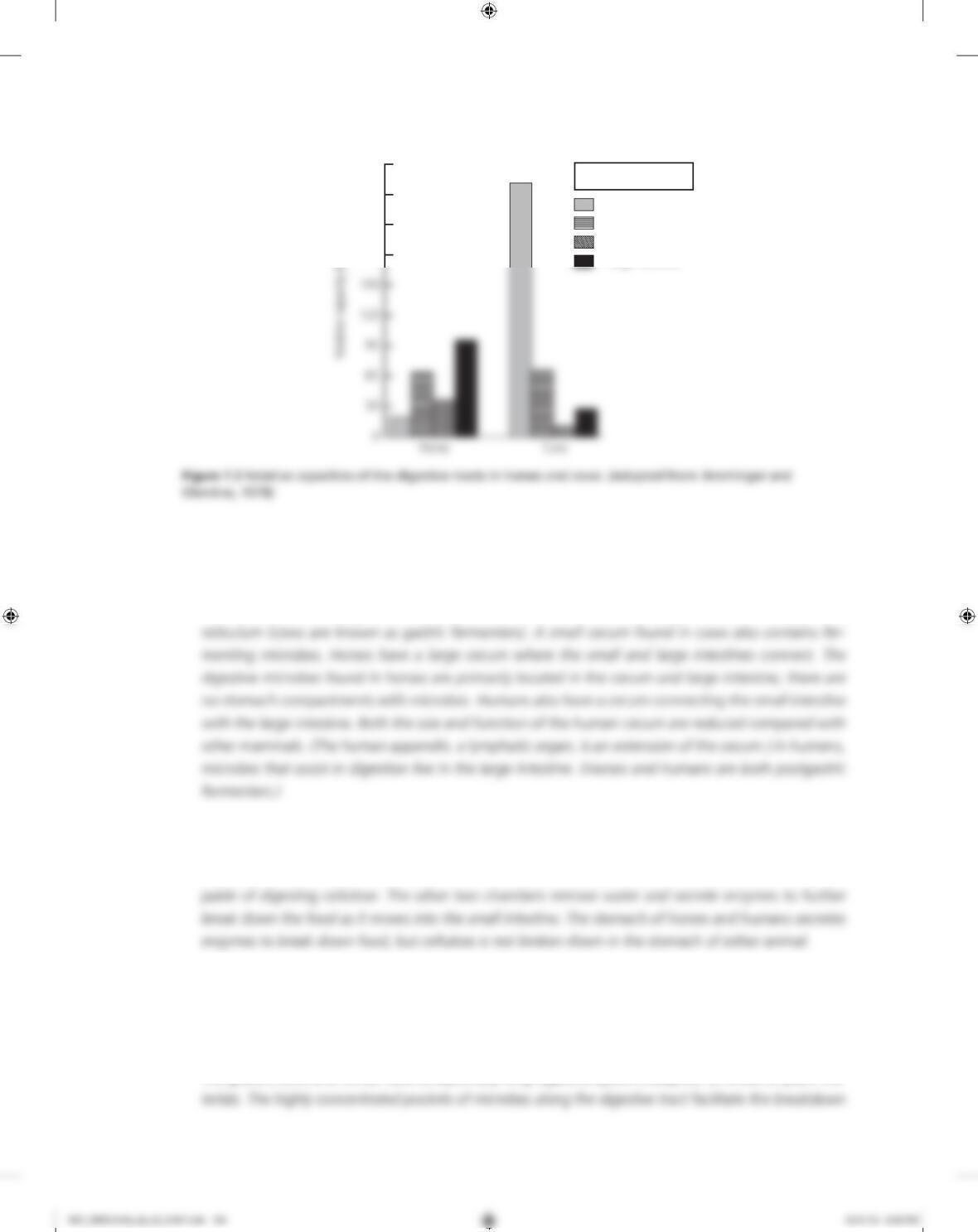
b.ExamineFigure7.3.Notethesignificantdifferenceintherelativecapacityofthestomachwhen
comparing a horse with a cow. What do you think this indicates about the location of digestion
inbothanimals?
In cows, almost all digestion occurs in the stomach, where large populations of microbes thrive.
c. Howdoyouthinktherelativecapacitiesofthestomach,smallintestine,andlargeintestine
woulddifferinhumansascomparedtohorsesandcows?
Chapter 7: Galloper’s Gut b 109
180
210
270
240
Key
Stomach
Small intestine
Cecum
Large intestine
2. Where are the microbes (mostly facultatively anaerobic) involved in digestion primarily
locatedinthecow,horse,andhuman?
In cows, most of the digestive microbes live in two of the stomach chambers, the rumen and the
3. Compare the function of the stomach in the cow, horse, and human. Also, comment on the
ability of each organism to digest cellulose in the stomach.
The cow, as a ruminant, has multiple chambers in its stomach, two of which contain microbes ca-
4. The function and structure of the digestive tracts of the cow, horse, and human fit the diets of
these animals. The grazers eat primarily leafy vegetation. Omnivores, however, consume more
calories from plant storage structures (grains, tubers, and roots) than from leaves. Compare the
relative sizes and functions of the digestive systems in grazers and omnivores.
The grazers (cow and horse) have exceptionally long digestive systems adapted for a diet of plant ma-
5. Once a horse swallows a bolus of food and it enters the stomach, strong muscles at the cardiac
endofthestomachpreventtheanimalfromregurgitatingitsfood.Howdoesthisdifferfromthe
swallowingprocessinruminants?
The ruminant swallows a bolus of food that may go to either the rumen or the reticulum. The cow
6. The digestion of what type of macromolecule begins in the organism’s stomach (the abomasum in
ruminants)?
Proteins are the macromolecules that undergo the most digestion in the stomach (or abomasum),
7. The small intestine functions similarly in all three organisms. Describe its function.
The small intestine is where further digestion of all classes of macromolecules occurs, facilitated by
8. The hindgut (structure of the digestive tract after the small intestine) in all three organisms contains
a diverse population of fermenting microbes. These microbes release gases, as well as fatty acids and
lactic acid as waste products of fermentation. Of the three organisms, the most hindgut fermenta-
tion occurs in horses.
Ifahorsefeedsontoomuchstarchygrain,alotofundigestedcarbohydratewillpassfrom
the foregut into the hindgut. The same digestion problem happens when a horse feeds on spring
grasses in the pasture. Grass plants produce many carbohydrate-rich leaves during the spring,
but in the summer they produce more stem than leaf. Microbes that ferment the excess starch
produceanincreasedleveloflacticacid,whichlowersthepHofthehindgut.Digestioninthe
hindgut stops and the horse often has to be treated for impaction. Why do you suppose excess
starchhaltsdigestion?
AsdiscussedinthecaseBeanBrew,manymicrobescannotwithstandachangeinpH.WhenpHdrops
9. The ecology of digestion relies on the presence of the right balance of microbial populations. For
example, over a long period of time, antibiotic treatments can affect digestion in humans, and
110 a BIoloGICal InquIry: A Workbook of Investigative Cases
M07_REEC4164_04_IE_CH07.indd 110 24/01/14 6:28 PM
Chapter 7: Galloper’s Gut b 111
10. Cows,horses,andhumansallconsumefoodscontainingcellulose.However,noneofthese
organisms produces enzymes that can break down cellulose. Fermenting microbes in the
stomach of cows convert cellulose to energy-rich fatty acids. Explain the fate of cellulose in
horses and humans.
Humanshaveneithertheenzymesnortheappropriatemicrobestodigestcelluloseandreapnutri–
II. Feeding Horses
Wild horses are grazers that feed freely in grasslands. Their diet consists mainly of grasses and forbs
(nongrass flowering plants). Domesticated horses are provided fewer choices. They are given access to
either grass forage or hay that provides all or most of their required nutrients. To offset deficits in the
quality and quantity of grass forage and hay, supplemental feed is provided. Often this feed contains
additional vitamins and minerals and specialty feeds such as oats or corn.
1. Grass forage and hay consist largely of structural carbohydrates in the form of fiber, primarily cellu–
lose. The fiber provides the raw material necessary for the growth and maintenance of microbial flora
requiredforgoodhorsehealth.Weknowthatfiberisprocessedmainlyinthehindgut.However,
wheredoestheprocessingofthefiberbegin?
2. When the yearling in the case showed signs of low weight gain, he was removed from the pasture.
The owners increased his total amount of feed and provided a higher proportion of supplemental
feed. The supplemental feed consisted of a mixture of lysine-rich field peas and cereal grains con-
taining methionine and cystine. Why do you think the owners decided to incorporate more amino
acidsintheyearling’sdiet?
Horsesrequireproteinforgrowth,muscledevelopment,skinandhairdevelopment,andbodytissue
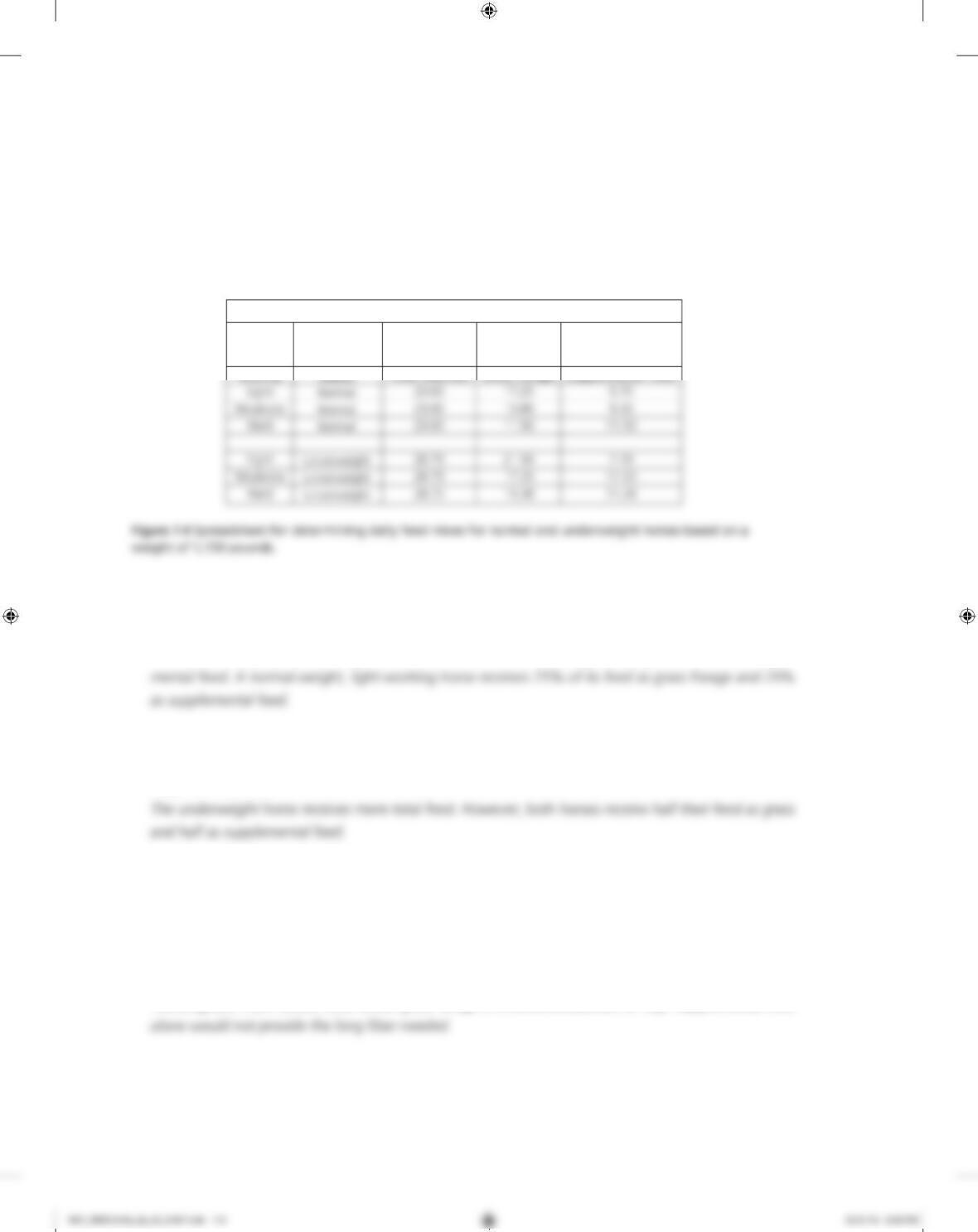
3. Weight status and activity levels can be used to estimate the amount of feed needed by individual
horses (Figure 7.4). According to this chart, should you feed a horse with a normal weight of
1,150 pounds that engages in hard activity more total feed than a horse with a normal weight of
1,150poundsthatengagesinlightactivity?
The total feed is the same.
112 a BIoloGICal InquIry: A Workbook of Investigative Cases
Weight
1,150 lb
Activity
Status
Total Feed (lb)
Grass Forage
Supplemental Feed
Calculating Daily Feed for Horses
4. Compare the proportions of grass forage and supplemental feed in the total feed mix for the
normal-weight horse with hard activity and the normal-weight horse with light activity.
The normal-weight, hardworking horse receives 50% of its feed as grass forage and 50% as supple-
5.Ifyouhaveanunderweighthorsethatisworkedhardandahorseofnormalweightthatisworked
hard,whichshouldreceivethemosttotalfeed?Isthereadifferenceintheratioofgrassforageto
supplementalfeed?
6. Some organisms that infect grass prove harmful to horses. When the mare in the case was pregnant,
the owners had the pasture with tall fescue grass tested. Fescue can contain an endophytic fungus
thatproducesergotalkaloidsthatarechemicallysimilartoneurotransmitters(Browning,2003).
These alkaloids can interfere with the physiological control of labor and delivery as well as the sur-
vival of the foal. Should a pregnant mare be removed from a pasture infected with this fungus and
fedsolelysupplementalfeed?
The pregnant mare would need either grass forage in a different pasture or hay. Supplemental feed
7.Inthecase,thecrowdingofbuffaloinaneighbor’spastureiscriticized.Overcrowdinglimitsavail–
able forage and substantially increases the potential for parasite infection. Parasites can be picked
upwhenanimalseatthelarvaeofflatwormsandroundwormslivingintheirpasturefeed.Howdo
thelarvaeoftheseanimalparasitesgetintothegrass?
8. Easy-keeper horses are usually insulin-resistant. Because their bodies do not respond to normal in–
sulin levels, they maintain abnormally high levels of insulin compared with horses that are not easy
keepers. Easy keeper horses tend to convert excess carbohydrates to fat and require less food to
maintaintheirweight.Easykeeperseasilybecomeoverweightonsupplementalfeed.Howmightthis
genetictraitbebeneficialtohorsesandtotheirowners?
This genetic trait may have adaptive value for horse populations that periodically suffer from drought
9. Owners of racehorses add oats to the supplemental feed to provide both extra protein for muscle
repair and extra carbohydrates for the quick energy needed by these active horses. The excess starch
in oats is processed in the large intestine. As you have learned, this may cause problems in horses.
One proposed preventive treatment is to add a microbial amylase that functions at a wide range of
pHtothesupplementalfeed.Howcouldthishelp?
Amylase is an enzyme that catalyzes the breakdown of starches into sugars. The added enzyme ensures
suggested answers for additional Investigations
III. Reproduction in Mammals
a. reproduction in Equus. After giving Leah the rest of the tour, Jim and Gina pointed out a pasture
near their farm that contained a male zebra and a female donkey. Their healthy offspring, born ear-
lier that year, was easily seen as it stood near the fence. Leah said, “Look at that weird little striped
donkey. What is that?”
“We’re guessing the donkey and zebra got together,” Jim said.
M07_REEC4164_04_IE_CH07.indd 113 24/01/14 6:28 PM
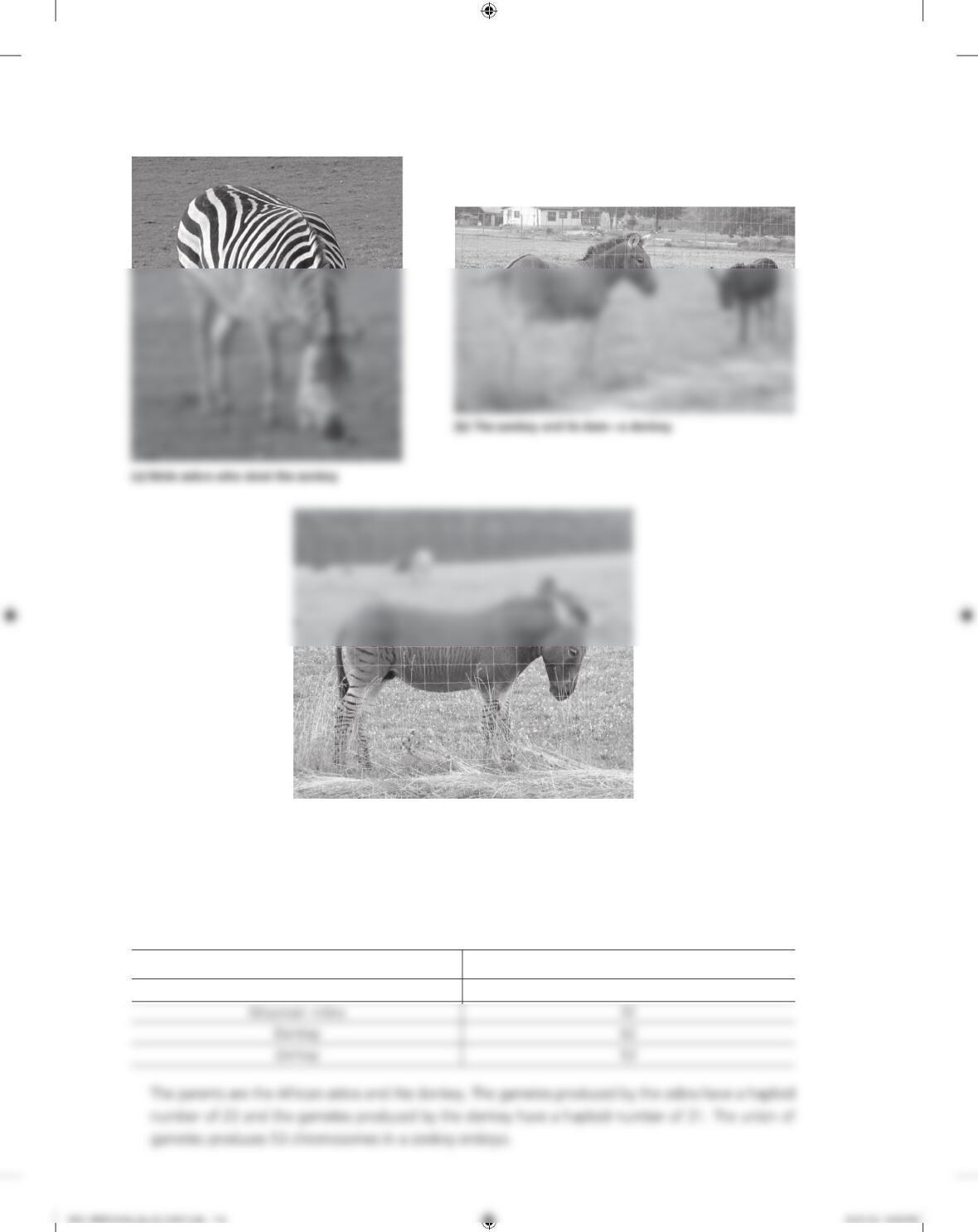
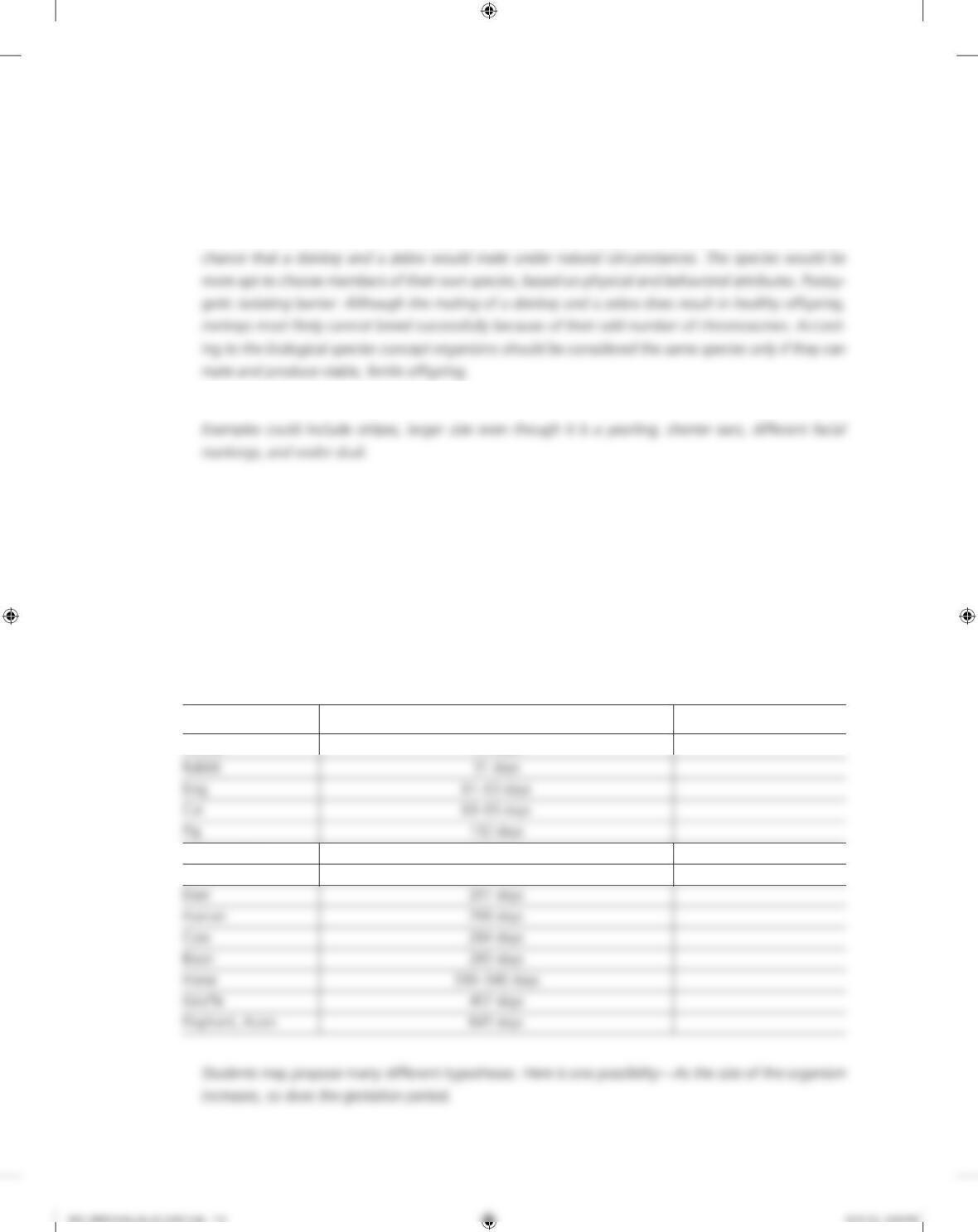
1.UsingthedatainTable7.1,determinethezonkey’sparents.Explain.
114 a BIoloGICal InquIry: A Workbook of Investigative Cases
Figure 7.5 This yearling zonkey is an offspring of a male zebra and a female donkey.
(c) the yearling zonkey
table 7.1 diploid Chromosome numbers in Various equid Mammals.
equid Mammal total Chromosome number
African zebra 44
2. Although zebras and donkeys can produce offspring, do you think these two types of organisms
shouldbeconsideredtobethesamespecies?Explain,usingdefinitionsof“species”andexamplesof
prezygoticandpostzygoticisolatingmechanisms(seeChapter24).
No. The two should not be considered the same species. Prezygotic isolating barrier: There is little
3.ExaminethephotosinFigure7.5andlist3traitsofthezonkeythataredifferentfromitsdam.
B. Gestation in Mammals. Gestation is the period of time in which developing young are carried
within the uterus. Table 7.2 shows the average gestation period for different placental mammals.
(Note: Whereas gestation time usually is calculated as the time from fertilization to birth, some
smaller placental mammals such as squirrels and minks have delayed implantation. In this case,
gestation refers only to the total time of active development.)
1. Provide a hypothesis about the length of gestation with respect to the animals involved. For
example, the larger the typical litter, the shorter the gestation period.
Chapter 7: Galloper’s Gut b 115
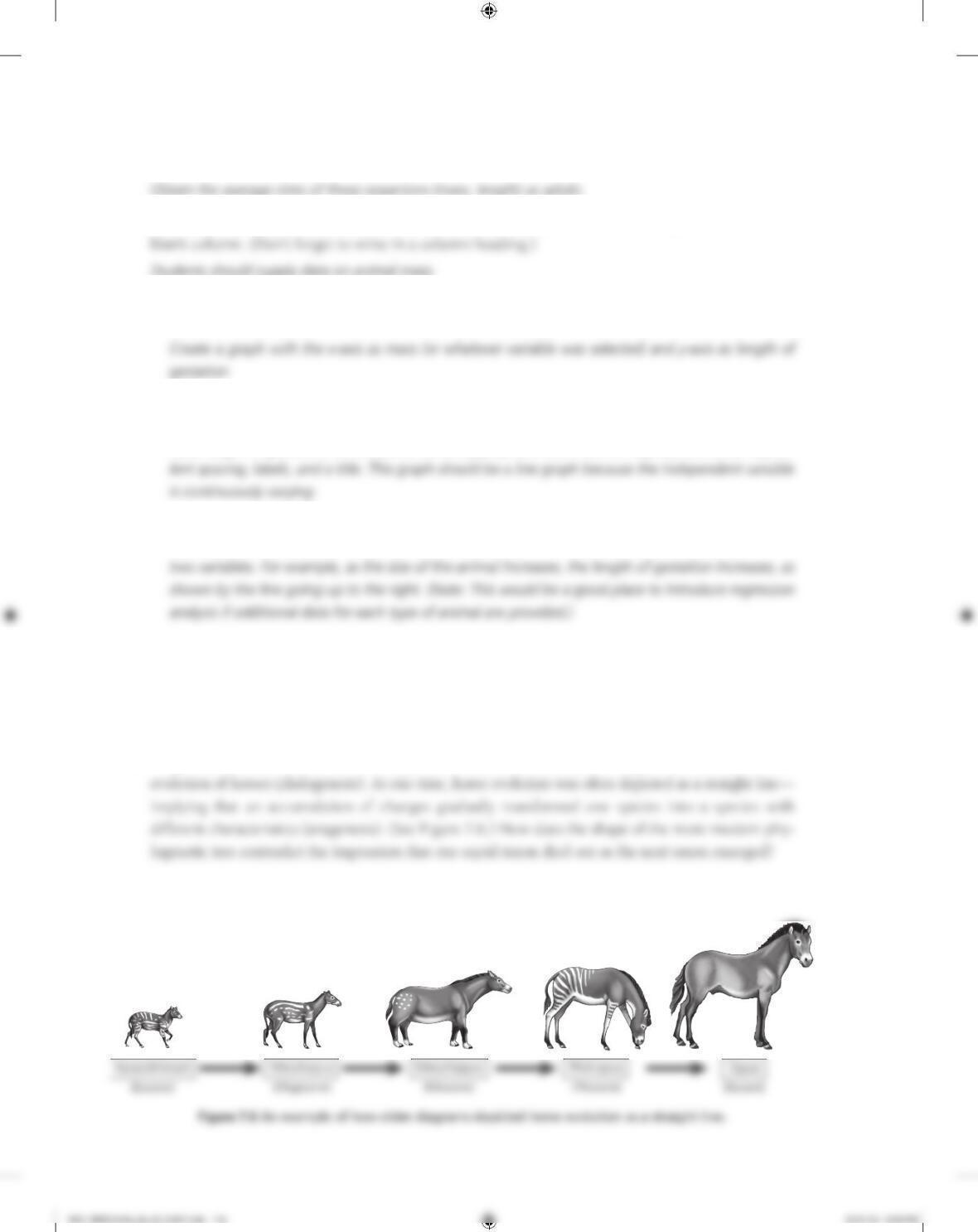
table 7.2 approximate Gestation periods for placental Mammals.
Mammal approximate length of Gestation
Mouse 19 days
Goat, pygmy 145 days
Goat 150 days
2.WhatsingledatacolumnwouldyouaddtoTable7.2tohelpyoutestyourhypothesis?
3. Choose six of the mammals in the table and look up the data for each. Enter your results in the
4. a. To test your hypothesis, construct a line graph with the data from the table. What will be on the
x-axisofthegraph?Whatwillbeonthey-axisofthegraph?
b. Plot your graph in the space below.
The independent variable (selected by the student) on the x-axis and the dependent variable (in this
case, length of gestation) on the y-axis will be appropriate. Look also for appropriate units, equiva-
c.Interpretthegraph.Aretheresultswhatyouexpected?
Students should discuss the shape of the line and what it tells about the relationship between the
IV. A Closer Look at Horse Evolution
In “Critical Reading,” some of the evolutionary adaptations found in the digestive systems of grazing
animals were considered. In this section, further adaptations found in modern horses and in fossils of
equids (horselike organisms) will be examined.
1. Togainanoverviewofover50millionyearsofhorseevolution,examineFigure25.29,thebranched
116 a BIoloGICal InquIry: A Workbook of Investigative Cases
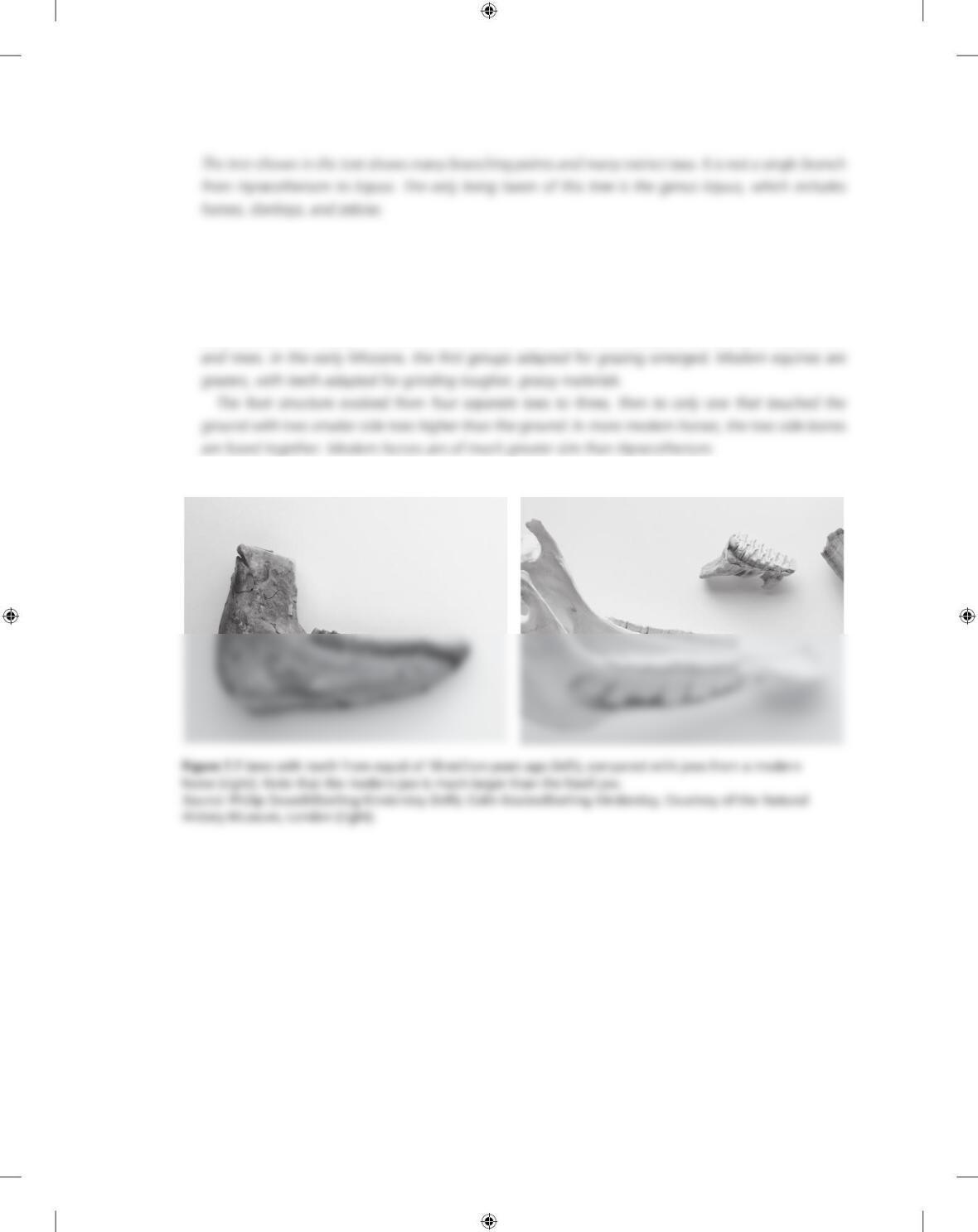
2. Summarize the changes in feeding habits, foot structure, and overall size of the animals depicted
inFigure25.29ontheonebranchleadingfromHyracotherium to Equus. (Note that the trends you
see on this branch did not occur together or at a steady rate. They may have occurred in several
branches of this evolutionary tree at different times. Evolution is not goal-oriented.)
Earlyancestorsoftoday’shorseswerebrowsers.Theirteethwereadaptedforeatingwoodyshrubs
3.ExamineFigure7.7.Comparetheteethoftheextinctandextantequidjaws.
Chapter 7: Galloper’s Gut b 117
M07_REEC4164_04_IE_CH07.indd 117 24/01/14 6:29 PM
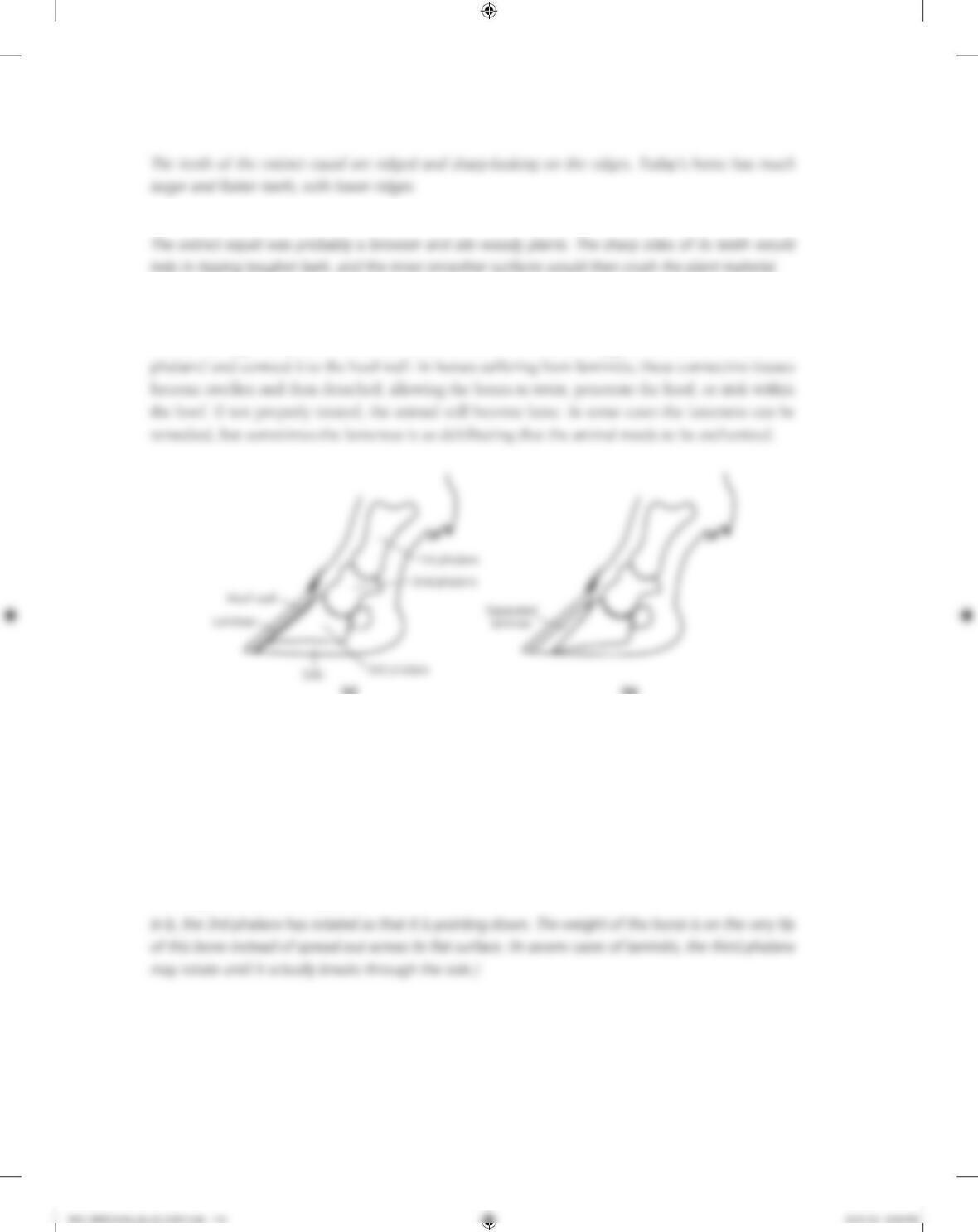
4.Whatkindoffooddidtheextinctequidlikelyeat?
5. Although well adapted for running, modern horses are susceptible to a foot condition called lami-
nitis,adeteriorationofconnectivetissueswithinthehoof(Figure7.8).Strongfibroustissuescalled
laminaeoccupythespacebetweentheboneandhoof.Thelaminaesupporttheterminalbone(3rd
118 a BIoloGICal InquIry: A Workbook of Investigative Cases
Figure 7.8 laminitis. (a) Normal foot anatomy. (b) Foot of horse with laminitis. Note the shifting bone structure.
(a) (b)
Although the cause of laminitis is not known, many predisposing factors have been correlated
with the onset of laminitis. One of these factors is overfeeding with lush spring grasses or other
sources of high carbohydrates. One hypothesis is that the excess carbohydrates lead to toxins in the
blood that irritate the sensitive laminae.
Whataresomedifferencesbetweenthenormalfootandthefootwithlaminitis?Considerwhere
the weight of the horse is placed.
6. Raising horses is at best an artificial system in which the horse’s normal movement, choice of feed,
population size, and breeding are restricted. What evolutionary implications might this have for
futuredomesticatedhorsepopulations?
Horsesthatsurviveundertheseartificialselectionpressuresmayexhibitareductioningeneticvari–
ability at the population level due to artificial selection for certain traits. (Other traits, however, may
V. Open-Ended Investigations
Go to the Case Book website at http://bioquest.org/icbl/casebook to access a live copy of the Excel
spreedsheetonfeedinghorses.Investigatescenariosprovidedthereormakeupyourown.
References
Browning,R.,Jr.2003.“TallFescueEndophyteToxicosisinBeefCattle:ClinicalModeofActionand
PotentialMitigationThroughCattleGenetics,”2003.http://www.bifconference.com/bif2003/
BIFsymposium_pdfs/Browning.pdf
Chapter 7: Galloper’s Gut b 119
M07_REEC4164_04_IE_CH07.indd 119 24/01/14 6:29 PM