As with all the cases in this book, please read the preface if you have not already
done so. In the preface you will find suggestions for using Investigative Case–Based
in Unit Six and sections of Unit Three on genetic engineering. Students be–
gin the investigative case by reading a narrative about growers at a meeting
who are discussing the use of genetically modified (GM) seeds. There are five
strands in the case:
• Corngrowthandreproduction
Students should complete the Case Analysis immediately following the read-
ingofthecase.Westronglysuggestthatstudentsworkingroupstocomplete
the Case Analysis. Actively listening to and challenging the ideas of others can
help learners become aware of their own misconceptions, yet also value their
ownandothers’priorknowledge.
Chapter 6:
Corn Under Construction
InstruCtor’s GuIde
84 a BIoloGICal InquIry: A Workbook of Investigative Cases
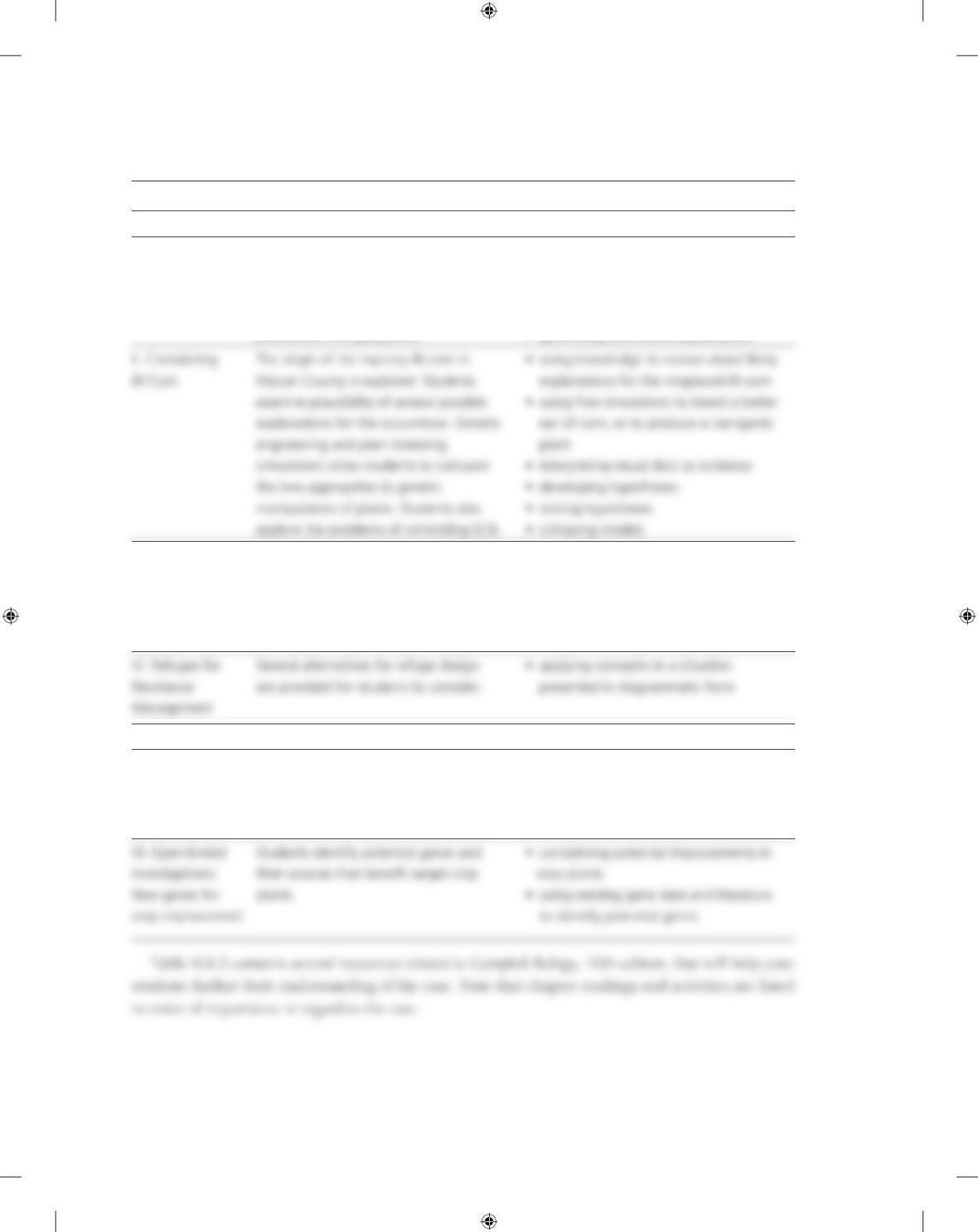
table IG6.1 Corn under Construction Case overview.
Investigation learning Goals Inquiry skills used
Core Investigations
I. Critical Reading Students apply information from • mathematical applications to calculate
Chapter 38: Angiosperm Reproduction pollen production
and Biotechnology to explore issues • interpreting images
relating to flowers, pollination, and fruit • applying concepts to new examples
production in angiosperms. • generating alternative explanations
III. Investigating Students model corn growth and ECB • building, using, and critiquing a physical
Corn Morphology damage. model
and Growth with
a Model of Insect
Damage
additional Investigation
V. Making Students argue for and against the use • critical thinking
Decisions About of transgenic crops in regard to global • constructing logical arguments
DNA Technology: agriculture. • considering global issues
Golden Rice
M06_REEC4164_04_IE_CH06.indd 84 24/01/14 6:47 PM
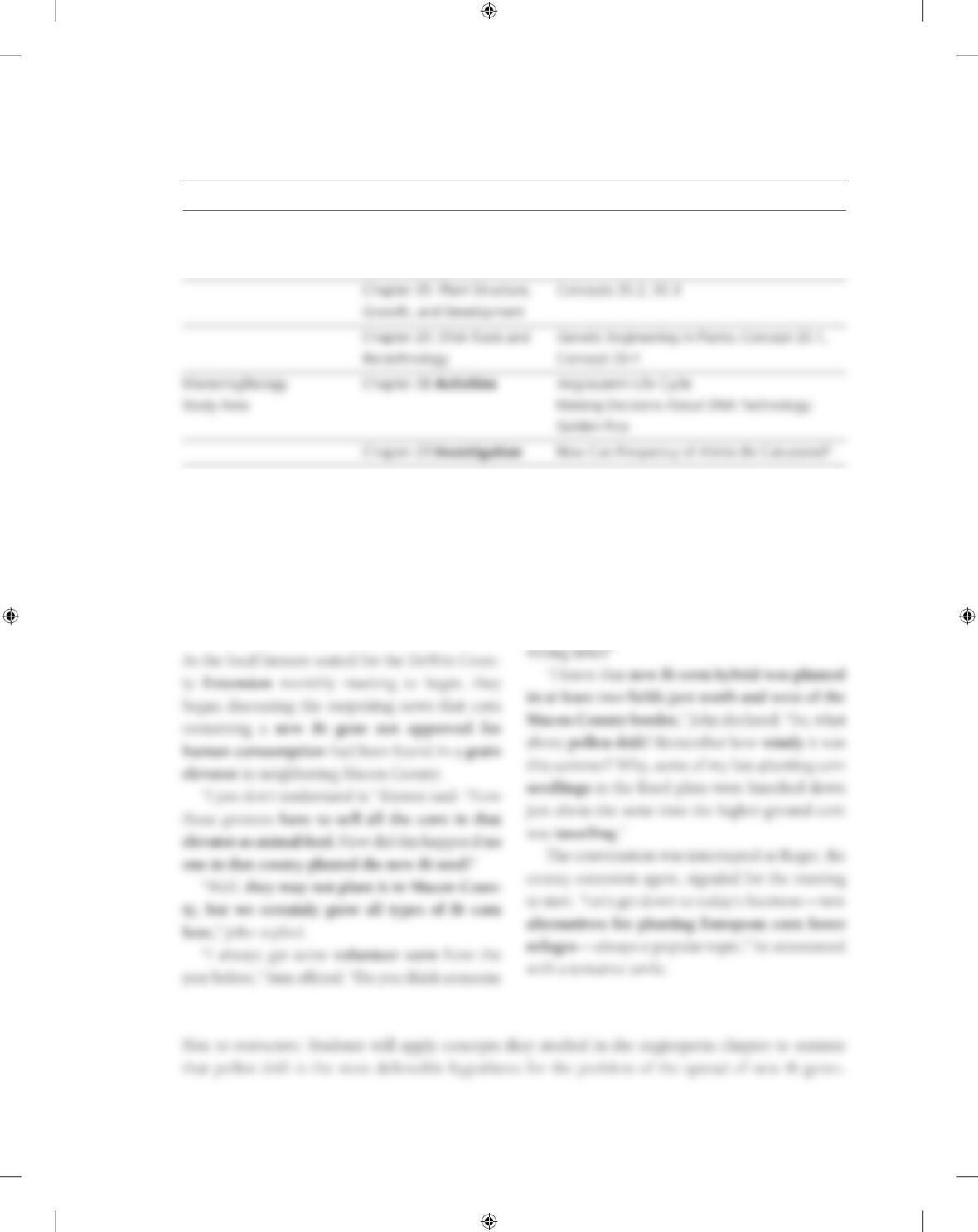
table IG6.2 Campbell-related resources.
resource Chapter/activity topics Covered/activity titles
Critical Reading Chapter 38: Angiosperm Concepts 38.1, 38.2, 38.3
from Campbell Biology, Reproduction and Figures 38.2, 38.8, 38.16
10th edition Biotechnology
Case narrative
Students were asked to underline terms or phrases
in the introductory narrative that they think are
important to understanding the case. Suggested
terms and phrases that students might have cho-
sen are in bold type.
plantednewacreageanddidn’tcheckforvolun–
teers from the prior owner’s crop?”
“I’m pretty sure the new Bt seed only be–
came available this year,” Emmet responded.
“Do you think the seed company might have
packaged some of the new Bt seed with the
Chapter 6: Corn Under Construction b 85
M06_REEC4164_04_IE_CH06.indd 85 24/01/14 6:47 PM
86 a BIoloGICal InquIry: A Workbook of Investigative Cases
EuropeancornborerswereintroducedaccidentallyintheUnitedStatesin1909.Earlycontrol
methods centered on burning infected fields and quarantining crops. The discovery that strains
ofBacillus thuringiensis (Bt)produceatoxineffectiveagainsttheEuropeancornborer(andother
lepidopterans)wasmadeinthe1920s.Spraysofwhole,driedculturesofB. thuringiensis have been
usedwidelytocontrolECBsincethe1930sinconventionallyandorganicallygrowncorn.Because
Bt sprays are effective only for a matter of days, use of sprays necessitates repeated scouting in the
fieldstodetectECBlarvae.MostareasoftheUnitedStatesaveragetwotofivegenerationsofECB
in a given field each year. Chemical pesticides are less effective than Bt spray and are costly and
hazardous.
Because the continuous expression of the Bt gene in corn puts strong selection pressure on the
ECB, mutations for resistance are likely to be selected for. The Environmental Protection Agen–
cy requires that a refuge of non-Bt corn be planted in each field. By maintaining a population of
nonresistantECBintherefuge,thespreadofresistancegenesisslowed.Someseedcompanieshave
suggested that a particular Bt hybrid will remain effective for about 3 times as long in fields where
growers use refuges. Refuges are required for most transgenic crops and range from 20% to 50% of
planted acreage for that crop.
suggested answers for Case analysis
1. Recognize potential issues and major topics in the case. What is this case about? Underline terms
or phrases that seem to be important to understanding this case. Then list 3 or 4 biology-related
topics or issues in the case.
Biology-related topics or issues: spread of genes from one variety of corn to another via pollen, how Bt
2. What specific questions do you have about these topics? By yourself, or better yet, in a group,
makealistofwhatyoualreadyknowaboutthiscaseinthe“WhatDoIKnow?”column.Listques–
tionsyouwouldliketolearnmoreaboutinthe“WhatDoINeedtoKnow?”column.
There are many possible answers, depending on the experience of your students. Some likely responses
follow.
Chapter 6: Corn Under Construction b 87
3.Putacheckmarkby1–3questionsorissuesfromthe“WhatDoINeedtoKnow?”listthatyou
thinkaremostimportanttoexplore.
What do I Know? What do I need to Know?
• Familiarity with corn—sweet and popcorn— • What is Bt corn?
as well as husking corn and picking off • Is Bt corn widely grown?
the silks. • What is tasseling?
• Some students may be familiar with • What is pollen drift?
4. What kinds of references or resources would help you answer or explore these questions?
Identifytwodifferentresourcesandexplainwhatinformationeachresourceislikelytogivethatwill
help you answer the question(s). Choose specific resources.
Accept any reasonable resource (e.g., text, other book, Internet sites, data tables, and so on) that could
suggested answers for Core Investigations
I. Critical Reading
To complete this investigation, you should have already read Chapter 38: Angiosperm Reproduction
and Biotechnology.
a. reproduction in Corn: Flowers and pollination. Like the majority of angiosperms, rose family
plants have complete flowers. Their floral structure includes sepals, petals, stamens, and carpels
(Figure 6.2). If you compare corn flowers to the rose flower, you can observe striking differences.
Corn, known globally as maize, has unisexual flowers and is monoecious—both male (staminate)
88 a BIoloGICal InquIry: A Workbook of Investigative Cases
1. Is there any advantage for the corn plant to having its staminate flowers higher than its carpellate
flowers?Explain.
2.Each tassel produces 2–5 million pollen grains. One acre of a cornfield may contain 20,000 to
30,000cornplants,producingupto68kg(approximately150pounds)ofpolleninasinglegrow–
ingseason.Eachearhasabout1,000carpellateflowers,althoughonlyabout400seed-containing
kernelsareproducedontheaverageear.
M06_REEC4164_04_IE_CH06.indd 88 24/01/14 6:47 PM
Chapter 6: Corn Under Construction b 89
The pollents ovule ratio (P/O) in wind-pollinated plants is often greater than 1,000 (1,000 pollen
grains:1ovule).Forexample,horsechestnuthasaP/Oof450,000andoakhasaP/Oof600,000.If
4 million grains of pollen are produced per tassel, what is the ratio of pollen to ovules in an average
corn plant bearing one tassel and one ear?
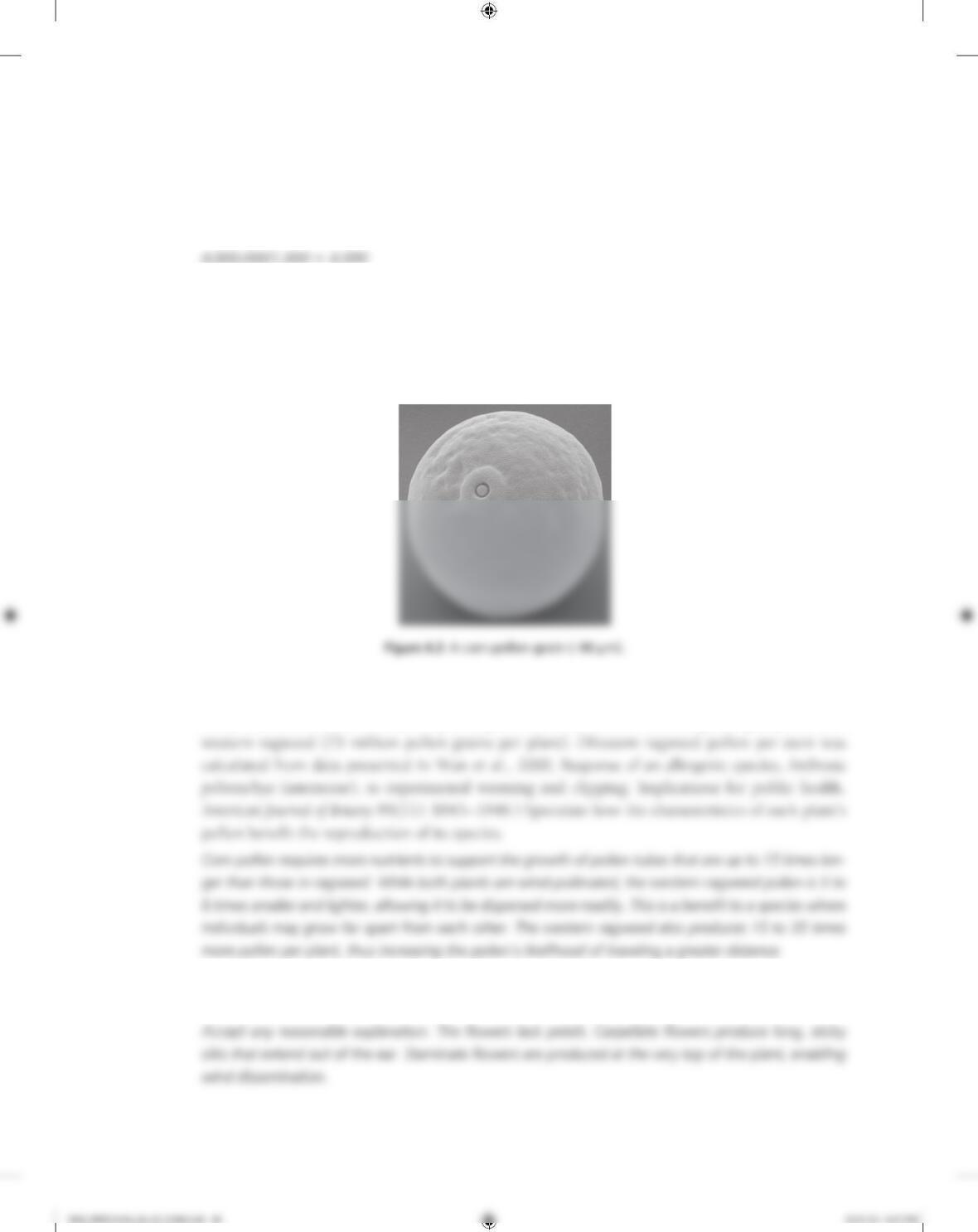
3. Pollen grain size is significant (see Figure 6.3). If a pollen grain is too large, it may not disperse
well; however, if it is too small, there will be insufficient resources to produce a pollen tube long
enough to reach the ovules. Corn pollen averages 120 µm in diameter, which is much larger than
eitherhorsechestnutoroakpollen.Unlikeeitherofthesetreepollens,cornhastosupportthe
growth of a pollen tube up to 15 cm long.
Western ragweed pollen averages 21 µm in diameter and produces a pollen tube length of about
1 cm. Consider the differences in pollen production by corn (4 million grains per plant) and
4.Ifyoudidn’tknowthatcorniswind-pollinated,whatcharacteristicsofcornflowerscouldpointyou
toward this conclusion?

5.Howdoyouthinkaroseispollinated?Consideryourownexperiencewithrosesaswellasthe
image provided in Figure 6.2. List two personal observations to support your answer.
6. Roses belong to the clade of flowering plants called eudicots. Corn belongs to the monocot clade.
Usingyourknowledgeofeudicotandmonocottraits,answer“monocot”or“eudicot”forthefol–
lowing features observed in plants from one of these two clades:
a. Parallel venation in the leaves
B. reproduction: Fertilization and the seed. See Figures 38.4 and 38.8 in the text to help you with
this investigation.
1.Ifyouweretosliceopenakernelofcornandapplyiodinesolutiontotheinterior,whichpartofthe
kerneldoyoupredictwouldturnthedarkestblue?Whatisthefunctionofthispartoftheseed?
Most likely the endosperm would turn the darkest blue because it contains the highest concentra tion
2. Do the embryo and endosperm contain genetic information from the female gamete, the male gam-
ete, or both?
Both the embryo and the endosperm contain genetic information from both types of gametes. One
3.Doboththeembryoandtheendospermhavethesamenumberofchromosomes?Explain.
No. The embryo has fewer chromosomes. One sperm nucleus fertilizes the egg cell, forming a diploid
II. Considering Bt Corn
a. Misplaced Bt Corn. Recall from the case that something strange happened in Macon County.
Some of the corn stored in the major grain elevator tested positive for new Bt genes. These
90 a BIoloGICal InquIry: A Workbook of Investigative Cases
Chapter 6: Corn Under Construction b 91
1. List the hypotheses posed by the DeWitt County growers as to how new Bt corn found its way into
the Macon County growers’ grain elevators.
2. Consider how the Bt genes turned up in the Macon County corn according to John’s hypothesis.
Within the seeds, would Btgenesbefoundintheembryo,theendosperm,orboth?Explain.
3. Farms are spread out all around Macon County. Two members of the growers’ cooperative had
samples of seed from corn left in their fields that tested for the presence of Bt genes. Compare
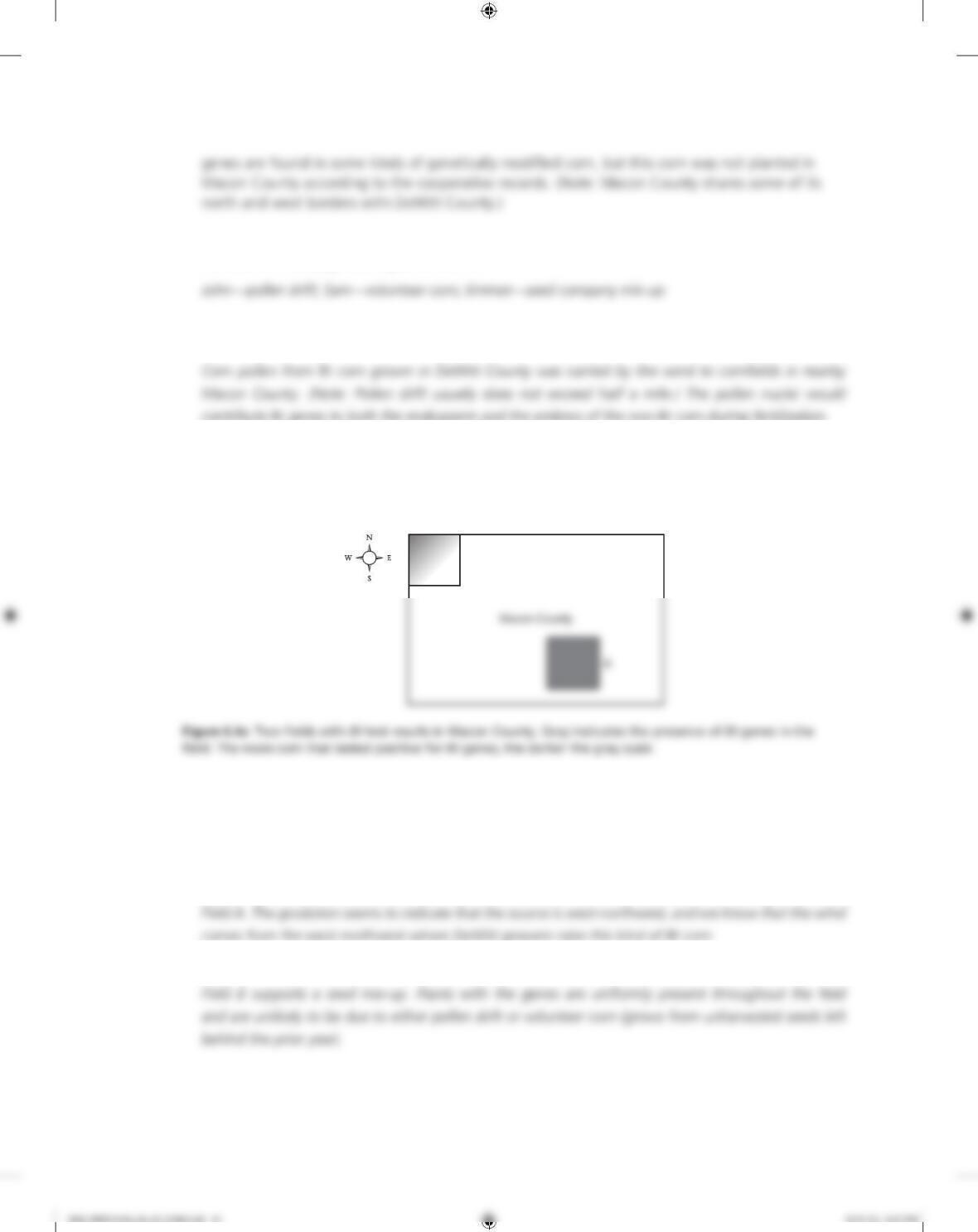
the test results of field A and field B in Figure 6.4a.
A
Field A shows a graduated occurrence of Bt genes. The field B location tests uniformly positive for Bt
genes.
4. Which field results would tend to support John’s explanation of how pollen traveled from DeWitt
to Macon County? Why?
5.WhichfieldresultswouldtendtosupportEmmet’sexplanation?Why?
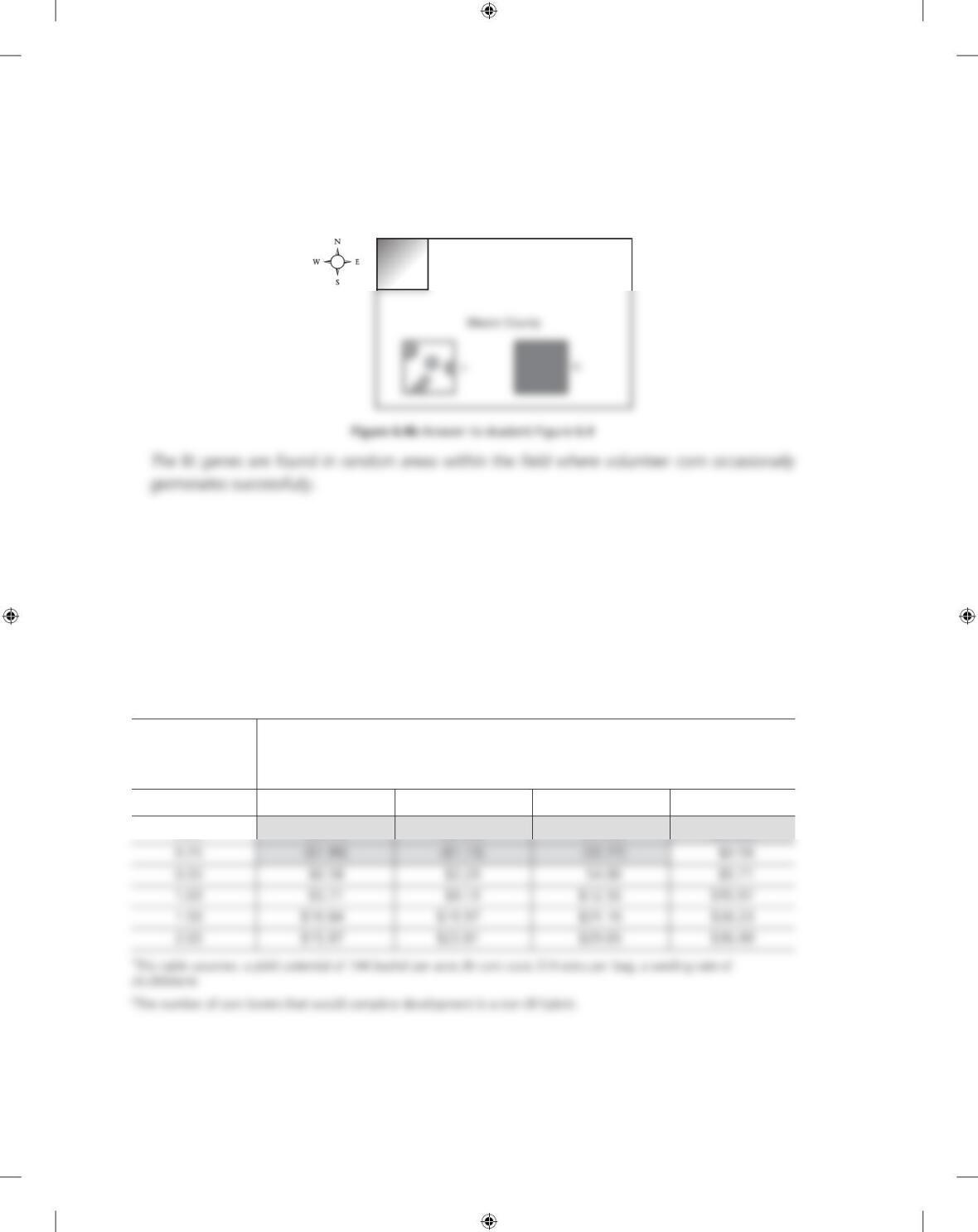
92 a BIoloGICal InquIry: A Workbook of Investigative Cases
6.DrawanewrectangletorepresentfieldCwithresultsthatwouldsupportSam’shypothesis.Explain
the significance of the pattern of Btgenesinyoursketch.
Example of a student sketch:
A
B. the economics of Bt Corn. The seed for Bt corn hybrids costs approximately $14 more per bag
than the seed for conventional corn hybrids. This “biotechnology premium” varies from year to
year and depends on the type of transgenic seed purchased. Table 6.1 describes the potential
savings (or losses) of using Bt corn under various levels of corn borer populations and corn pricing.
table 6.1 potential savings (or loss) per acre of Bt Corn
Versus no Corn Borer Control.1
average number
of Corn price per Bushel
Borers/plant2
$1.50 $2.00 $2.50 $3.00
0.00 ($4.55) ($4.55) ($4.55) ($4.55)
M06_REEC4164_04_IE_CH06.indd 92 24/01/14 6:47 PM
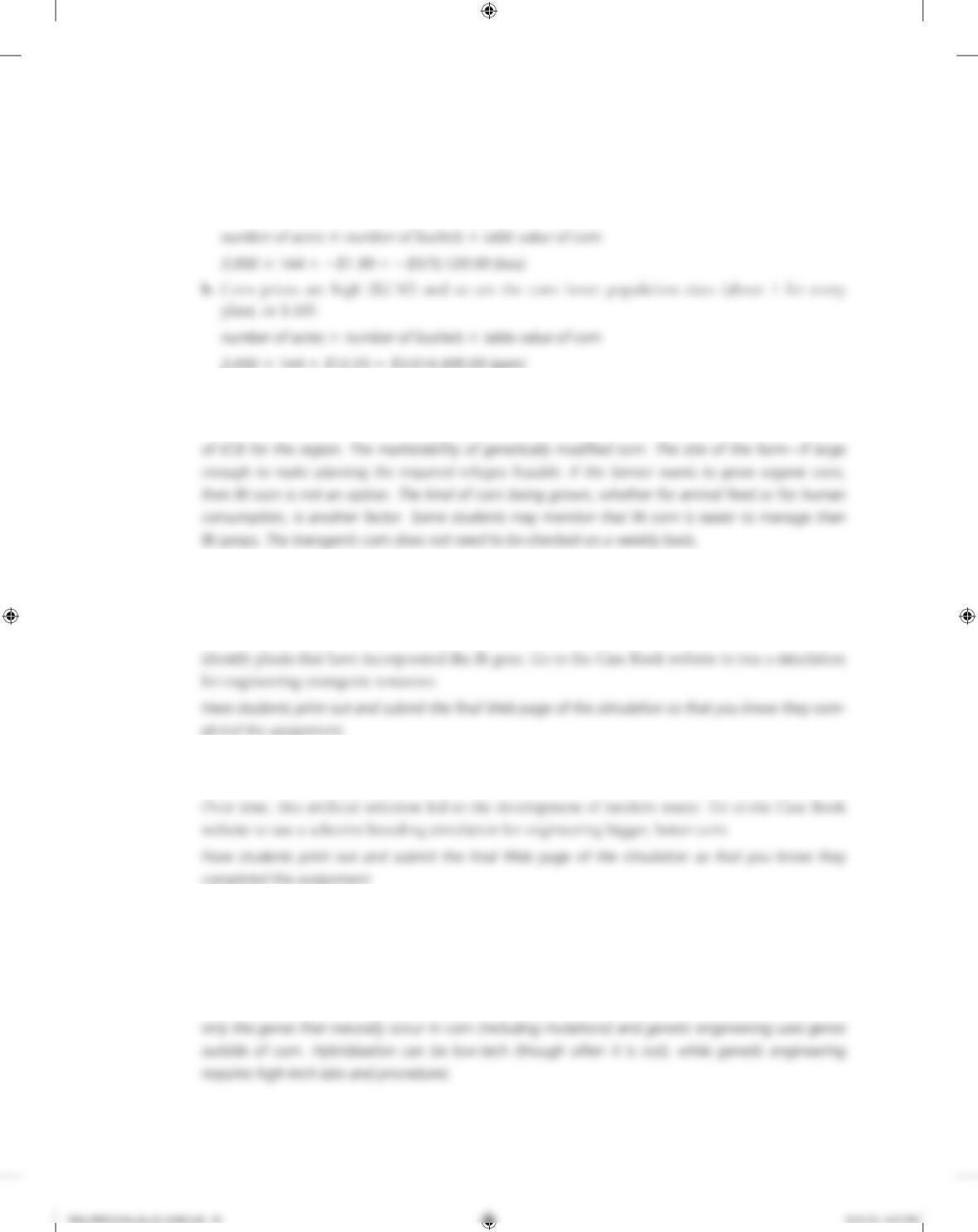
1.Estimatethenetlossornetgainforafarmerwith2,000acresinthefollowingscenarios:
a. Corn prices are low ($1.50) and so are the corn borer populations (about 1 for every 4 corn
plants, or 0.25).
2. What other factors might enter into a grower’s decision about whether to plant Bt corn?
The severity of corn borers in the area and seasonal forecasts. The number of expected generations
C. simulations: hybridization and Genetic engineering of Crops.
1. Bt corn is made by replicating the gene for the Bt toxin found in the bacterium Bacillus thuringiensis
and inserting the gene into corn. Techniques described in Chapter 20 enable the plant engineer to
2. Figure 38.16 in the text compares modern corn with its ancestral plant, teosinte. Neolithic farmers
selectedfortraitssuchaslargecobsandkernelsizeaswellasatoughhuskencasingtheentirecob.
3. Although both of these strategies are examples of artificial selection of crop plants, describe two
differences between these approaches.
Among the answers might be the following: Hybridization has been used for thousands of years, but
genetic engineering is new. It takes many generations to produce plants with the gene combination
you desire, but it can be done through genetic engineering within one generation. Hybridization uses
Chapter 6: Corn Under Construction b 93
d. alternatives for Controlling european Corn Borers. The European corn borer (ECB) was intro–
duced into the United States in the early 1900s, most likely arriving with imported European plant
products. Without predators to keep the population in check, ECBs spread rapidly. In most of the
1. Many farmers growing corn using conventional methods still choose to apply B. thuringiensis sprays.
WhataretheadvantagesofthisstrategyforcontrollingECBs?
The farmers use the bacterial mixture because it works well, is not harmful to their health, and does
2. What are some of the disadvantages of applying sprays?
The effects of direct bacterial applications are short-lived. In some locations, several applications may
III. Investigating Corn Morphology and Growth
with a Model of Insect Damage
a. Corn Morphology. Maize is a member of the grass family. As you may recall from Chapter 35,
grasses contain meristematic tissue in each node along the length of their shoots as well as in a
basal meristem. Although most other plants produce new growth from apical meristems, grass
leaves and shoots grow up from the base. Mowing is the equivalent of a “haircut” for grasses,
which grow back quickly. Nongrass plants recover from mowing much more slowly, because new
apical meristems must form.
1. How does this type of growth in the leaves help grasses survive being eaten by herbivores such
as bison?
Browsers such as bison would substantially slow the regrowth of grasses if they ate growing tips (meri–
94 a BIoloGICal InquIry: A Workbook of Investigative Cases
Chapter 6: Corn Under Construction b 95
M06_REEC4164_04_IE_CH06.indd 95 24/01/14 6:47 PM
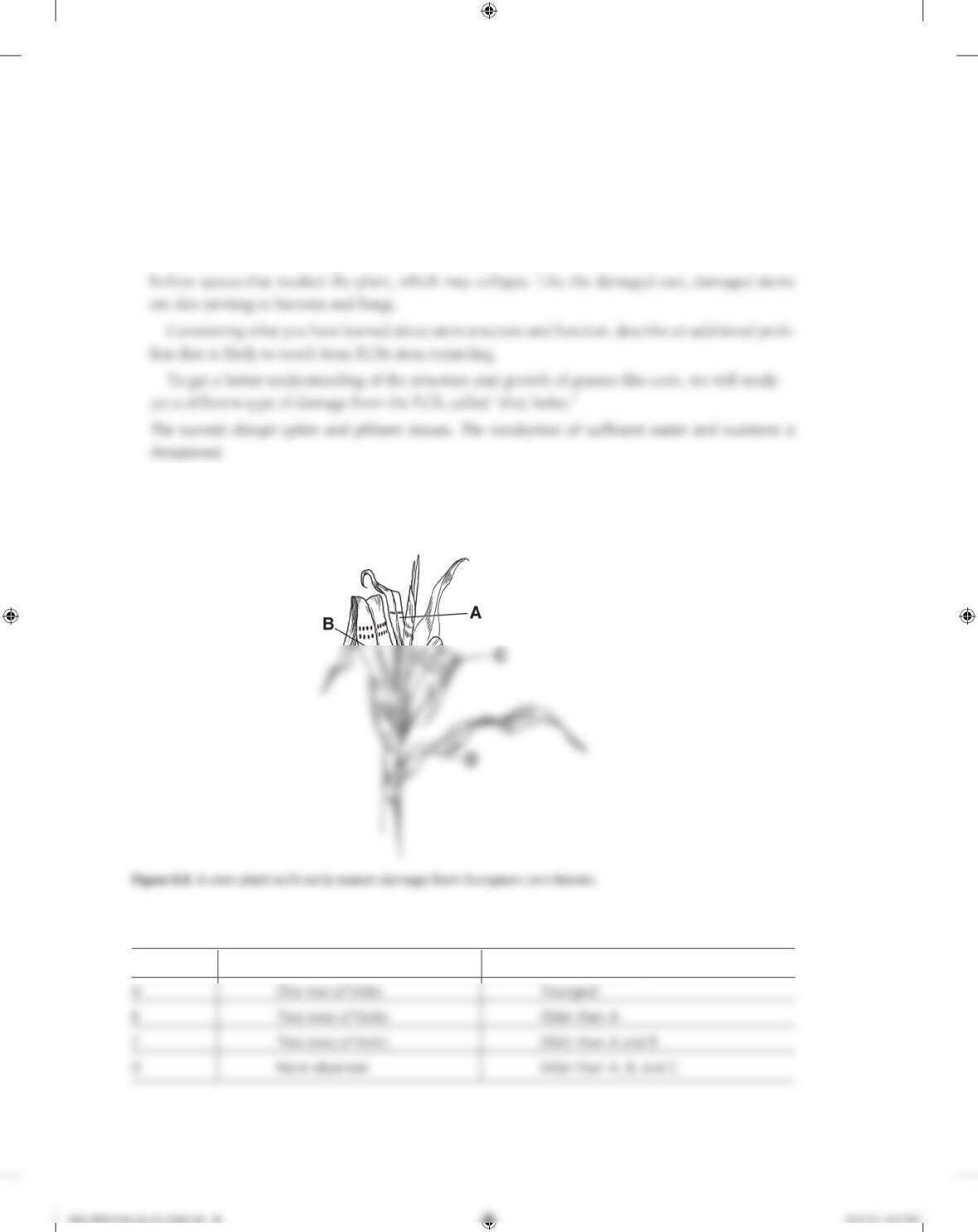
2.WhencornisinfestedwithECBs,severaltypesofdamagecanoccur.Late-seasonborersmayinvade
the corn ears. Not only does this result in an unsightly appearance and decrease in yield, but the
damagedsitesarealsolikelytobecolonizedbybacteriaandfungi.Productionoftoxicby-products
from certain species of fungi such as aflatoxin can result in the entire crop being rejected at the mill.
Another kind of damage occurs when ECBs tunnel into the solid stalks and create
3. Using Figure 6.6, note the position of each leaf and fill in Table 6.2. Row D is filled in for you.
96 a BIoloGICal InquIry: A Workbook of Investigative Cases
table IG6.3 answers to student table 6.2.
leaf damage Comparative age

4.DoyouthinkthatthedamageinFigure6.6wascausedbyseveralcaterpillarsfeedingonthe
leavessuccessivelyorbyoneortwofeedingatthesametime?Explain.
This is just to prompt students to propose an explanation. Although the second explanation better
B. Making a Model of shot hole damage to explore Growth. Models are often useful in exploring
complex phenomena by limiting the number of factors involved. Models allow us to simulate interac–
tions, test hypotheses, and ask new questions.
part 1: Making the leaves
Step 1: With the pen or pencil, draw a vertical line at 4 inches and another at 7 inches from the left
edge of the paper (Figure 6.7a).
Chapter 6: Corn Under Construction b 97
part 2: Modeling the age of the leaves
Step 1: Mark leaf A 10 lines from the bottom (Figure 6.7c). Roll the strip tightly from the bottom until you
reach the 10-line mark. Press firmly to fold the rolled paper in place. Leaf A is the youngest leaf. It is the
thinnest and the shortest. Much of its maturation and elongation has not occurred.
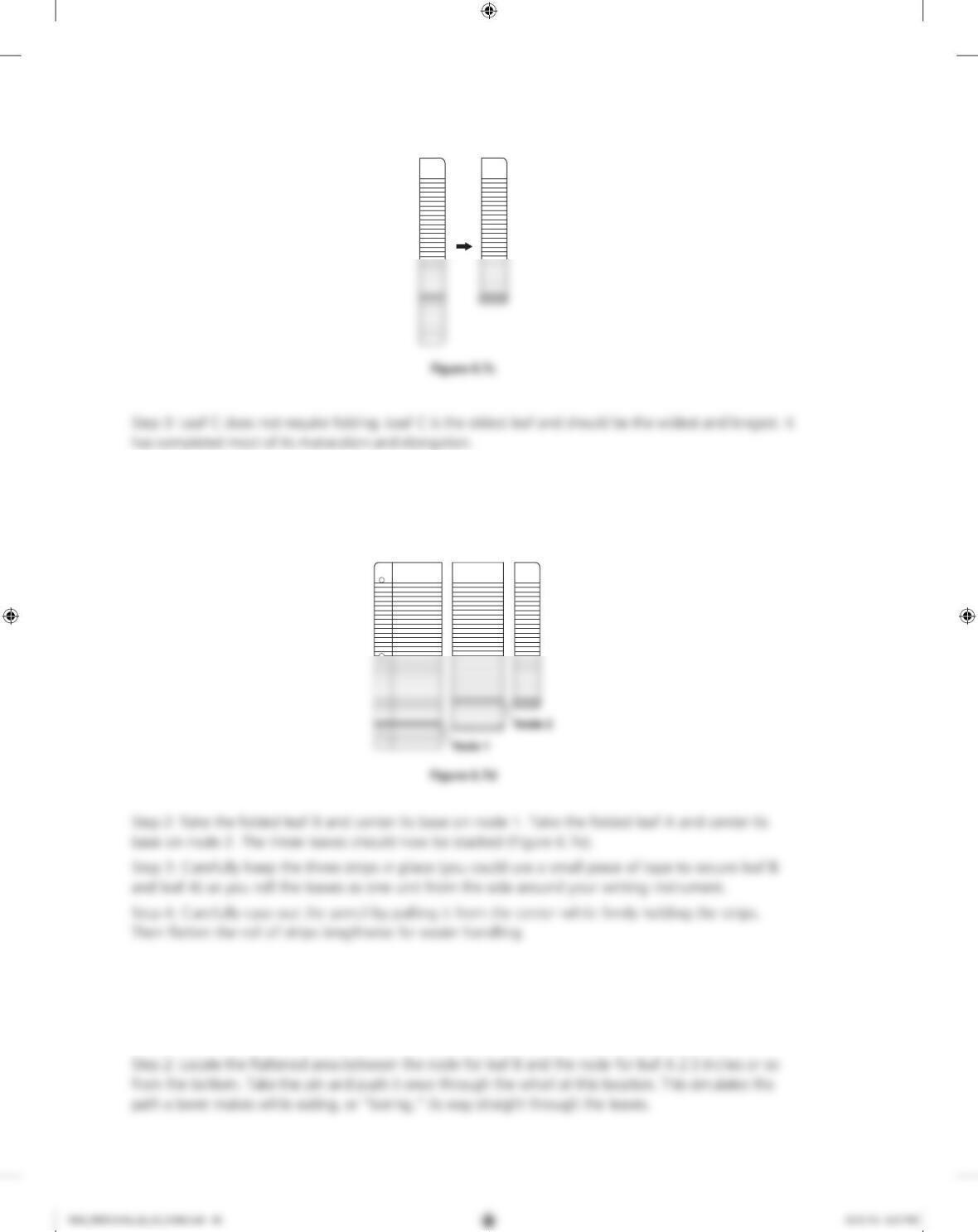
part 3: assembling the Whorl
Step 1: Mark leaf C in the center of the strip 5 lines from the bottom. Label this mark “node 1.” Mark
leaf B in the center of the strip at 5 lines from the bottom. Label this mark “node 2” (Figure 6.7d).
98 a BIoloGICal InquIry: A Workbook of Investigative Cases
AA
CB
A
part 4: simulating the Corn Borer damage
Step 1: The resulting model of a corn plant whorl should look tubelike. If you feel along the tube,
there will be a noticeable thickening where leaf B begins and another where leaf A begins. These
represent nodes on the stem, where the meristems that produce the leaves are located.
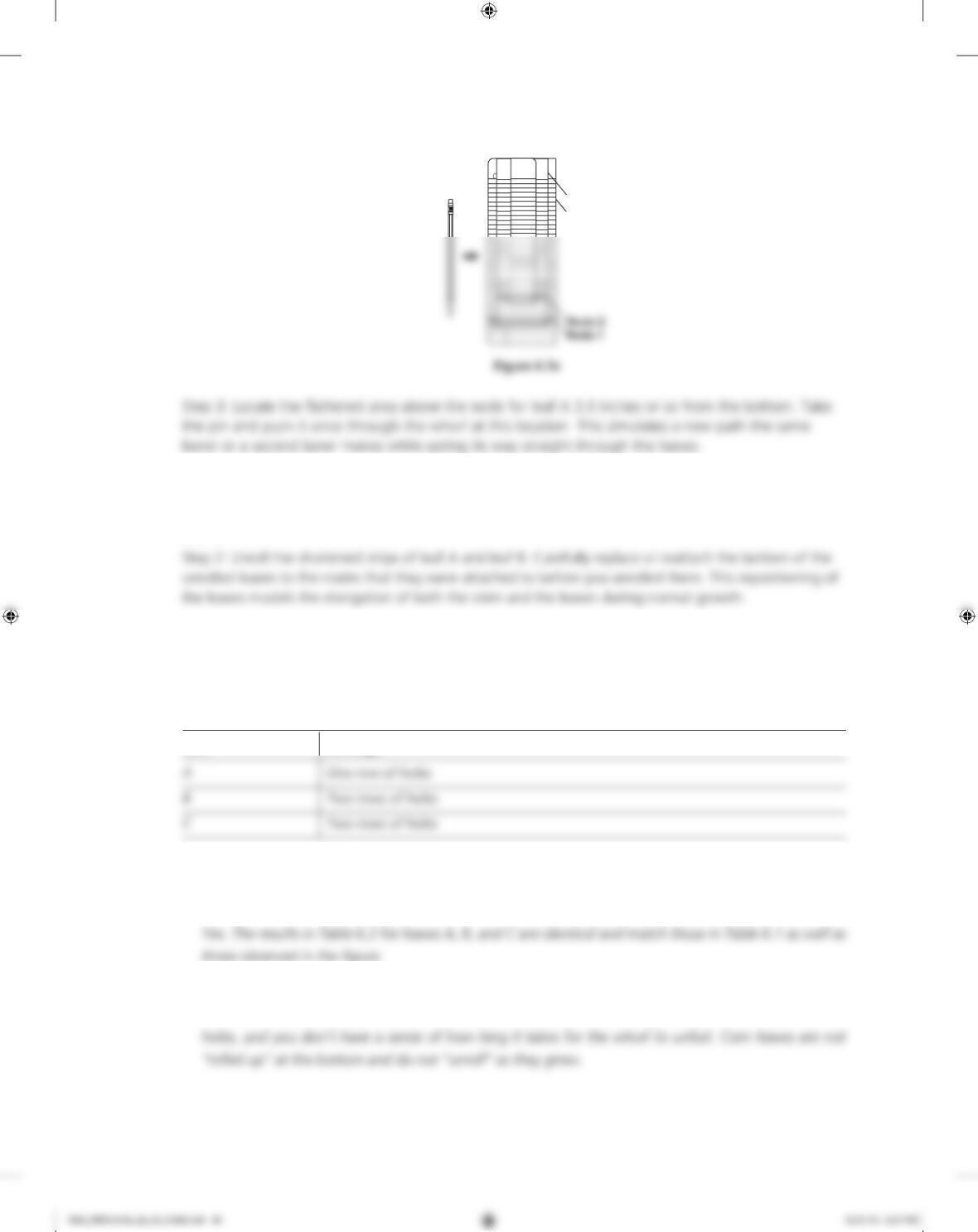
part 5: Modeling Growth after the damage
Step 1: Unroll the model of the damaged whorl and separate leaf A from leaf B and leaf B from
leaf C.
1. Describe the pattern of damage you see on the leaves by filling in Table 6.3.
Hint: You could ask students to bring in their final models for demonstration. This could be evaluated
if desired.
Chapter 6: Corn Under Construction b 99
C
B
A
B
C
table IG6.4 answers to student table 6.3.
leaf damage
2.Look again at Figure 6.6 of shot hole damage. Are your model results consistent with this
picture?
3. What do you consider to be the limitations of this model of corn growth?
There is no real stem, the leaves don’t expand in width, the borers might make different numbers of
4. What do you consider to be the strengths of this model of corn growth?
5.Doyouthinkmakingaphysicalmodelwashelpfulinunderstandingthispatternofdamage
byEuropeancornborers?Explain.
Yes. The model provided a plausible explanation for how the pattern of damage could be generated
IV. Refuges for Resistance Management
In the case, we saw that the farmers were going to discuss planting refuges for the European corn
borer (ECB). The Environmental Protection Agency requires every grower who plants Bt corn to
use a refuge so that some Bt-susceptible corn borers will survive. When Bt-susceptible corn borer
1. In the case, the growers meet to discuss planting refuges in order to reduce the chance that a pop–
ulation of corn borers resistant to Bt toxin will become established. Offer two explanations why
the development of resistant bacteria is more difficult to control than the development ofresistant
corn borers. (Hint: See the heading “R Plasmids and Antibiotic Resistance” in Concept 27.2.)
100 a BIoloGICal InquIry: A Workbook of Investigative Cases
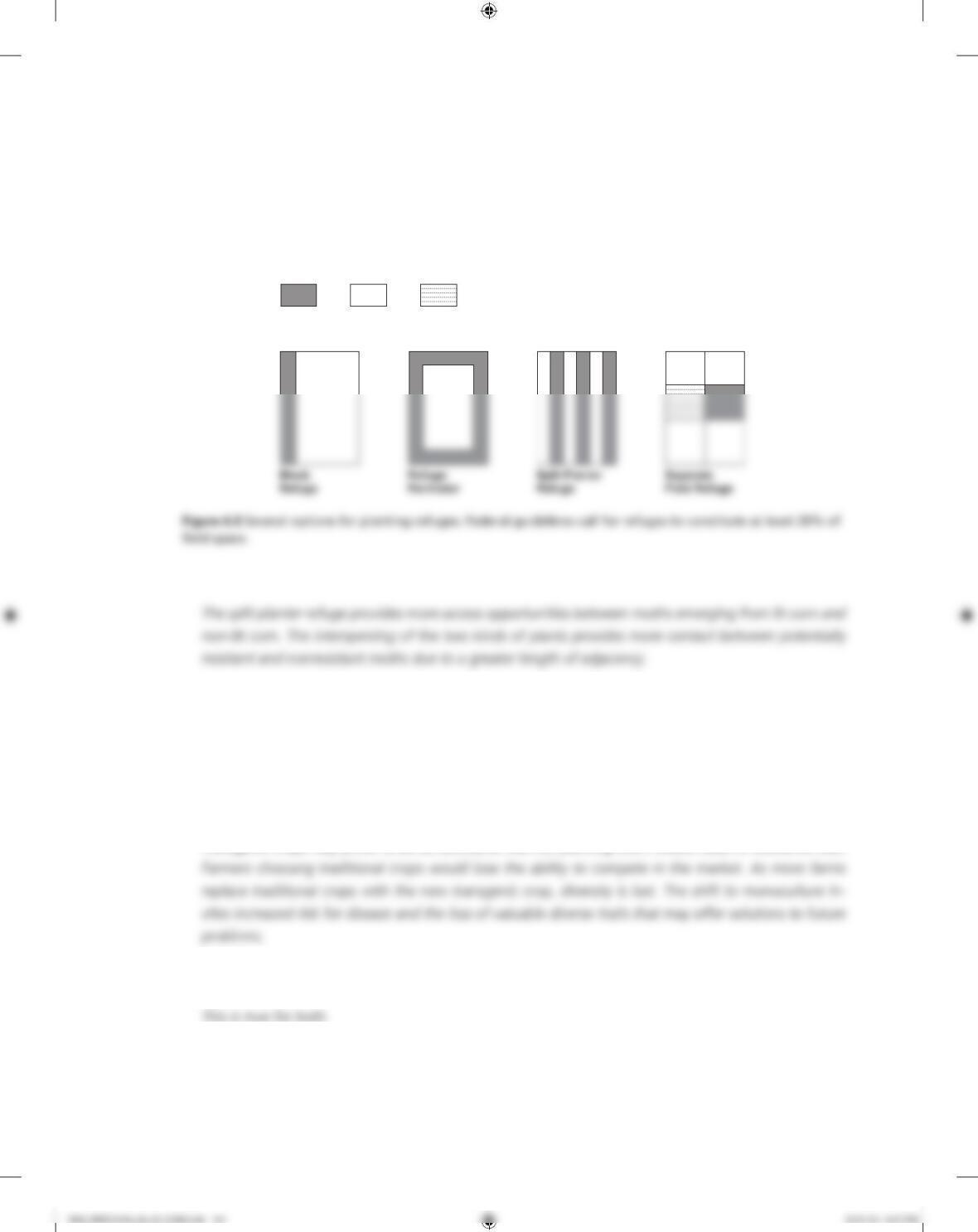
2. All the refuge plans shown in Figure 6.8 provide an interface between Bt and non-Bt corn. Do you
thinktheblockrefugeorthesplitplanterrefugewouldbemorelikelytofacilitatetheopportunity
for a rare Bt-resistant corn borer moth to mate with a moth that isn’t Bt-resistant?Explain.
Chapter 6: Corn Under Construction b 101
Non-Bt
refuge
Bt corn
field
Soybeans
suggested answers for additional Investigation
V. Making Decisions About DNA Technology: Golden Rice
1.CompletetheMasteringBiologyActivity:MakingDecisionsAboutDNATechnologyinChapter38.
This activity raises a concern that transgenic crops may reduce biodiversity. In your own words,
explain how this might occur and why it is significant.
Transgenic crops may prove to be so successful that not planting them would result in economic loss.
2.Consideryourexplanationabove.Dotheserisksonlyapplytotransgenicseeds,oristhisalsotrue
of the hybrid seed that farmers have been using for many years?
3. In developing nations, farmers generally depend on crops that produce both food and seed.
Develop arguments both for and against the distribution of Bt corn seed to farmers in develop–
ing nations. Is a growing reliance on seed companies problematic, or do the benefits outweigh
therisks?
Before you answer this question, consider reading the following two position papers from Action
BioscienceontheCaseBookwebsite:
VI. Open-Ended Investigations
A gene from Antarctic fish that allows the fish to avoid freezing has been put into tomatoes.
These tomatoes also survive hard frost.
102 a BIoloGICal InquIry: A Workbook of Investigative Cases
M06_REEC4164_04_IE_CH06.indd 102 24/01/14 6:47 PM