b 69
As with all the cases in this book, please read the preface if you have not
already done so. In the preface you will find suggestions for using Investigative
Unveiling the Carboniferous accompanies Unit Five: The Evolutionary
History of Biological Diversity in Campbell Biology, 10th edition. The case,
in which a company develops a mural exhibit depicting the Carbonifer–
ous, emphasizes material covered in Chapter 25, Chapter 26, and Chapters
29–34 (plants, fungi, and animals). There are three strands in the case:
• TheCarboniferousperiod
• MajorbiologicaleventsoftheCarboniferous
• Terrestrialadaptationsinanimalsandchangesinplantcommunities
Students should complete the Case Analysis immediately following the
Chapter 5:
Unveiling the
Carboniferous
InstruCtor’s GuIde
M05_REEC4164_04_IE_CH05.indd 69 24/01/14 6:21 PM
70 a BIoloGICal InquIry: A Workbook of Investigative Cases
table IG5.1 unveiling the Carboniferous Case overview.
Investigation learning Goals Inquiry skills used
Core Investigations
II. The Carboniferous Using maps of landforms of • combining information from
Globe ancient Earth, students determine other disciplines (geoscience,
global climatic conditions during meteorology) to develop a global
the Carboniferous, further devel- understanding of this period
oping their understanding of
this period.
additional Investigations
V. Calculating Scale Students practice calculating scale • measuring
Bars and Magnifications values and magnification from • applying mathematics to
images of fossils. Scale will affect biological images and objects
their choices of organisms to • calculating size and
illustrate in the mural. magnification
VI. Educational Resources The mural project is to be a • making complicated science
to Accompany the Mural community and educational resource. accessible to nonscientists (a key
Table IG5.2 contains several resources related to Campbell Biology, 10th edition, that will help your
students further their understanding of this case. Note that chapter readings and activities are listed
in order of importance.
table IG5.2 Campbell-related resources.
resource Chapter/activity topics Covered/activity title
Critical Reading from Chapter 25: The History of Life Table 25.1: The Geologic Record;
Campbell Biology, on Earth the fossil record (Concept 25.3);
Related Readings Chapter 31: Fungi First evidence of mycorrhizae
(Concept 31.3)
Chapter 32: An Overview of History of animals (Concept 32.2)
Animal Diversity
Chapter 5: Unveiling the Carboniferous b 71
M05_REEC4164_04_IE_CH05.indd 71 24/01/14 6:21 PM
72 a BIoloGICal InquIry: A Workbook of Investigative Cases
Case narrative
To:MilesHarrington,BioConsultingAssociates
Re:CarboniferousMural
(3) serve as a resource for teaching science.
The Carboniferous period is an appropriate
choice for the mural, as there is a strong scientific
connection to the region’s history of coal mining
and the donor’s interests. However, your draw-
ings of a swampy forest of the Carboniferous
fall short. A similar conception of the Carbonif-
erous is found in many museums, but it fails to
emphasize several significant events of the pe-
riod. Further, it gives the impression of a single
organisms such as seed plants, tetrapods, and
insects.
The climatic changes in the Carboniferous
were a significant factor in the evolution of
plant communities, which changed in compo-
forest. Throughout the period, a wide variety
of structural adaptations resulted in taller
mammals) and reptiles. Another major develop–
ment during the early Carboniferous was flight
in insects. A tremendous radiation of flying in–
sects is seen in the fossil record by the end of the
Carboniferous.
While the Carboniferous was a time during
which terrestrial habitats were well exploit–
ed by an increasing variety of life forms, keep in
mind that many of the early adaptations for
the regional and educational communities. Let
us know if we can be of further assistance.
“Well, this certainly changes things,” Dericia thought as she prepared the agenda for the next design
meeting.“Maybeweshouldconsidermultiple panels and involve the biology department from Colter
College.” She anticipated lively discussion at the next meeting.
suggested answers for Case analysis
1. Recognize potential issues and major topics in the case. What is this case about? Under–
line terms or phrases that seem to be important to understanding this case. Then list 3 or 4
2. What specific questions do you have about these topics? By yourself, or better yet, in a group,
make a list of what you already know about this case in the “What Do I Know?” column. List ques-
tions you would like to learn more about in the “What Do I Need to Know?” column.
There are many possible answers, depending on the experience of your students. Some likely responses
follow.
Chapter 5: Unveiling the Carboniferous b 73
What do I Know? What do I need to Know?
• Coal is from the Carboniferous. (Note: This • How long ago was the Carboniferous?
is not strictly correct because coal was • What organisms lived during the
3. Put a check mark by 1–3 questions or issues from the “What Do I Need to Know?” list that you
think are most important to explore.
You should expect a range of responses. Most students will use the contextual clues of being in a biol–
4. What kinds of references or resources would help you answer or explore these questions?
Identify two different resources and explain what information each resource is likely to give that will
help you answer the question(s). Choose specific resources.
Accept any reasonable resource (e.g., text, other book, Internet sites, maps, data tables, and so on)
M05_REEC4164_04_IE_CH05.indd 73 24/01/14 6:21 PM
74 a BIoloGICal InquIry: A Workbook of Investigative Cases
suggested answers for Core Investigations
I. Critical Reading
You will need to use information from several chapters in Unit Five, as well as the geologic record table
in Chapter 25 (Table 25.1), to answer the following questions. You may also want to refer to some of
the Web links provided for this unit on the Case Book website.
1. How long ago was the Carboniferous?
2. List five other terrestrial organisms (not listed elsewhere in this case) that likely lived during the
Carboniferous. Include organisms from at least three kingdoms. You may use common names.
Note: This question is to encourage students to look at many chapters in Unit Five, and to allow stu-
3. List four animal phyla that you would expect to find living in the aquatic environments of the
Carboniferous including swamps and oceans.
4. At the first meeting, the artists from Wall Works gave the biology students a list of organisms from
their image files. Please evaluate whether or not the organisms listed in Table 5.1 would be appropri–
ate for the mural of the Carboniferous.
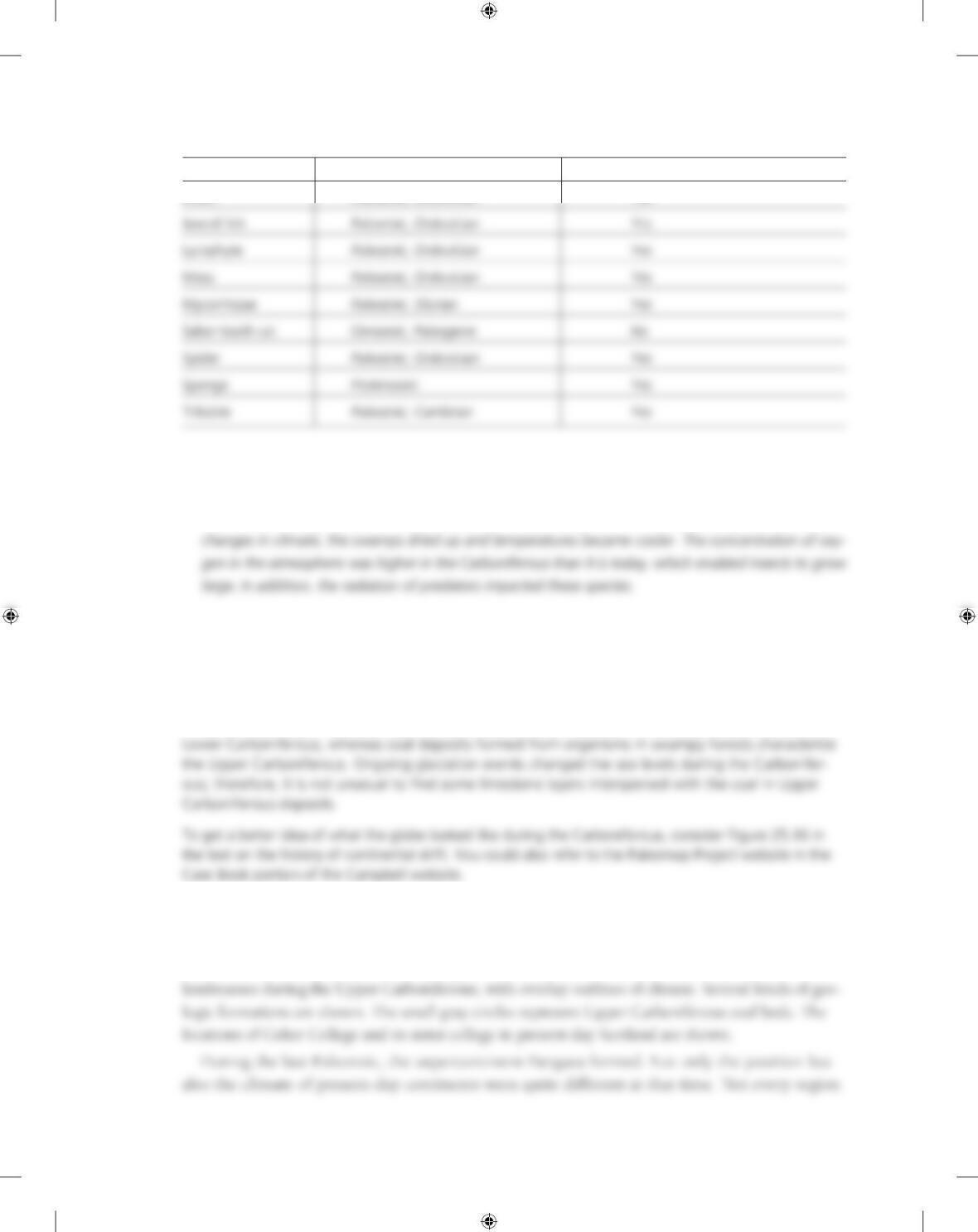
table IG5.3 answers to student table 5.1.
type of organism era and period in Which organism Is present in the Carboniferous?
thought to have originated (yes or no)
Amphibian Paleozoic, Devonian Yes
Human Cenozoic, Neogene No
Insect Paleozoic, Ordovician Yes
5. Suggest some reasons for the absence today of dog-size amphibians, tree-size club mosses, and
giant dragonflies.
Expect a wide range of answers. Most students will probably mention climatic changes. As a result of
II. The Carboniferous Globe
The Carboniferous, originally named for the rich deposits of coal found in strata of that period in
England, is divided into the Lower Carboniferous (or early, often called the Mississippian by researchers
in North America) and the Upper Carboniferous (or late, often called the Pennsylvanian by researchers
in North America). Limestone deposits laid down on the floors of shallow seas characterize the
1. Which of the four global landmasses shown in Figure 25.16 corresponds to the Carboniferous?
Pangaea, the landmass present during the late Paleozoic
Additional information is provided by Figure 5.1, which is an evidence-based map of the
Chapter 5: Unveiling the Carboniferous b 75
M05_REEC4164_04_IE_CH05.indd 75 24/01/14 6:21 PM
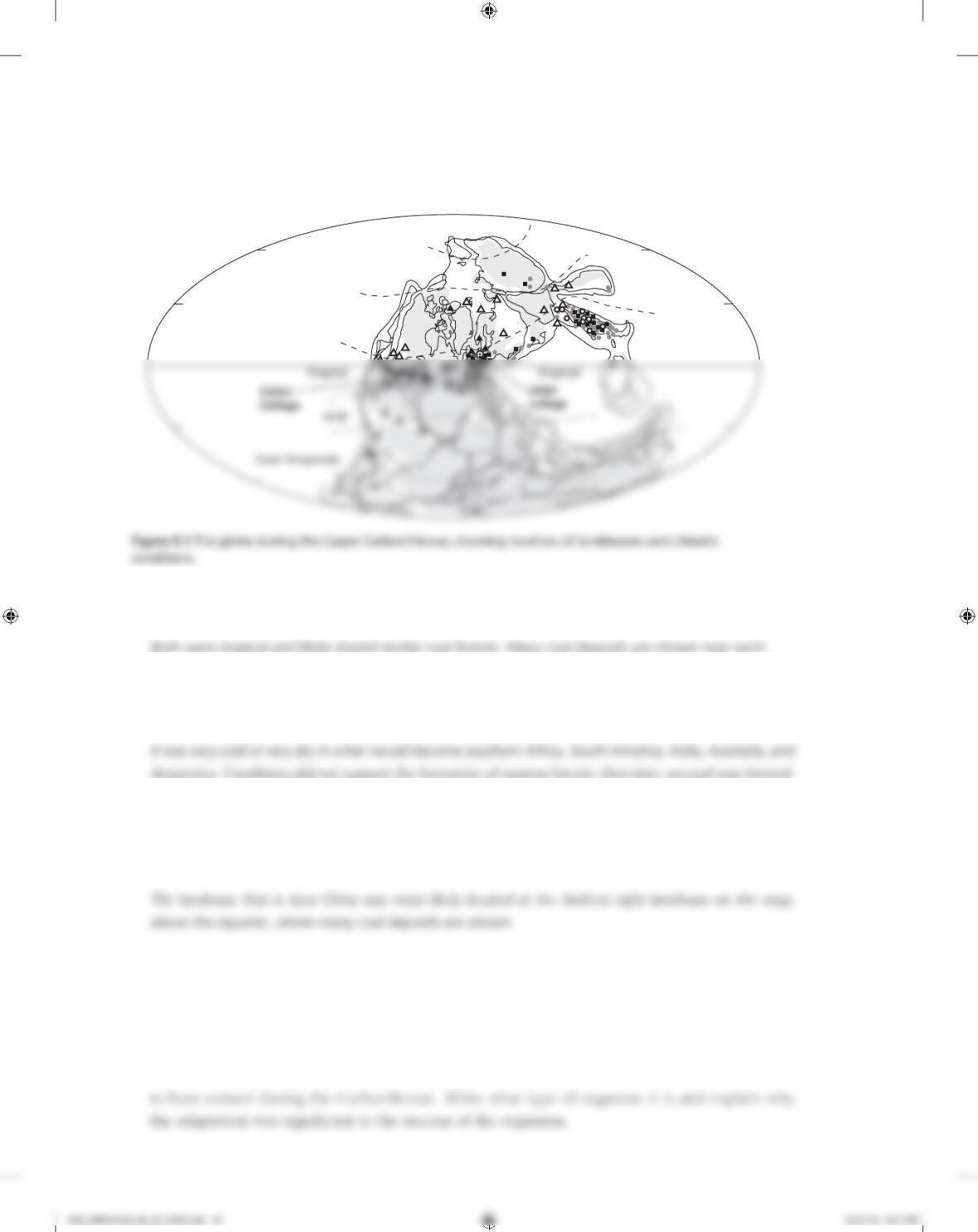
had conditions that led to the formation of coal. Use Figure 5.1 to answer the following
questions.
76 a BIoloGICal InquIry: A Workbook of Investigative Cases
Cold
Cool Temperate
Arid
2. Consider the map in Figure 5.1 carefully. Are there geographic and/or climatic similarities between
Colter College and its sister college in Scotland? Explain.
3. Why don’t we find Upper Carboniferous coal deposits in present-day South America, India,
Australia, Africa, and Antarctica? What was the climate like in these areas during the Upper
Carboniferous?
4. The first recorded use of coal occurred about 3,000 years ago at the Fushun mine in northeastern
China.Atthattime,thepeoplethoughtofcoalasjustaremarkablestonethatcouldburn.Basedon
Figure 5.1, where do you think the land that is now China was located during the Carboniferous?
Explain your reasoning.
III. Adaptations in the Carboniferous
Many adaptations contributed to the success of life on land. In the case, Miles Harrington mentioned
some important adaptations of amniotic eggs and insect wings seen for the first time during the
Carboniferous.
1. For the two adaptations listed, attach an image of an organism with this feature that is thought
Adaptation: Amniotic eggs
Image Source: Many possible answers. Some of the Web links in the Case Book website will have
images.
Type: Students may have chosen a reptile or a basal synapsid, both amniotes.
Significance: The amniotic egg can be laid on dry ground. The egg retains moisture for the embryo and
2. During the Carboniferous, forests grew to unprecedented heights. Describe one adaptation in plants
that would account for this dramatic change.
Most students will answer “vascular tissue.” They might also mention that vascular tissues conduct
IV. Coal Connections
1. Why do we refer to coal as a “fossil fuel”?
Coal is the product of organic debris that accumulated in vast swamps of the past, forming layers
Chapter 5: Unveiling the Carboniferous b 77
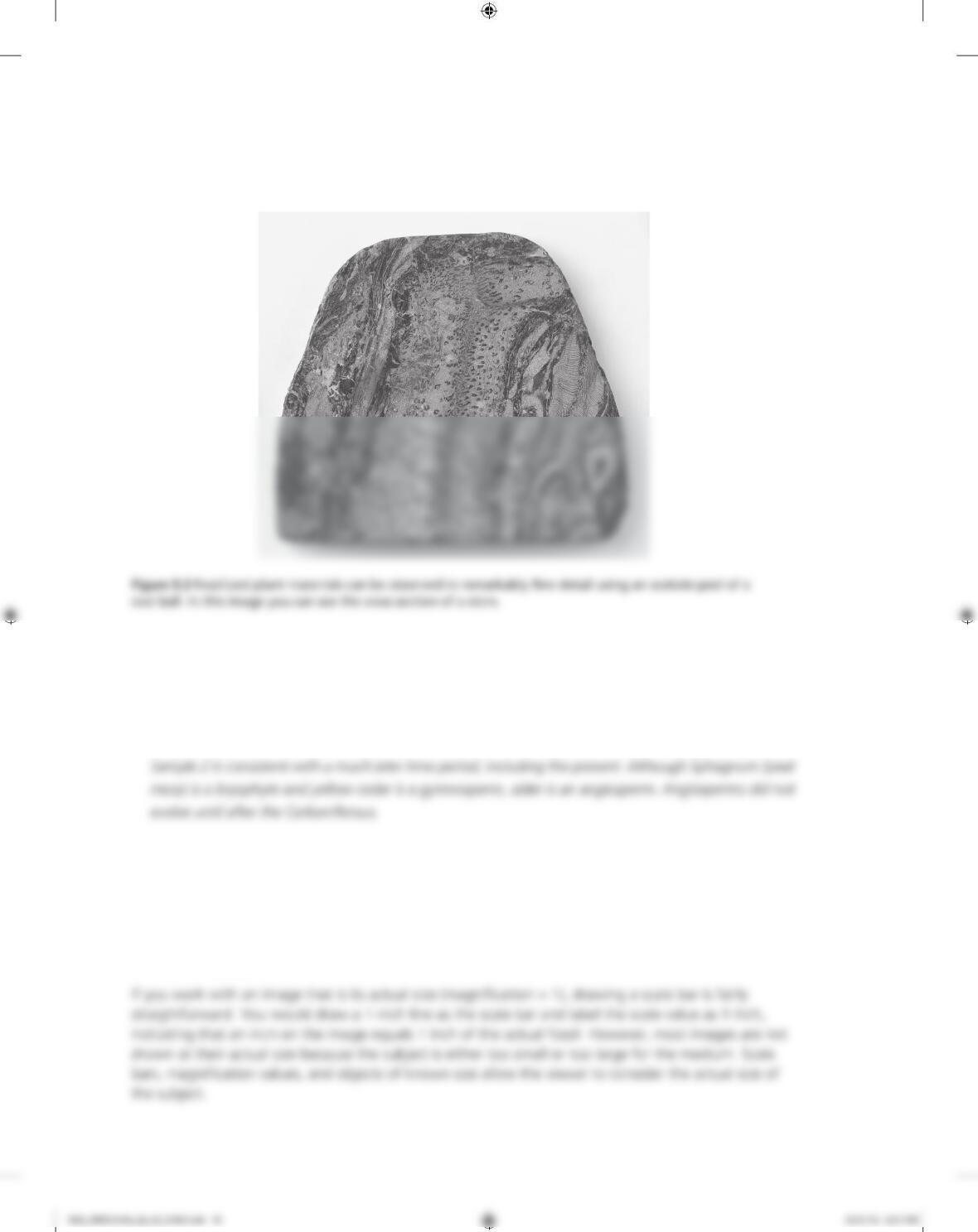
example, if you were to compare coal ball material with modern peat samples you should expect to
see significant differences in the plant groups.
78 a BIoloGICal InquIry: A Workbook of Investigative Cases
2. You observe samples from two coal balls collected in different places. Sample 1 contains roots and
stems of tree-size lycophytes and horsetails. Sample 2 contains evidence of sphagnum moss “leaves,”
yellow cedar needles, and alder pollen. From what time period do you think each sample origi-
nated? Explain your answer.
Sample 1 is consistent with Carboniferous coal balls. Tree-size lycophytes and horsetails no longer exist.
suggested answers for additional Investigations
V. Calculating Scale Bars and Magnifications
To increase the scientific accuracy and to allow comparisons of the relative sizes of the organisms
featured in the mural, you are asked to provide a scale bar or magnification for each of the fossils the
artists will be using.
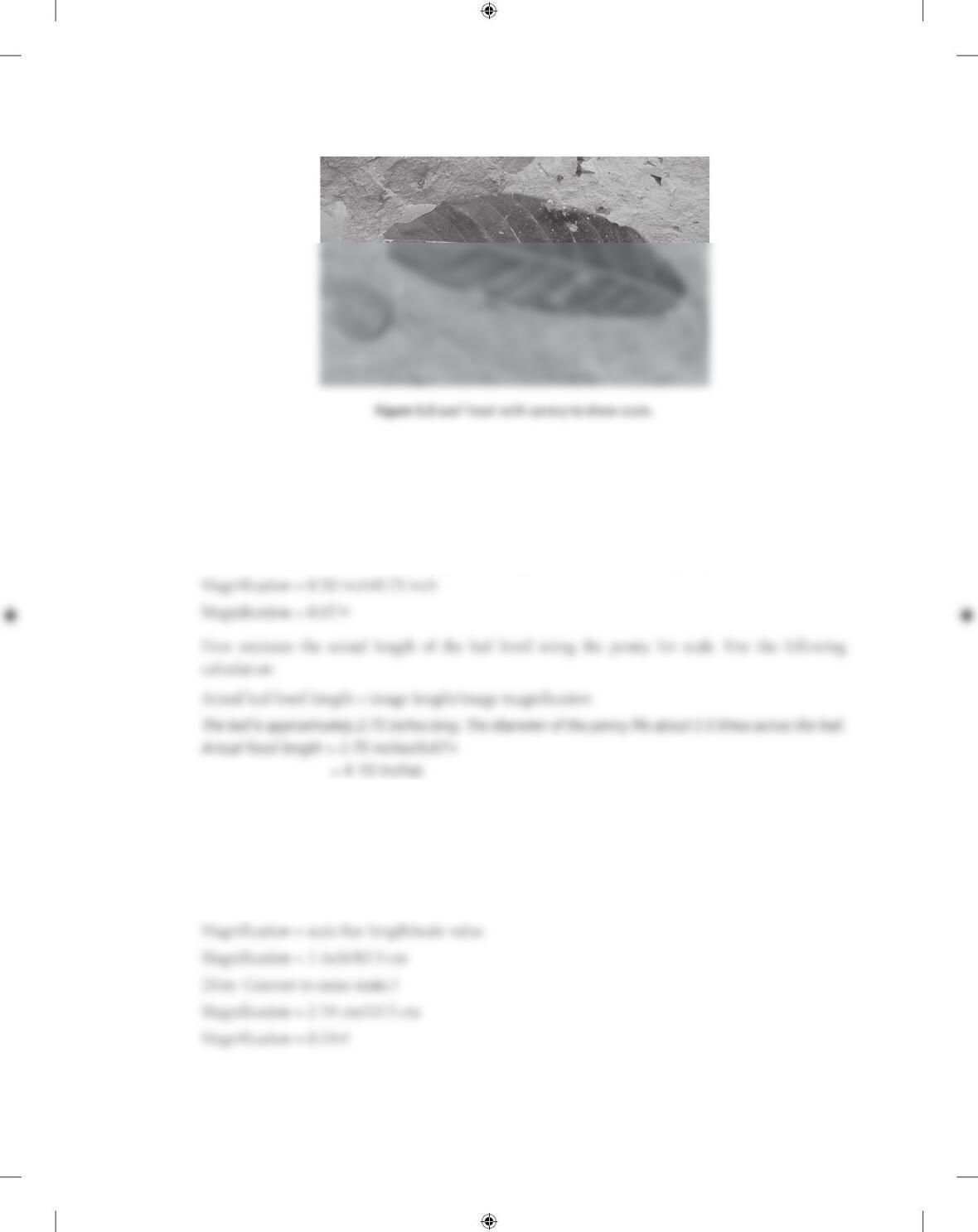
1. Youcandetermineboththeimagemagnificationandthesizeofafossilspecimenifanobjectofknown
size is included in the image. In Figure 5.3, the penny has a known diameter of 0.75 in. However, in
this image the penny measures only 0.5 inch across. Now you know that the image is smaller than its
actual size. In fact, the magnification is 0.67 times its actual size. (See calculations below.)
Magnification=diameterofthepennyintheimage/actualdiameterofapenny
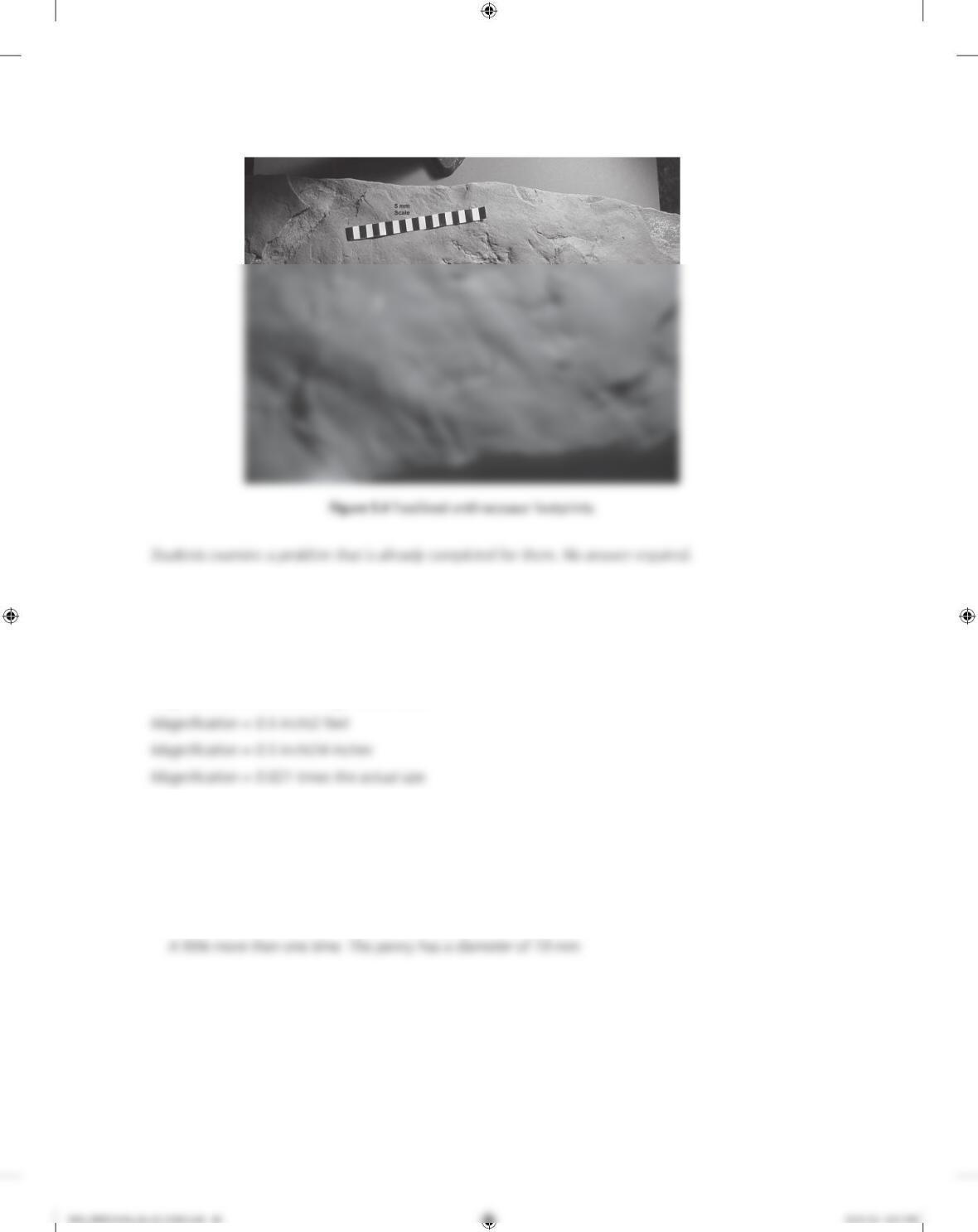
2. Figure 5.4 shows a fossil of footprints made by an anthracosaur, an amphibian from the Upper
Carboniferous. We can calculate the magnification of this image because we know that the scale bar
(black and white strip) measures 1 inch long with a value of 10.5 cm (each stripe on the bar is 5
mm wide). By doing the calculations below, we can conclude that this image is about one-fourth its
actual size.
Chapter 5: Unveiling the Carboniferous b 79
M05_REEC4164_04_IE_CH05.indd 79 24/01/14 6:21 PM
3. While searching for images, you find a drawing of an early swamp with a dragonfly. The cap-
tion says the dragonfly has a wingspan of 2 feet. Use 2 feet as the scale value. The size of the
dragonfly wingspan measured from this image is 0.5 inch. Use this value for the length of the
scale bar. What is the total magnification of this image?
Magnification = scale bar length/scale value
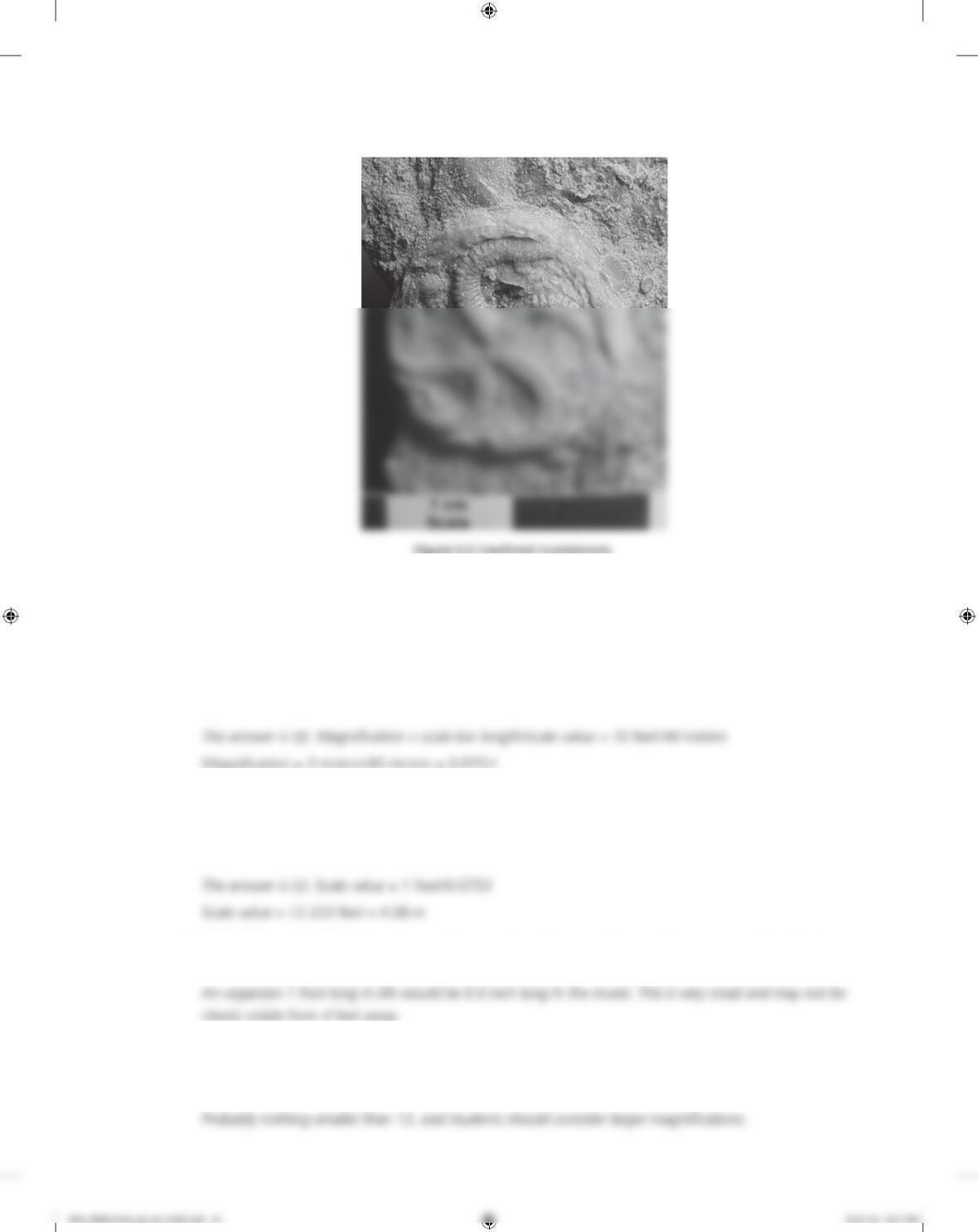
4. a. Figure 5.5 is an image of a fossilized echinoderm. Estimate the actual diameter of the fossil.
(Note:Measurefromleftarmtorightarm.)
Using the scale bar, the diameter is approximately 15 mm or 1.5 cm.
b. If a penny has an actual diameter of 0.75 inch, how many times would this fossil fit across the
diameter of a penny?
80 a BIoloGICal InquIry: A Workbook of Investigative Cases
5. The wall space for the mural measures 10 feet high by 20 feet wide. You wish to include a
40-m-tall lycophyte and a “giant horsetail” at 15 meters tall. To determine which of the magnifica-
tions would allow you to fit these organisms in the mural, use the height of the wall as the scale bar
length and the height of the tallest organism as your scale value. Which of the following magnifica-
tions would allow you to include these organisms?
(a) 33 (b) 0.53 (c) 0.13 (d) 0.0753
Magnification = 3 meters/40 meters = 0.0753
6. You suggest a scale bar that is 1 foot long for the final mural. What is the approximate value of this
scale bar in meters?
(a) 0.4 m (b) 1 m (c) 4 m (d) 10 m
7. Now that you know the dimensions of the mural and the magnification that accommodates the larg–
est trees, what size would a 1-foot-long reptile be in the mural?
8. Artists often use insets (small internal drawings) to change the magnification of a portion of a larger
drawing. If you wish to show this reptile and its 1-inch-long egg, what magnification might you
choose for an inset? Explain.
Chapter 5: Unveiling the Carboniferous b 81
Figure 5.5 Fossilized invertebrate.

VI. Educational Resources to Accompany the Mural
One of the goals of the mural project is to be a resource for science education. After meeting with the
artists, the biology students accepted the challenge to develop some resources for explaining the mural
to visitors, such as local schoolchildren.
1. For the resource you selected, answer the following questions:
• Whoisyouraudience?
2. Explain your rationale for the design of the resource. Justify the content decisions as well as the
layout decisions. For example, you might argue that it is important to develop a social perspective.
Thismightjustifylinkstoalocalcoalminers’museumincludedonthewebsite,eventhoughthisis
VII. Open-Ended Investigations
Use at least three resources to investigate a different post-Cambrian period in order to plan a bro-
chure, mural, time line, or image.
82 a BIoloGICal InquIry: A Workbook of Investigative Cases
M05_REEC4164_04_IE_CH05.indd 82 24/01/14 6:21 PM