Notes to Instructors
Chapter 47 Animal Development
What is the focus of this activity?
Chapter 21 provided a review of how genes act to control development. Chapter 47
What is this particular activity designed to do?
Activity 47.1 What common events occur in the early development of animals?
Answers
Activity 47.1 What common events occur in the early
development of animals?
The early stages in the development of all vertebrates (and many other animals) include
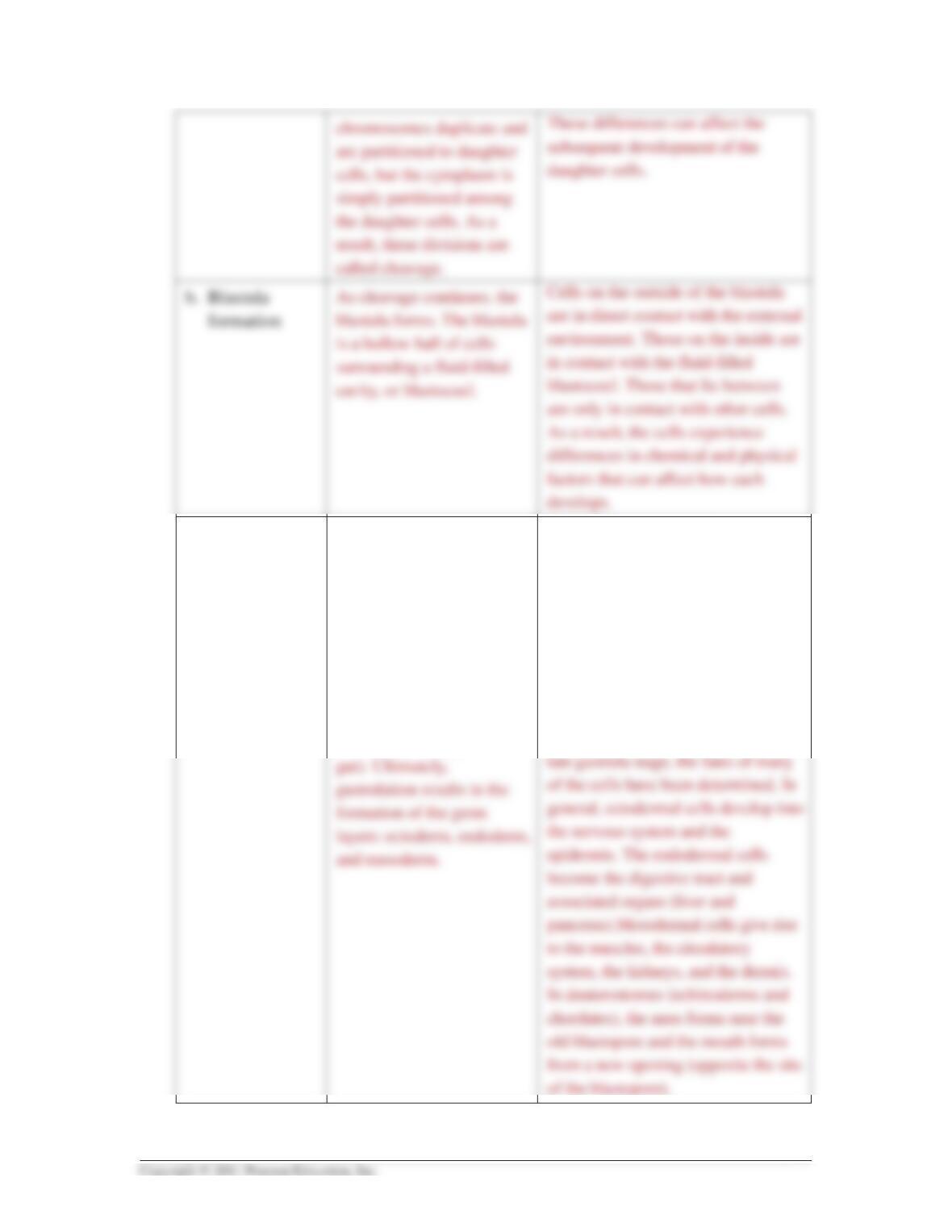
1. What key events occur at each stage of development?
310 Notes to Instructors
Developmental
stage
What occurs during this
stage?
What is the influence or effect on
the subsequent development of the
embryo?
a. Cleavage In vertebrates, cell division
In many animals (mammals are an
(Continued on next page)
Activity 47.1 311
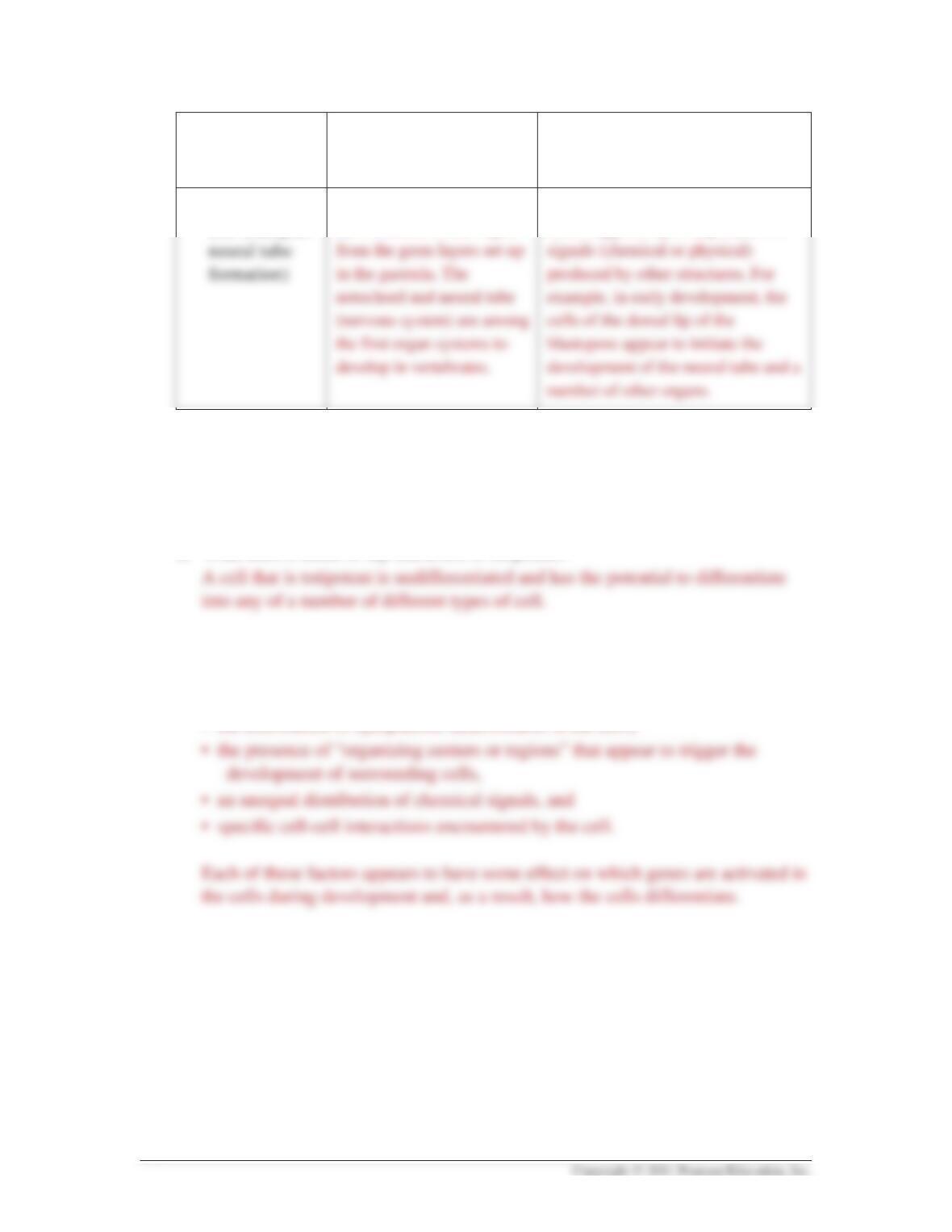
c. Gastrula
formation
Blastula cells (near what
will become the blastopore)
begin to divide rapidly.
These cells undergo
changes in their shape,
motility, and adhesion
properties. Overall, there is
a general migration of cells
into the blastocoel to form
the archenteron (primitive
These cellular movements and
rearrangements produce new
gradients in chemical signals and new
types of cell-cell interactions between
ectoderm and mesoderm and between
mesoderm and endoderm.
Extracellular glycoproteins, such as
fibronectin, have been shown to play
a role in directing the cell
movements of gastrulation. By the
(Continued on next page)
2. Many animal species share these similarities in early development. Yet, the stage at
which the individual cells of the embryo lose their totipotency can vary considerably
among these species.
a. What does it mean to say that a cell is totipotent?
b. What factors can affect the point at which a cell loses its totipotency—that is,
when its fate becomes determined?
Among the factors that affect when a cell loses it totipotency are:
• the distribution of cytoplasmic determinants in the cells,
312 Activity 47.1
Developmental
stage
What occurs during this
stage?
What is the influence or effect on
the subsequent development of
the embryo?
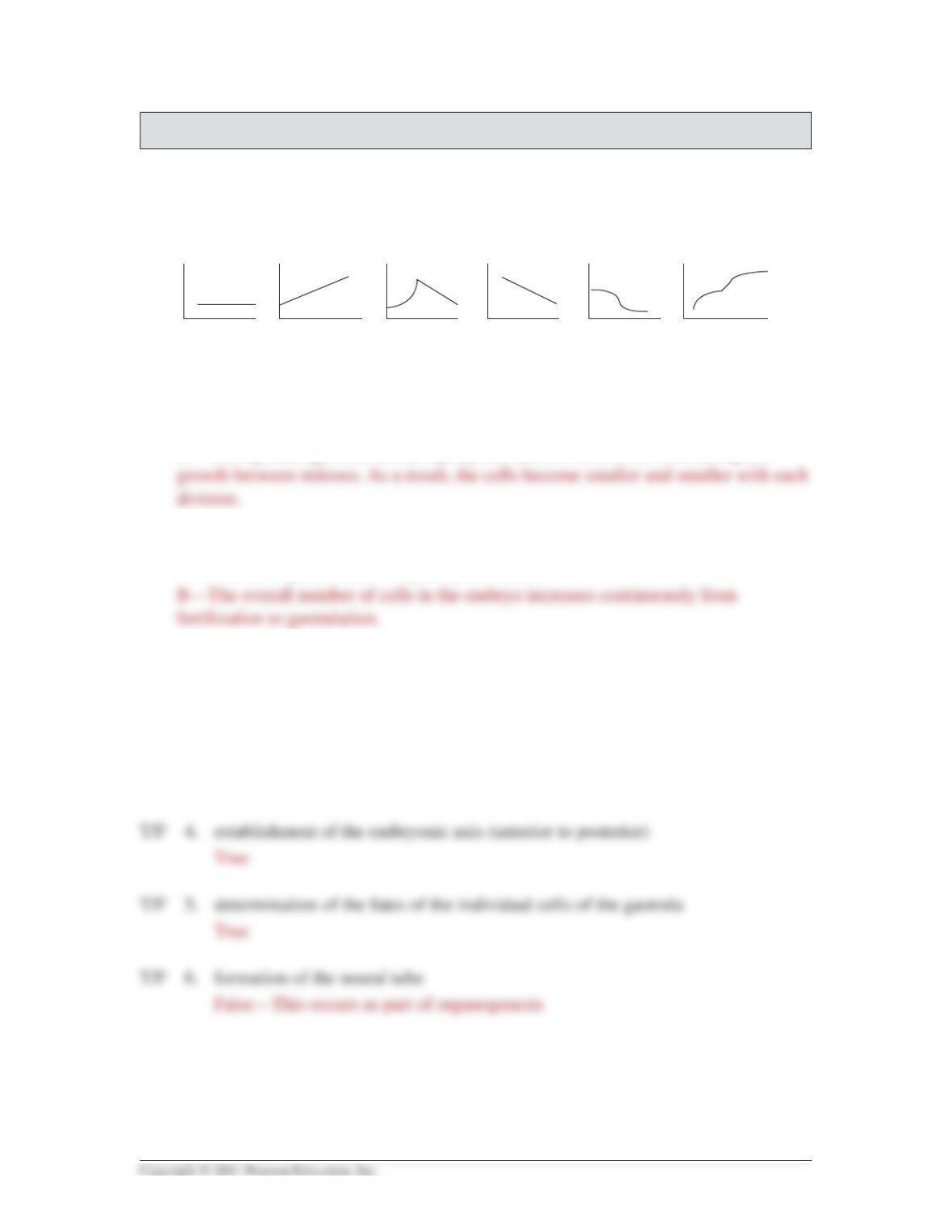
d. Organogenesis
(for example,
Organogenesis is basically
the formation of the organs
The development of one structure is
often triggered by or dependent on
Activity 47.1 313
47.1 Test Your Understanding
1 and 2. Choose the graph that best fits each situation.
A
time
B
time
C
time
D
time
E
time
F
time
1. Which graph best describes the change in size of individual cells of a vertebrate
embryo from the time of zygote formation to the end of cleavage? Explain your
answer.
D—During cleavage cells divide rapidly, but there is little or no intervening cell
2. Which graph best describes the change in the number of cells in the embryo from
fertilization to gastrulation? Explain your answer.
3 to 6. While the mechanics of gastrulation may differ among various organisms, the
overall objectives and problems are the same. Which of the following are
accomplished by the end of gastrulation?
T/F 3. formation of the three germ layers—ectoderm, mesoderm, and endoderm
True
7. In a now classic experiment, Spemann and Mangold took cells from the dorsal lip of
the blastopore from one frog embryo (the donor) and transplanted them to an area
opposite the dorsal lip in another frog embryo (the host). As a result, the host
embryo developed two heads, one at the site of the “new” or transplanted dorsal lip
and the other at the site of the host’s original dorsal lip. A thorough examination
indicated that the second head was formed from host cells.
Which of the following developmental cues or mechanisms was most likely the
trigger (or cause) for the generation of the second head. Explain your answer.
a. cytoplasmic determinants that are unequally distributed in the host embryo
314 Activity 47.1