CHAPTER 43 GLOBAL ECOLOGY AND CONSERVATION BIOLOGY
Scientific Skills Exercise
Teaching objective: Through this exercise, students will plot and interpret graphical data. They
including seasonal changes and longer-term trends showing CO2 concentrations increasing
because of the burning of fossil fuels for energy production.
Teaching tips: A version of this Scientific Skills Exercise can be assigned in MasteringBiology.
Students may be surprised to see how much the concentration of CO2 in the atmosphere changes
seasonally in the northern hemisphere where there is a lot of land. A good follow-up exercise
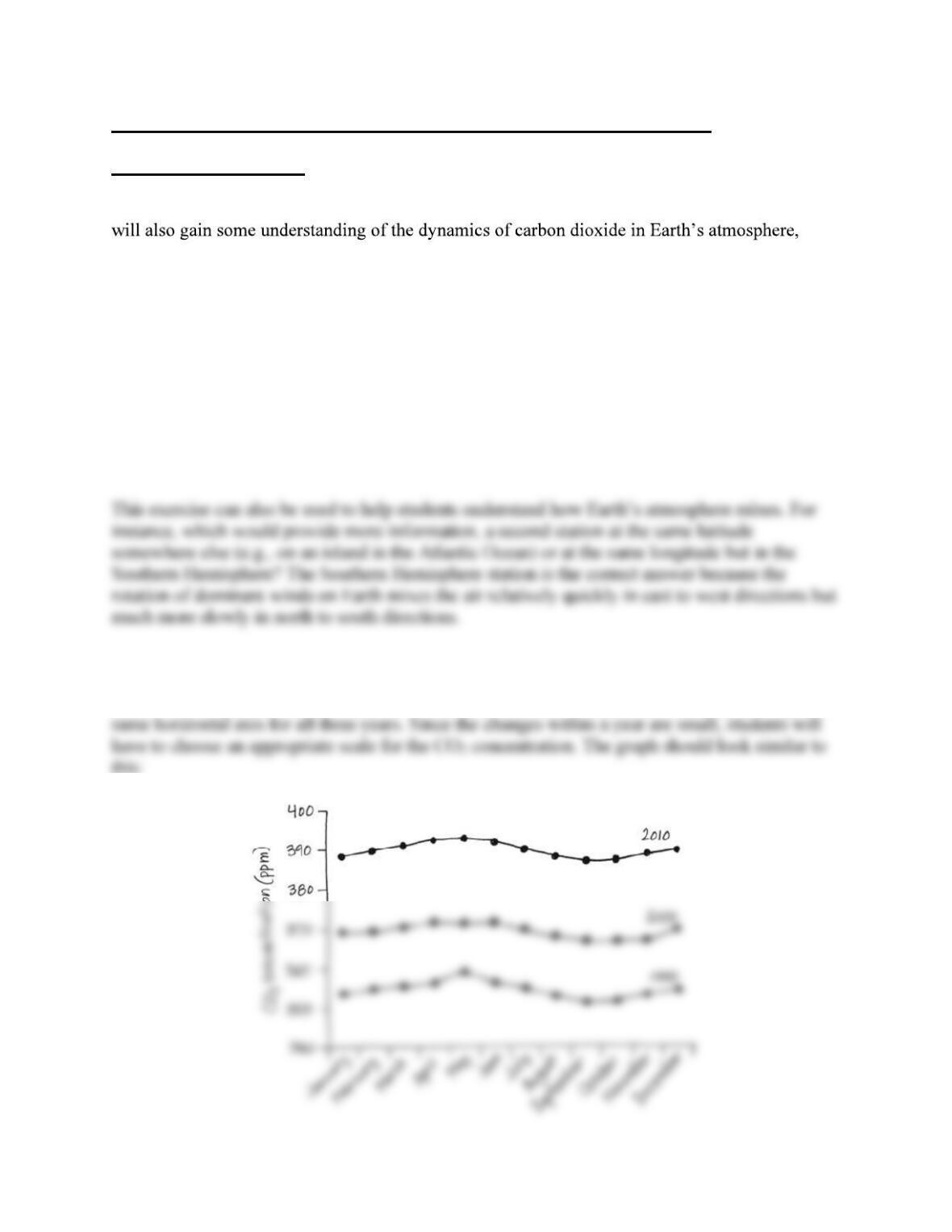
would be to get them to calculate the amplitude of change within each year for the three years
shown. The range is 5 to 8 ppm CO2 across the three years. Have the students note the lack of
overlap in any values across the three years shown, an indication of how quickly atmospheric
CO2 is increasing.
Answers:
1. One way to graph the data is to plot connected points for each year on a line graph, using the

2. Within each year, the CO2 concentration is highest in April May and lowest in September
Suggested Answers for End-of-Chapter Essay Questions
See the general information on grading short-answer essays and the suggested rubric at the
beginning of this document.
8. Scientific Inquiry/Draw It

To minimize the area of forest into which the cowbirds penetrate, you should locate the road
9. Focus on Evolution
Although extinctions occur on a regular basis, life on Earth has undergone five mass extinction
events through time. The largest of these was the Permian extinction 252 million years ago.
When a mass extinction occurs, 50% or more of all species are driven to extinction, and many
10. Focus on Interactions
Sample key points for one possible answer:
Many diseases are important environmental concerns.
Disease may become a weapon for bioterrorism or warfare.
Sample top-scoring answer:
Answers will vary. One possible answer is that disease will ultimately have the greatest effect in
regulating the size of the human population. In recent decades, many diseases, including AIDS
11. Synthesize Your Knowledge
The most important conservation tool that would help big cats survive is habitat preservation. An
effective conservation strategy would therefore include identifying biodiversity hot spots for big
cats and establishing new protected areas based on that and other information. A more specific
approach would be needed for species such as the snow leopard. This species lives at high