
CHAPTER 42 ECOSYSTEMS AND ENERGY
Scientific Skills Exercise
Teaching objective: Students build scientific skills by reading and interpreting quantitative data
from a table. The exercise uses an analysis of energy content and flow in a salt marsh as the
specific example.
Teaching tips: A version of this Scientific Skills Exercise can be assigned in MasteringBiology.
The math in this exercise is straightforward. The primary confusion for students with a relatively
weak math background will be the difference between a proportion and a percentage.
To broaden the relevance of the exercise, teachers could compare the energy in the consumer
Another teaching opportunity is a discussion of how to measure energy content. Some students
completely to assess its energy content accurately. Advanced students could be shown chemical
reactions and the net energy content released when organic matter is oxidized. Different
chemical bonds have different energy contents, of course.
Answers:
1. The proportion of solar energy incorporated into gross primary production = 34,580 kcal/m2
Interpret the Data
Table 42.1 Molybdenum limits primary production in this system because the addition of N + P
+ Mo stimulates growth six fold. There is also a multiplicative benefit in adding iron and
molybdenum together. They stimulate primary production 72-fold, compared with 6- and 12-fold
individually.
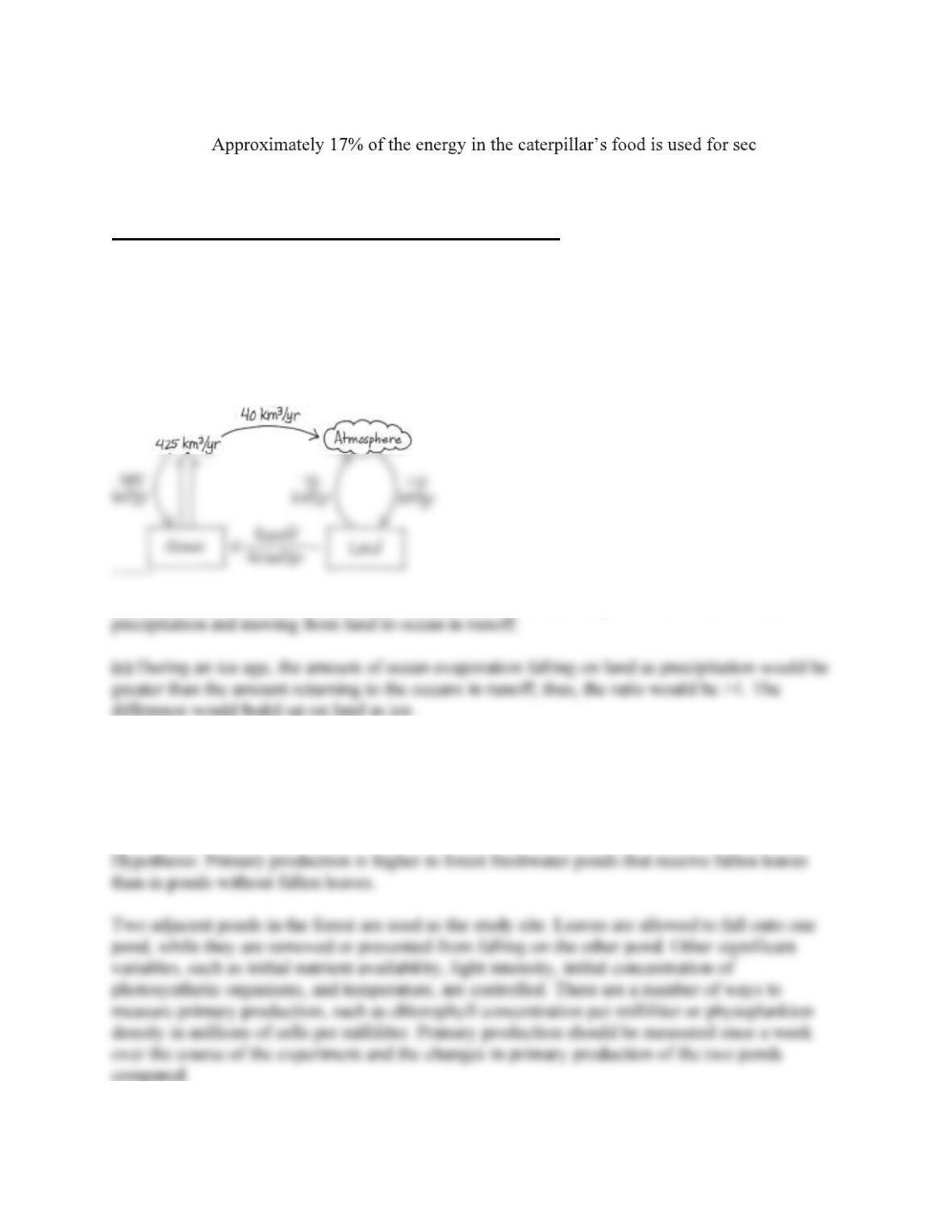
Figure 42.9 ondary
production (33J/200J = 0.165 = 0.165 x 100% = 16.5%)
Suggested Answers for End-of-Chapter Essay Questions
See the general information on grading short-answer essays and the suggested rubric at the
beginning of this document.
9. Interpret the Data
(a)
(b) On average, the ratio is 1, with equal amounts of water moving from the ocean to land as
10. Scientific Inquiry
Nutrient availability may limit primary production in aquatic ecosystems. Decomposing fallen
leaves are a source of nutrients in aquatic ecosystems, increasing primary production of rooted
vegetation and phytoplankton.
11. Focus on Evolution
Certainly ecosystems and the biosphere change over time, but is such change evolution? If we
define evolution as changes to genomes over generational time, it is a stretch to consider Earth
12. Focus on Energy and Matter
Sample key points:
Tropical peatlands typically have high rates of primary production.
Sample top-scoring answer:
Like other moist tropical forests, tropical peatlands have relatively high rates of primary
production. Unlike their moist forest counterparts, however, peatlands have reduced oxygen
13. Synthesize Your Knowledge
By collecting and burying the dung, the beetle speeds up the process of decomposition. The dung
decomposes more quickly in the relatively moist soil than it would have if it were left exposed to