CHAPTER 40 POPULATION ECOLOGY AND THE DISTRIBUTION OF
ORGANISMS
Scientific Skills Exercise
Teaching objective: The goal of this exercise is for students to use and interpret a mathematical
model. Many students will have considered, and possibly analyzed, population numbers between
0 and K using the logistic growth model. This exercise asks them to use the model in cases where
N > K, something they likely will not have considered. The exercise also encourages students to
N somehow briefly
exceeds K.
Teaching tips: A version of this Scientific Skills Exercise can be assigned in MasteringBiology.
Encourage the students to use the example of Table 40.2 as the organization tool for their
calculations. A few students with weaker math backgrounds may have trouble with
population numbers approach K both from below and from above, when N > K (under the rarer
conditions in which N temporarily is greater than K).
In Part 3, the students are asked to compare the behavior of the population that they modeled in
Parts 1 and 2 to actual data for a Daphnia population (Figure 40.20b). Between about 70 and 105
Answers:
1. Using a population size of 1,510 as an example, if r = 1.0 and K = 1,500, then
2. Doubling r will double the population
Interpret the Data
Figure 40.8 Because tundra is much cooler than deserts, less water evaporates during the
growing season and the tundra retains more moisture.
Figure 40.13 When only urchins were removed, limpets may have increased in abundance and
reduced seaweed cover somewhat (the difference between the purple and green lines on the
graph).
Suggested Answers for End-of-Chapter Essay Questions
See the general information on grading short-answer essays and the suggested rubric at the
beginning of this document.
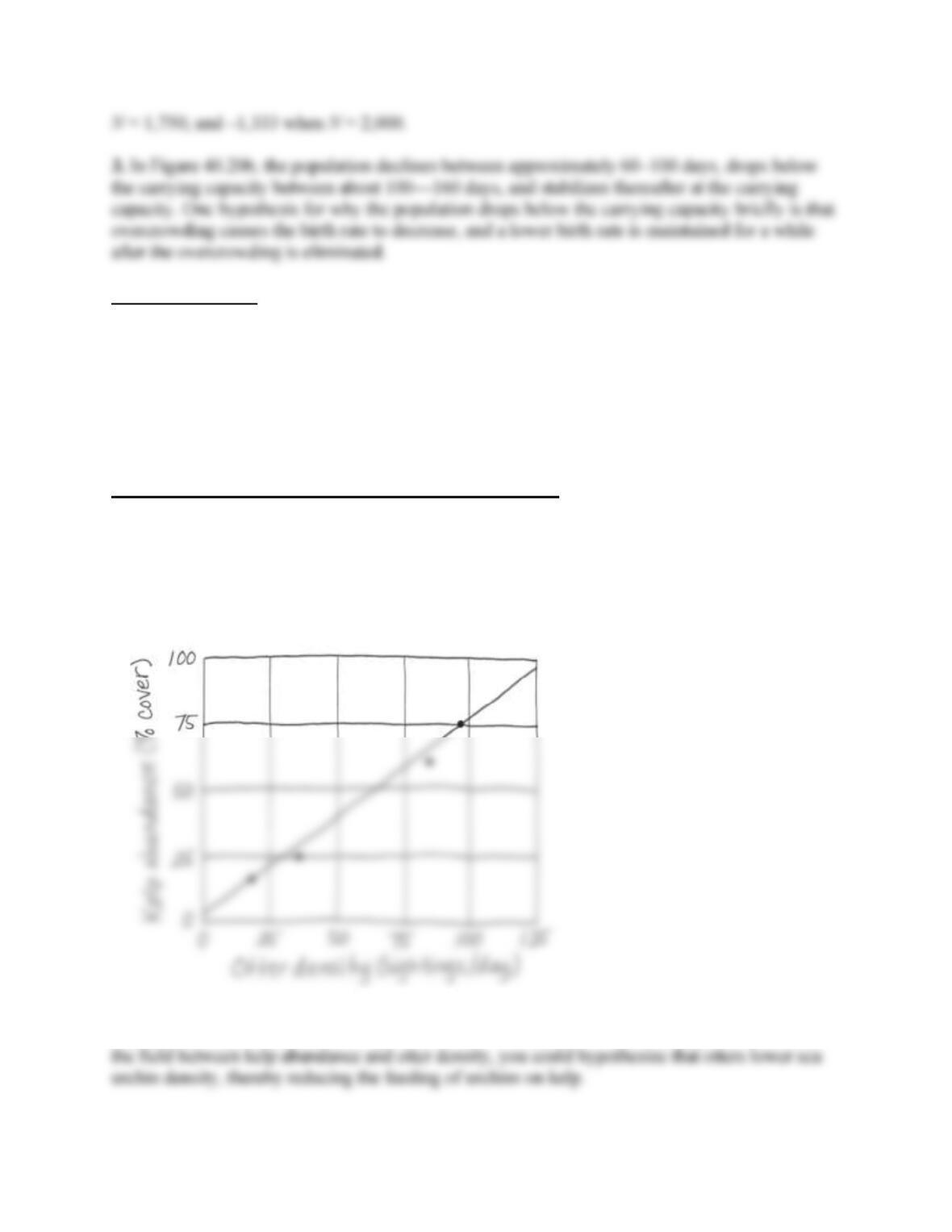
6. Interpret the Data
Based on what you learned from Figure 40.13 and on the positive relationship you observed in
7. Scientific Inquiry
You could plant both sets of seeds at low and high elevations. If the differences are strictly
genetic, then seeds from low-elevation plants would still produce tall plants at high elevations,
8. Focus on Evolution
Where a species lives today can be affected by a combination of its evolutionary history and
9. Focus on Interactions
Sample key points for a possible answer:
Many diseases are important environmental concerns.
Sample top-scoring answer:
Answers will vary. One possible answer is that disease may ultimately be the most important
density-dependent factor regulating the size of the human population. In recent decades, many
diseases, including AIDS and the disease caused by the West Nile virus, have emerged as
important environmental concerns. An influenza pandemic caused by a new strain of virus, such
10. Synthesize Your Knowledge
Competition and predation are the two factors most likely to affect the locust population.
Individual locusts are likely to compete for food and in fact can defoliate large areas. Predation