b 49
As with all the cases in this book, please read the preface if you have not already
done so. In the preface you will nd suggestions for using Investigative Case–Based
Tree Thinking accompanies Unit Four: Mechanisms of Evolution in Campbell
Biology, 10th edi tion. The case emphasizes material covered in Chapter 26:
Phylogeny and the Tree of Life and provides clues that will lead students to look
at other chapters in this unit. There are ve strands in the case:
• Preparingcladogramsusingobservablecharacters
• Using bioinformatics and DNA testing as forensic methods to detect
illegal whale products
ing of the case. We strongly suggest that students work in groups to complete
theCaseAnalysis.Activelylisteningtoandchallengingtheideasofotherscan
helplearnersbecomeawareoftheirownmisconceptions,yetalsovaluetheir
own and others’ prior knowledge.
Chapter 4:
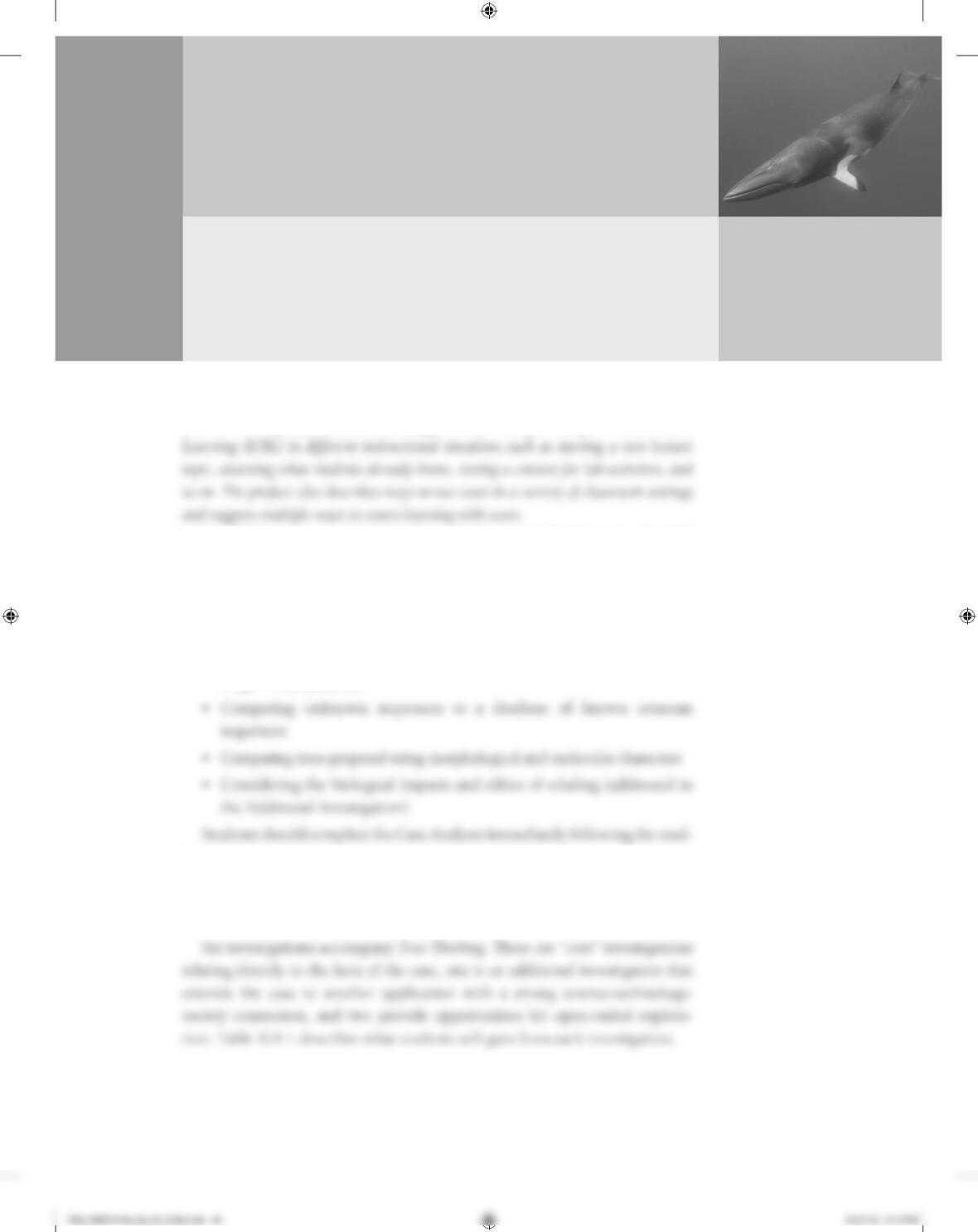
Tree Thinking
InstruCtor’s GuIde
50 a BIoloGICal InquIry: A Workbook of Investigative Cases
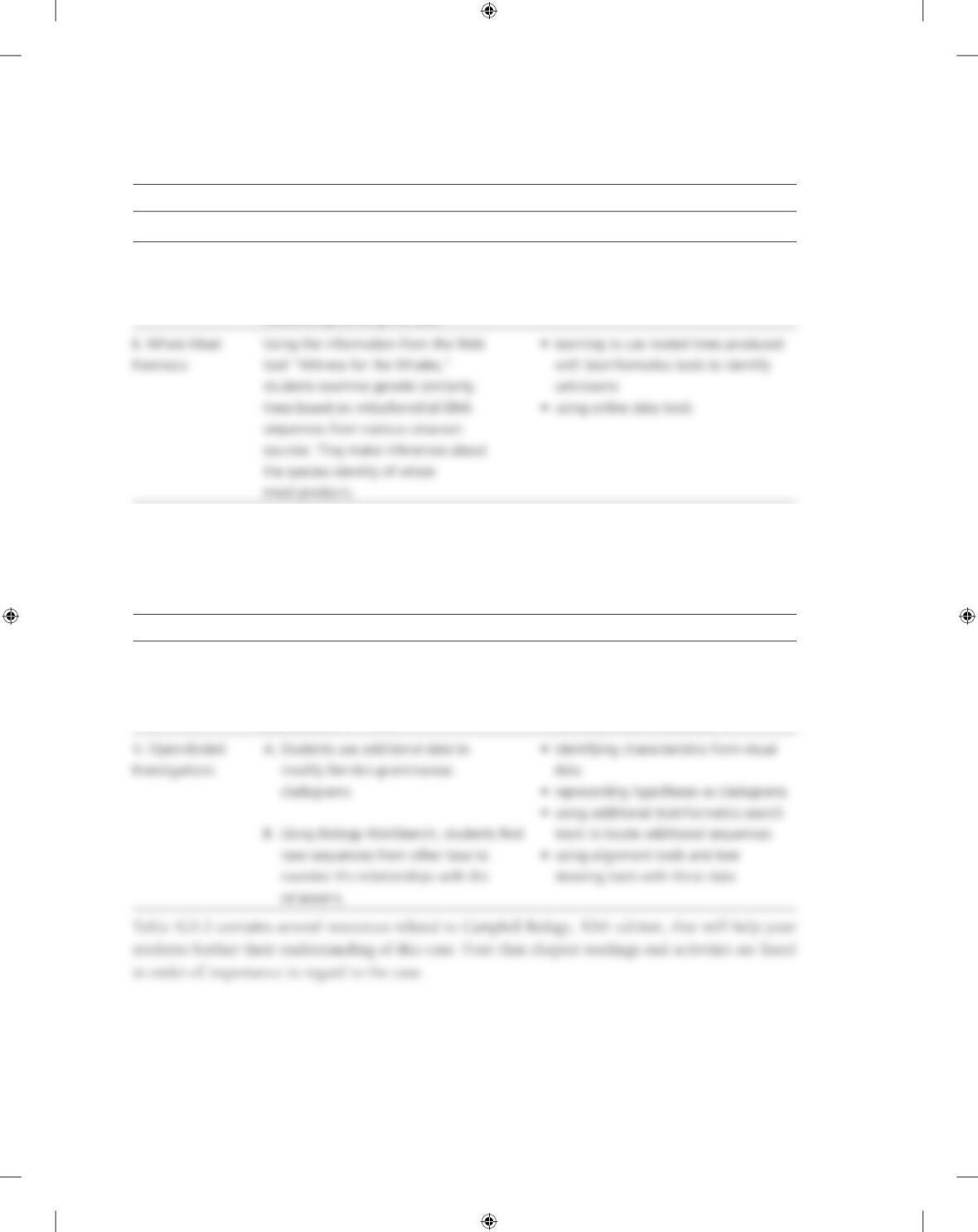
table IG4.1 tree thinking Case overview.
Investigation learning Goals Inquiry skills used
Core Investigations
I. Critical Reading Using fictional plants, students • generating comparisons
interpret and develop morphologically • interpreting data
based cladograms as hypotheses about • working with conventions of cladistics
relationships among the taxa.
III. Which The Whippo problem space is introduced. • inferring relationships from models
Mammals Are Students investigate phylogenetic trees
Most Closely as hypothetical explanations of
Related to evolutionary relationships among whales
Whales? and their terrestrial relatives.
additional Investigation
IV. Position Students explore the biological impacts • identifying reliable resources of data
Paper on and systematics of whaling and consider • reasoning from data to prepare
Whaling sustainable management of whale position papers about whaling based
populations. on many kinds of evidence
M04_REEC4164_04_IE_CH04.indd 50 24/01/14 8:13 PM
Case narrative
Students were asked to underline terms or phrases
in the introductory narrative that they think are
important to understanding the case. Suggested
terms and phrases that students might have cho-
sen are in bold type.
dadeventriedtobringsomecannedwhalemeat
back,butcustomsagentstookitattheairport.”
“Why?” Sean asked. “Isn’t whaling legal in
Japan?”
“Sortof.ThishappenedatU.S.Customs.Itturns
out that you can’t bring in any product that is
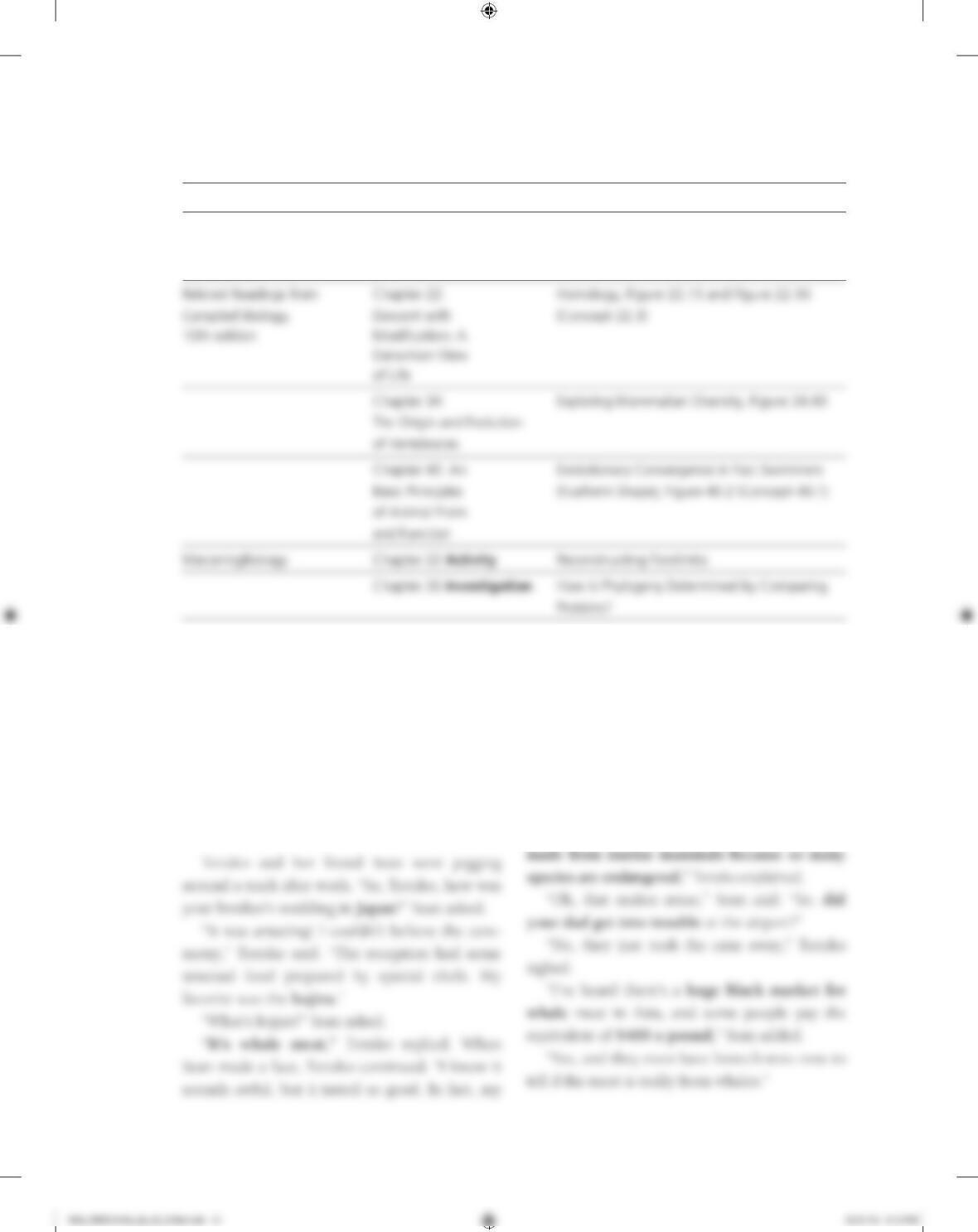
table IG4.2 Campbell-related resources.
resource Chapter/activity topics Covered/activity titles
Critical Reading from Chapter 26: Concepts 26.1–26.3
Campbell Biology, Phylogeny and
10th edition the Tree of Life
Chapter 4 Tree Thinking b 51
52 a BIoloGICal InquIry: A Workbook of Investigative Cases
suggested answers for Case analysis
1. Recognize potential issues and major topics in the case.Whatisthiscaseabout?Underline
termsorphrasesthatseemtobeimportanttounderstandingthiscase.Thenlist3 or 4biology-
related topics or issues in the case.
2. What specific questions do you have about these topics?Byyourself,orbetteryet,inagroup,
makealistofwhatyoualreadyknowaboutthiscaseinthe“WhatDoIKnow?”column.Listques–
tionsyouwouldliketolearnmoreaboutinthe“WhatDoINeedtoKnow?”column.
There are many possible answers, depending on the experiences of your students. Some likely
responses follow.
“How can they tell what type of meat is in
the can?” Sean asked.
of ‘whale meat’ from Asian markets has turned
up dolphin, shark, and even horse meat.”
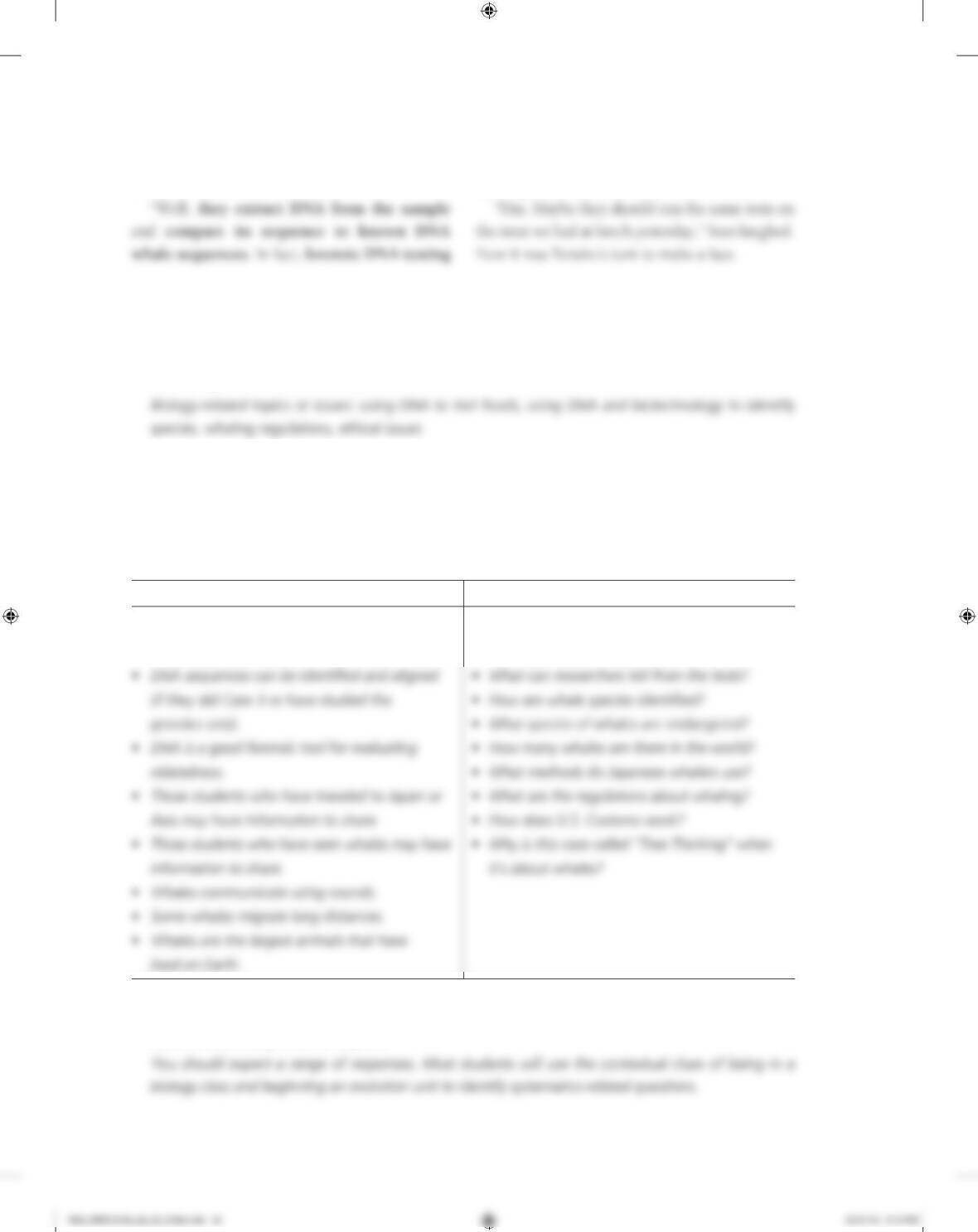
What do I Know? What do I need to Know?
• Whalesaremammals. • Whendidwhalesbecomemarineorganisms?
• DNAisuniqueamongspecies. • WhatarethetestsdoneontheDNA?How?
3.Putacheckmarkby1–3questionsorissuesfromthe“WhatDoINeedtoKnow?”listthatyou
think are most important to explore.
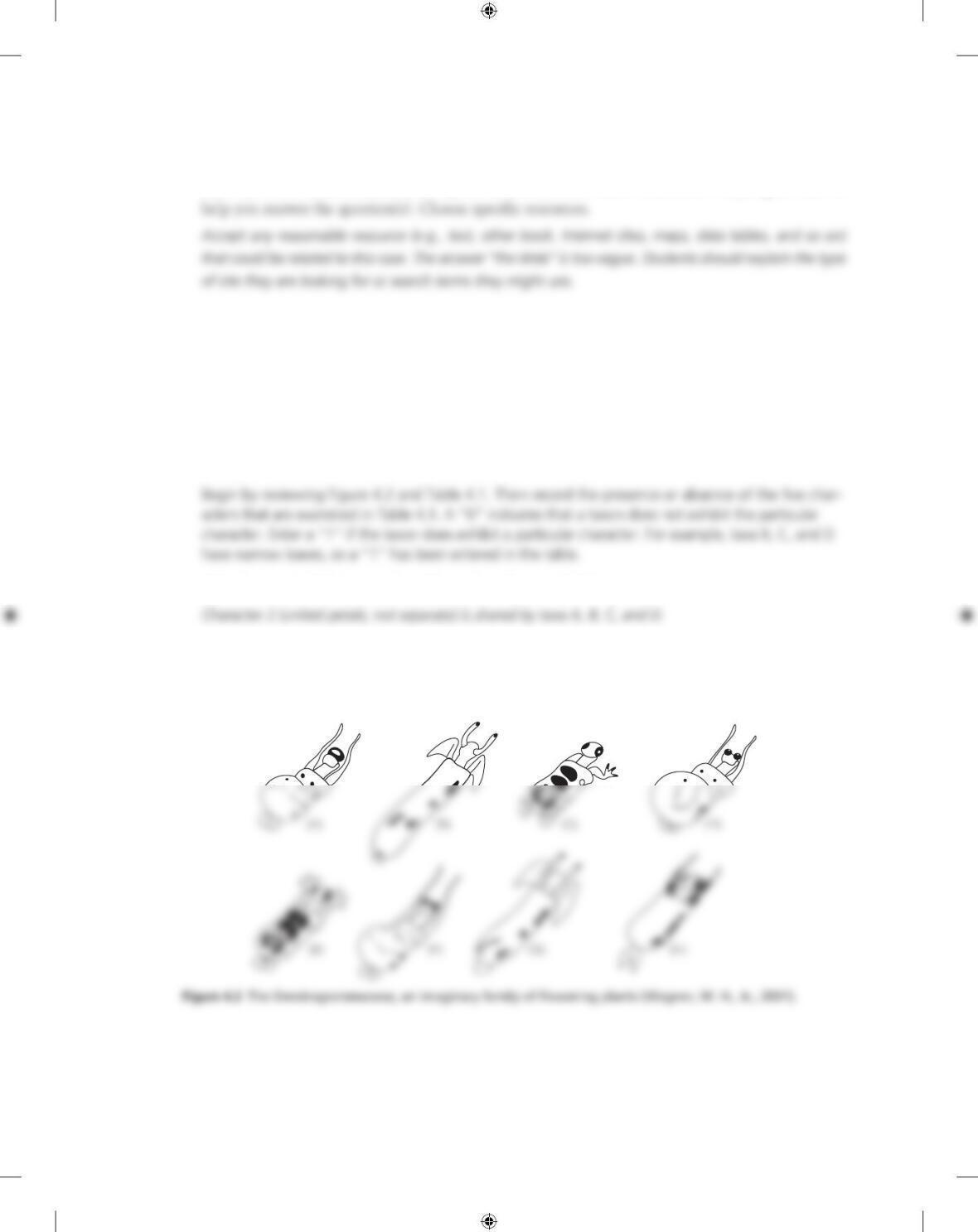
4. What kinds of references or resources would help you answer or explore these questions?
Identifytwodifferentresourcesandexplainwhatinformationeachresourceislikelytogivethatwill
suggested answers for Core Investigations
I. Critical Reading
To complete this investigation, you should have already read Chapter 26: Phylogeny and the Tree of Life.
a. Morphological observations: Identifying Characters in the dendrogrammaceae. In this
exercise, you will observe and record morphological characters and investigate the construction of a
cladogram based on five characters.
1.WhichtraitinTable4.1issharedbyatleastfourtaxa?Whichtaxaarethey?
2.Allvecharactersarepresentinwhichtaxon?
AllfivecharactersarepresentintaxonD.
Chapter 4 Tree Thinking b 53
M04_REEC4164_04_IE_CH04.indd 53 24/01/14 8:13 PM
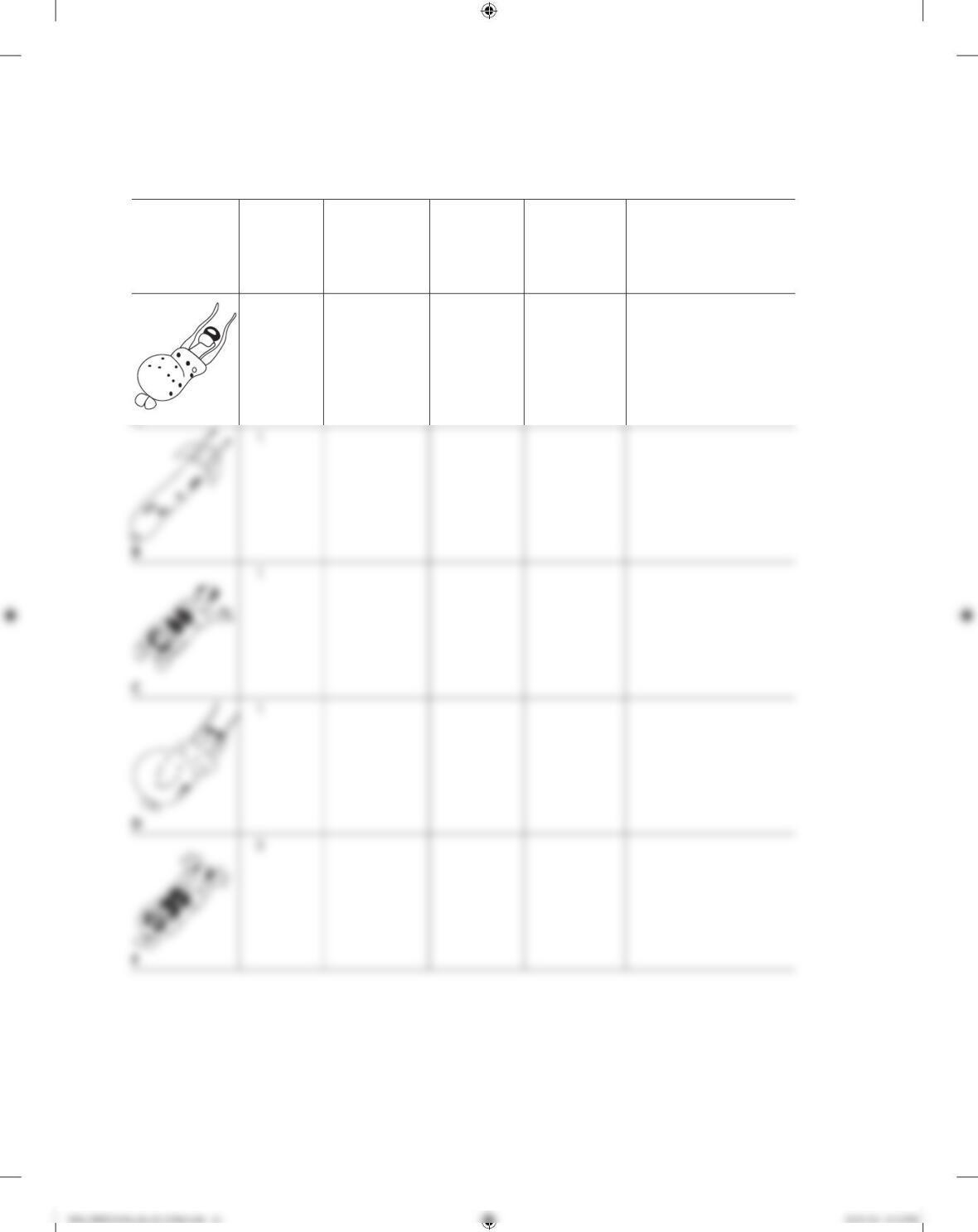
54 a BIoloGICal InquIry: A Workbook of Investigative Cases
table 4.1 observation and Identification of Morphological Characters.
(Refer to your text for definitions of unknown terms.)
1 2 3 4 5
selected taxa leaves united tubelike elongated Flower with Bilateral,
narrow petals, not petals sepals not radial, symmetry
separate
0
a
3.Areanyofthesecharacterssharedbyallvetaxa?
No.
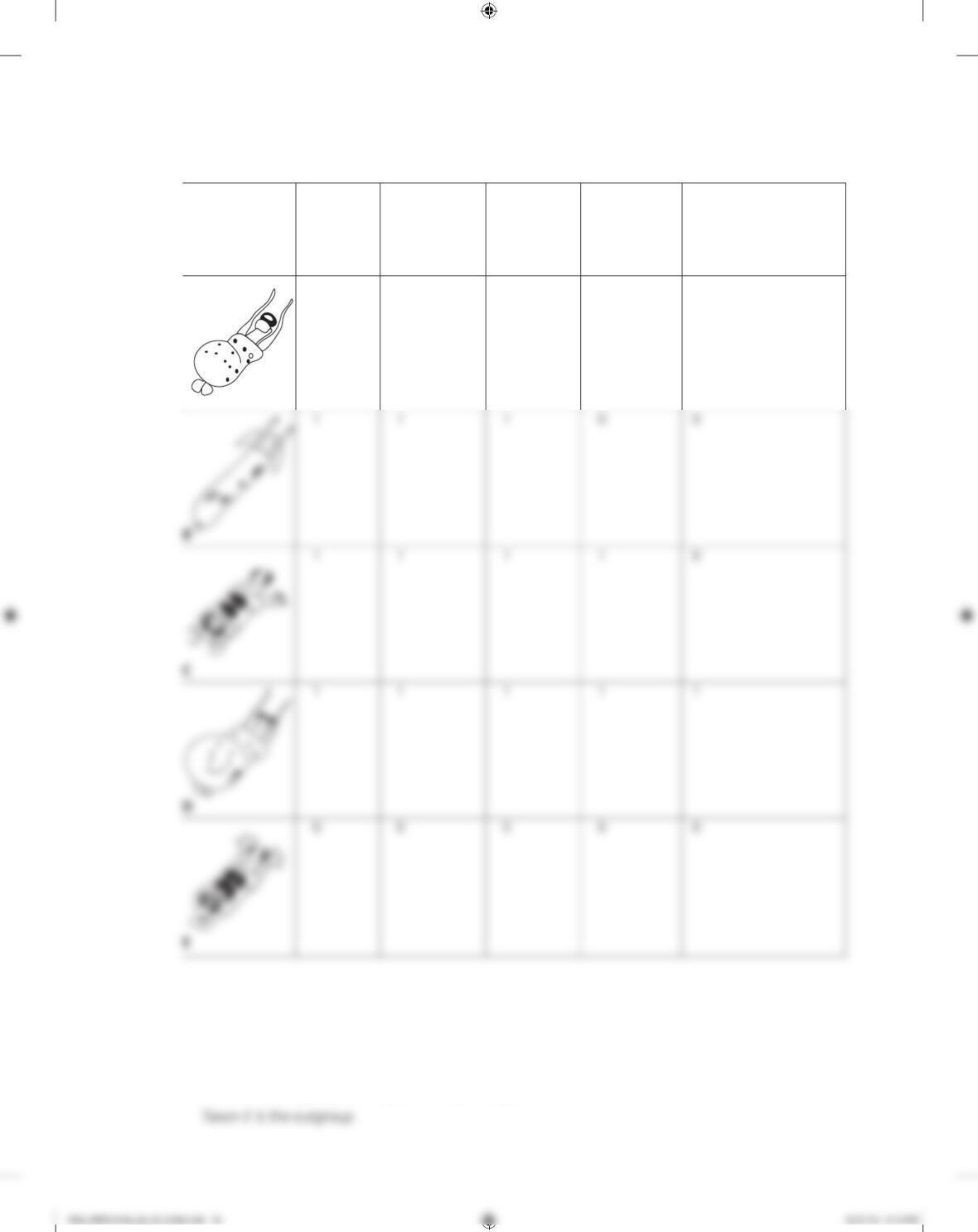
Chapter 4 Tree Thinking b 55
table IG4.3 answers to student table 4.1.
1 2 3 4 5
selected taxa leaves united tubelike elongated Flower with Bilateral,
narrow petals, not petals sepals not radial, symmetry
separate
0 1 0 0 0
a
4. One methodology that has proven useful in developing cladograms is to include a taxon that is less
related to the other taxa. This “outgroup” is assumed to have ancestral forms of the characters found
in these taxa. Characters that are not shared with this “outgroup” taxon are considered derived. Which
taxon is the outgroup in this plant family example?
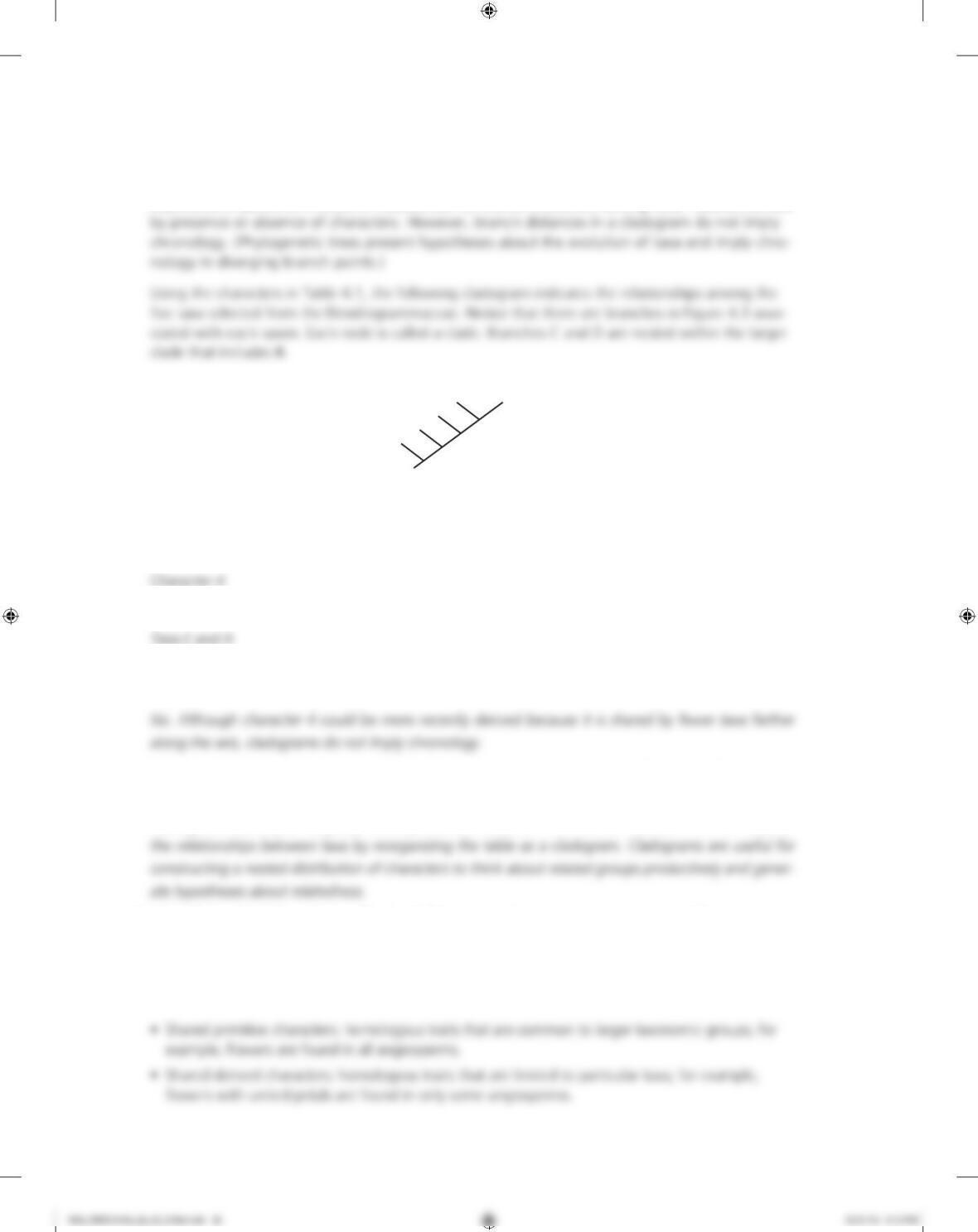
B. examining a Cladogram. By constructing a cladogram using the morphological characters
recorded in Table 4.1, you can infer relatedness among the taxa. Cladograms can be helpful
depictions of patterns in levels of relatedness for shared characters among taxa. Taxa are sorted
56 a BIoloGICal InquIry: A Workbook of Investigative Cases
C
B
A
E
D
5
4
1, 3
2
Figure 4.3 The characters are placed below the diagonal. The taxa A, B, C, D, and E are positioned in
branches along the diagonal to indicate which characters they share.
1.WhichcharacterinFigure4.3isexclusivelysharedbytaxaCandD?
2. Consider character 1 in the cladogram. Which taxa lack this character?
3. Canyou estimatehowmuchtime passedbetweenthedevelopment ofcharacter2 andcharacter4?
Explain.
4.Comparethetableofcharacterstothecladogram.Docladogramscontainthesameinformationas
thetable?Arecladogramsmoreuseful?Explain.
Cladograms allow you to group taxa by shared characters in a concise format. You can look at
C. Identifying primitive Versus derived Characters. Simple observation helps differentiate
morphological characteristics of these plant taxa, but what characters can help us understand
the evolutionary relationships between taxa? To be useful for cladistics, characters must be
homologous (reflect shared ancestry). Among the homologous characters, we need to identify
the following:
Chapter 4 Tree Thinking b 57
table 4.2 Character table for taxon F.
1 2 3 4 5
selected taxa leaves united tubelike elongated Flower with Bilateral,
narrow petals, not petals sepals not radial, symmetry
separate
F
1.LookatthecompletegroupoftaxainFigure4.2.Selectataxonwithamorphologicalcharacter
(otherthanthoseyouusedinTable4.1)thatyouthinkisasharedderivedcharacter.Whatmakes
itlikelytobederived?
If the presence of a character enables you to differentiate between Dendrogrammaceae taxa, it is a
d. revising a Cladogram. Systematists use existing data or gather new data to consider carefully
which characters to use in constructing a cladogram. Determination of the branch points is based on
1.EnteryourobservationsoftaxonFinTable4.2.Note: These are the same ve characters used
inTable4.1.
M04_REEC4164_04_IE_CH04.indd 57 24/01/14 8:14 PM
table IG4.4 answers to student table 4.2.
1 2 3 4 5
selected taxa leaves united petals elongated Flower with Bilateral,
narrow petals, not tubelike, sepals not radial, symmetry
separate Much
longer
than Wide
2.UsethecharacterinformationfromtaxonFtoredrawthecladogram(Figure4.3).
58 a BIoloGICal InquIry: A Workbook of Investigative Cases
A
C
B
F
E
D
5
4
13
2
II. “Whale Meat Forensics”
a. using Biotechnology and systematics. In this investigation you will be working with DNA
sequence analysis. You should be familiar with the DNA analysis methods covered in Chapter 20.
People in many regions of the world rely on animals harvested from the sea as a significant source of
protein. Several cultures enjoy traditional dishes made from whale meat (Figure 4.5). With declining
populations of cetaceans (the mammalian order to which whales and their close relatives belong),
however, this practice has come under international scrutiny.

1.Whattypesofbiotechnologytechniqueswereusedtoinvestigateproductssoldaswhalemeat?
2.Theresearcherscombinedsystematicswiththeuseofbiotechnologytodotheirforensicwork.
Denesystematics.
3. Why was it important for a systematist to identify the “known” cetacean species from which
DNAwasextractedandsequenced?
4.Basedonyourreadinginthecase,whydoyouthinkvendorswouldsubstitutehorsemeatfor
whalemeatinsomeoftheAsianmarkets?
Becausewhale meat is hard to obtain, it isexpensive. Vendors can increaseprofits by substituting
B. how Is the analysis of Whale products done? This next investigation introduces forensic
tools that were used to study whale products, as well as some of the reasoning processes used by
systematists to develop hypotheses about relationships.
Chapter 4 Tree Thinking b 59
60 a BIoloGICal InquIry: A Workbook of Investigative Cases
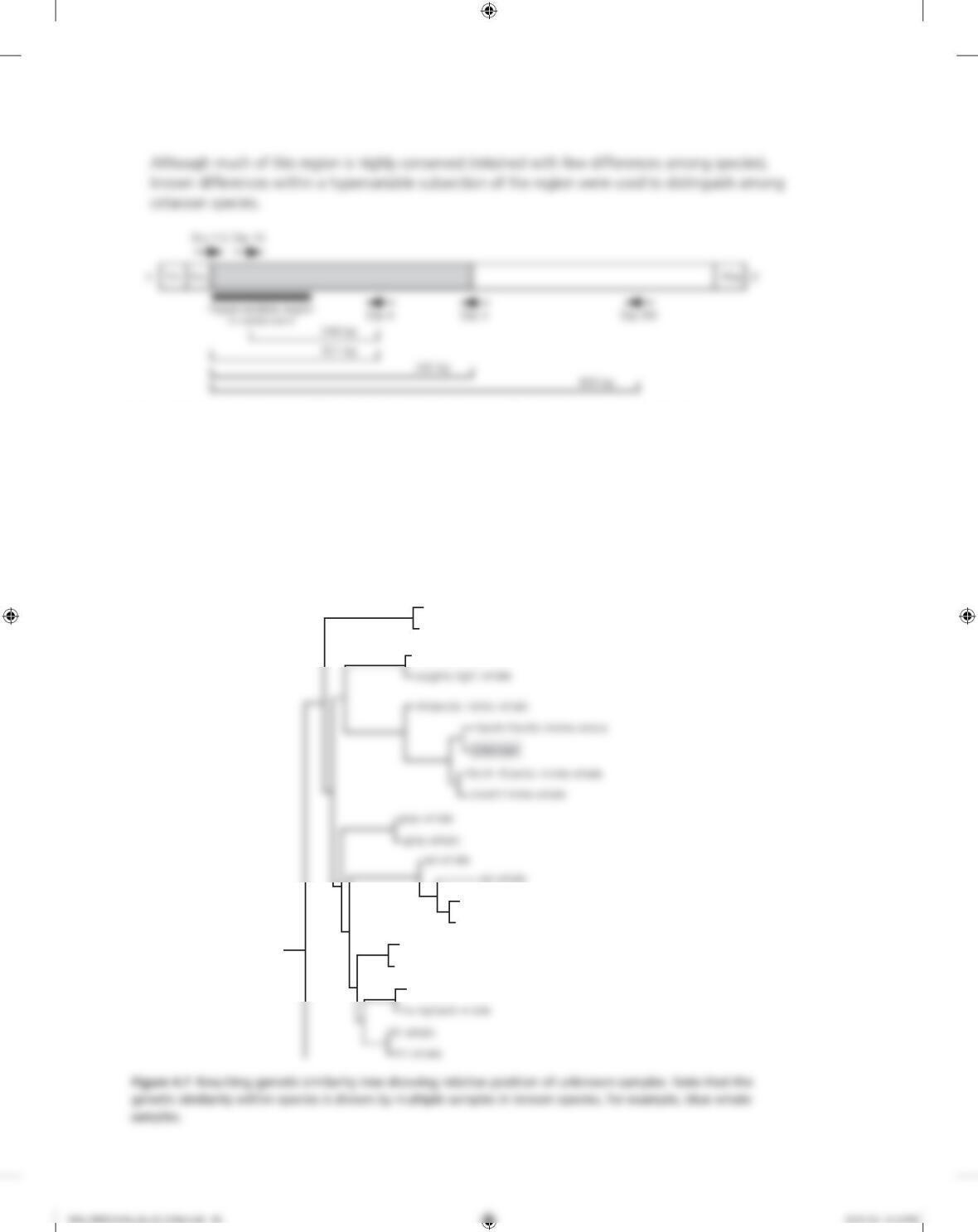
Figure 4.6 A schematic map of the mtDNA control region as well as the binding sites and orientation
of the primers used in isolating cetacean DNA. The shaded region represents the portion of the control
region covered by most sequences in the reference data sets.
Researchers used PCR to amplify the target mtDNA sequence in the unknown meats. The target
mtDNA was then sequenced and aligned with the data set of known cetacean sequences for this
segment of DNA. A computer program first compared the target sequence of the sample to known
cetacean sequences. Then the program generated a model based on the overall similarities between
the target sequence and known cetacean sequences (Figure 4.7).
bowhead
bowhead
pygmy right whale
Bryde’s whale
blue whale
humpback whale
Bryde’s whale
blue whale
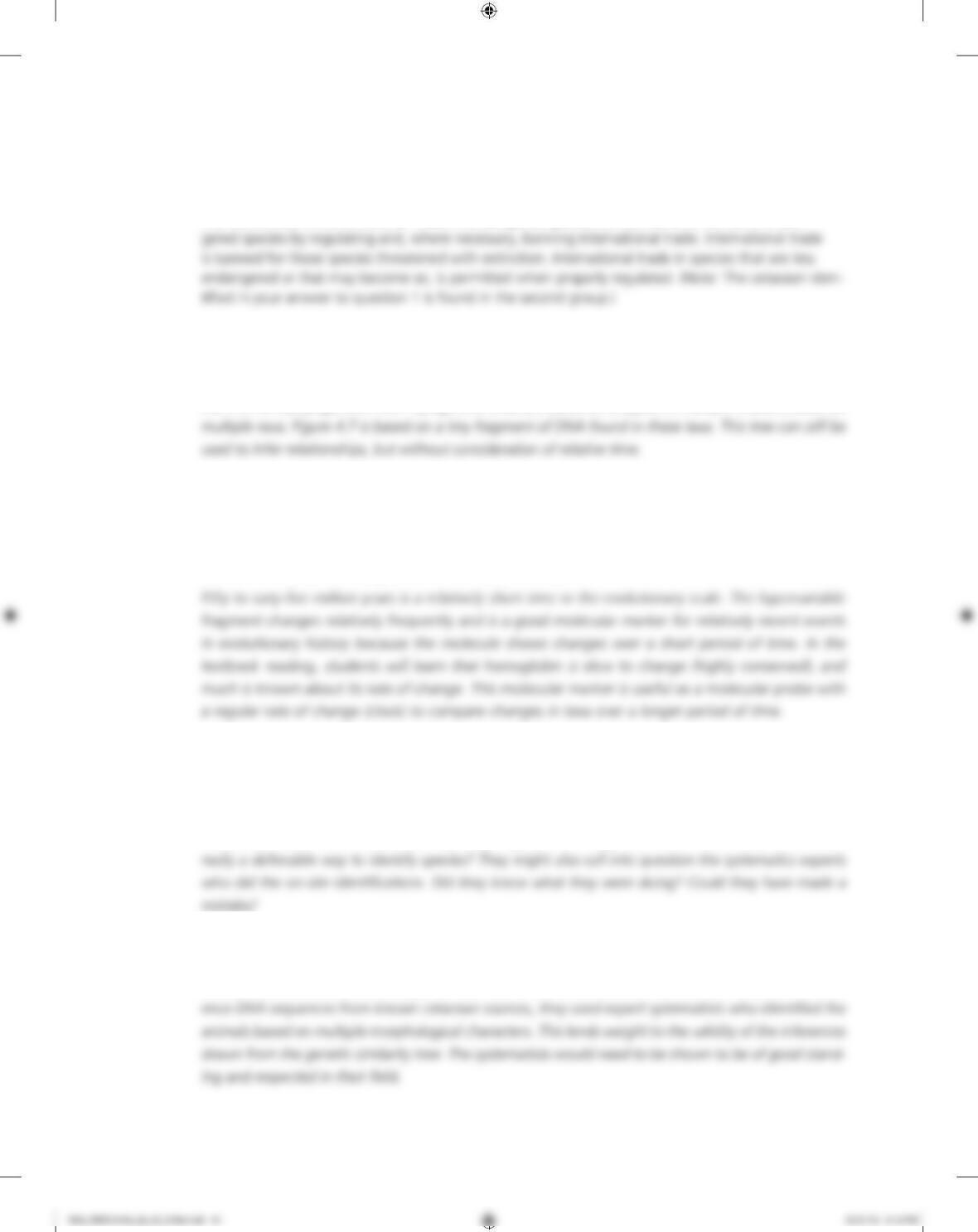
1. Which cetacean does the unknown sample most closely match?
NorthPacificminkewhale
The Convention on International Trade in Endangered Species (CITES) works to conserve endan–
2.Phylogenetictreesarehypothesesthatshowapatternofevolutionaryrelationships,basedonanal–
ysesofmultiplecharacters,formultipletaxa.Aphylogenetictreeimpliesachronologicalsequence
ofdivergence(branching).ExplainwhyFigure4.7isnotaphylogenetictree.
No,itisnotaphylogenetictree.Phylogenetictreesarebasedonanalysesofmultiplecharacteristicsfor
3.Divergenceofcetaceanspeciesoccurredwithinthelast50to65millionyears(O’LearyandGeisler,
1999).ExplainthedifferencebetweentheuseofafragmentofhypervariablemitochondrialDNAas
amolecularmarkerandtheuseofagenesuchastheonethatencodesforhemoglobin.Howmight
youuseeachofthesetocompareDNAsequencesbetweencetaceansandotherorganisms?(Hint:
SeetheinformationinChapter26onmolecularclocks.)
4.An attorney defending a whale meat supplier accused of improperly labeling meat would most
likelyclaimthattheinferencesdrawnfromtheprosecution’sevidencewerequestionable.Providea
potentialargumentthatspecicallydescribesaweaknessinthemethodologyusedtoinferspecies
identity of the whale meat in this investigation.
The whale market researchers used only a tiny fragment of a single piece of mitochondrial DNA. Is this
5.Howmighttheprosecutingattorneyanswerthisargument?(Note:Defendthemethodology
thatwascriticizedabove.)
TheresearchersdiduseatinyfragmentofDNA;however,toestablishtheidentificationsoftherefer–
Chapter 4 Tree Thinking b 61
C. Going Further: testing unknowns with “Witness for the Whales.” At the website “Witness
for the Whales,” users can submit unknown mtDNA sequences to be compared against known
cetacean sequences. Genetic similarity analyses can be performed. Results are returned in tree and
table format, summarizing the genetic distances between the unknown and reference sequences.
(Go to the Case Book website for access to and instructions for “Witness for the Whales.”)
III. Which Mammals Are Related Most Closely to Whales?
a. the ungulates. Most scientists agree that whales are members of the ungulates, or hoofed
mammals. Some evidence suggests that whales share a common ancestor that gave rise to other
living ungulates such as deer, rhinoceroses, horses, camels, pigs, and hippopotamuses. The
1.Listthreecharactersthatyoucouldobserveinlivingwhalesthatwhite-taileddeerorother
even-toed ungulates do not seem to share.
Students will provide many different answers: limbs designed for swimming, no adult body hair, blubber,
2.Moleculardatacanalsobeusedtoexaminerelationshipsbetweenorganisms,buttheinacces–
sibilityofcomparativeDNAsamplesforextincttaxalimitstheusefulnessofthesedata.Evidence
forsharedcharactersbetweenwhalesandungulatesbasedonproteinornucleicacidsequences
involvessamplingofextanttaxaonly.However,whaleskeletaldataincorporateextensivepaleon–
tological data from fossils as well as data from extant species. Scientists use fossil data to help
62 a BIoloGICal InquIry: A Workbook of Investigative Cases
M04_REEC4164_04_IE_CH04.indd 62 24/01/14 8:14 PM
B. explore Whale evolution with the Whippo problem space. A good place to begin exploring
the relationship between whales and other mammals is the Whippo Problem Space at the
BEDROCK bioinformatics education site (see the Case Book website for access information). This
Whippo site organizes diverse resources including data and tools to support inquiry.
Chapter 4 Tree Thinking b 63
Tree B
hippos
ruminants
whales
Artiodactyls
even-toed ungulates
1.Whatisthehypothesizedoutgroupforbothtrees?
Perissodactyls,orodd-toedungulates
2. Which tree shows whales and hippos sharing the closest relationship?
3. Tree thinkingisatermbiologistsusetodescribetheprocessofapproachingbiologicalproblem
solvingbyconsideringtheroleofdescentwithmodicationbasedonphylogeneticevidence.This
canresultincontroversiessuchasthatsurroundingtheevolutionofbirds.Didthecladethatin–
cludesbirdsdivergefromaparticulargroupofdinosaurs?Ordiditdivergefromalineofreptiles
thatdidnotincludedinosaurs?Thesetypesofquestionshavefueledmuchdebateandextensive
64 a BIoloGICal InquIry: A Workbook of Investigative Cases
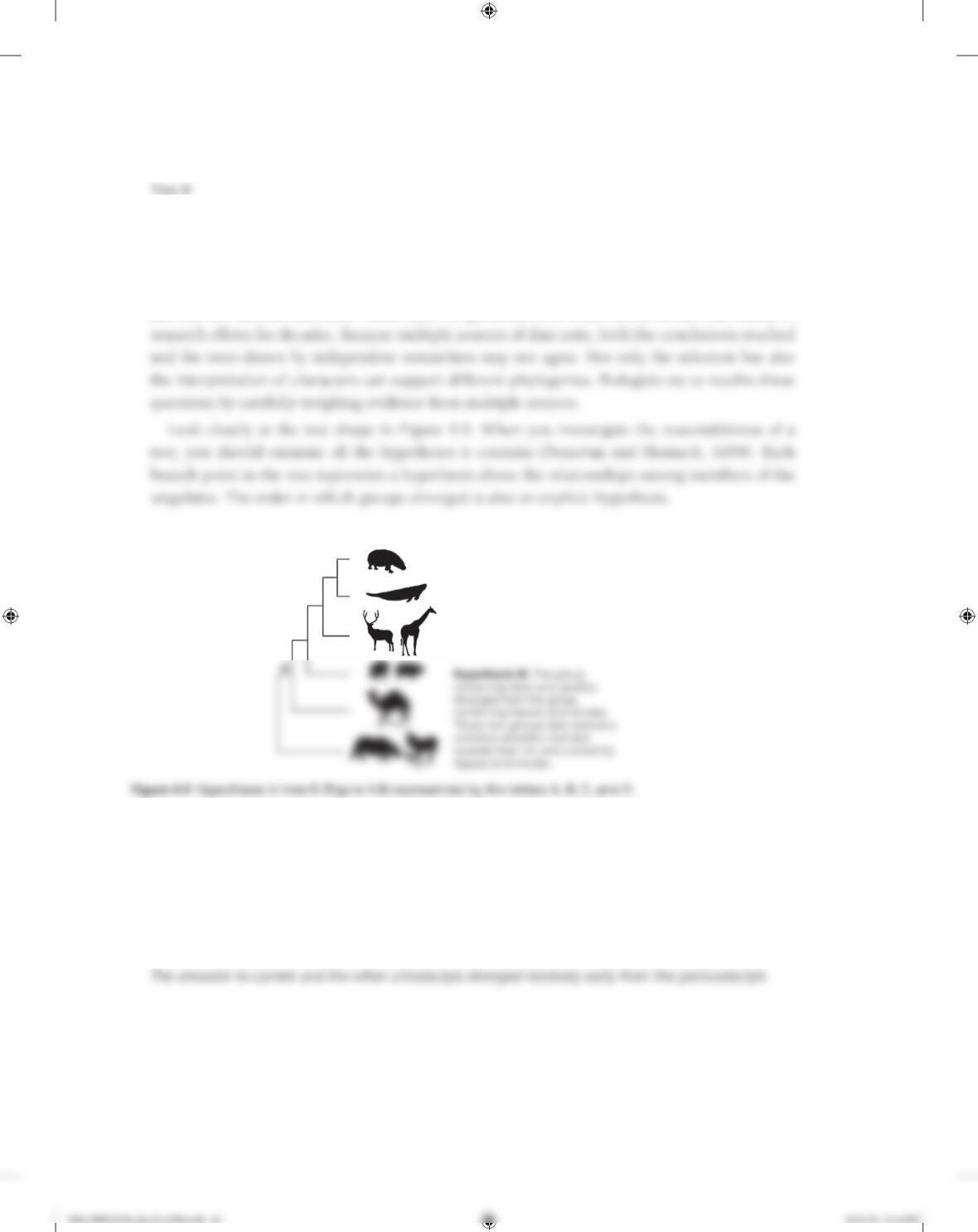
A
B
C
Hypothesis A: Hippos and
whales shared a common
ancestor more recently with
each other than with other
ungulates. The two groups have
since diverged. Each possesses
derived characters not found in
the other groups.
AfteryouhavereviewedthedescriptionsofhypothesisAandhypothesisB,describehypothesisD.
Camels as a group diverged from the group containing hippos, whales, deer, giraffes, pigs, and tapirs.
The common ancestor of the camel group and the other group is older than the common ancestors at
A, B, or C; therefore, the camels diverged from the others earlier.
4.WhatdoeshypothesisDtellusabouttherelationshipbetweenperissodactylsandartiodactyls?
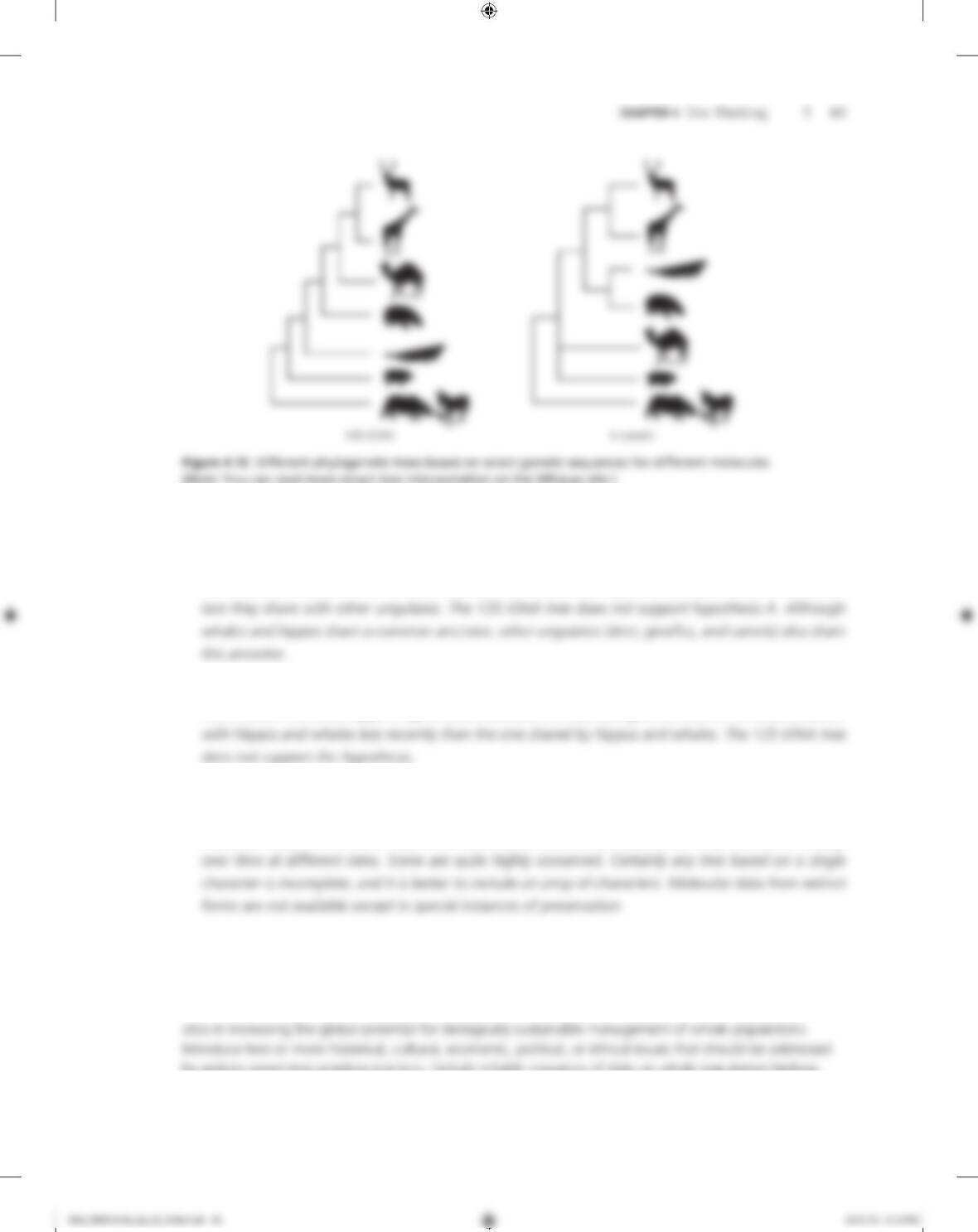
5.WhichofthetreesbasedonmolecularsequencedatashowninFigure4.10supports
hypothesisAintreeB?Explain.
The k-casein tree shows the common ancestor for whales and hippos to be more recent than ances–
6.DoeseithertreeinFigure4.10supporthypothesisBintreeB?Explain.
The k-casein tree does support hypothesis B because the deer and giraffes share a common ancestor
7.Doyouthinkmolecularsequencedataarehelpfulcharacterstousetoinferphylogeneticrela–
tionships?Whatconcernsmightyouhaveifatreewerebasedonasinglemolecule?
Molecularsequencedataarehelpful,butthesedatashouldbeconsideredcarefully.Moleculeschange
additional Investigation
IV. Position Paper on Whaling
Explore the management of whaling in the modern world. Explain the role of biotechnology and system–
by policies governing whaling practices. Include reliable resources of data on whale population biology.
Reason from information and data to prepare a 3- to 5-page position paper that specifically addresses
your findings about modern whaling policy.
Examples of issues that your paper might address include:
66 a BIoloGICal InquIry: A Workbook of Investigative Cases
Resources and links to some websites can be found on the Case Book website.
(Note: Your instructor may assign this as a class debate.)
Note to instructors: There are several ways to use this investigation. You could have students work
V. Open-Ended Investigations
A.FournewspeciesofadditionalDendrogrammaceaehavebeendiscovered.Howmightthis
changeyourphylogram?Evolutioncanincludebothacquisitionandlossoftraits,somorethan
onecladogrammaybepossiblewithoutfurtherinformation.
References
Baker,C.S.,G.M.Lento,F.Cipriano,andS.R.Palumbi.2000.Predicteddeclineofprotectedwhales
basedonmoleculargeneticmonitoringofJapaneseandKoreanmarkets.Proceedings of the Royal Society
of London B267(1449):1191–1199,2000.