CHAPTER 32 THE INTERNAL ENVIRONMENT OF ANIMALS: ORGANIZATION
AND REGULATION
Scientific Skills Exercise
Teaching objective: Students build scientific skills by analyzing quantitative data in a table.
Specifically, students will quantitatively compare osmolarity and urea concentration in blood and
urine from two experimental treatment groups of mice.
Teaching tips: A version of this Scientific Skills Exercise can be assigned in MasteringBiology.
The topic fits with teaching about blood osmoregulation and mammalian kidney function.
Students will interpret mean and standard deviation values provided. An option is to ask students
Answers:
1. (a) large difference; (b) small difference; (c) large difference; (d) medium difference; (e) The
Suggested Answers for End-of-Chapter Essay Questions
See the general information on grading short-answer essays and a suggested rubric at the
beginning of this document.
9. Interpret the Data
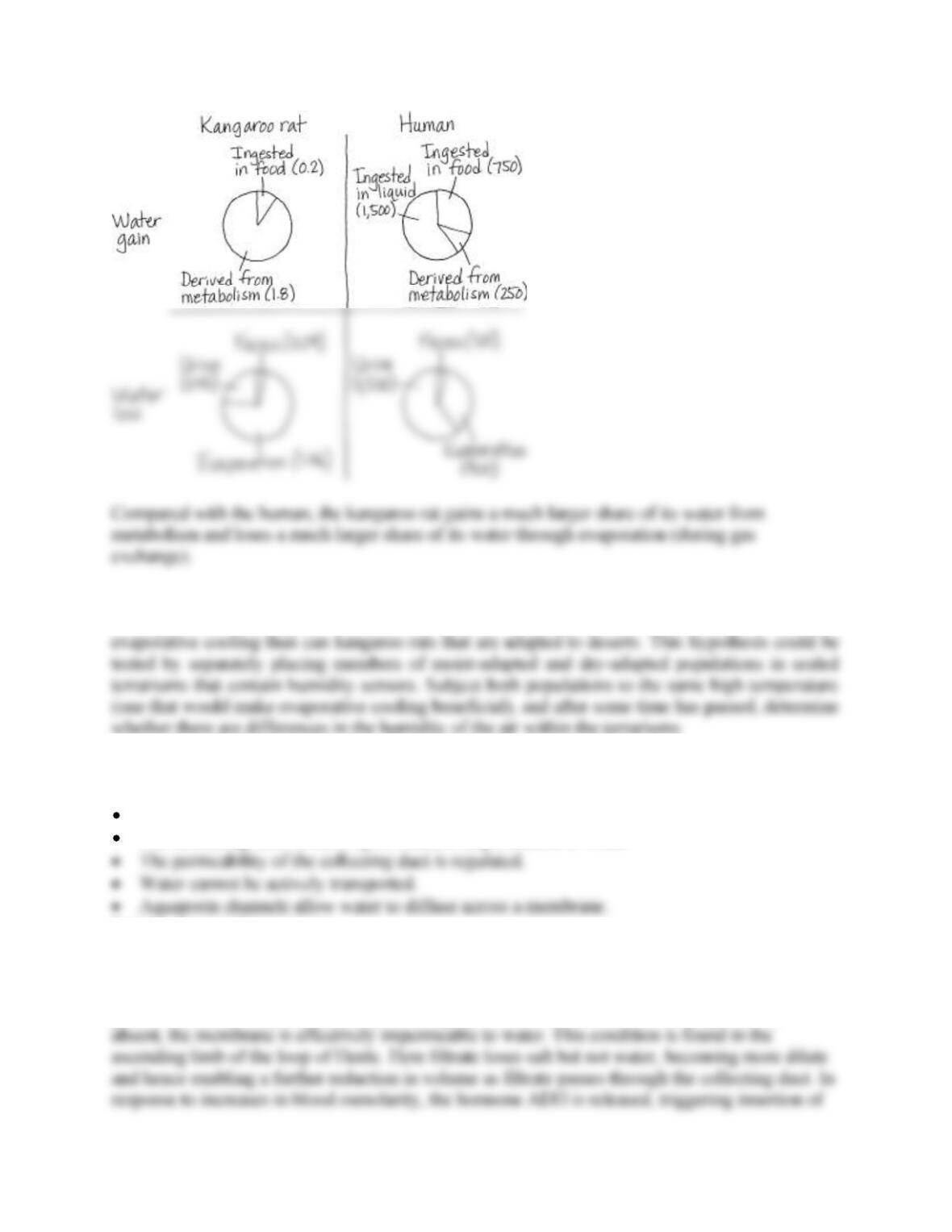
10. Focus on Evolution
If kangaroo rats are adapted to moist conditions, they can better afford to lose water to perform
11. Focus on Organization
Sample key points:
The descending limb of the loop of Henle is freely permeable to water.
The ascending limb of the loop of Henle is impermeable to water.
Sample top-scoring answer:
Kidney function in water recovery relies on structural differences in the membranes lining
particular portions of the nephron. Where aquaporin channels are present, as in the descending
limb of the loop of Henle, water can readily diffuse across the membrane in response to a
gradient of osmolarity, substantially reducing the volume of filtrate. Where aquaporins are

12. Synthesize Your Knowledge
The macaque has thick fur that provides insulation, reducing the rate of heat loss to the cold air.