CHAPTER 3 CARBON AND THE MOLECULAR DIVERSITY OF LIFE
Scientific Skills Exercise
Teaching objective: In this exercise, students will examine aligned amino acid sequences from
three different species to find any and all differences between them. They will calculate percent
identity and create supportable hypotheses about relatedness among the species.
Teaching tips: A version of this Scientific Skills Exercise can be assigned in MasteringBiology.
A key aspect of this exercise is using the data to support a hypothesis about evolutionary
exercise, may not be intuitive for students who have not yet studied evolution. The group game
p them to understand. In this game, one person whispers
a sentence to the next person, and so on down the line, until the last person says it out loud. The
farther away a person is from the source, the more errors will have been introduced into the
sentence. Similarly, the more generations between species separations, the more changes there
will be to the DNA and protein sequences.
If you would like to show your students the gorilla sequence of â globin (mentioned in the text),
it is at http://www.ncbi.nlm.nih.gov/protein/P02024.2.
Answers:
1. (a) There are eight amino acid differences between the human and monkey sequences (S/N,
3. Based solely on the –globin amino acid sequences, one can hypothesize that gibbons are
more closely related to humans than rhesus monkeys are. The reasoning is that the more similar
Suggested Answers for End-of-Chapter Essay Questions
See the general information on grading short-answer essays and the suggested rubric at the
beginning of this document.
12. Scientific Inquiry
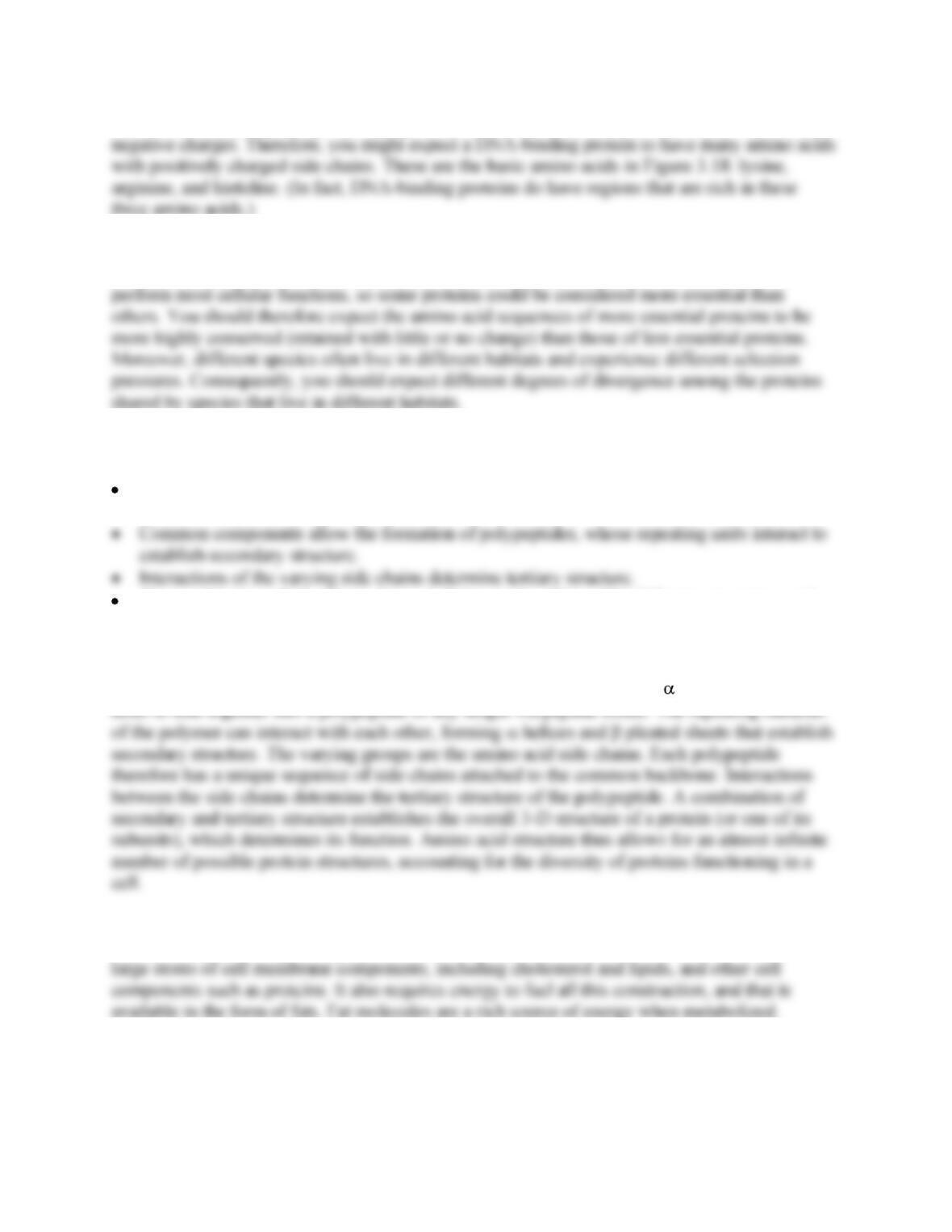
DNA has many phosphate groups along the backbone of each strand, so the molecule has many
13. Focus on Evolution
Some cellular functions are more essential than others to the survival of the organism. Proteins
14. Focus on Organization
Sample key points:
Amino acids share common chemical groups but have unique side chains that allow for
variation.
The combination allows for an almost infinite number of possible different structures, each
with a different function.
Sample top-scoring answer:
The structure of an amino acid, including both common and varying groups, is key to its
function. The common groups (amino and carboxyl groups attached to an carbon) allow amino
15. Synthesize Your Knowledge
A developing chick is growing rapidly, increasing its number of cells. To build new cells it needs