CHAPTER 28 PLANT STRUCTURE AND GROWTH
Scientific Skills Exercise
Teaching objective: This exercise is designed to give students practice in constructing and
interpreting a bar graph, and to introduce them to the concept of phenotypic plasticity, the
capacity of an organism with a specific genotype to produce different phenotypes when exposed
to different environments.
Teaching tips: A version of this Scientific Skills Exercise can be assigned in MasteringBiology.
Many students labor under the misconception that morphological traits are hardwired by genes.
They think that if an organism has a certain genotype, it will look a certain way. More often,
Answers:
1.
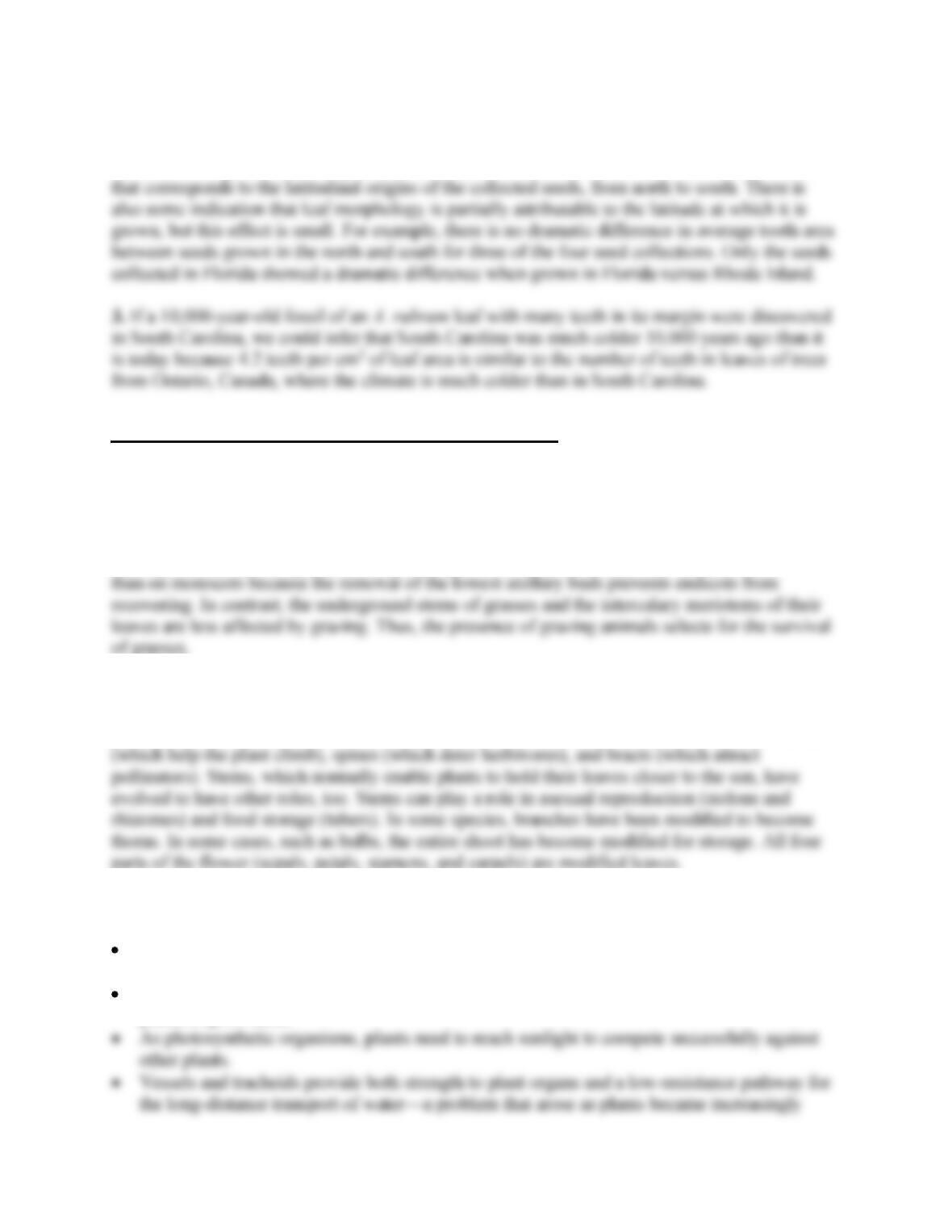
2. Genetics plays a large role in determining the phenotypes of the leaves. Regardless of where
the seeds were grown, there is generally an increase in teeth size and a decrease in teeth number
Suggested Answers for End-of-Chapter Essay Questions
See the general information on grading short-answer essays and a suggested rubric at the
beginning of this document.
7. Scientific Inquiry
Grazing animals that crop plants close to the ground have a more detrimental effect on eudicots
8. Focus on Evolution
Plant organs exhibit many exaptations. For example, in addition to their role as the primary
photosynthetic organs, leaves have evolved to have other roles in some species, such as tendrils
9. Focus on Organization
Sample key points:
Lignin is a tough polymer found in the cell walls of sclerenchyma cells and vascular cells,
such as tracheids and vessel elements.
Fibers are sclerenchyma cells that give rigidity to stems during primary growth, enabling
plants to grow taller.
taller.
Sample top-scoring answer:
Lignin is a tough, polymeric cell-wall substance found in sclerenchyma cells, such as fibers, and
in some vascular cells, such as tracheids and vessel elements. Lignified cells make plant tissues
10. Synthesize Your Knowledge
(a) As shown in Figure 28.14, a root has a solid vascular cylinder, in contrast to the three
separate vascular bundles in this micrograph. Also, this organ has stomata, which are not found