
CHAPTER 27 THE RISE OF ANIMAL DIVERSITY
Scientific Skills Exercise
Teaching objective: This exercise provides students with the opportunity to analyze
experimental design and interpret graphed results. Students are asked to identify the hypothesis
that is tested in an experiment and to identify dependent and independent variables. They are
asked to explain how the experimental treatments test the stated hypothesis, to summarize the
graphed results of the experiment in words, and to identify whether or not these results support
the initial hypothesis. Finally, students are asked to interpret the significance of the experimental
results in an evolutionary context.
Teaching tips: A version of this Scientific Skills Exercise can be assigned in MasteringBiology.
Point out to students that predators are important agents of natural selection that select for
successful behavioral or structural defenses in prey species. In turn, prey species act as agents of
natural selection in selecting for increased weaponry in predator species. The result is escalating
predator-prey arms races over evolutionary time. The invertebrate paleontologist Geerat Vermeij
studies the fossil record of evolutionary arms races, focusing on molluscs and their predators. He
Answers:
1. of
predation by crabs have become less vulnerable to crab predation through evolution.
Suggested Answers for End-of-Chapter Essay Questions
See the general information on grading short-answer essays and a suggested rubric at the
beginning of this document.
7. Scientific Inquiry/Draw It
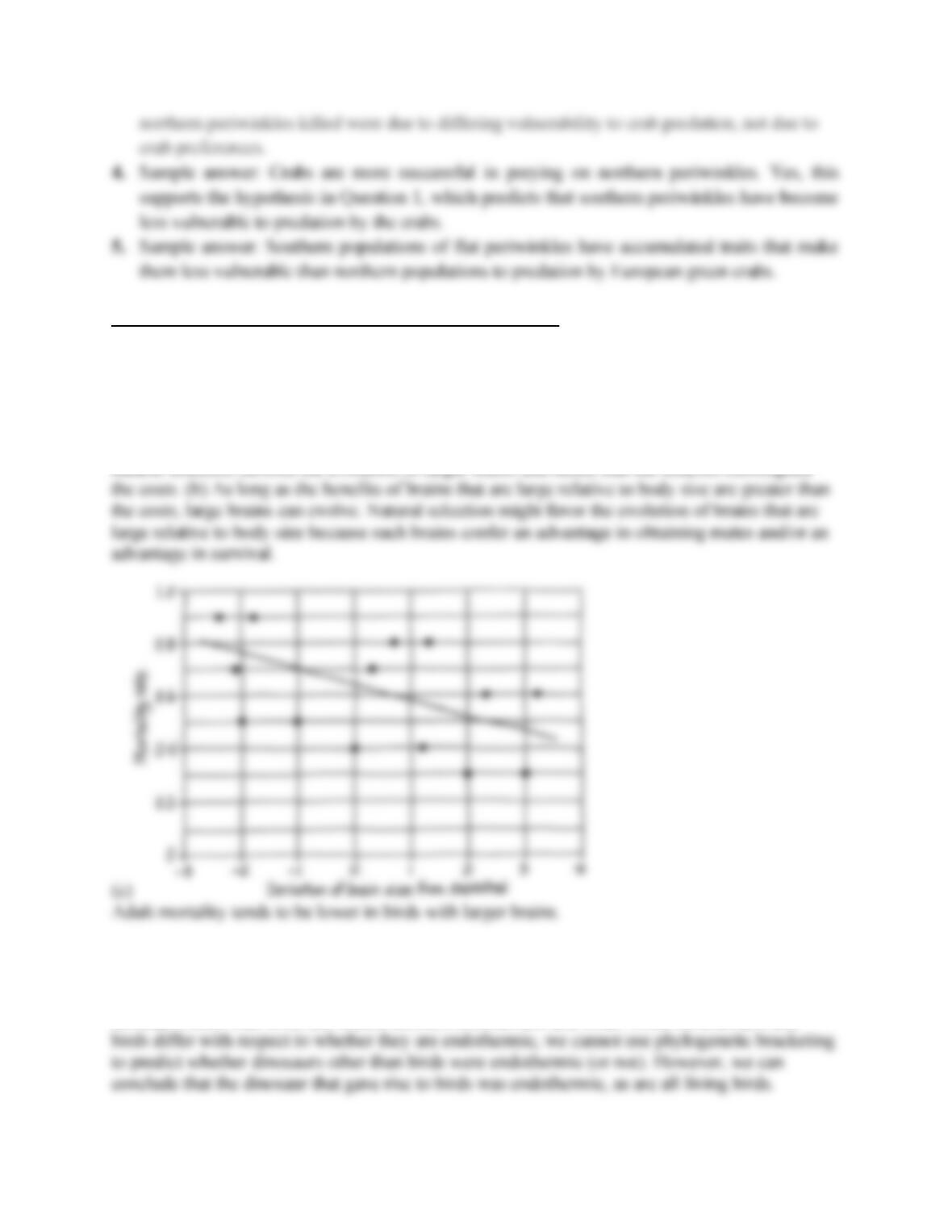
(a) Because brain size tends to increase consistently in such lineages, we can conclude that
natural selection favored the evolution of larger brains and hence that the benefits outweighed
8. Focus on Evolution
The circled clade should include the birds, the ornithischian dinosaurs, and the saurischian
dinosaurs other than birds, plus the common ancestor of the dinosaurs. The phylogeny shows that
dinosaurs other than birds are nested between crocodilians and birds. Since crocodilians and
9. Focus on Organization
Sample key points:
Early tetrapods diversified into a wide range of species.
Early tetrapods could not run for long distances because their sprawling gait prevented
normal breathing while running.
Tetrapod lineages that solved this problem (such as dinosaurs) would have had a competitive
advantage.
Sample top-scoring answer:
Although early tetrapods diversified into a wide range of species, their sprawling gait prevented
them from breathing while running. Tetrapod lineages that solved this problem, such as the
dinosaurs, had a competitive advantage. For example, a predator that could run without
10. Synthesize Your Knowledge
No. Invertebrate species in phylum Chordata are more closely related to vertebrates than they are
to other invertebrates. Thus, a group comprised of all of
recent common ancestor. In terms of evolutionary history, the first animals were invertebrates.