CHAPTER 26 THE COLONIZATION OF LAND
Scientific Skills Exercise
Teaching objective: Students build scientific skills by reading and interpreting two tables that
provide information on the genome and gene expression patterns of mycorrhizal and
nonmycorrhizal fungi.
Teaching tip: A version of this Scientific Skills Exercise can be assigned in MasteringBiology.
Answers:
1. (a) L. bicolor has 505 such genes, which is more than the other species studied. (b)
3. (a) The number 22,877 indicates that the amount of RNA transcript of this gene made in
Suggested Answers for End-of-Chapter Essay Questions
See the general information on grading short-answer essays and a suggested rubric at the
beginning of this document.
7. Scientific Inquiry/Interpret the Data
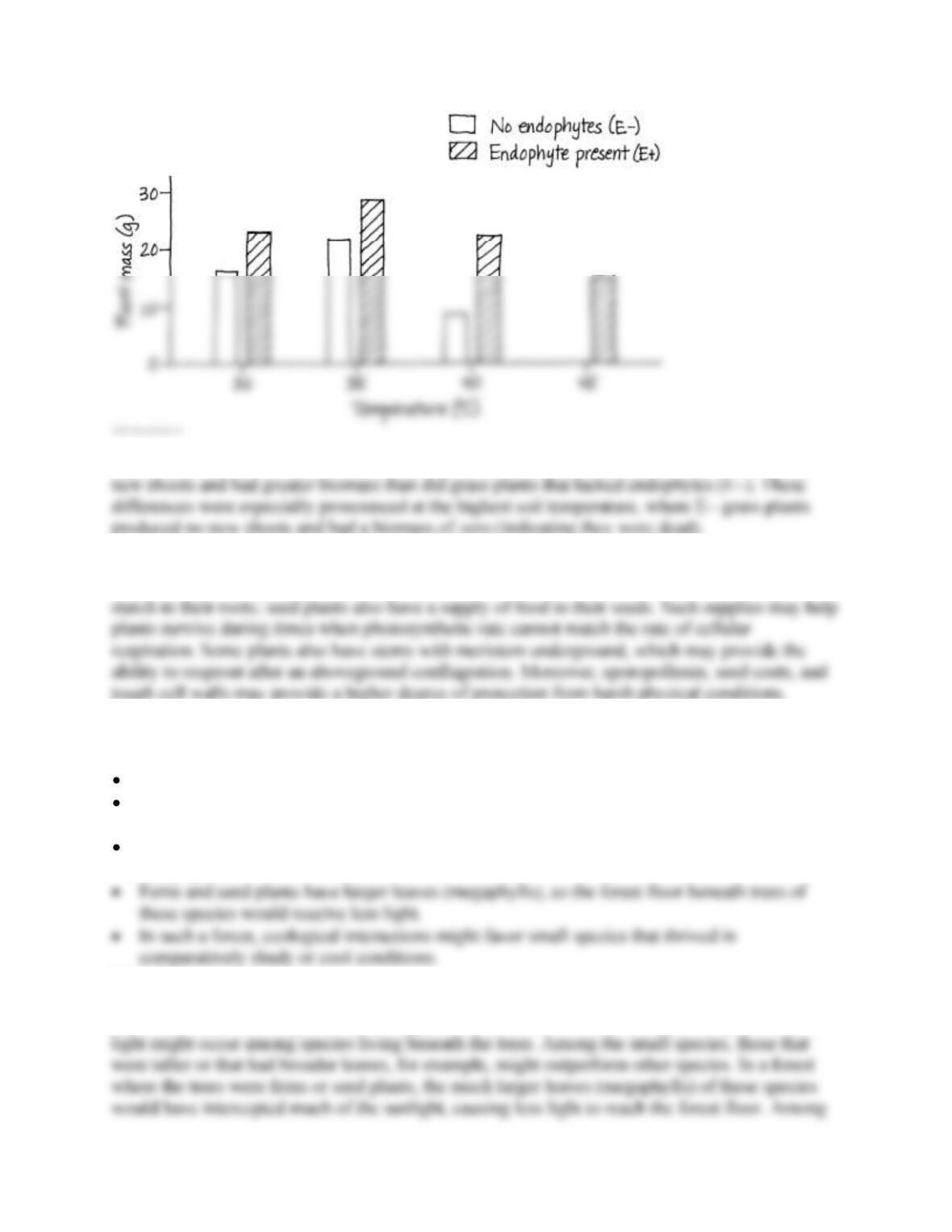
As indicated by the raw data and bar graph, grass plants with endophytes (E+) produced more
8. Focus on Evolution
Plants, being immobile, can store large amounts of food in their tissues, such as the storage of
9. Focus on Interactions
Sample key points:
Tree lycophytes had small leaves called microphylls.
These leaves would not have intercepted much sunlight, causing the forest floor to get a lot
of light.
Hence, there might be competition for light among the small plants living beneath tree
lycophytes.
Sample top-scoring answer:
Because the leaves (microphylls) of tree lycophytes were small, a considerable amount of light
would have reached the ground in this type of forest. In such an environment, competition for
10. Synthesize Your Knowledge
Stomata are specialized pores that support photosynthesis by allowing the exchange of CO2 and
O2 between the plant body and the outside air. Because plants are always exposed to the air, they
run a much greater risk of drying out than did their algal ancestors. One way that plants cope