CHAPTER 25 THE ORIGIN AND DIVERSIFICATION OF EUKARYOTES
Scientific Skills Exercise
Teaching objective: In this exercise, students interpret a comparison matrix of rRNA gene
sequences for five bacterial species and a plant mitochondrion. Students assess the similarity of
the six rRNA gene sequences and interpret the significance of their findings.
Teaching tips: A version of this Scientific Skills Exercise can be assigned in MasteringBiology.
Explain to your students that DNA comparisons provide information that can be used to
reconstruct the evolutionary history of related groups of organisms. As a general rule, the greater
the similarities between DNA sequences of living organisms, the more recently the lineages
Many alpha proteobacterial species are intimately associated with eukaryotic hosts, establishing
intracellular associations with their hosts. For example, Rhizobium species live in nodules in the
roots of legumes and fix atmospheric N2 into ammonia, which can be used by the host plant to
make proteins. Agrobacterium species live within plant tissues, where they grow as tumors. This
feature of alpha proteobacteria is likely relevant to the origin of mitochondria, which arose as
mutualistic endosymbionts and evolved into essential eukaryotic organelles.
You can expand on this Scientific Skills Exercise, if you wish. Once students have completed the
exercise, ask them whether the rRNA gene of A. tumefaciens appears to be more closely related
to the rRNA gene of the wheat mitochondrion or to the other bacterial species. They should note
Now tell students that researchers also compared the rRNA genes of the bacterial species and
the wheat mitochondrion with the rRNA gene of the archaean Methanococcus vannielii. The
researchers found that all of the bacterial sequences are equally similar to the archaeal sequence,
while the mitochondrial sequence is significantly less similar to the sequence of the archaean.
Ask students whether this finding supports their hypothesis. When Yang et al (1985) compared
the rRNA genes of the five bacteria and the wheat mitochondrion to the rRNA gene of the
archaean Methanococcus vannielii, they found that all of the bacterial rRNA gene sequences are
equally similar to the archaeal sequence, while the mitochondrial sequence was significantly less
similar. This does not support the first hypothesis outlined above but does support the second
hypothesis. Archaea and bacteria diverged long before the origin of the mitochondrion.
All of the species included in the comparison matrix the five bacteria and the wheat
mitochondrion have had an equally long evolutionary history since the bacterial and archaeal
Answers:
1. The value of the cell that represents the comparison of C. testosteroni and E. coli is 61. This
means that C. testosteroni and E. coli are identical at 61% of the 617 nucleotide positions in
2. The researchers wished to compare the gene that codes for the small-subunit rRNA
Suggested Answers for End-of-Chapter Essay Questions
See the general information on grading short-answer essays and a suggested rubric at the
beginning of this document.
8. Focus on Evolution
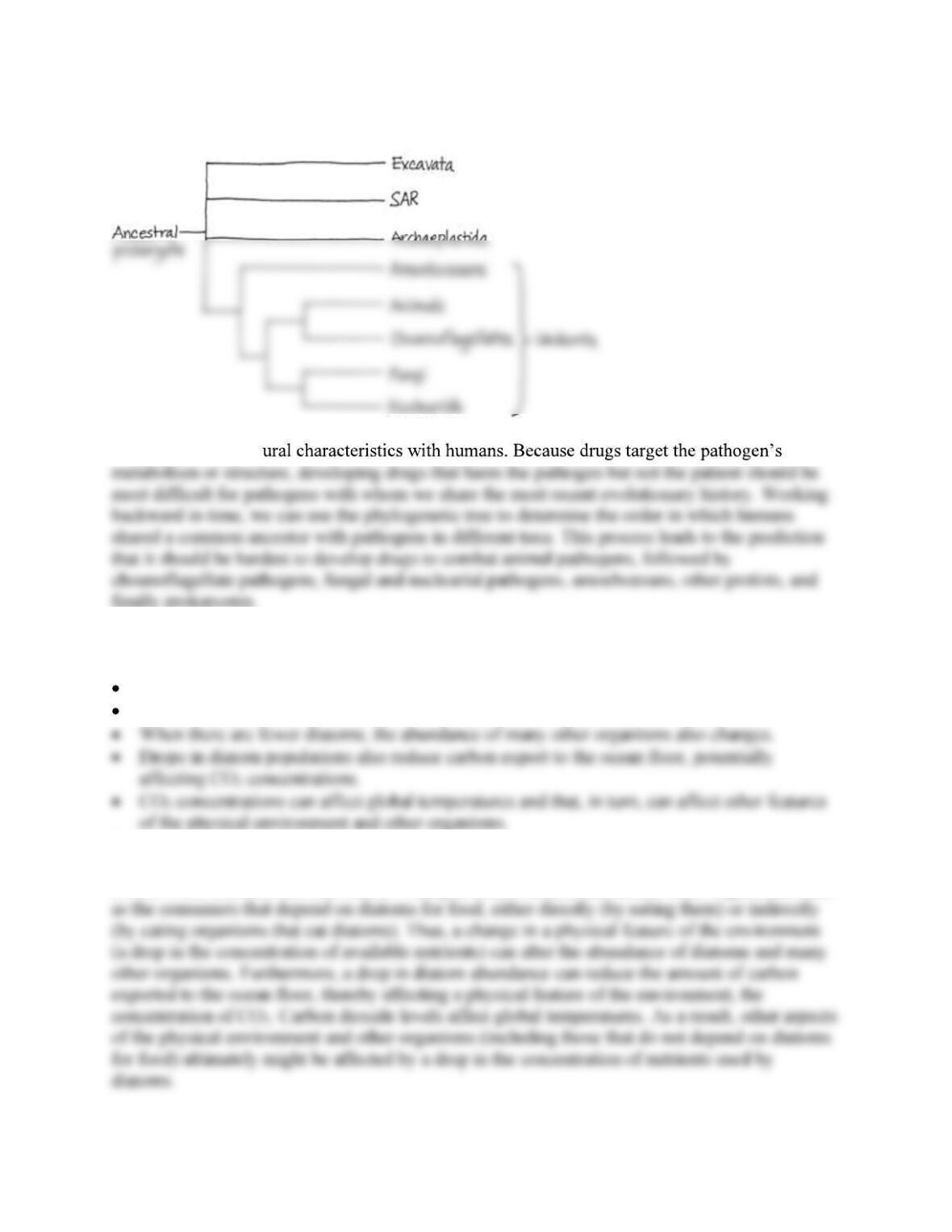
Pathogens that share a relatively recent common ancestor with humans will likely also share
metabolic and struct
9. Focus on Interactions
Sample key points:
Organisms interact with other organisms and the physical environment.
Diatoms decrease in abundance when nutrient concentrations drop.
Sample top-scoring answer:
Organisms interact with each other and the physical environment. Diatom populations decrease
in size when nutrients become scarce. A drop in diatom abundance affects other organisms, such
10. Synthesize Your Knowledge
The amoeba changes shape as it engulfs its ciliate prey. Eukaryotic cells can change shape (or
maintain an asymmetric form) because they have a well-developed cytoskeleton that provides
structural support. Endosymbiosis has played a large role in the evolutionary history of the