CHAPTER 24 Early Life and the Diversification of Prokaryotes
Scientific Skills Exercise
Teaching objective: Students build scientific skills by interpreting data in a bar graph and by
identifying elements of experimental design. Specifically, students are asked to state the
hypothesis tested in an experiment; to identify the independent variable, dependent variable, and
controlled variables; and to explain how the experimenters provided replication. They draw a bar
graph from a table of data and are asked to explain whether the experimental results support or
disprove the experimental hypothesis.
Teaching tips: A version of this Scientific Skills Exercise can be assigned in MasteringBiology.
The rhizosphere, the soil layer surrounding plant roots, is not a passive layer of dirt but rather a
complex community in which archaea, bacteria, fungi, and plants interact with one another. Plant
roots may secrete over 20% of the carbon-containing compounds synthesized by the plant at the
root-soil interface. As a result, rhizosphere bacteria and archaea are far more metabolically active
than those in surrounding soils.
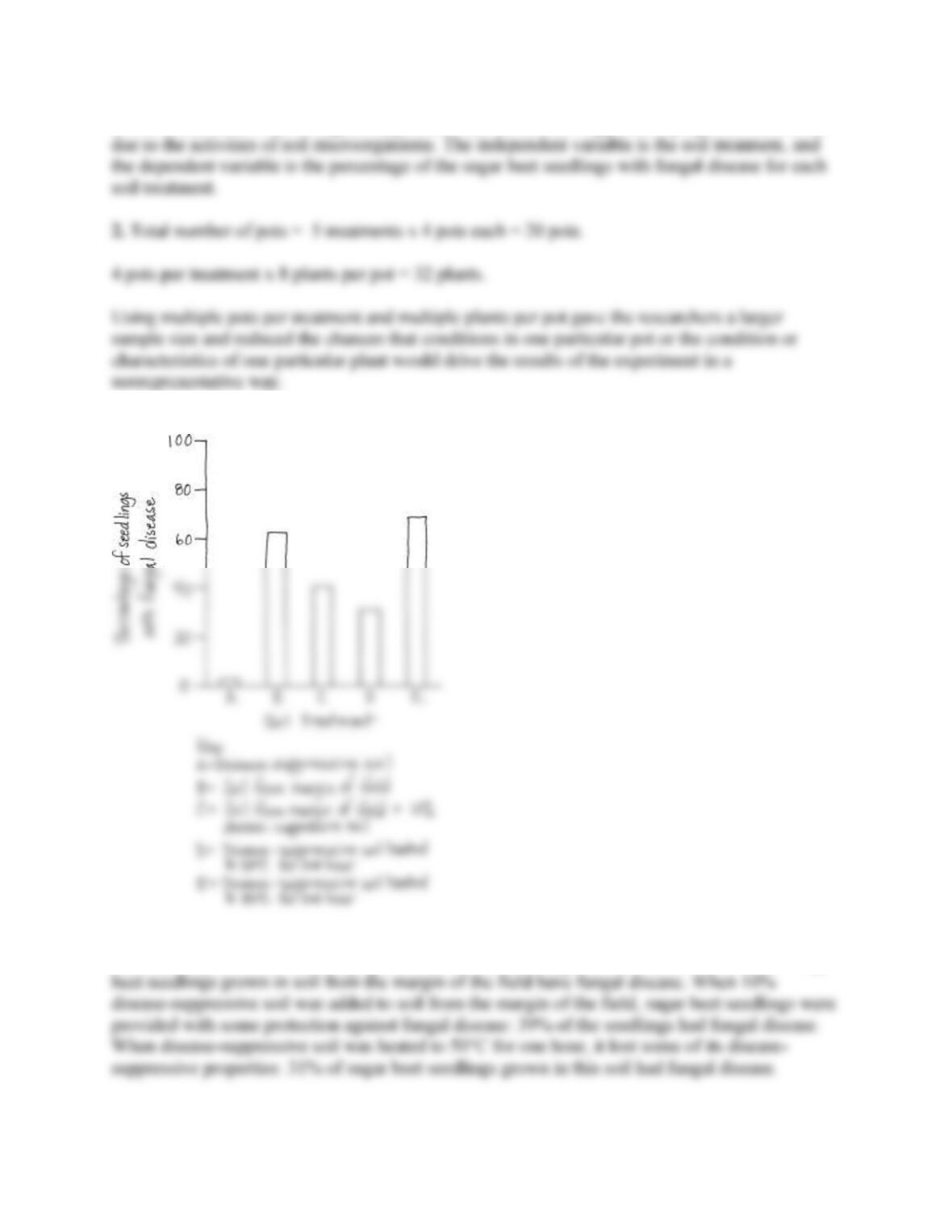
Eight beet seedlings were grown in four pots in each of five different soil treatments: (1)
disease-suppressive soil, (2) soil from the margin of the field, (3) soil from the field margin
supplemented with 10% suppressive soil, (4) disease-suppressive soil heated to 500C for one
hour, and (5) disease-suppressive soil heated to 800C for one hour. All sugar beet seedlings were
grown in greenhouses at 240C, 70% relative humidity, and a 16-hour light: 8-hour dark regime.
The soil was inoculated with mycelia from the fungal pathogen Rhizoctonia solani. 20 days after
inoculation, the number of infected sugar beet seedlings was counted and the percentage disease
incidence was determined for each soil treatment.
Answers:
1. The researchers were testing the hypothesis that the disease-suppressive properties of soils are
3.
Disease-suppressive soil was very successful in protecting sugar beet seedlings from fungal
disease: Only 3% of the seedlings grown in this soil had fungal disease. In contrast, 62% of sugar
4. Rhizoctonia solani was
Suggested Answers for End-of-Chapter Essay Questions
See the general information on grading short-answer essays and a suggested rubric at the
beginning of this document.
8. Scientific Inquiry/Interpret the Data
(a)
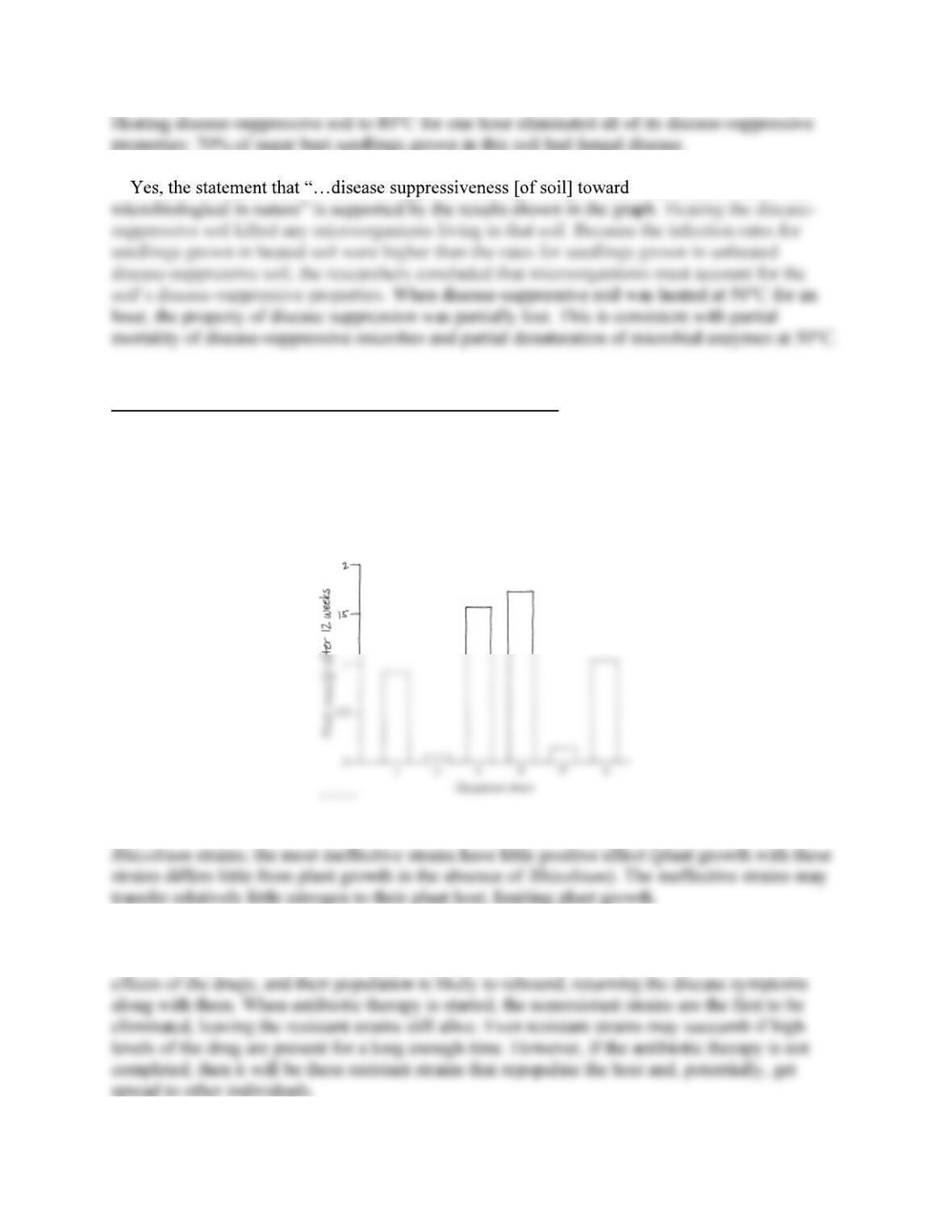
(b) Some Rhizobium strains are much more effective at promoting plant growth than other
9. Focus on Evolution
Discontinuing treatment while bacteria are still present frees the bacteria from the inhibiting
10. Focus on Energy and Matter
Sample key points:
The activities of life require energy.
There is no sunlight in hydrothermal vent communities, and hence there are no
photoautotrophs.
Energy is also transformed into other forms, such as kinetic energy.
Sample top-scoring answer:
The activities of life require energy. In hydrothermal vent ecosystems, no sunlight is available
and hence there are no photoautotrophs. Instead, the producers on which other organisms rely for
11. Synthesize Your Knowledge
As a result of their small size, bacterial populations can consist of trillions of individuals that live
in small regions, such as a few handfuls of soil or the digestive tract of a person. Many species of