CHAPTER 23 BROAD PATTERNS OF EVOLUTION
Scientific Skills Exercise
Teaching objective: In this scientific skills exercise, students consider how the fossil record may
be used to explore the link between ecological factors and species longevity. Specifically,
students are asked to estimate quantitative data from a graph to determine whether differing
modes of larval dispersal explain species longevity within one taxon of marine snails. Students
then propose a hypothesis to explain differences in longevity of species with planktonic and
nonplanktonic larvae.
Teaching tips: A version of this Scientific Skills Exercise can be assigned in MasteringBiology.
Hansen (1978) analyzed the fossil record of the Volutidae (volutes), a taxon of widely
distributed, burrowing predatory or scavenging marine snails with distinctive spiral shells. Some
extinct volute species had swimming larvae that lived as plankton for long periods, allowing
them to disperse over great distances on ocean currents. Hansen points out that in living snails,
such larvae commonly disperse across the Atlantic Ocean. Other extinct volutes underwent direct
development. The dispersal of such snails is limited to the distance they can crawl as adults.
Because their larvae are not carried by ocean currents, they are incapable of crossing ocean
basins.
Encourage your students to consider how the life histories of snails with planktonic and
nonplanktonic larvae would be expected to differ. When snails have long-lived and planktonic
larvae, the larvae and young adults will likely encounter conditions that are very different from
those to which their parents are adapted. Snails with planktonic larvae would have had much
higher fecundity than snails with nonplanktonic larvae, because the mortality rate of planktonic
larvae and the young adults that metamorphose from them were likely to be very high. Snails
with nonplanktonic larvae disperse only as far as the adult snail can crawl. Both larval and adult
snails will survive well, as they will find themselves in conditions similar to the ones that their
parents lived in.
Answers:
1. Here are the persistence times for the snails:
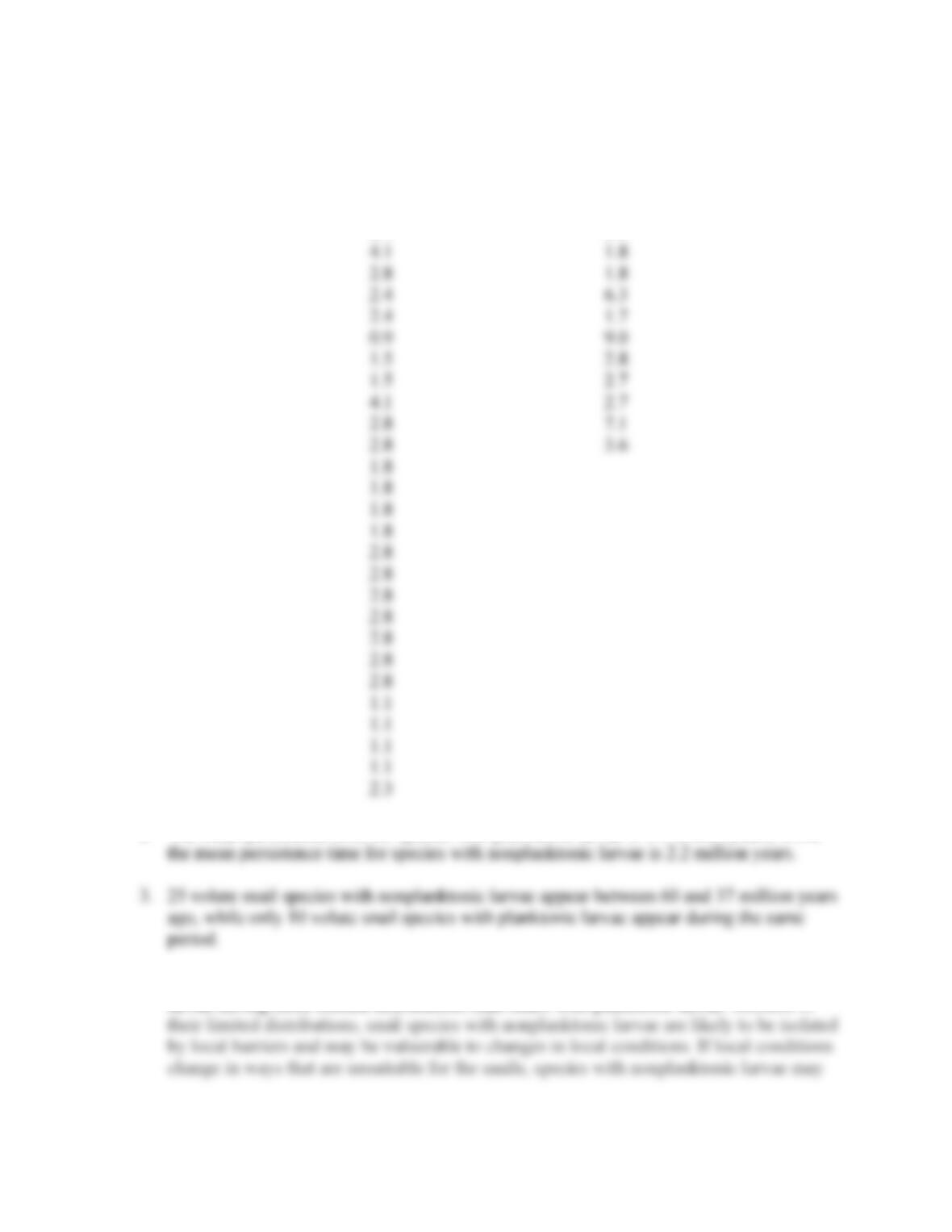
Volute species with
nonplanktonic larvae
Volute species with
planktonic larvae
1.7 5.9
1.7 5.9
1.7 5.9
2. The mean persistence time for species with planktonic larvae is 4.4 million years, while
4. One hypothesis is that the difference in longevity is related to snails with nonplanktonic
larvae having more limited distributions than snails with planktonic larvae. Because of
Interpret the Data
Figure 23.6 There are two speciation events and five extinctions in lineage A, while there are
five speciation events and one extinction in lineage B during the last 2 million years.
Figure 23.11 The blue curve is for marine animal families. Families often contain many species,
so we would expect the percentage of families that became extinct to be lower than the
percentage of species that became extinct.
Suggested Answers for End-of-Chapter Essay Questions
See the general information on grading short-answer essays and a suggested rubric at the
beginning of this document.
6. Scientific Inquiry
The information presented in this problem suggests that the evolution of herbivory in moths and
7. Focus on Evolution
A factor (such as the separation of continents by continental drift) that reduces gene flow in
many groups of organisms promotes speciation on a grand scale, thereby influencing the
8. Focus on Organization
Sample key points:
There is generally a good match between form and function.
However, structures are not designed to perform their function in the best possible way. If
Sample top-scoring answer:
The structure of a feature often gives clues as to its function there is, in general, a good match
between form and function. However, this match does not indicate that the structure has been
9. Synthesize Your Knowledge
The episode of volcanic eruptions at the end of the Permian period are thought to have produced
enough carbon dioxide to warm the global climate by 6°C, harming many temperature-sensitive