CHAPTER 22 THE ORIGIN OF SPECIES
Scientific Skills Exercise
Teaching objective: Students build scientific skills by analyzing experimental design and
interpreting a scatter plot.
Teaching tip: A version of this Scientific Skills Exercise can be assigned in MasteringBiology.
Answers:
1.
distance between dusky salamander populations. The independent variable in this study
4. (a) The scatter plot helps reveal that there is a general trend upward from left to right in
Suggested Answers for End-of-Chapter Essay Questions
See the general information on grading short-answer essays and a suggested rubric at the
beginning of this document.
7. Scientific Inquiry
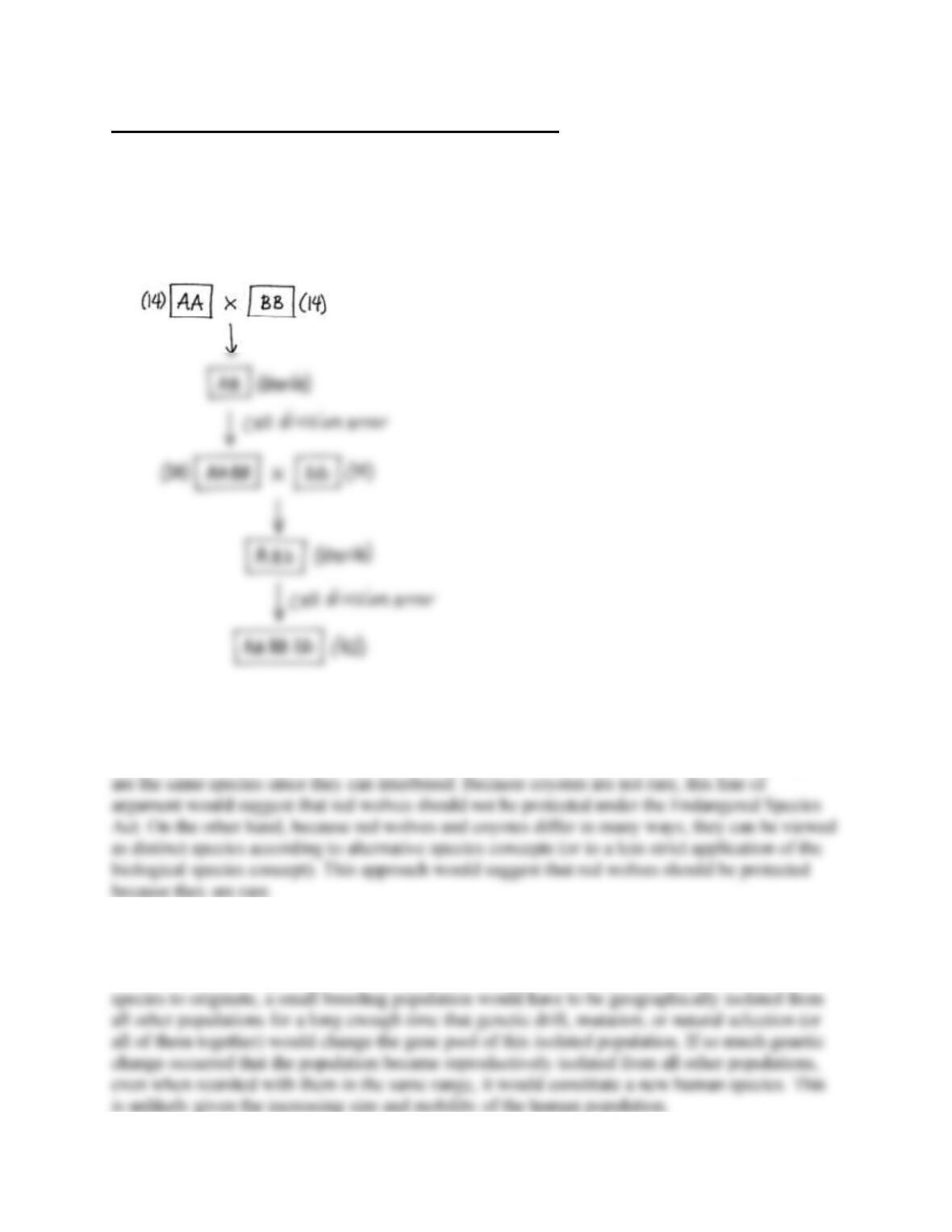
Here is one possibility:
8. Science, Technology, and Society
It is possible to argue both sides of this question based on the underlying biology. For example,
if the biological species concept is followed strictly, one could argue that red wolves and coyotes
9. Focus on Evolution
All fertile humans alive today can interbreed to produce viable, fertile offspring. Thus, they
conform to the biological species concept and are assigned to a single species. For a new human
10. Focus on Information
Sample key points:
Overall, 50% of the DNA in F1 hybrids comes from each parent species.
However, on a per-chromosome basis, 100% of the DNA in one member of each
homologous pair is from one parent species, while 100% of the DNA in the other homolog is
another locus, selection may favor DNA from the other parent species.
Sample top-scoring answer:
When parent species with homologous chromosomes produce hybrid offspring, overall 50% of
the DNA in the F1 hybrids comes from each parent species. On a per-chromosome basis,
however, 100% of the DNA in one homolog is from one parent species, while 100% of the DNA
11. Synthesize Your Knowledge
In allopatric populations of D. pumilio, genetic drift may have led to the fixation of one color